
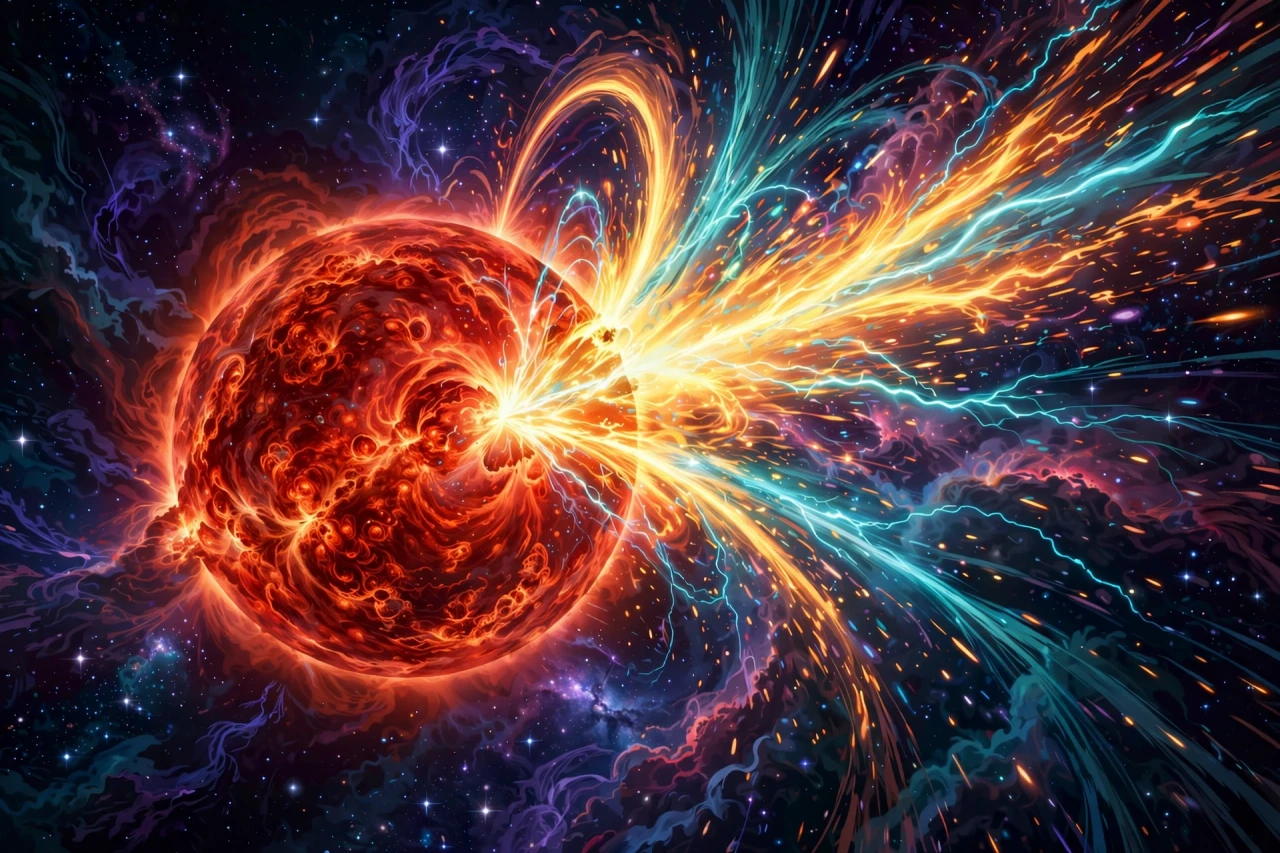
Illustration: a red giant star erupting with a colossal superflare against deep space
Budapest — It is not the largest star NASA's Kepler space telescope ever watched, nor the brightest — but by a wide margin, it is the most violent. Astronomers have now uncovered what makes the red giant KIC 2852961 the most explosively active star in the entire Kepler field, solving a mystery that has puzzled stellar physicists since the star first drew attention. A new study led by researchers at the Konkoly Observatory in Budapest, accepted for publication in the journal Astronomy & Astrophysics, reveals that the star's record-breaking superflares are fueled by a subtle interplay between a close stellar companion, vast dark starspots, and a highly efficient internal magnetic dynamo.
What Happened
The research team, led by Zsolt Kővári of the HUN-REN Research Centre for Astronomy and Earth Sciences (HUN-REN CSFK), set out to answer a deceptively simple question: what makes this one particular star so extreme? KIC 2852961 produces superflares — eruptions of energy so enormous they dwarf even the most powerful solar flares our own Sun can muster. Understanding what fuels them has been an open question for years.
"We wanted to find out what makes this particular star so extreme," Kővári said. "Is it the nearby companion star pulling on it? Or something happening deep inside? The answer turned out to be more nuanced than either option alone."
Using new radial velocity measurements, the team clinched what had long been suspected: KIC 2852961 is part of a close binary system, with a companion star orbiting near enough to influence it. But the companion alone does not explain the violence. The full picture, the researchers found, involves three ingredients working together — the gravitational and magnetic influence of the close companion, enormous dark starspots marring the star's surface, and an unusually efficient magnetic dynamo churning deep in its interior.
The new paper builds directly on the team's own earlier work. In a 2020 study published in Astronomy & Astrophysics, the same researchers cataloged 59 flares and superflares from the full Kepler data set for this star and showed that flares and superflares across very different types of stars likely share the same underlying physical mechanism. The new study takes that foundation much further, using the confirmed binary nature of the system to build a detailed picture of what drives its extreme behavior.
Background
NASA's Kepler space telescope, launched in 2009, stared at a single patch of sky for years, measuring the brightness of some 150,000 stars with extraordinary precision. Its primary mission was to find exoplanets by watching for the tiny dips in starlight caused by transiting worlds — but the same data proved to be a goldmine for stellar astrophysics, recording the flickers, flares, and pulsations of stars in exquisite detail.
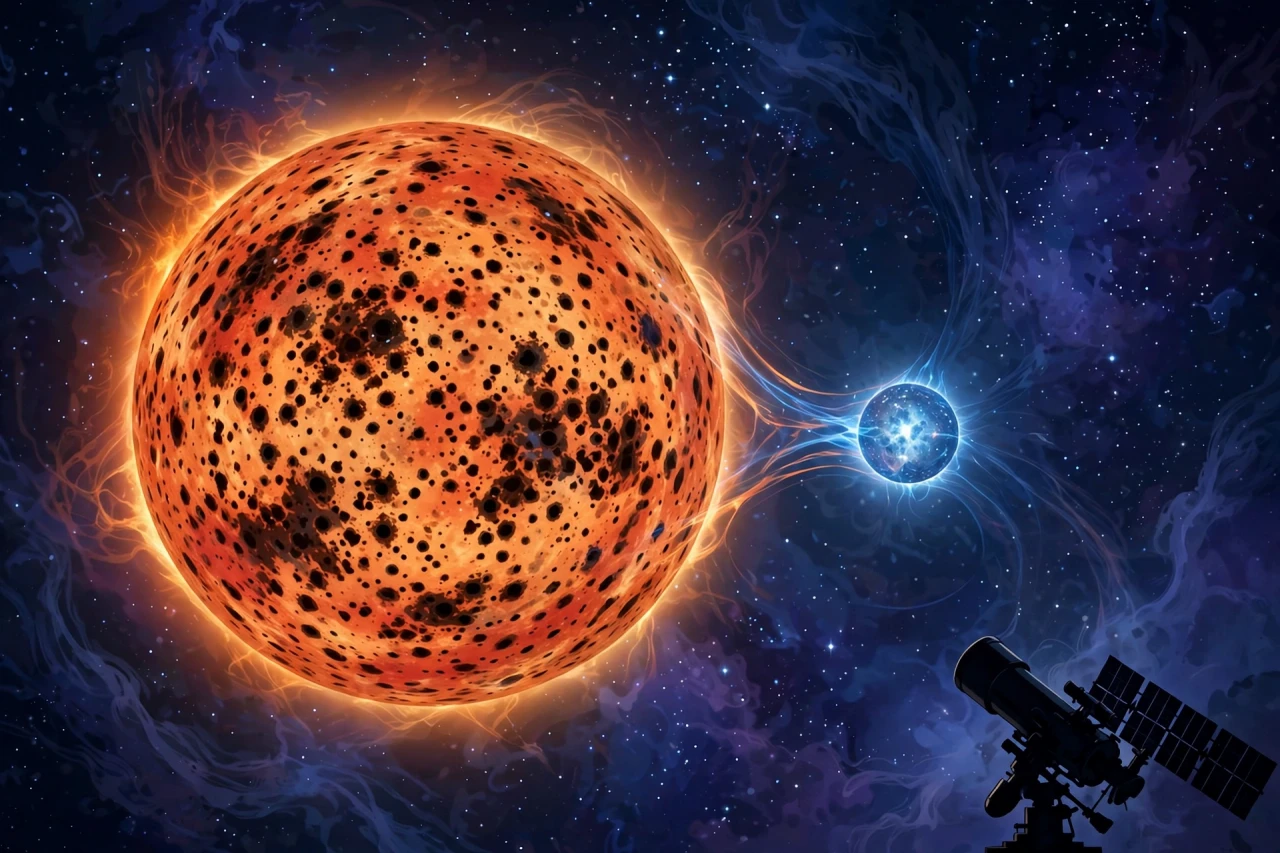
Illustration: a close binary star system with dark starspots beside a space telescope
Among those stars, KIC 2852961 stood out immediately. A red giant — a star in the bloated late stage of its life — it should, by conventional wisdom, be relatively sedate. Instead, Kepler caught it erupting again and again with superflares carrying energies far beyond anything the Sun has produced in recorded history. A single superflare can release in minutes or hours the energy our Sun emits over days or weeks, and the most powerful ones observed on KIC 2852961 sit at the extreme end of that scale.
For years, the leading hypotheses competed. One camp pointed to the suspected companion star: tidal forces from a close partner can spin a star up and stir its magnetic field, much like stirring a pot makes it boil more vigorously. Another camp looked inward, arguing that something about the star's internal magnetic dynamo — the process by which churning plasma generates magnetic fields — must be unusually efficient. The new study shows both camps were partly right, and that the starspots — vast, dark, magnetically intense regions analogous to sunspots but on a grander scale — are the visible signature of the whole turbulent system.
Why It Matters
Superflares are more than a stellar curiosity. As astronomers discover more planets orbiting other stars, understanding how violently those stars can erupt has become central to the search for habitable worlds. A planet bathed repeatedly in superflares can have its atmosphere stripped away and its surface sterilized — no matter how perfectly it sits in its star's habitable zone. Knowing what makes a star flare-prone helps astronomers judge which exoplanets are worth a closer look and which orbit stars too hostile for life as we know it.
The findings also sharpen our understanding of our own Sun. The 2020 study suggested that flares and superflares across very different stars share the same underlying mechanism — which raises the question of whether the Sun itself, under the right conditions, could produce a superflare. Solar physicists consider truly Sun-sized superflares unlikely given the Sun's age and rotation, but pinning down the exact recipe — companion, spots, dynamo — gives them a far better framework for assessing the risk to satellites, power grids, and communications from extreme space weather.
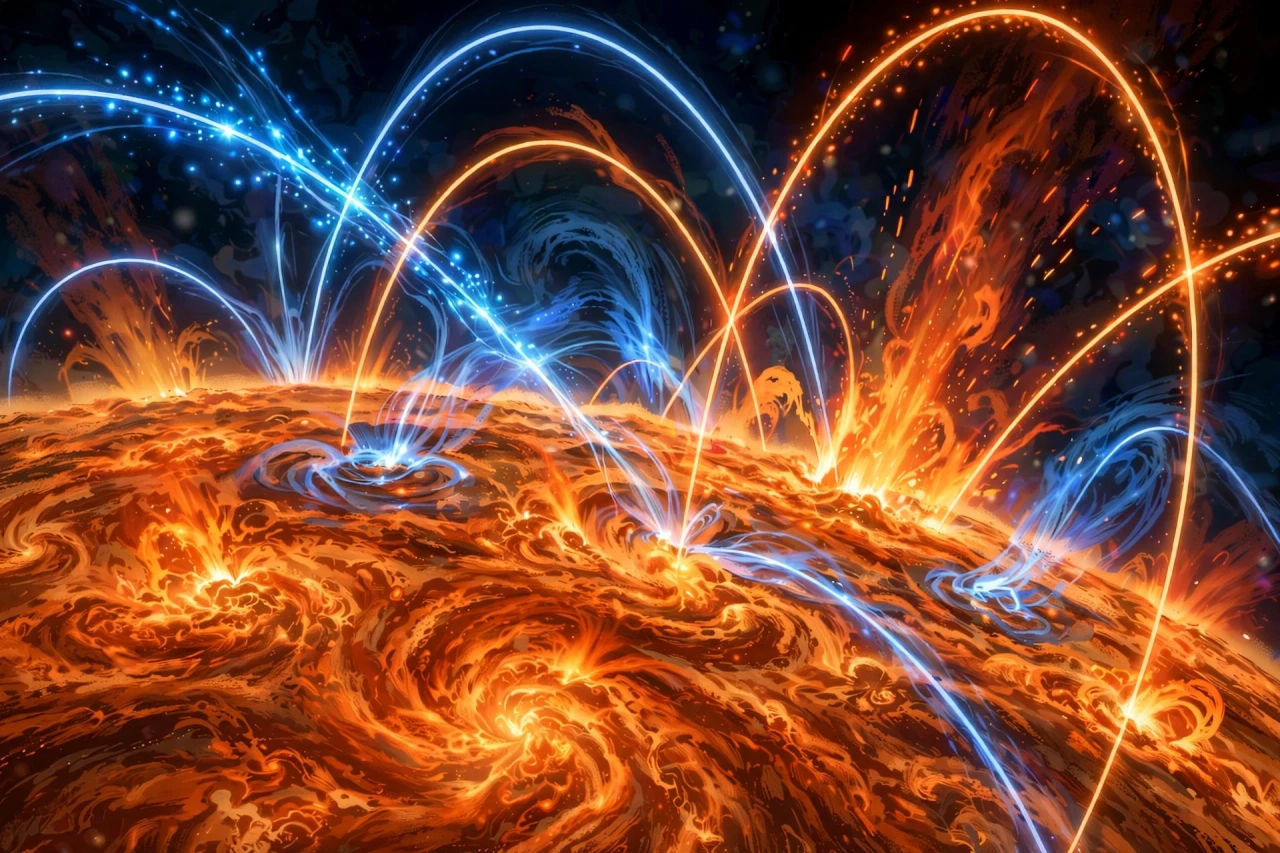
Illustration: a stellar magnetic field looping over a star's surface with flaring plasma
There is a broader lesson too. KIC 2852961 shows that extreme stellar behavior often emerges not from a single cause but from the interaction of several — a companion's gravitational stirring, a churning interior, and a spotted surface feeding back on each other. That kind of systems thinking is increasingly how astronomers approach everything from planet formation to galaxy evolution.
What Happens Next
With the paper accepted for publication in Astronomy & Astrophysics, the results will now face the scrutiny of the wider community — and the team expects follow-up. The confirmed binary nature of KIC 2852961 opens the door to detailed modeling of how the companion's orbit and the star's rotation interact over time, and to searches for similar "perfect storm" systems in data from Kepler's successor missions.
Astronomers will also be watching whether the recipe identified here — close companion plus giant starspots plus efficient dynamo — predicts superflare activity in other stars. If it does, it could become a practical tool: a way to flag the most dangerous stellar neighbors of newly discovered exoplanets, and to prioritize the calmest stars in the ongoing search for life beyond Earth.
Sponsored: explore today's featured sponsored offers
FAQ
What is KIC 2852961?
KIC 2852961 is a red giant star observed by NASA's Kepler space telescope. It is not the largest or brightest star in the Kepler field, but it is the most flare-active — producing superflares, eruptions of energy that dwarf even the most powerful solar flares, more violently than any other star Kepler watched.
What causes a superflare?
Like ordinary solar flares, superflares are driven by the sudden release of energy stored in a star's magnetic field. The new study finds that in KIC 2852961, three factors combine: a close companion star that gravitationally stirs the star, vast dark starspots marking intense magnetic regions, and a highly efficient internal magnetic dynamo generating the field in the first place.
How did astronomers confirm the star has a companion?
The team used radial velocity measurements — tracking the star's subtle back-and-forth motion along our line of sight — to clinch the binary nature of the system. The measurements showed the gravitational tug of a nearby companion star, confirming what had previously only been suspected.
Could our Sun produce a superflare?
An earlier study by the same team suggested flares and superflares across different star types share the same underlying mechanism, which makes the question legitimate. However, solar physicists consider a true superflare from our middle-aged, slowly rotating Sun unlikely. The new findings help refine models of exactly which stellar conditions are required.
Why do superflares matter for the search for life?
Planets orbiting flare-prone stars can have their atmospheres stripped and surfaces sterilized by repeated giant eruptions, even if they orbit at otherwise habitable distances. Understanding what makes stars like KIC 2852961 so violent helps astronomers identify which exoplanet host stars are calm enough that life might have a chance.
Sources
- Phys.org — "Astronomers uncover the engine behind the most powerful stellar flares in the Kepler field" (October 21, 2026), reporting on Kővári et al.
- Zsolt Kővári et al. — new study accepted for publication in Astronomy & Astrophysics (2026), on the binary nature and superflare drivers of KIC 2852961.
- Zsolt Kővári et al. — Astronomy & Astrophysics (2020), cataloging 59 flares and superflares of KIC 2852961 from Kepler data.
- NASA — Kepler mission background on stellar flare observations.
Comments
Post a Comment