
PYONGYANG, North Korea — North Korean state media has released a new set of photographs of Kim Jong Un inspecting a light-industry exhibition, in what appears to be a deliberate "proof of life" move after a weekend of viral, unsubstantiated social media claims that the North Korean leader had died following a brain hemorrhage in Beijing.
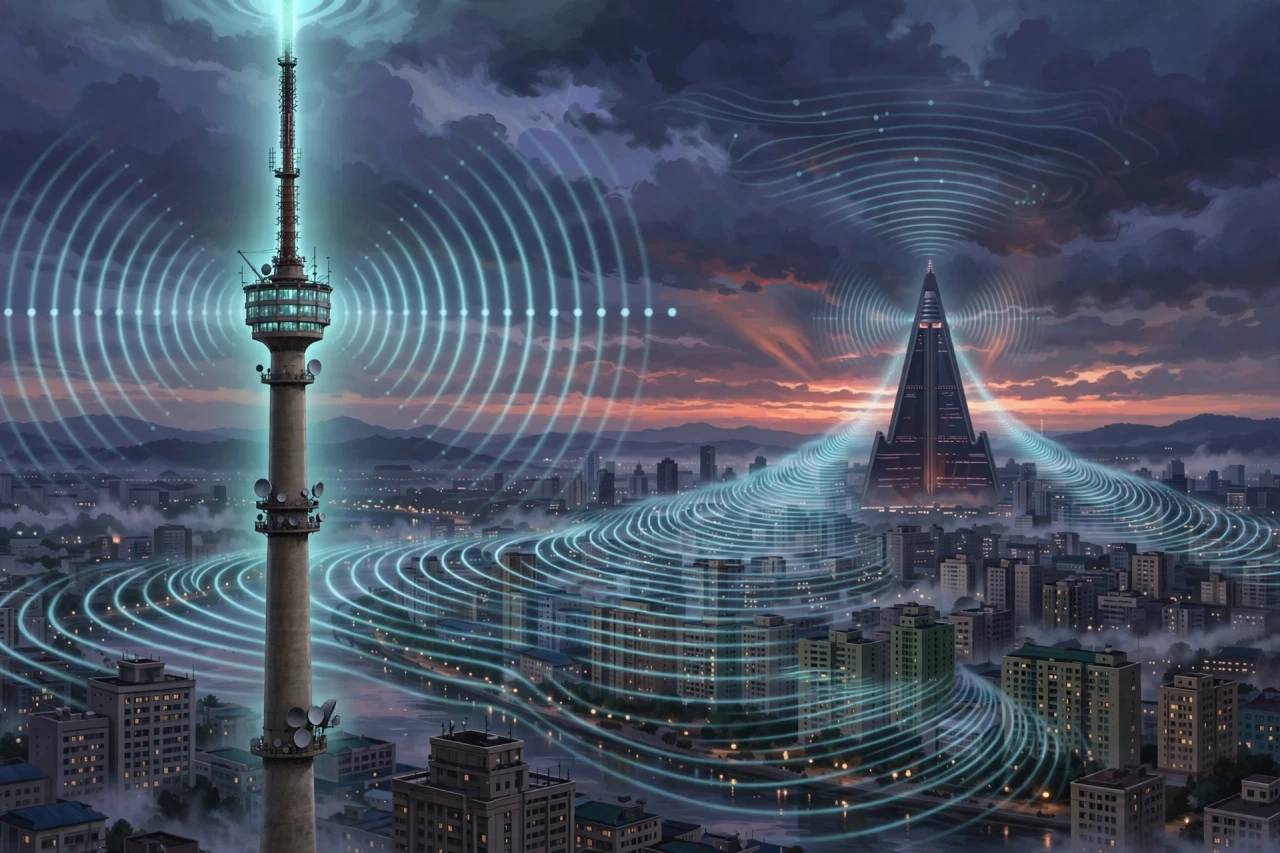
Illustration: the Pyongyang skyline at dusk with a tall broadcasting tower transmitting radio waves over the city.
What Happened
On Monday, October 19, 2026, North Korean state media reported that Kim had "looked round the venue of the garment and footwear exhibition of the field of light industry," according to specialist outlet NK News, which flagged the photo-report on social media. The photographs, carried by the Korean Central News Agency, showed Kim gesturing as he addressed officials while inspecting merchandise at the exhibition.
The photo-report came directly after rumors emerging on social media over the weekend suggested the North Korean leader had died. Pyongyang has not explicitly addressed the death reports, but the release of the images appears intended to dispel speculation about his fate, the New York Post reported.
The episode began on Sunday, October 18, when Wanjun Xie — a US-based Chinese dissident associated with the China Democracy Party — posted a series of explosive, unverified allegations on X. Xie claimed that Kim had died after a severe cerebral hemorrhage, that China had dispatched 9,000 troops to Pyongyang amid fears of a succession crisis, and that a team of specialists from Beijing's Peking Union Medical College Hospital had been sent to North Korea to treat him. According to Xie's account, Kim had slipped into a coma before being transferred to Beijing, where doctors were unable to save him, and his body was then secretly returned to North Korea.
None of the allegations were accompanied by medical records, photographs, identifiable witnesses, or other independently verifiable evidence, and several international outlets — including The Sun — characterised the story as unverified speculation. South Korean authorities and analysts did not corroborate the death claim, and the absence of official mourning signals — such as abrupt changes to state broadcasting, public weeping ceremonies, or an immediate succession announcement — did not support the assertion that Kim had died.

Illustration: a smartphone surrounded by speech bubbles under a large magnifying glass, symbolising unverified viral news spreading online.
Background
The rumour followed a roughly week-long gap in new public appearances after Kim's October 11 visit to a defence museum — a gap that, combined with North Korea's secrecy and prior health scares involving Kim, made the claims unusually viral despite their lack of sourcing. Documented state-media engagements in early October, including events around the 81st founding anniversary of the Workers' Party of Korea and the defence museum opening on October 11–13 with his wife and daughter, were all public record before the rumours began.
This is a familiar pattern. In April 2020, Kim missed a major national holiday and rumours spread that he was dead or in a vegetative state; on May 1, 2020, state media showed him cutting the ribbon at a fertiliser factory opening, ending about three weeks of speculation. Kim's health has long been a subject of international scrutiny, and North Korea tightly controls all information about its leadership, which makes independent verification extremely difficult.
As the rumours spread, they also raised questions about whether Kim's powerful sister, Kim Yo Jong, had taken control of the secretive regime — a succession question that always shadows North Korea, which has no publicly named successor. His teenage daughter, Kim Ju Ae, who has appeared alongside him at recent events, is also seen as a possible figure in the succession picture.
Why It Matters
Beyond the immediate tabloid frenzy, the episode underscores two deeper realities. First, North Korea remains one of the most information-opaque states on earth: a single unverified social media post from a politically motivated source can, within hours, be amplified by social accounts and repeated by tabloids until it acquires the appearance of multiple independent confirmations — even when the original evidence remains a single unverified post.
Second, the stakes of any genuine leadership transition in Pyongyang are enormous. North Korea's nuclear weapons programme, its growing military cooperation with Russia, and its hostile posture toward the South mean that succession uncertainty in the Kim regime is a first-order security concern for Seoul, Washington, Tokyo and Beijing. That is why even baseless rumours move markets of attention: the cost of being wrong about North Korea is high, and the cost of missing a real transition is higher.
At the same time, the episode is a reminder of how state media functions in Pyongyang: not as a news service correcting the record, but as a signalling instrument. The garment-and-footwear exhibition photo-report says nothing about the rumours directly — and pointedly does not confirm the date the photos were taken — yet its timing, barely 24 hours after the claims went viral, is the message.

Illustration: press cameras with flashes inside a grand state exhibition hall displaying garments and shoes on stands.
What Happens Next
Analysts will be watching North Korean state media closely in the coming days and weeks. Kim's schedule typically includes major year-end party plenums and New Year messaging; sustained, dated appearances would put the rumour to rest more definitively than a single undated photo-report.
South Korea's National Intelligence Service, which has previously flagged health risks linked to Kim's weight, will continue monitoring for any genuine signals. And the information-warfare dimension will persist: Pyongyang's secrecy guarantees that the next rumour — whenever it comes — will spread just as fast unless independent verification improves. For now, the only established facts are that the death claims remain entirely unsubstantiated, and that state media shows Kim conducting routine public business.
Sponsored: explore today's featured sponsored offers
FAQ
Did Kim Jong Un die?
There is no credible evidence that he did. The claims — that he suffered a cerebral hemorrhage, was treated in Beijing and died — came from a single unverified social media account, with no medical records, photographs, identifiable witnesses or official confirmation from any government. South Korean authorities and analysts did not corroborate the claim.
Where did the rumour come from?
The claims began on Sunday, October 18, in a series of posts on X by Wanjun Xie, a US-based Chinese dissident associated with the China Democracy Party. He alleged a brain hemorrhage, a coma, a secret transfer to Beijing, and the dispatch of 9,000 Chinese troops to Pyongyang — all without verifiable evidence.
What are the "proof of life" photos?
On Monday, October 19, North Korean state media reported that Kim had toured a garment and footwear exhibition of the light industry, releasing photographs of him inspecting merchandise and addressing officials, according to specialist outlet NK News. The timing — a day after the rumours went viral — suggests the release was intended to counter the speculation, though Pyongyang did not address the rumours directly.
Why do such rumours spread so easily about North Korea?
North Korea is one of the world's most secretive states, and the regime releases no information about the leader's health. Gaps in public appearances — this time about a week after an October 11 museum visit — combined with past health scares and the absence of a named successor, create an information vacuum that rumours fill. A similar episode in April 2020 ended when state media showed Kim at a factory opening on May 1.
Who would succeed Kim Jong Un?
North Korea has no publicly named successor. The figures most often mentioned by analysts are his powerful sister, Kim Yo Jong, and his teenage daughter, Kim Ju Ae, who has appeared alongside him at recent state events.
Sources
- New York Post, October 19, 2026 — North Korea releases "proof of life" photos of Kim Jong Un after wild rumors dictator died from brain hemorrhage; reporting via NK News.
- NK News (@nknewsorg), October 19, 2026 — state media reported Kim "looked round the venue of the garment and footwear exhibition of the field of light industry" on Monday.
- Wikipedia, October 19, 2026 — summary of the "Kim-Jong-Un Possible Death" claims: no confirmation from North Korean state media or China; South Korean authorities did not corroborate; no credible evidence.
- Fact-check reporting (aggregated, October 19, 2026) — claims entirely unsubstantiated; no mainstream outlet reported Kim's death; recent documented public appearances include the October 11 defence museum opening.
Comments
Post a Comment