
Meta's $97.5 Billion AI Bet Draws Nvidia and AMD In — and Raises Questions About Circular AI Financing
MENLO PARK — Meta Platforms expanded its planned artificial intelligence infrastructure financing to as much as $97.5 billion on 27 October 2026, with chipmaker Nvidia committing $3 billion to the social media giant's stock offering, in a deal that ties the fortunes of AI's biggest customer ever more tightly to the companies that sell it chips.
The fundraising, one of the largest equity raises in corporate history, will help pay for the data centres, servers and custom chips Meta needs to build and run its AI systems. But it has also sharpened a debate on Wall Street: when the suppliers of AI hardware become investors in their biggest customer, where does ordinary business end and circular financing begin?
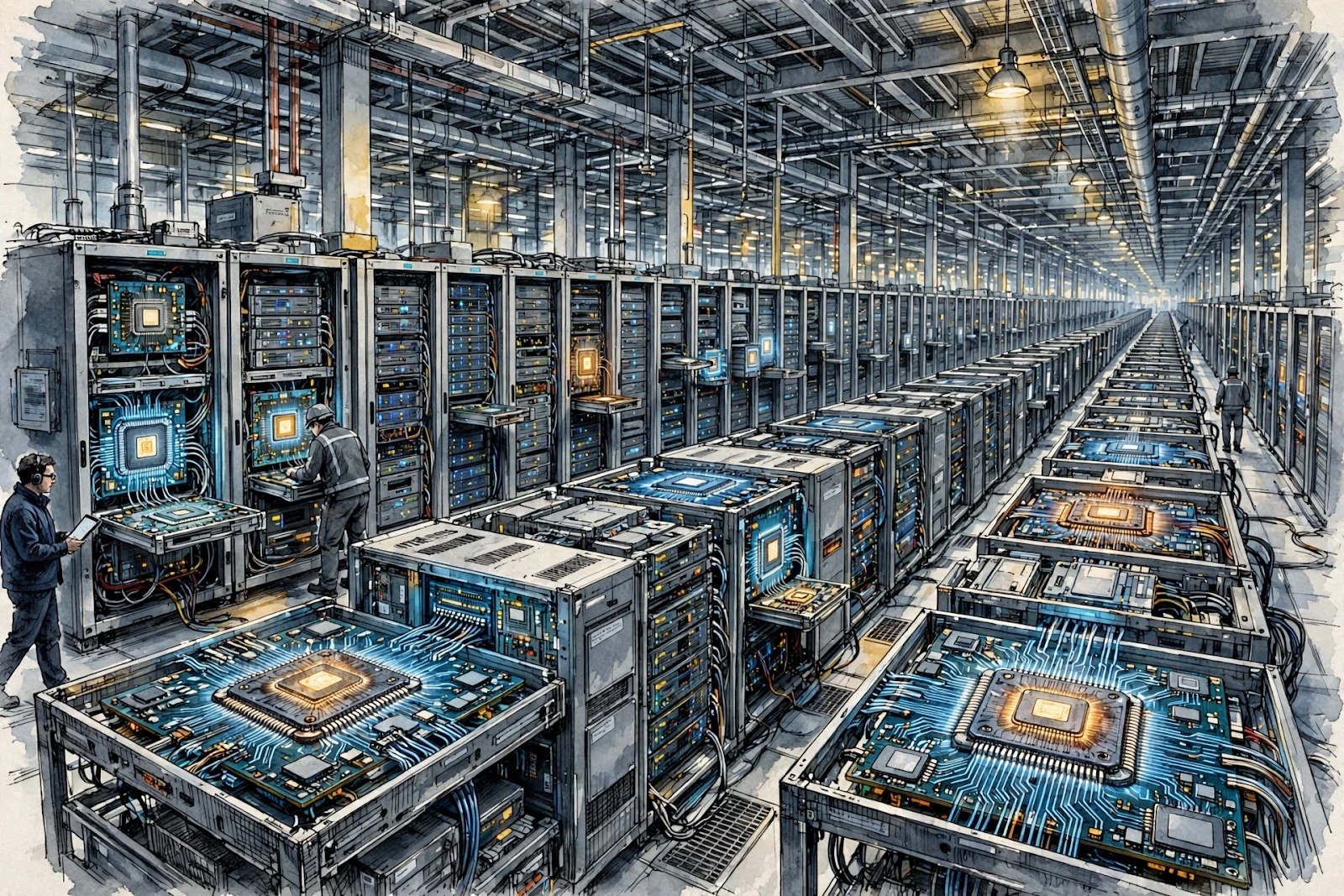
Illustration: A vast AI data centre hall, the kind of infrastructure Meta's expanded financing round is designed to build.
What Happened
Meta priced 40 million common shares at $625 each, raising $25 billion, alongside $12.5 billion of mandatory convertible preferred securities, according to its official offering announcement. The company also outlined a proposed future $60 billion at-the-market share programme, taking the total headline figure to $97.5 billion. The common-stock transaction uses forward-sale agreements and is expected to close on 29 October, subject to conditions. The $60 billion programme is prospective, so the headline figure should not be read as cash already received.
Nvidia announced a $3 billion investment in Meta's equity offering as part of an expanded partnership between the two companies. AMD committed $1 billion, according to market reporting on 27 October, and Broadcom was also identified among interested chip suppliers. AMD shares jumped more than 5% on the news, while Nvidia shares also rose, as investors welcomed signs of continued spending on AI infrastructure.
The Meta deal landed on the same day as another giant AI financing structure: Bank of America, Blackstone, Citi and Morgan Stanley announced a $63 billion financing package to support AI computing capacity for Anthropic, built around Broadcom's custom AI accelerators, known as XPUs, and networking equipment that Anthropic will lease, with deliveries expected to begin in 2027. Broadcom will provide residual value support to the financing vehicle for an amount equal to the first-lien debt, giving it both a large growth opportunity and financial exposure.
Separately, Taiwan Semiconductor Manufacturing Company (TSMC) is reportedly considering raising prices for its advanced CoWoS packaging process by 10% to 20%, according to Taiwan's China Times, cited by supply-chain reporting on 27 October. CoWoS integrates AI chips with high-bandwidth memory into a single package and is critical for high-end AI accelerators, so any price rise would feed through to Nvidia, AMD and other chip firms — and, indirectly, to customers such as Apple.
Background
Meta, the parent company of Facebook, Instagram and WhatsApp, has become one of the world's largest buyers of AI computing power. Training and running large AI models requires enormous data centres filled with specialised chips, and the race to build that capacity has driven a wave of capital spending across the technology industry in 2025 and 2026.
Nvidia dominates the market for the graphics processing units (GPUs) that power AI data centres, while AMD is fighting to become a credible second supplier with its own chips and server racks, including its Helios rack platform. Broadcom, meanwhile, has built a growing business in custom AI accelerators designed for individual customers such as Anthropic.
That structure creates an unusual interdependence. Chip suppliers need Meta's orders to justify their own factories and product lines; Meta needs their chips to keep its AI systems competitive. When suppliers also invest in Meta, the relationship deepens further — which is why analysts are asking whether the arrangement spreads risk or merely moves it around in a circle. As one market analysis put it on 27 October, concern about circular financing is an analytical risk, not evidence of wrongdoing.
The deals also arrived alongside Anthropic's IPO filing, which disclosed soaring sales alongside steep losses, a month-long training pause over security concerns, and a $1.5 billion copyright settlement — a reminder that the AI boom rests on companies that are spending far faster than they are earning.

Illustration: Chips and semiconductor wafers in a circular chain — a picture of the supplier-customer ties at the heart of the AI financing debate.
Why It Matters
The scale of the money matters first. A $97.5 billion financing programme, even spread over time, signals that Meta intends to keep spending at a pace few companies on Earth can match. That spending supports jobs, factory orders and data-centre construction across the United States and beyond — but it also raises the stakes if AI revenues grow more slowly than expected.
The structure of the money matters second. In a traditional supply chain, a customer pays a supplier and the transaction ends. When the supplier invests in the customer, and the customer uses the money to buy more of the supplier's products, revenue can appear stronger than the underlying end demand would justify. Investors and regulators are therefore watching closely for signs that AI spending is being propped up by its own participants rather than by paying customers.
For the chip industry, the Meta deal is also a competitive signal. AMD's $1 billion investment and its expanded role in Meta's infrastructure give it a foothold with the world's largest AI buyer, while Nvidia's $3 billion commitment locks in demand at its biggest customer even as Meta develops its own custom chips. Broadcom's Anthropic financing shows a third model: supplying custom hardware through a leased, bank-financed structure rather than a straight sale.
For ordinary users, the consequences are less direct but real. The AI features appearing in social media, messaging and search are paid for by this infrastructure. If financing tightens or chip costs rise — as a TSMC price increase would imply — the pace of new features, and the prices of devices such as phones and computers, could both be affected.
What Happens Next
The near-term milestones are concrete. Meta's common-stock transaction is expected to close on 29 October, subject to conditions, and markets will watch whether the shares hold their $625 pricing. Anthropic's Broadcom-backed capacity is due to begin delivery in 2027, and any decision by TSMC on packaging prices will be watched for its effect on chipmakers' margins.
Longer term, the questions are about sustainability. Analysts will look for evidence that AI spending is converting into durable revenue — from advertising, subscriptions, enterprise services or new products — rather than simply funding the next round of hardware. Anthropic's path towards a potential US IPO will also test investor appetite for AI companies that are still loss-making at scale.
Regulators may also take an interest. No authority has suggested that the Meta or Anthropic structures break any rule, and supplier investment in a customer is a long-established practice in many industries. But the sheer size of the AI build-out means that competition authorities and financial regulators are likely to keep asking how much of the boom is funded by its own supply chain — and what happens if one link in the chain weakens.

Illustration: A soaring chart of glowing circuit lines above a city skyline, as AI-linked stocks rallied on the financing news.
Sponsored: explore today's featured sponsored offers
FAQ
How much is Meta raising for AI infrastructure?
Meta priced $25 billion of common shares and $12.5 billion of mandatory convertible preferred securities, plus a proposed future $60 billion at-the-market programme — a headline total of up to $97.5 billion, of which the $60 billion portion is prospective, not cash already received.
How much are Nvidia and AMD investing in Meta?
Nvidia committed $3 billion to Meta's equity offering, and AMD committed $1 billion, according to market reporting on 27 October 2026. Broadcom was also identified among interested chip suppliers.
What is "circular financing" in AI?
It is the concern that when chip suppliers invest in their biggest customer, and that customer uses the money to buy more chips, revenue can look stronger than underlying end demand — an analytical risk, not evidence of wrongdoing.
What is the $63 billion Broadcom–Anthropic deal?
It is a financing structure announced on 27 October 2026, arranged by Bank of America, Blackstone, Citi and Morgan Stanley, to fund AI computing capacity for Anthropic using Broadcom's custom accelerators, with deliveries expected from 2027.
Could TSMC price rises affect consumers?
TSMC is reportedly considering a 10–20% rise for its advanced CoWoS packaging; if it goes ahead, it could raise costs for Nvidia, AMD and other chip firms, and indirectly affect prices of devices such as phones and computers.
Sources
- Bitcoin Versus, "Meta's $97.5 Billion AI Stock Plan Draws NVIDIA, AMD and Broadcom Into Financing Debate," 27 October 2026.
- Invezz, "Nvidia stock rises after Meta deal, but AI financing risks linger," 27 October 2026.
- TipRanks, "Why Are AI Chip Stocks Broadcom, AMD, and Nvidia Rising in Premarket Today, October 27," 27 October 2026.
- Stocktwits, "Nvidia, Chipmakers Face Higher Costs? TSMC Reportedly Plans Up To 20% Price Hike For Advanced Chip Packaging," 27 October 2026.
Comments
Post a Comment