
WASHINGTON, 28 October 2026 — NASA's Perseverance rover has detected the finest dust particles ever measured on Mars, including ultrafine grains as small as about 100 nanometers across — roughly 500 times thinner than a human hair — according to a new study that could shape how future astronauts, spacesuits and habitats are designed for the first crewed missions to the Red Planet, which NASA hopes to launch as early as the 2030s.
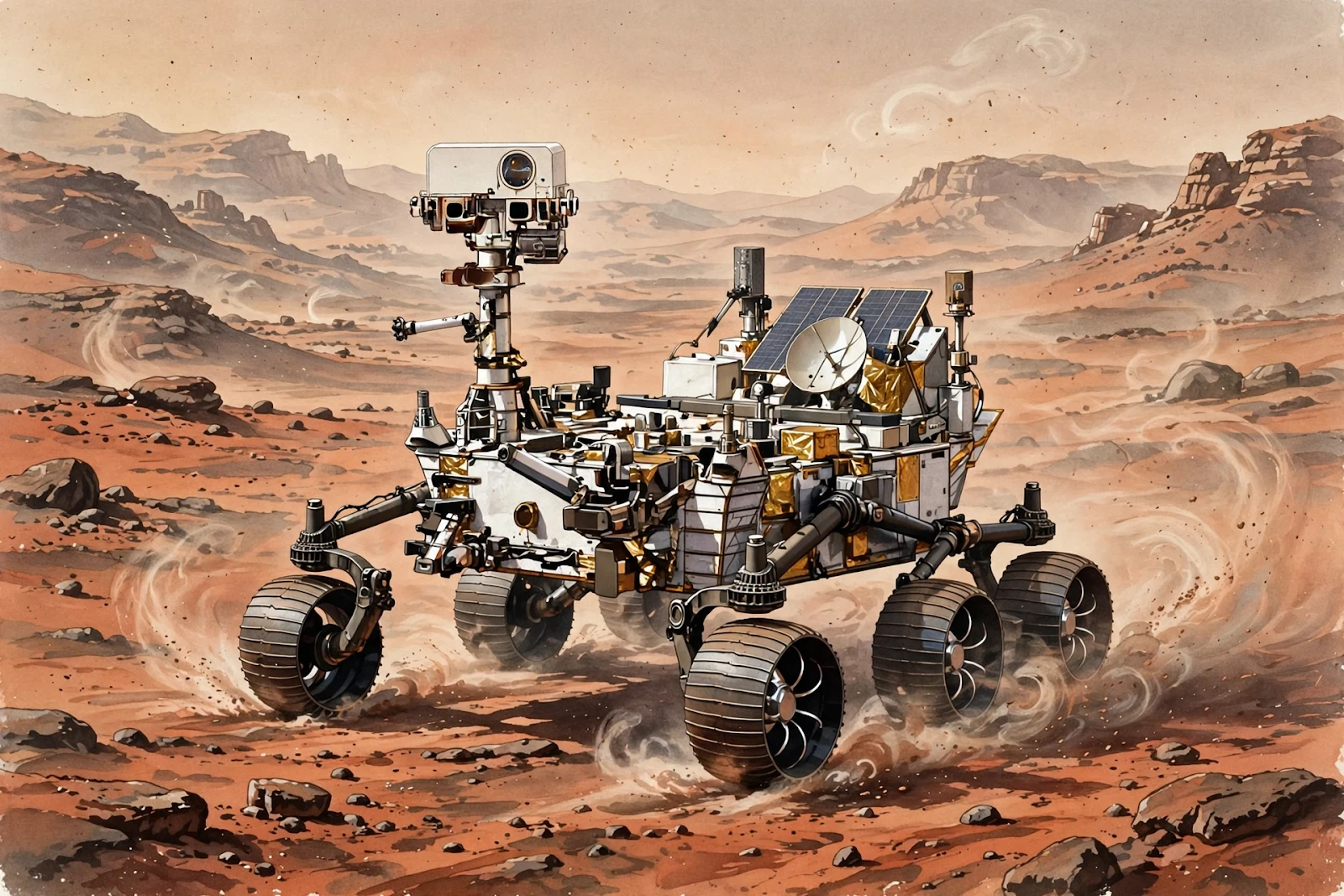
Illustration: NASA's Perseverance rover on a dusty rust-red Martian landscape with fine dust swirling in the thin atmosphere.
What Happened
Mars is a dusty place. Dust is circulated by everyday winds, by whirlwinds known as dust devils, and by larger storms raging at local, regional and global scales — and new data from NASA's Perseverance rover, reported on Wednesday, 28 October 2026, reveal just how fine that dust can be. Perseverance, which has been operating in and around Jezero Crater in the Martian northern hemisphere since landing in 2021, documented ultrafine particles as small as around 100 nanometers wide, about 500 times thinner than a human hair.
The findings come from a study published in the journal Proceedings of the National Academy of Sciences, led by planetary scientist Scott VanBommel of Washington University in St. Louis, a member of the Perseverance science team. Previous measurements had resolved Martian dust particles only down to about 3 micrometers in diameter. Perseverance's Planetary Instrument for X-ray Lithochemistry, or PIXL, documented two categories of particles even smaller: the ultrafine particles of around 100 nanometers, and a category of fine particles of less than 2.5 micrometers — about 30 times thinner than a strand of hair.
Perseverance measured dust particles that had stuck to rover hardware, including samples of possible spacesuit materials — such as the manufactured fiber Vectran and the protective coating Teflon, each about 20 mm square — carried aboard specifically to observe how they hold up in the planet's harsh environment.
"A smaller particle size does not necessarily make dust more dangerous, but smaller particles do have a higher potential to penetrate deeper into the human body and are harder for the body to clear," VanBommel said. "Like any substance, toxicity depends on dose and duration. Martian dust contains silica, iron compounds and chlorine compounds such as perchlorate, which are known to be harmful at high enough doses on Earth."
The study found that such tiny particles could be small enough to penetrate an astronaut's lungs, enter the bloodstream and potentially damage vital organs, and that the dust's physical properties could degrade spacesuit and habitat materials over time.
Background
Perseverance's main mission has been searching for signs of ancient microbial life in Jezero Crater, a basin that once held a lake and a river delta. But NASA has also used the rover to prepare for human missions, and dust has long been recognised as one of the practical obstacles standing between robots and astronauts on Mars.
NASA has experience with dust from the Apollo moon landings of 1969 to 1972: lunar dust degraded spacesuit layers, damaged seals and scratched visors, and may have caused hay-fever-like symptoms in some astronauts. But Mars dust differs in important ways, VanBommel explained.
"On the moon, dust is generated largely by surface impacts, including by micrometeorites. With no atmosphere or wind to wear them down, lunar particles stay sharp and angular, so most of the concern about lunar dust comes from its shape, whereas for Martian dust its chemistry and particle size are the primary concerns," he said.
Mars dust arises primarily from the planet's fine-grained basaltic rocks. Weathering makes the grains less abrasive than lunar dust, but the active wind environment mixes dust globally, giving it a rather uniform composition — and gradually breaks particles into smaller ones through collisions, producing grains as small as 100 nanometers.
The material tests produced a nuanced result. "We don't have evidence that the dust damaged the spacesuit materials, just that the materials tended to interact with dust differently," VanBommel said. "Vectran appeared to hold larger dust particles, with the greatest prevalence on the underside of its weave. The Teflon sample held less dust, but the dust it held was finer, reflecting differences in how electrostatic properties can preferentially adhere particles of different sizes to each material."

Illustration: Microscopic dust particles magnified under a scientific instrument, showing grains far smaller than a human hair.
Why It Matters
The discovery changes the engineering problem for human Mars missions. Spacesuits, airlocks and habitats must now be designed for sub-micron particles — far smaller than engineers had previously measured on Mars — and filters, seals and cleaning methods built for larger grains may not stop particles that slip deep into lungs and linger in the body.
The health dimension is the most sensitive part of the finding. Ultrafine particles that penetrate the lungs and enter the bloodstream could, at sufficient doses, damage vital organs, and perchlorate — one of the chlorine compounds in Martian dust — is known to interfere with thyroid function on Earth. Dust exposure must therefore be treated as a toxicological risk to be managed, alongside radiation and the sheer distance from Earth.
The material results matter too: if different suit fabrics attract different sizes of dust, the choice of material becomes a safety decision, not just a durability one, since a fabric holding finer dust could bring more of the most penetrating particles into a habitat when an astronaut returns indoors.
What Happens Next
The findings will feed directly into the design of future human support systems, VanBommel said. "These findings will help inform the design of future human support systems for crewed Mars missions, including the choice of suit and habitat materials and cleaning methods that work at sub-micron particle sizes. They also add to the guidelines and protocols NASA has established for toxicological risk," he said.
NASA is currently studying suitports — docking stations that let astronauts climb into spacesuits from outside without bringing the suit indoors — as well as dual-chamber airlocks and other concepts to keep dust out of living areas. How much dust reaches a habitat will depend largely on how suits and airlocks are designed, and that work is ongoing.
VanBommel offered a measured summary. "The results from this study do not mean Mars is too dangerous for humans. Mars dust is a hazard that has to be designed for, in the same way radiation and distance from Earth are," he said. The dust is not a reason to stay home — it is a specification for the machines and suits that will one day take humans there.

Illustration: An astronaut in a white spacesuit standing on the dusty surface of Mars near a habitat module.
Sponsored: explore today's featured sponsored offers
FAQ
What did Perseverance find on Mars?
The rover detected the finest dust particles ever measured on Mars, including ultrafine grains about 100 nanometers wide — roughly 500 times thinner than a human hair — plus a category of fine particles smaller than 2.5 micrometers, using its PIXL instrument.
Why are ultrafine particles a concern for astronauts?
Because of their size, ultrafine particles have a higher potential to penetrate deep into the human body, reach the lungs and enter the bloodstream, and they are harder for the body to clear. Martian dust also contains silica, iron compounds and perchlorate, which are harmful at high enough doses.
How is Mars dust different from Moon dust?
Moon dust is sharp and angular because it is created by impacts and never weathered, so its main danger is its shape. Mars dust is rounded and broken down by wind, so its main dangers are its chemistry and particle size.
Did the study find that dust damages spacesuit materials?
No. The researchers found no evidence that the dust damaged the test materials, but they did find that materials interact with dust differently: Vectran held larger particles, while Teflon held less dust overall but finer grains, likely due to electrostatic properties.
Does this mean Mars is too dangerous for humans?
According to the study's lead author, no. Dust is a hazard that must be designed for — through suit materials, airlock designs such as suitports, and cleaning methods that work at sub-micron sizes — in the same way radiation and distance from Earth are managed.
Sources
- Reuters, "NASA rover detects ultrafine dust particles on Mars", 28 October 2026
- Proceedings of the National Academy of Sciences, Perseverance dust study led by Scott VanBommel, Washington University in St. Louis (as reported by Reuters)
- NASA, Perseverance rover mission, Jezero Crater (background)
Comments
Post a Comment