
PITTSBURGH — A treatment based on optogenetic research that won the 2026 Nobel Prize in Physiology or Medicine has restored the ability to detect objects in blind patients, in a small trial whose promising early results were published in The New England Journal of Medicine and reported by Reuters on October 9, 2026.
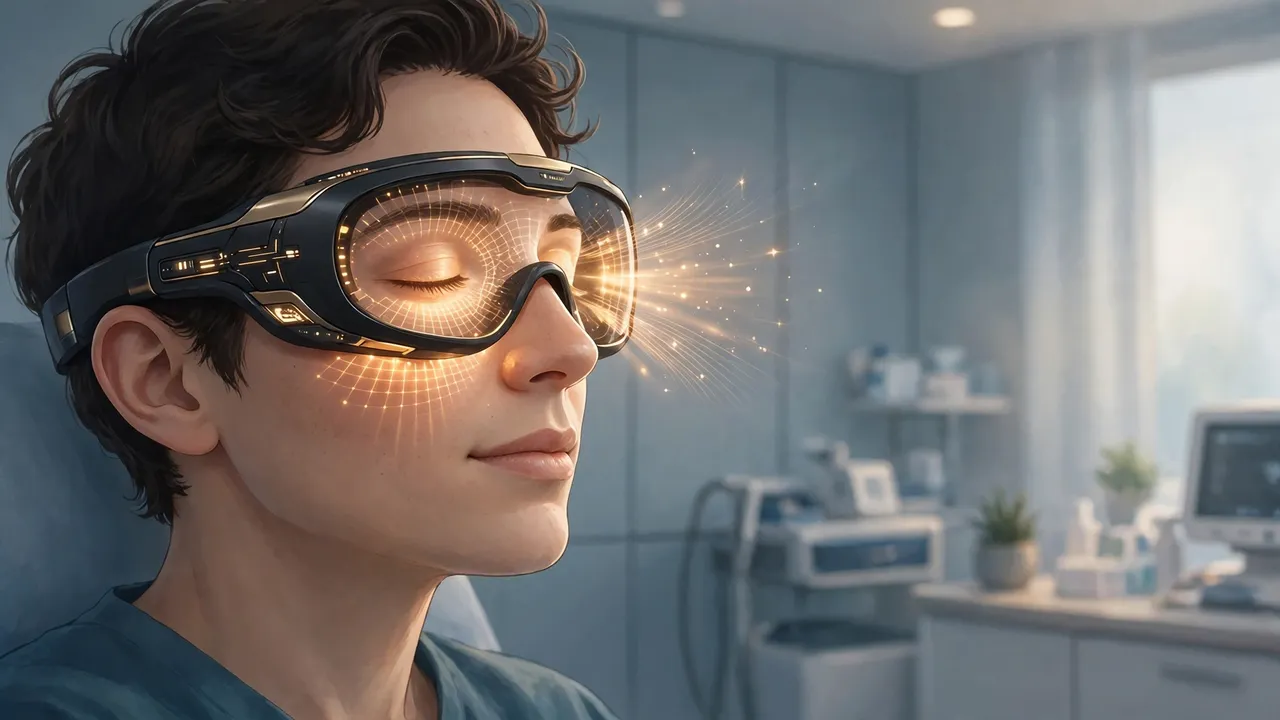
Illustration: A patient wearing light-emitting therapeutic goggles. The goggles convert visual information into light patterns that stimulate treated retinal cells. (AI-generated illustration)
What Happened
Ten participants with blindness caused by retinitis pigmentosa received a single injection into one eye carrying genetic instructions for ChrimsonR, a light-sensitive protein developed by GenSight Biologics. The gene therapy was designed to make surviving retinal ganglion cells sensitive to light. Patients then wore special goggles that captured visual information, converted it into patterns of light at wavelengths that activated ChrimsonR in the modified retinal cells, and sent those patterns of light back into the eye.
Seven of the ten patients became more sensitive to light, with six achieving clinically meaningful improvements — such as being able to detect when an object was present, determine where it was located, and reach toward it accurately, Reuters reported. One severe adverse event occurred immediately after the injection and resolved within minutes, the researchers reported.
"Even in people with profound vision loss, the visual system retains a remarkable capacity to process new information," study leader Dr. José-Alain Sahel of the University of Pittsburgh said in a statement.
Background
Retinitis pigmentosa is an inherited retinal disease in which the eye's photoreceptor cells gradually degenerate, often leading to severe vision loss and blindness. In advanced stages, the photoreceptors are gone — but the retinal ganglion cells, the eye's "output cables" that carry signals to the brain, often survive.
Optogenetics — the technique of using light to control cells — was honored with the 2026 Nobel Prize in Physiology or Medicine for three scientists whose research made this kind of therapy conceivable. The trial builds directly on that Nobel-winning science: by inserting genetic instructions for a light-sensitive protein into the surviving ganglion cells, the researchers effectively gave those cells a new job as artificial light sensors.
Previous optogenetic approaches for blindness have been explored in early experiments, but the new trial paired the gene therapy with purpose-built goggles that translate the visual world into the exact light wavelengths the modified cells respond to — an engineered system combining gene therapy and wearable optics.
Illustration: A human eye with glowing retinal cells. The therapy uses gene therapy to make surviving retinal ganglion cells sensitive to light. (AI-generated illustration)
Why It Matters
The findings show that even at a very advanced stage of blindness, surviving retinal ganglion cells can be made responsive to light and transmit visual information to the brain, the researchers said. That is a meaningful shift in how scientists think about late-stage retinal disease: the visual pathway, long assumed to be a dead end after photoreceptor loss, still has enough plasticity to process new signals.
For the roughly estimated hundreds of thousands of people worldwide living with advanced retinitis pigmentosa, the results offer a realistic — if still early — pathway. Unlike retinal implants, which require invasive surgery, the approach combines a single injection with non-invasive wearable goggles, potentially making future versions more scalable.
The timing is also significant. Trials grounded in Nobel-winning research tend to attract scientific and investment attention, and a result like this — six of ten patients with meaningful functional improvement — could accelerate larger studies across multiple inherited retinal diseases. The researchers were careful, however, to stress the study's limits: ten patients is a small sample, and the treatment is far from a cure.
From a medical-research standpoint, the trial is another demonstration that gene therapy's center of gravity is moving beyond rare childhood diseases toward sensory restoration in adults — a field where "even partial restoration" can transform independence and quality of life.
What Happens Next
Larger studies will be needed to definitively prove the usefulness of ChrimsonR and the goggles before any regulatory approval, the researchers acknowledged. The team is expected to expand the trial to more patients, refine the goggles' light-encoding patterns, and follow current participants for longer to confirm the durability of the improvements.

Illustration: A golden Nobel-style medal surrounded by beams of light. The trial builds on optogenetic research honored with the 2026 Nobel Prize in Physiology or Medicine. (AI-generated illustration)
Regulators will also want a fuller picture of safety: the single severe adverse event resolved quickly, but a wider patient population will test how reliably the injection and the wearable system perform outside a tightly controlled trial.
Sponsored: explore today's featured sponsored offers
FAQ
What is optogenetic therapy?
Optogenetics is a technique that uses light to control cells. In this trial, gene therapy inserted instructions for ChrimsonR — a light-sensitive protein — into surviving retinal ganglion cells, so those cells could respond to light patterns projected by special goggles. The research underpinning optogenetics won the 2026 Nobel Prize in Physiology or Medicine.
What did the trial find?
In 10 blind patients with retinitis pigmentosa, seven became more sensitive to light and six achieved clinically meaningful improvements, such as detecting an object's presence, locating it and reaching toward it. One severe adverse event occurred right after injection and resolved within minutes.
Is this a cure for blindness?
No. The researchers describe it as promising early evidence from a small study. The improvements are meaningful but partial — light detection and object location, not restored normal vision — and larger studies are needed before any treatment could be approved.
What is retinitis pigmentosa?
It is an inherited retinal disease in which the eye's photoreceptor cells progressively degenerate, often causing severe vision loss and blindness. In advanced stages, photoreceptors are gone, but retinal ganglion cells often survive — which is why they are the target of this therapy.
What happens next in the research?
The team is expected to expand the trial to more patients, refine the goggles' light-encoding technology, monitor durability of the improvements over longer follow-up, and build the safety evidence regulators will require.
Sources
- Reuters, Oct 9, 2026 — "Blindness treatment based on Nobel-winning research shows promise" (healthcare/pharmaceuticals)
- The New England Journal of Medicine, Oct 2026 — study report on the optogenetic therapy trial (via Reuters)
- University of Pittsburgh — statement by study leader Dr. José-Alain Sahel (via Reuters, Oct 9, 2026)
Comments
Post a Comment