
HELSINKI, Finland — A temperature once treated as almost unthinkable for the far north can no longer be dismissed in the Nordic countries, according to a new peer-reviewed study published on 31 October 2026. Researchers at the Finnish Meteorological Institute conclude that 40°C heat is no longer implausible in Norway, Sweden and Finland, and that the annual chance of such heat occurring somewhere in the region has risen sixfold since 1981.
The study, published in the journal npj Natural Hazards, does not say that 40°C has already been recorded across the Nordics. Its warning is about a threshold that has not yet been seen there: on the evidence of thousands of years of simulated summers, the authors argue, planners should no longer treat it as out of reach. "Our findings suggest that the Nordic countries should prepare for substantially higher peak temperatures than indicated by the historical observational record alone," the paper states.

Illustration: A Nordic city street in summer heat, with people seeking shade as temperatures climb beyond what the region has traditionally expected.
What Happened
The research team — Mika Rantanen, Otto Hyvärinen, Mikko Laapas, Kirsti Jylhä and Anna Luomaranta, all of the Finnish Meteorological Institute in Helsinki — analysed all available forecasts from the European Centre for Medium-Range Weather Forecasts' seasonal prediction system. Together, those forecasts correspond to 7,308 years of simulated summers, a sample far larger than the few decades of direct observations available for the region.
From that simulated record, the authors estimate that the annual probability of reaching 40°C somewhere in the Nordic countries was 0.53% in 2025, with a 95% confidence interval of 0.38% to 0.70%. That is roughly a one-in-190 chance in any given year for the region as a whole — small in absolute terms, but, the authors stress, six times higher than in 1981. The increase matters, they argue, precisely because a risk that was once negligible is now measurable.
The study also looks at a second, more immediate benchmark: the chance of exceeding a country's observed national heat record so far. That annual probability is highest in Norway, at 10.9% under present-day climate conditions, according to the paper. In other words, the study finds that breaking an existing national record is no longer a remote outlier for Norway, even before the 40°C threshold itself is considered.
The authors identify a specific recipe for the unseen extremes. They arise, the paper says, from the joint occurrence of strong omega blocking — a persistent high-pressure pattern that parks hot air over a region — combined with low soil moisture in northern Europe. When dry ground cannot cool the air through evaporation, heat builds further, and a blocking pattern can hold that heat in place for days.
The paper was received on 19 August 2026 and accepted on 14 October 2026, and is published as an early-access, peer-reviewed version that is citable with a permanent DOI. The publisher notes that this version is subject to further edits and will be replaced automatically by the final Version of Record.
Background
The Nordic countries — Norway, Sweden and Finland in this study — have traditionally been characterised by less intense heatwaves than continental Europe, the authors note. That history shapes both public expectations and infrastructure: heat that would be unremarkable in southern Europe can feel exceptional further north, and, as the paper puts it, people and infrastructure in the Nordics are generally less adapted to extreme heat than in warmer climates.
That context changed during recent events, including the 2026 heatwave, the paper says. During that heatwave, exceptionally high temperatures were observed across large parts of Europe, with temperatures of 40°C reaching further north than previously observed. The new study does not claim that the 2026 heatwave itself produced 40°C in the Nordic countries; rather, it uses the northward reach of extreme heat as part of the case for re-examining what the region should plan for.
The method is the study's main contribution. Historical weather records in the Nordics are too short to say much, on their own, about events as rare as a 40°C day. By pooling thousands of seasonal forecasts — each one a plausible summer, generated by the same forecasting system — the researchers built a much larger catalogue of possible summers, and then counted how often extreme heat appeared in it. That approach lets them estimate probabilities for events that have not yet happened, rather than waiting for the observational record to catch up.
The authors acknowledge Copernicus Climate Change Service data and ECMWF data in the paper, and note that the research was supported by the ILMOS Uusimaa project and the Research Council of Finland project CLAIMS. They declare no competing interests.
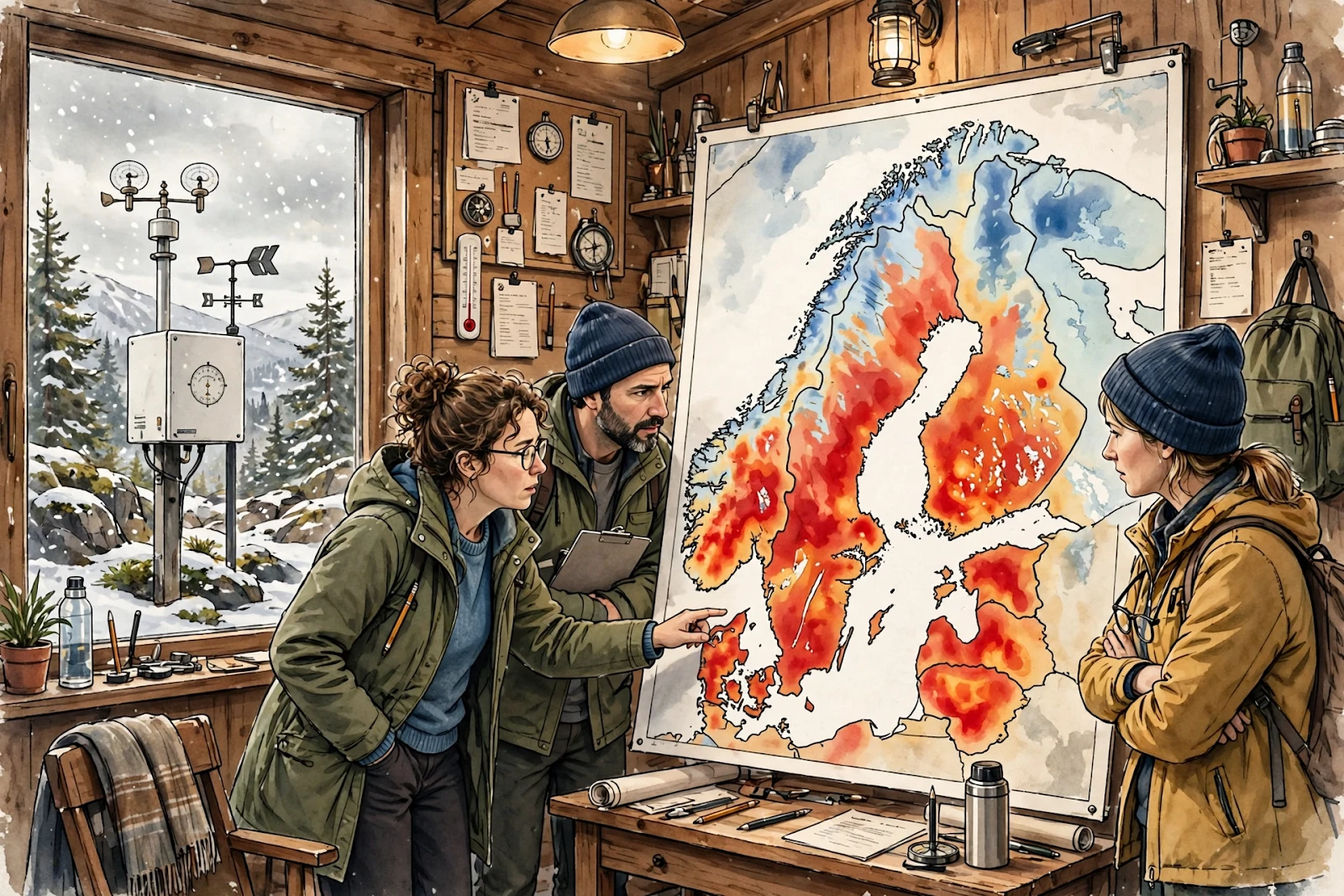
Illustration: Researchers studying a heat map of Norway, Sweden and Finland, the countries covered by the new Nordic heat-extremes study.
Why It Matters
The headline figure — 0.53% a year — can sound reassuring until it is read the way the authors intend it. A probability that small still means that, over a few decades of planning, the chance of seeing such an event at least once is no longer trivial. And the direction of travel is clear: a sixfold rise since 1981 means the risk facing today's planners is materially different from the risk their predecessors faced.
The Norway finding sharpens the point. A 10.9% annual chance of exceeding the observed national record, under present-day conditions, means that record-breaking heat is something Norwegian forecasters, health services and infrastructure operators may need to treat as a recurring planning scenario rather than a once-in-a-generation shock. The paper does not give equivalent record-breaking probabilities for Sweden and Finland in its abstract, and this article does not invent them.
The adaptation gap is the study's underlying concern. Because extreme heat has historically been rarer in the Nordics, homes, workplaces, transport systems and health services have been built around cold-weather risks first. The authors' warning is that design assumptions drawn from the historical record alone will understate the peaks a hotter climate can produce — and that waiting for a 40°C day to arrive before preparing for one would leave the region exposed.
The mechanism the study identifies also matters for forecasting. If unseen extremes depend on the combination of strong blocking and dry soils, then monitoring those two conditions together — not just forecast temperatures alone — could give earlier warning that a summer is lining up for exceptional heat. That is a practical implication for weather services, even though the paper itself is a study of probabilities, not a forecast for a specific summer.
Finally, the study is a reminder that climate risk is not only about averages. Averages in the Nordics remain far cooler than in southern Europe, and will stay that way. What is changing, according to this research, is the far tail of the distribution: the hottest days a region might plausibly experience, and how often they might occur. Planning that only tracks the average will miss exactly the events that cause the most disruption.
What Happens Next
The immediate next step is the final Version of Record of the paper, which will replace the early-access version now published. Readers and planners should check that final version for any edits, although the core findings reported here come from the peer-reviewed version published on 31 October 2026.
For Nordic weather services and public authorities, the study sets an agenda rather than a deadline: review heat plans, building guidance and emergency preparations against peaks higher than those in the historical record, and consider how blocking patterns and soil moisture are monitored together during summer. The paper does not prescribe specific measures, and this article does not add any.
For the public, the message is proportionate rather than alarming. A 40°C day in the Nordics remains unlikely in any single year, on the study's own estimate. What has changed is that it can no longer be called implausible — and that, the authors argue, is reason enough to prepare for substantially higher peaks than history alone would suggest.
Future summers will test the estimate. Each additional year of observations, and each new round of seasonal forecasts, will refine the probabilities. If the warming trend continues, the annual chance will be expected to rise further; if a 40°C day does occur, it will move from the study's simulated catalogue into the observational record — and the question for the Nordics will shift from whether such heat is possible to how well the region coped with it.
Sponsored: explore today's featured sponsored offers
FAQ
What did the new study actually find?
Researchers at the Finnish Meteorological Institute estimate that the annual probability of reaching 40°C somewhere in the Nordic countries was 0.53% in 2025, six times higher than in 1981, and conclude that such heat can no longer be considered implausible in Norway, Sweden and Finland.
Has 40°C already happened in the Nordic countries?
No — the study describes 40°C as an unseen extreme for the region. Its point is that, on the evidence of 7,308 years of simulated summers, such heat is now plausible enough that planners should prepare for it, not that it has already been recorded there.
What is the chance of breaking a national heat record?
The study puts the annual probability of exceeding the observed national heat record so far at 10.9% for Norway, the highest of the countries covered, under present-day climate conditions.
What weather pattern produces these extremes?
According to the paper, the unseen extremes arise from the joint occurrence of strong omega blocking — a persistent high-pressure pattern — and low soil moisture in northern Europe, which together allow heat to build and persist.
How did the researchers estimate something that has not happened yet?
They pooled all available forecasts from the European Centre for Medium-Range Weather Forecasts' seasonal prediction system, equivalent to 7,308 years of simulated summers, and counted how often extreme heat appeared in that much larger catalogue of possible summers.

Illustration: A dry, cracked landscape under a blocked high-pressure pattern, the combination the study links to unseen Nordic heat extremes.
Sources
- Rantanen, M., Hyvärinen, O., Laapas, M., Jylhä, K. & Luomaranta, A., "40°C heat extremes are no longer implausible in the Nordic countries," npj Natural Hazards (2026), published 31 October 2026, DOI: 10.1038/s44304-026-00290-9.
- European Centre for Medium-Range Weather Forecasts (ECMWF) seasonal prediction system, as analysed in the study, corresponding to 7,308 years of simulated summers.
- Copernicus Climate Change Service data (NGCD and ERA5), acknowledged in the study.
Comments
Post a Comment