
FDA to Review Orexo's Nasal Naloxone Powder IZIPRY for Opioid Overdoses, With Decision Due in March 2027
This article is general information about a public-health development, not medical advice. If someone may be experiencing an opioid overdose, call local emergency services immediately and follow local guidance.
UPPSALA, 29 October 2026 — The United States Food and Drug Administration (FDA) has accepted for review Swedish drugmaker Orexo's resubmitted application for IZIPRY, a high-dose naloxone nasal powder designed to reverse opioid overdoses, including those involving highly potent synthetic opioids such as fentanyl.
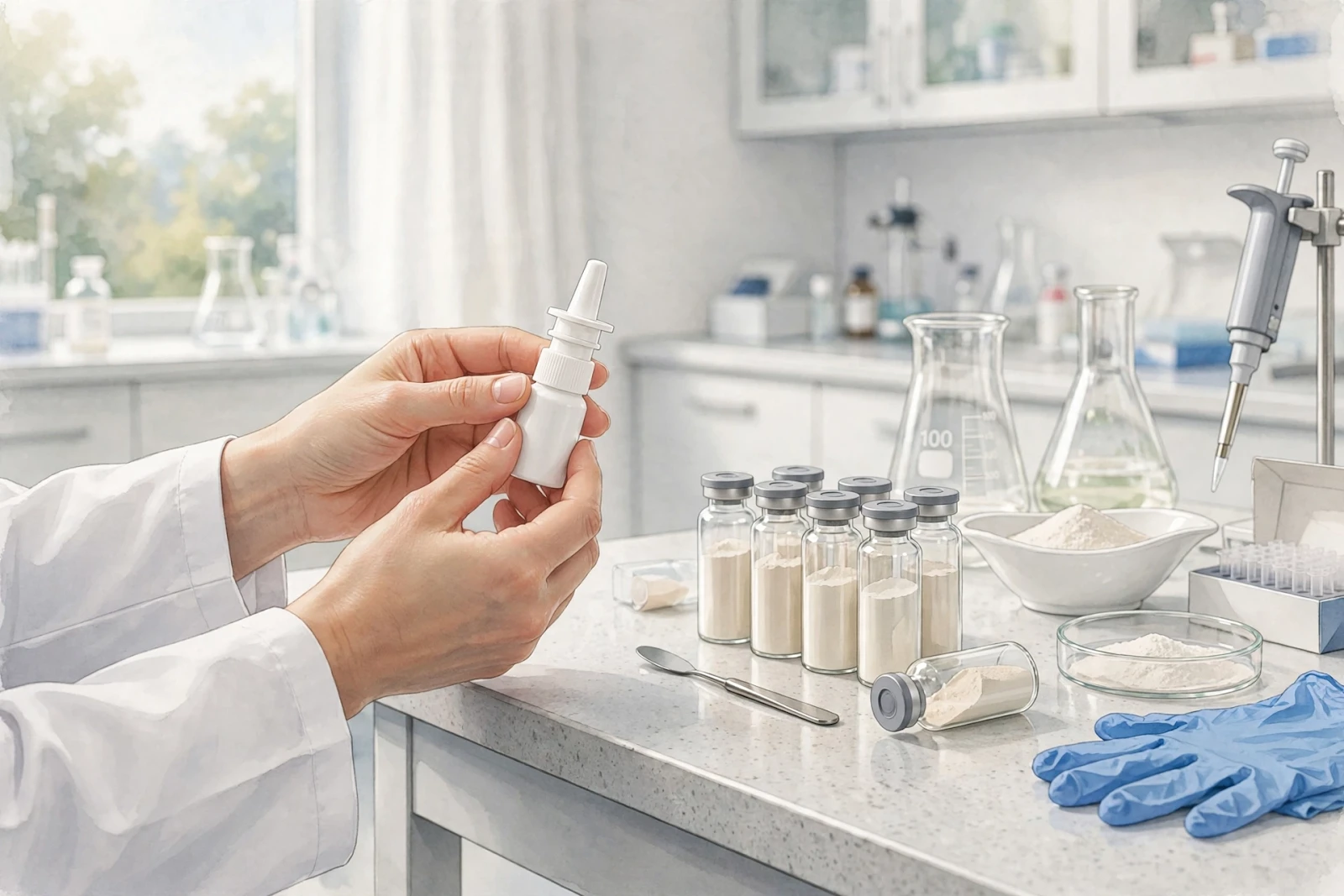
Illustration: A pharmacist holds a nasal powder device beside laboratory vials.
What Happened
Orexo announced on 29 October 2026 that the FDA had accepted its resubmitted New Drug Application (NDA) for IZIPRY (naloxone nasal powder) and set a Prescription Drug User Fee Act (PDUFA) target action date of 29 March 2027. That date is the agency's target for a decision — it is not an approval, and the FDA could still ask further questions or take longer.
Acceptance for review means the agency considers the resubmission complete enough to examine. According to Orexo, the filing contains the additional information and documentation needed to address the observations in the FDA's Complete Response Letter of July 2024, which had halted the earlier application.
If approved, IZIPRY would be the first nasal naloxone powder available in the United States, Orexo said. Existing naloxone rescue products in the country are liquid nasal sprays or injections. Orexo argues that a dry powder has practical advantages: it is highly stable, has low sensitivity to temperature fluctuations, and can be used in freezing temperatures — conditions in which liquid formulations can be harder to store or use.
The product is built on Orexo's proprietary AmorphOX powder-based drug delivery platform. The company says combining a high dose with rapid absorption and high bioavailability has the potential to reduce repeat dosing and rapidly reverse life-threatening overdoses. Those are company claims about the product's design, not findings the FDA has yet endorsed; the review now under way will test them.

Illustration: An emergency responder aids a person on a city street as ambulance lights blur behind them.
Background
Naloxone is a medicine that can temporarily reverse an opioid overdose by blocking opioid receptors, restoring breathing while emergency help is sought. It does not replace emergency medical care, and a person who has received naloxone still needs urgent medical attention, because the overdose can return as the medicine wears off.
The need for stronger rescue options has grown as fentanyl and other synthetic opioids have spread through illicit drug supplies. These substances are far more potent than heroin or prescription opioids by weight, so overdoses can develop faster and, according to real-world evidence cited by Orexo, increasingly require multiple naloxone doses from bystanders and emergency medical services.
The United States Drug Enforcement Administration has also advised that fentanyl combined with emerging synthetic opioids may require several doses of naloxone to be effective, Orexo noted. That shifting picture is the core of the company's case for a high-dose product: a single administration that delivers more naloxone, more quickly, could matter in the minutes before paramedics arrive.
Orexo's path to this point has been long. The company first sought approval for the product, then known as OX124, and received a Complete Response Letter in July 2024 asking for commercial manufacturing data, an additional human factors study and further technical information. Orexo completed its resubmission on 29 September 2026, after working with manufacturing and development partners to address the deficiencies identified. The FDA's acceptance, announced a month later, confirms the agency will now review whether those issues have been resolved.
Why It Matters
First, the decision date gives the opioid response field a concrete milestone. A March 2027 decision would come just as winter — when cold-weather storage and use matter most for community rescue kits — gives way to spring, and as harm-reduction programmes plan their purchasing for the year ahead.
Second, the powder format could change where naloxone can practically be kept. A formulation that tolerates temperature swings and freezing conditions could be easier to stock in cars, outdoor outreach kits, rural clinics and community distribution points, expanding access beyond pharmacies and hospitals. That potential, if confirmed in review, is the product's main differentiator from liquid sprays.
Third, the case is a test of how regulators weigh real-world dosing patterns. If bystanders and paramedics are routinely giving multiple doses, a high-dose single product could simplify rescue and reduce delay — but it also raises questions reviewers will examine, including safety, ease of use under stress, and whether the higher dose changes the risk profile for the person being rescued. Those questions are exactly what the six-month review is for, and approval is not guaranteed.

Illustration: A community health worker hands a rescue kit to a person outside a neighbourhood clinic.
What Happens Next
Orexo said it looks forward to the review process and to working with the agency to respond to any questions, while seeking a commercialisation partner for the United States market. The company has not announced a launch date or price, and neither would be set until — and unless — the FDA approves the product.
The key dates to watch are the months leading to 29 March 2027: any FDA questions, advisory discussion or labelling negotiations will signal how the review is progressing, while silence is normal for much of a standard review. If the FDA approves IZIPRY, attention will turn quickly to pricing, distribution through harm-reduction programmes and pharmacies, and training for bystanders on the powder device, which differs from familiar liquid sprays.
If the agency issues another Complete Response Letter, Orexo would need to address new questions before resubmitting again — a further delay in a field where, advocates argue, every month of waiting carries a human cost. For now, the acceptance itself is the news: after a two-year setback, the powder naloxone is formally back under FDA review.
Sponsored: explore today's featured sponsored offers
FAQ
What is IZIPRY?
IZIPRY is a high-dose naloxone nasal powder developed by Swedish company Orexo to reverse opioid overdoses, including those involving potent synthetic opioids such as fentanyl. It is built on Orexo's AmorphOX powder-based delivery platform.
Has the FDA approved IZIPRY?
No. On 29 October 2026 the FDA accepted Orexo's resubmitted application for review. Approval has not been granted, and the agency's target date for a decision is 29 March 2027.
How would a powder naloxone differ from existing products?
According to Orexo, the dry powder is highly stable, less sensitive to temperature changes, and usable in freezing temperatures, unlike liquid nasal sprays. If approved, it would be the first nasal naloxone powder in the United States.
Why does Orexo argue a high dose is needed?
The company cites real-world evidence that bystanders and emergency services increasingly give multiple naloxone doses, and a Drug Enforcement Administration warning that fentanyl mixed with emerging synthetic opioids may require several doses. A high-dose product aims to reduce repeat dosing.
What happened to the earlier application?
The FDA issued a Complete Response Letter in July 2024, asking for commercial manufacturing data, an additional human factors study and further technical information. Orexo resubmitted the application on 29 September 2026, and the FDA has now accepted it for review.
Sources
- Orexo AB, "Orexo announces FDA acceptance of IZIPRY NDA resubmission for review", 29 October 2026.
- Nordic Life Science, "FDA to review Orexo's nasal naloxone powder", 29 October 2026.
- Orexo AB, "Orexo resubmits NDA for IZIPRY to the FDA, a high-dose rescue medication for opioid overdose", 29 September 2026.
Comments
Post a Comment