
Laboratory tests on rocks returned from asteroid Bennu have finally solved a mystery that baffled NASA scientists for years: hidden networks of cracks inside the asteroid's boulders explain why Bennu sheds heat far faster than its rocky surface suggests it should — a discovery that changes how astronomers read asteroid data from afar.
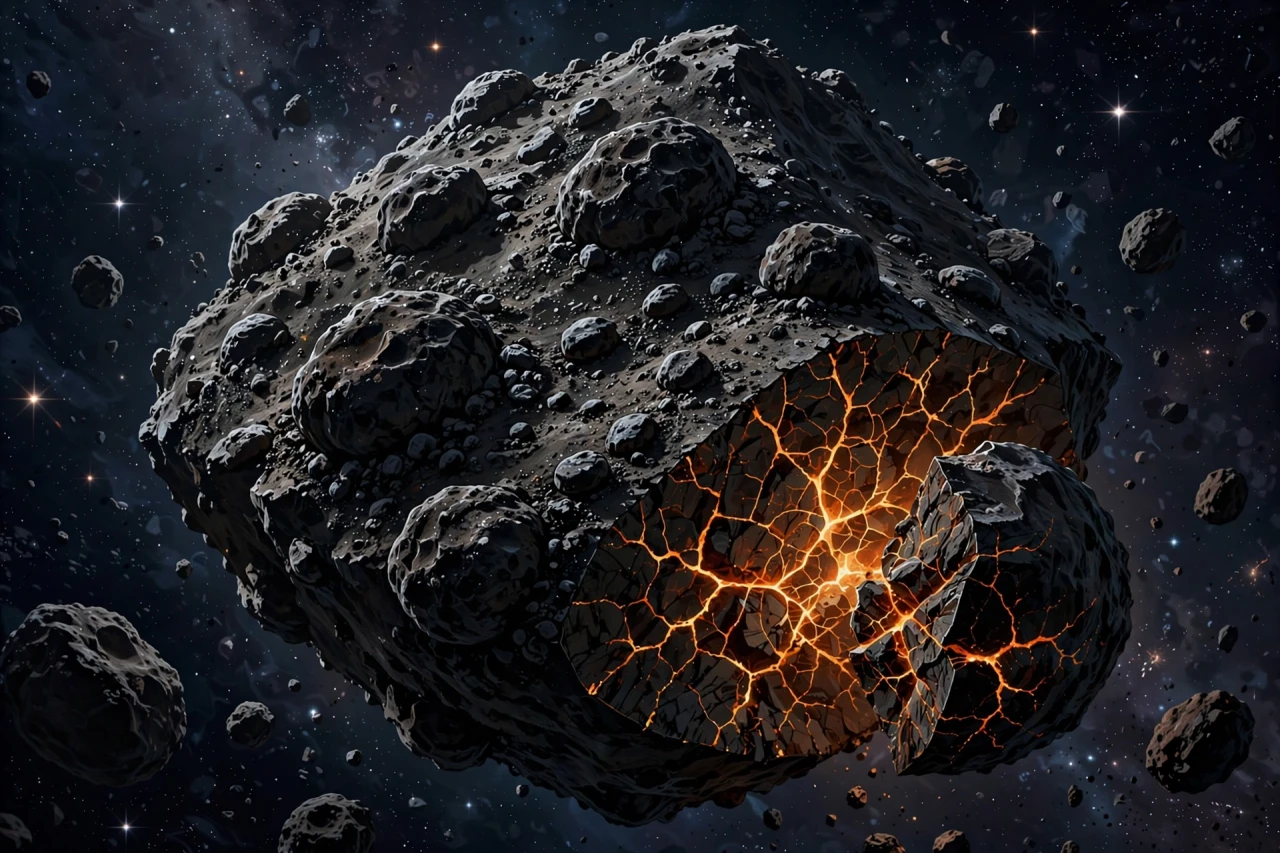
Illustration: asteroid Bennu's boulder fields, with a cutaway revealing the hidden crack networks inside the rocks.
What Happened
When NASA's OSIRIS-REx spacecraft arrived at asteroid Bennu in 2018, scientists expected to find smooth, sandy, beach-like terrain. Instead they found a celestial body littered with large boulders. "When OSIRIS-REx got to Bennu in 2018, we were surprised by what we saw," said Andrew Ryan, a scientist with the University of Arizona's Lunar and Planetary Laboratory who led the mission's sample physical and thermal analysis working group. "We expected some boulders, but we anticipated at least some large regions with smoother, finer regolith that would be easy to collect. Instead, it looked like it was all boulders, and we were scratching our heads for a while."
There was a second mystery. Data gathered in 2007 by NASA's Spitzer Space Telescope had measured low thermal inertia on Bennu — meaning the surface heated up and cooled down quickly as it rotated into and out of sunlight, like sand on a beach. But the boulders OSIRIS-REx found should have held heat more like blocks of concrete, staying warm well after sunset. Measurements from the spacecraft itself hinted at an explanation: the boulders might be far more porous than expected. But only when samples reached Earth could researchers test the idea directly.
Now, in a study published in Nature Communications that has been highlighted in fresh coverage this week, Ryan's team reports the answer — and it was hiding inside the rocks themselves. At NASA's Johnson Space Center, scientists scanned the pristine samples with X-ray computed tomography (XCT), using machine learning to map the internal structure, then scaled the particles up to boulder size in heat-flow simulations. The simulations matched the spacecraft's measurements.

Illustration: a pristine Bennu sample in its protective container undergoing X-ray CT scanning at a NASA laboratory.
Background
The study found that Bennu's rocks fall into two types. Rough "hummocky" particles have lower thermal inertia, fine pores and winding crack networks that resist breaking apart. Smoother "angular" particles are harder, hold heat better, and carry fewer but longer cracks that split them more easily. Porosity alone, the team found, explained only part of the rapid heat loss — the widespread internal fractures were equally important. "It turns out that they're really cracked too, and that was the missing piece of the puzzle," Ryan said.
The imaging was an achievement in itself. The samples are kept in nitrogen environments to prevent atmospheric contamination, which would alter their physical and thermal properties. Nicole Lunning, lead OSIRIS-REx sample curator within the Astromaterials Research and Exploration Science division at NASA Johnson, explained that each sample goes into its own protective "spacesuit," gets a CT scan, and returns to its pristine environment. The 3D scans revealed the pore space and crack networks in detail — structures invisible from the outside.
The researchers say the cracks may date from geological activity inside Bennu's parent body, or they may have formed more recently from micrometeoroid impacts and the stress of daily heating and cooling. The same signature appears on another carbon-rich asteroid: samples from Ryugu, returned by Japan's Hayabusa2 mission, show cracks much like those in Bennu's hummocky particles — suggesting the mechanism likely explains low heat readings on other asteroids of this type.
Why It Matters
The finding changes how scientists interpret telescope observations of asteroids. Astronomers routinely measure how an asteroid absorbs and releases heat to estimate the physical properties of its surface — but Bennu shows those readings can be misleading unless researchers know how fractured the rock is inside. "We can finally ground our understanding of telescope observations of the thermal properties of an asteroid through analyzing these samples from that very same asteroid," said Ron Ballouz of the Johns Hopkins University Applied Physics Laboratory, the study's second author.
There is also a practical, planetary-defense dimension. As Bennu rotates, its surface releases heat unevenly, and that tiny push — the Yarkovsky effect — shifts the asteroid's orbit over decades. A 2021 analysis built on OSIRIS-REx tracking put Bennu's chance of hitting Earth on September 24, 2182, at 1 in 2,700, and about 1 in 1,750 in total through the year 2300. Accurate thermal properties make such forecasts more reliable, and this study gives modelers the measured internal structure they were missing.
More broadly, the work is a vindication of sample-return missions. NASA's own image article on the scans, "Solving Asteroid Bennu's Mysteries," released in March 2026, framed the XCT results as the bridge between remote observations and ground truth — a bridge that can now be crossed for any asteroid where telescopes provide the heat data.

Illustration: uneven heat release from an asteroid's surface gently nudging its orbit — the Yarkovsky effect.
What Happens Next
OSIRIS-REx is not done. The spacecraft — now continuing on an extended mission — is headed for asteroid Apophis, and scientists are eager to apply the lessons of Bennu's cracks to the next target. With the heat-behavior mystery resolved, attention turns to the origin of the fractures: mapping which cracks are ancient and which are recent will help reconstruct the history of Bennu's parent body and the violence it endured.
For planetary defense, the next step is refinement. The Yarkovsky effect depends on exactly how heat moves through boulder-filled material, and Bennu now provides a calibrated laboratory case. Similar analyses of Ryugu and other carbon-rich asteroids will extend the framework — and every improvement in orbit forecasting sharpens our picture of which near-Earth objects deserve the closest watch.
There is also a lesson about how science gets done. The Bennu heat mystery was not solved by a bigger telescope or a better camera, but by bringing a piece of the asteroid home and subjecting it to laboratory tools — X-ray tomography, machine learning, thermal simulation — that no spacecraft could carry. As Ballouz put it, the team can finally anchor what telescopes see to what rocks actually are. That feedback loop between remote observation and returned samples is becoming the gold standard of planetary science, and Bennu is its textbook case.
Sponsored: explore today's featured sponsored offers
FAQ
What was the Bennu mystery?
Two puzzles: NASA expected Bennu's surface to be smooth but found it covered in boulders, and those boulders were losing heat far faster than solid rock should — behaving thermally more like sand on a beach than like concrete.
What solved it?
Lab analysis of OSIRIS-REx samples at NASA's Johnson Space Center using X-ray computed tomography found the boulders are highly porous and riddled with hidden crack networks. Computer simulations confirmed those cracks increase heat loss enough to match spacecraft measurements.
Who made the discovery?
The study, published in Nature Communications, was led by Andrew Ryan of the University of Arizona's Lunar and Planetary Laboratory, with Ron Ballouz of the Johns Hopkins Applied Physics Laboratory as second author. The findings were highlighted in new coverage on October 20, 2026.
What is the Yarkovsky effect and why does it matter?
As an asteroid rotates, uneven heat release acts like a tiny thruster, gradually shifting its orbit. Accurate thermal data improves predictions of Bennu's future path — currently estimated at a 1-in-2,700 chance of an Earth impact on September 24, 2182.
Does this help with other asteroids?
Yes. Ryugu's samples show similar cracks, suggesting the same mechanism explains low heat readings on other carbon-rich asteroids. It gives astronomers a calibrated way to interpret thermal telescope data for asteroids with no samples.
Sources
- technology.org, "Hidden Cracks Explain Why Bennu Loses Heat Fast" (October 20, 2026).
- SciTechDaily, "'We Were Scratching Our Heads' – Scientists Finally Solve Asteroid Bennu's Surface Mystery" (2026).
- Sky & Telescope, "NASA Has Cracked the Mystery of Asteroid Bennu's Boulders" (2026).
- NASA, "Solving Asteroid Bennu's Mysteries" image article (March 17, 2026).
- newsbeep.com, "NASA solves a strange mystery hidden inside asteroid Bennu's boulders" (October 20, 2026).
Comments
Post a Comment