
LIMA — Peru's nearshore El Niño Costero is expected to remain at an "extraordinary" magnitude through February 2027 and then taper toward June 2027, according to Peru's national El Niño commission, ENFEN, in reporting published on 31 October 2026. The forecast points to above-normal rainfall on the northern and central coasts and in the western highlands from November 2026 into early 2027, with higher river discharges, continued coastal warmth and an elevated risk of floods, erosion and anomalous waves — a warning that arrives just as the rainy season gathers pace.
ENFEN, the Multisectoral Commission for the National Study of the El Niño Phenomenon, uses "extraordinary" as its highest category for the coastal event. Its latest outlook, as reported on 31 October, keeps that rating in place through the southern hemisphere summer, the period when heavy rain historically does the most damage in northern Peru. National services have already reported early impacts in the north, including rising rivers and road closures in the Piura region, according to the same reporting.

Illustration: Heavy rain flooding a northern Peruvian coastal town street.
What Happened
ENFEN's forecast extends a warning that has been in place for months. In September 2026, the commission maintained its El Niño Costero alert and said there was a high probability the phenomenon would reach extraordinary magnitude between September 2026 and January 2027, according to UNESCO Peru, which cited the commission in an October preparedness campaign. The 31 October reporting extends that extraordinary phase through February 2027, with a gradual easing toward June 2027.
For November 2026 into early 2027, the outlook anticipates above-normal coastal and western-sierra rainfall and higher river discharges. ENFEN also warns that coastal temperatures and mean sea level will stay high enough to raise the risk of floods, coastal erosion and anomalous waves. The World Meteorological Organization warned in late October that Pacific sea-surface anomalies could reach unusually large values, a development that would shift rainfall and temperature patterns across many regions, according to the same reporting.
The timing matters. Peru's rainy season runs through the southern hemisphere summer, and northern coastal communities are among the most exposed to river flooding when warm Pacific waters combine with heavy rain. Preparedness work — clearing drains, reinforcing riverbanks and keeping evacuation routes open — is most effective before rivers rise, which is why officials and aid groups have been urging early action since September.
Background
El Niño Costero is the coastal form of the El Niño phenomenon, centred on unusually warm waters off Peru and Ecuador in the Niño 1+2 region. Unlike the basin-wide El Niño tracked in the central Pacific, the coastal version can develop and intensify close to shore, bringing warm, moist air directly onto Peru's desert coast, where infrastructure is often built for dry conditions rather than sustained downpours.
Peru has painful experience of what an extraordinary coastal event can do. The 2017 coastal El Niño brought devastating floods and landslides to the north, damaging homes, roads and farmland. Earlier reporting in October noted that coastal sea temperatures in the current event had already exceeded peaks recorded in 1983 and 1997, two of the most damaging El Niño years on record — a comparison that helps explain why forecasters are treating this event with particular seriousness even before the wettest months arrive.
The global picture adds to the concern. The US National Oceanic and Atmospheric Administration (NOAA) said in its 8 October update that there was an 83 percent chance this El Niño would become the strongest since its records began in 1950, measured over October through December, according to reporting on 28 October. ENFEN said on 16 October that the coastal El Niño was likely to stay at extraordinary magnitude through January 2027, a view the latest forecast extends by a month.
UNESCO Peru launched a preparedness campaign, Comunidades PRO (Prepared, Resilient and Organized Communities), on 26 October at a women's football match in Lima, using the event to encourage households to prepare for the 2026–2027 El Niño. The campaign stressed preventive measures against heavy rainfall, flooding and river overflows, particularly along the northern and central coasts and in the northwestern highlands, where above-average summer rainfall is expected.

Illustration: Peruvian fishing boats on unusually warm Pacific waters.
Why It Matters
The human stakes are high. A University of Chicago-linked Climate Impact Lab update raised its El Niño Heat Mortality Tracker to roughly 373,000 projected excess heat deaths for October 2026 to March 2027 and about 857,400 for June 2026 to March 2027, according to reporting on 31 October. Those figures are statistical model estimates — they combine observed temperatures, historical mortality patterns and 51 European Centre for Medium-Range Weather Forecasts simulations — and do not represent individually confirmed deaths. The tracker identifies the highest country-level risks for October to March as Nigeria (about 56,000), India (about 55,200), Indonesia (about 29,300), Brazil (about 19,500) and Sudan (about 14,700), with about 3,200 additional heat deaths estimated in Peru itself.
Beyond heat, experts warn that higher temperatures will amplify dengue and waterborne disease risk, increase wildfires and floods, disrupt transport and food supplies, and force governments to expand cooling, water and health services. In Peru, the immediate economic channel runs through the sea: warm waters push anchoveta, the small fish at the heart of the world's largest single-species fishery, deeper and further from shore, disrupting catches and the fishmeal industry that feeds farmed fish and livestock worldwide.
The broader economic risk is also significant. Regional analyses cited on 31 October say a prolonged extraordinary El Niño could push food prices higher and, under weak policy execution, trim Peru's 2027 growth toward about 2 percent. Earlier economic estimates were already sobering: the Bank of Peru cut its 2026 growth forecast from 3.4 percent to 3.2 percent, attributing the revision to El Niño damage in primary sectors, while BBVA Research estimated the event would reduce Peru's GDP by 0.9 percentage points in 2026 and another 1.3 points in 2027, and Credicorp Capital Asset Management put cumulative losses at up to 16 billion soles, about $4.3 billion, focused on northern coastal infrastructure.
Preparedness gaps remain a central worry. Reporting in mid-October said the government had prioritised 536 coastal risk points but only about 17 percent had works in execution as of 7 October, and more than 6 million hectares — roughly 53 percent of Peru's farmland — were at high flood risk, with the Lambayeque region especially exposed. That gap between warning and works is what makes the February horizon so consequential: the forecast gives authorities months of lead time, but only if it is used.
What Happens Next
The next formal milestones are close. ENFEN's late-October update underpins the February 2027 outlook reported on 31 October, and NOAA's next monthly El Niño update is scheduled for 12 November 2026. Those updates will test whether the extraordinary phase is holding, strengthening or beginning to ease, and whether rainfall forecasts for the northern coast are shifting.
In the meantime, the practical watchpoints are straightforward: river levels and road conditions in Piura and neighbouring northern regions, rainfall totals on the northern and central coasts through November, and sea-surface temperatures off Peru. A wetter-than-expected November would raise the urgency of flood preparations; a drier month would not end the risk, given the forecast runs through February.
For households, the official advice remains consistent: stay informed through ENFEN and civil defence updates, avoid crossing flooded roads and rivers, keep drains clear, and prepare for possible disruptions to water, transport and power during heavy rain. For the fishing and farming sectors, the months ahead will test how far early warnings can cushion an event that forecasters already describe as extraordinary.
If the forecast holds, Peru faces a long, wet summer with the peak still ahead. The question is no longer whether the coastal El Niño will be strong — forecasters say it already is — but whether preparation keeps pace with it through February and beyond.
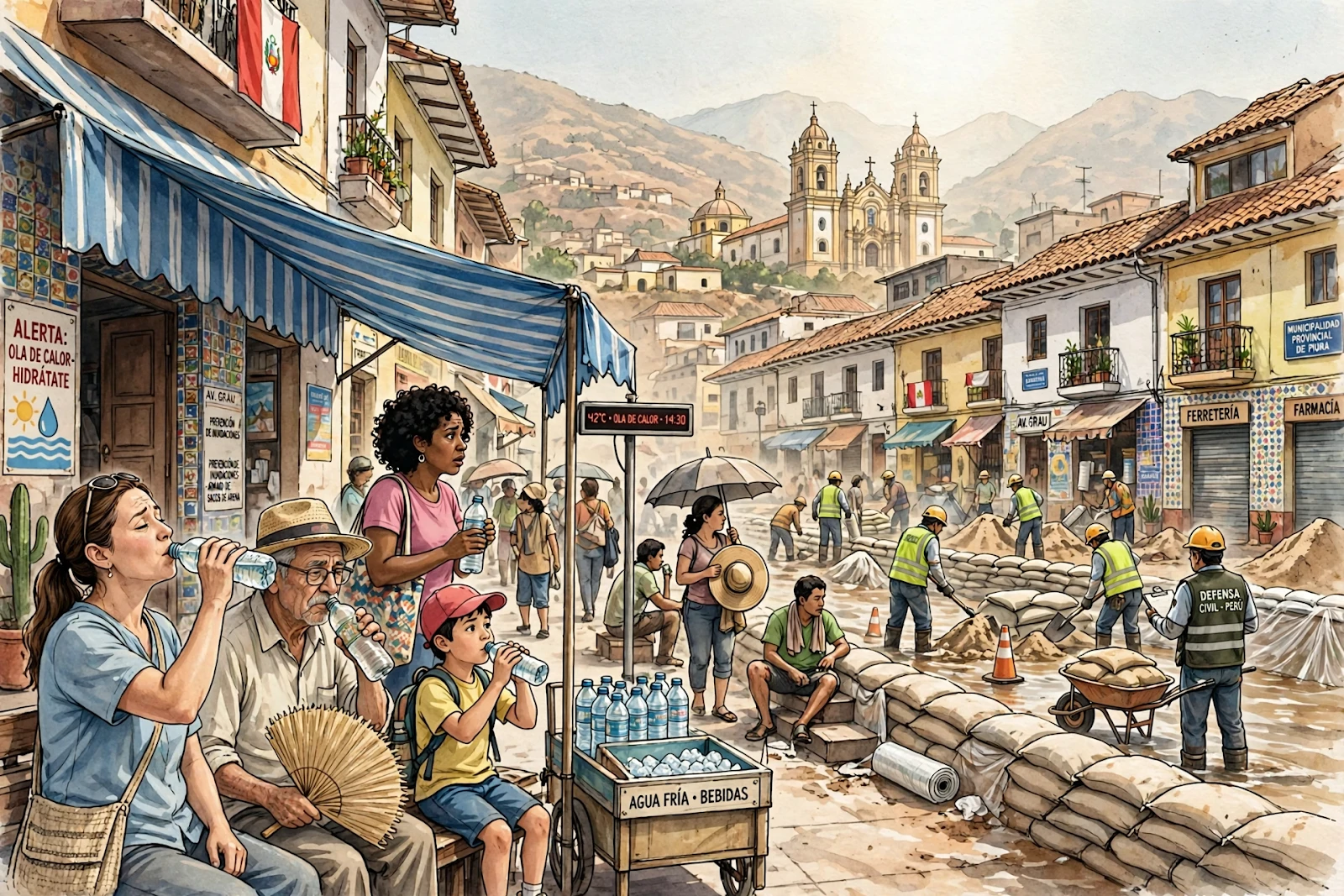
Illustration: People in a hot Peruvian city preparing flood defenses during a heatwave.
Sponsored: explore today's featured sponsored offers
FAQ
What is El Niño Costero?
El Niño Costero is the coastal form of El Niño, marked by unusually warm sea-surface temperatures off Peru and Ecuador. It can bring heavy rain to Peru's normally dry northern coast, raising flood and landslide risks.
How long is the extraordinary phase expected to last?
According to reporting on 31 October 2026, ENFEN expects the coastal El Niño to remain at extraordinary magnitude through February 2027, then taper toward June 2027.
Which areas of Peru are most at risk?
The northern and central coasts and the western highlands face above-normal rainfall from November 2026 into early 2027, with Piura already reporting rising rivers and road closures. The southern highlands and parts of the Amazon are expected to see normal to below-normal rainfall.
Are the heat-death figures confirmed deaths?
No. The Climate Impact Lab figures — about 373,000 projected excess heat deaths for October 2026 to March 2027 — are statistical model estimates, not individually confirmed deaths. They are intended to show the scale of risk, not a counted toll.
What should people in northern Peru do now?
Follow ENFEN and civil defence updates, avoid flooded roads and rivers, keep drains clear, and prepare for possible disruptions to water, transport and power during heavy rain.
Sources
Particle News, "Extraordinary El Niño Costero To Hold Through February 2027, Raising Flood, Heat and Economic Risks," 31 October 2026 (reporting ENFEN's forecast, WMO warnings and Climate Impact Lab estimates); UNESCO Peru, "UNESCO promotes prepared, resilient, and organized communities," 30 October 2026 (ENFEN September 2026 alert and rainfall outlook); 4Hunger.org, "The Strongest El Niño Ever Recorded Is Here," 28 October 2026 (NOAA 8 October update, ENFEN 16 October statement, fisheries and preparedness reporting); Particle News, "Strong El Niño Forecasts Raise Alarm as Peru's Preparedness Lags," 11 October 2026 (coastal risk points, farmland flood risk, sea-temperature comparisons).
Comments
Post a Comment