
Putin Proposes Trump-Putin-Xi Summit at APEC as Diplomacy Enters a Critical Stretch
Russian President Vladimir Putin has proposed a trilateral summit with US President Donald Trump and Chinese President Xi Jinping on the sidelines of the APEC meeting in Shenzhen, China, on November 18-19, raising the prospect of the first-ever meeting of the three leaders in this format — while Ukraine and European governments insist no settlement can be decided without Kyiv at the table.
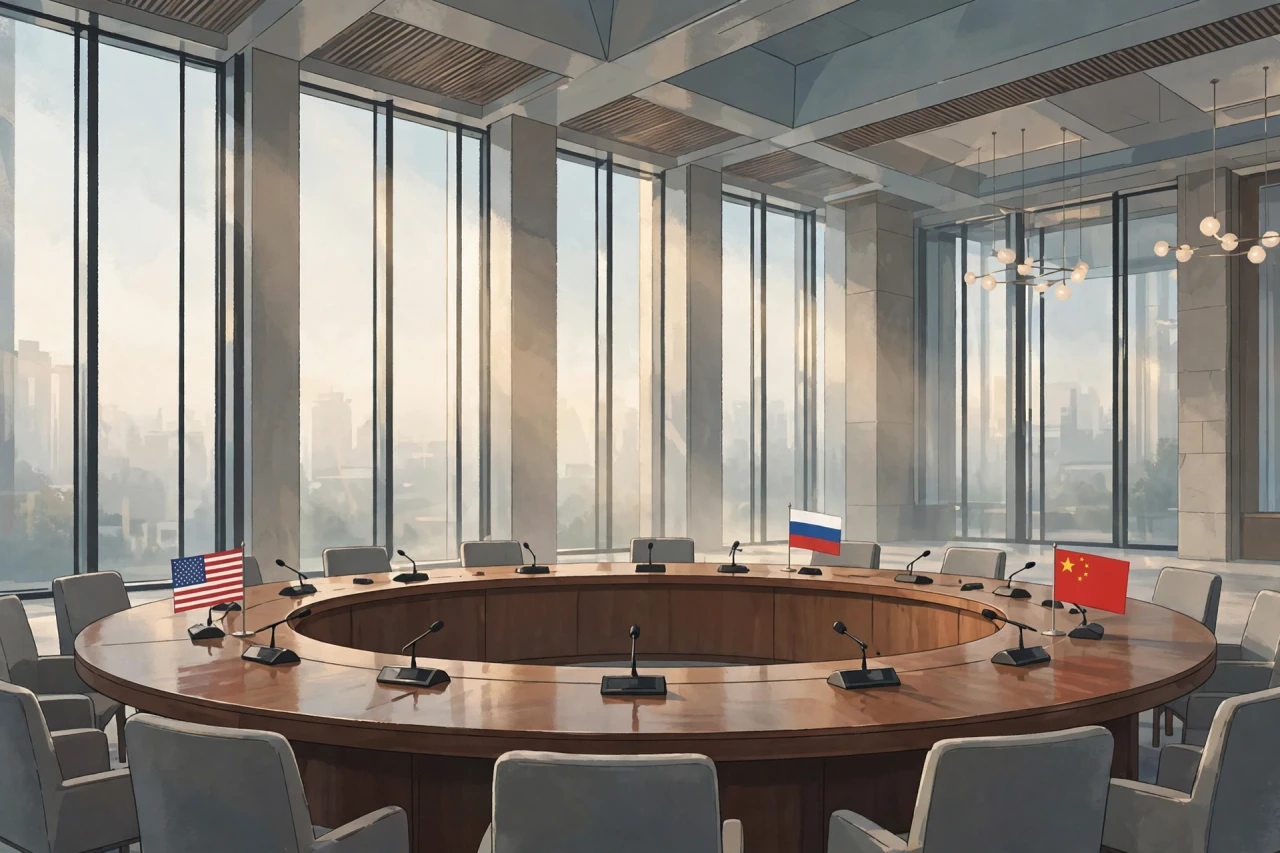
Illustration: a summit table set for three leaders, with the flags of the United States, Russia and China.
What Happened
The proposal emerged from nearly three hours of talks on October 21, 2026, between Putin and US special envoy Steve Witkoff at the Konstantin Palace in St. Petersburg — Witkoff's ninth in-person meeting with the Russian president. Kremlin aide Yury Ushakov said afterward that Putin had raised the idea of the three-way meeting with Witkoff and described it as potentially "historic," noting it would be the first meeting of the three leaders in this format. Ushakov added that Beijing had begun preparations, though he stressed that "much, if not everything, depends on the Chinese hosts of the summit."
Trump has previously expressed openness to three-way talks, suggesting nuclear disarmament — rather than primarily Ukraine — should top the agenda. Putin offered during the St. Petersburg meeting to support Washington in managing the conflict with Iran and said Russia could take in the enriched uranium held by Tehran, according to Russian media reports. China's response has been cautious: Foreign Ministry spokesperson Mao Ning said she had no information about the proposed meeting, while adding that Beijing would continue encouraging peace negotiations.
Background
The proposal follows months of fitful diplomacy. Three rounds of Ukraine-Russia-US negotiations earlier in 2026 — two in Abu Dhabi in January and February, and one in Geneva in February — produced little beyond prisoner-of-war exchanges. Putin and Trump last met in person at a summit in Anchorage, Alaska, in August 2025, and spoke by phone on October 9, a call that also produced a US deal involving Russian diesel exports and an executive order easing some sanctions on Moscow. Trump and Xi have met twice in 2026 — in Beijing in May and at the White House in September — while Putin and Xi have held regular talks, including on the sidelines of the Shanghai Cooperation Organization summit in Bishkek in August.
Ahead of the Shenzhen proposal, the Kremlin said Moscow was in principle ready to resume trilateral Ukraine-Russia-US technical negotiations in mid-November — after November 10 — possibly in Abu Dhabi, focused on post-war security arrangements for Russia and Ukraine. Russian investment envoy Kirill Dmitriev attended the St. Petersburg session, and Trump's son-in-law Jared Kushner joined remotely.

Illustration: diplomats at the negotiating table as talks over Ukraine's future gather pace.
Why It Matters
A meeting of the leaders of the United States, Russia and China would be an extraordinary diplomatic event — and an extraordinary risk. For Moscow, the format offers recognition as a major power and a chance to seek a Ukraine settlement favorable to Russia. For Trump, it is a stage for his stated priority of nuclear disarmament talks. Analysts cited by regional outlets, however, doubt Beijing wants to take responsibility for Ukraine's future: China would likely prefer a symbolic role, preserving its freedom to respond to later developments rather than committing to enforce a settlement or pressure Moscow.
The pushback was immediate. Ukrainian President Volodymyr Zelensky, speaking in Oslo on October 20, said the three leaders could decide for themselves whether to meet — but insisted that negotiating over Ukrainian territory, security and sovereignty requires Ukraine's participation. Ukrainian Foreign Minister Andrii Sybiha warned that a trilateral meeting excluding Kyiv would only encourage Moscow to continue the war. European governments echoed the concern that decisions made in Shenzhen could affect their security and their support for Ukraine. Analysts also note the stakes of parallel US actions: Trump has pressed Kyiv and European partners while offering Moscow concessions, and a summit that sidelines Ukraine could harden Russia's maximalist demands rather than soften them.
What Happens Next
The calendar is crowded. The APEC summit in Shenzhen on November 18-19 is the proposed venue, with the Kremlin aiming for trilateral technical talks in Abu Dhabi in mid-November as a possible prelude. Watch three signals: whether China confirms the three-way meeting and on what terms, what comes out of the Witkoff channel's next round, and how Ukraine and European capitals respond to being asked to accept a format they did not design. No final agreement on the leaders' meeting — its format, agenda or participants — has been announced. For now, the proposed summit remains a diplomatic possibility rather than a scheduled event, and the gap between Moscow's ambitions and Beijing's caution will decide whether Shenzhen becomes the setting for a historic encounter or another missed connection.

Illustration: the Shenzhen skyline at dusk — the proposed setting for the leaders' meeting in November.
Sponsored: explore today's featured sponsored offers
FAQ
What is the proposed Trump-Putin-Xi summit?
Vladimir Putin proposed to US envoy Steve Witkoff on October 21, 2026, that he, Donald Trump and Xi Jinping meet on the sidelines of the APEC summit in Shenzhen, China, on November 18-19. The Kremlin described it as potentially "historic" — the first meeting of the three leaders in this format.
Has the summit been confirmed?
No. No final agreement on the meeting, its format, agenda or participants has been announced. China has been cautious — its Foreign Ministry said it had no information about the proposal — and much depends on Beijing as the APEC host.
What would the leaders discuss?
Trump has suggested nuclear disarmament should be the focus. Moscow hopes to discuss ending the war in Ukraine on terms favorable to Russia, and Putin also offered to help Washington on the Iran conflict, including taking in Iran's enriched uranium. Ukraine and Europe fear the war could be decided without Kyiv.
Why does Ukraine oppose the format?
President Zelensky and Foreign Minister Sybiha insist that any negotiations over Ukrainian territory, security and sovereignty require Ukraine's participation, and warn that a summit excluding Kyiv would encourage Moscow to continue the war. European governments share the concern about their own security.
What else was agreed at the Witkoff-Putin talks?
The Kremlin said Moscow was in principle ready to resume trilateral Ukraine-Russia-US technical negotiations in mid-November, possibly in Abu Dhabi, focused on post-war security arrangements. It was Witkoff's ninth in-person meeting with Putin, with Kirill Dmitriev attending and Jared Kushner joining remotely.
Sources
- Reuters — "US, South Korean officials see little chance of Trump-Kim meeting this year," October 23, 2026
- Informat.ro — "Vladimir Putin proposed a summit with Donald Trump and Xi Jinping in November," October 21, 2026
- Asia Daily — "Proposed Trump-Putin-Xi Summit Puts China's Role and Europe's Influence Under Scrutiny," October 21, 2026
- QNC News — "Putin Says He Could Meet Trump in China During Witkoff Talks in St Petersburg," October 22, 2026; "EU Leaders Extend November Summit to Weigh 70 Billion Euro Ukraine Package," October 22, 2026
- NewsBeep — "Trilateral Ukraine talks: What's in it for China?" October 22, 2026
- The 21st Century (21cir.com) — "Putin, Xi and Trump Could Hold 'Historic Summit' — Kremlin," October 22, 2026
- Chinese Foreign Ministry — spokesperson Mao Ning's regular press conference, October 21, 2026
Comments
Post a Comment