
LIVERPOOL — Giving radiotherapy after surgery for a type of brain tumour called atypical meningioma can halve the risk of the tumour returning, according to results from a major international clinical trial announced this week and published in The Lancet, providing the strongest evidence to date that patients with completely resected tumours should be offered radiotherapy rather than observation alone.
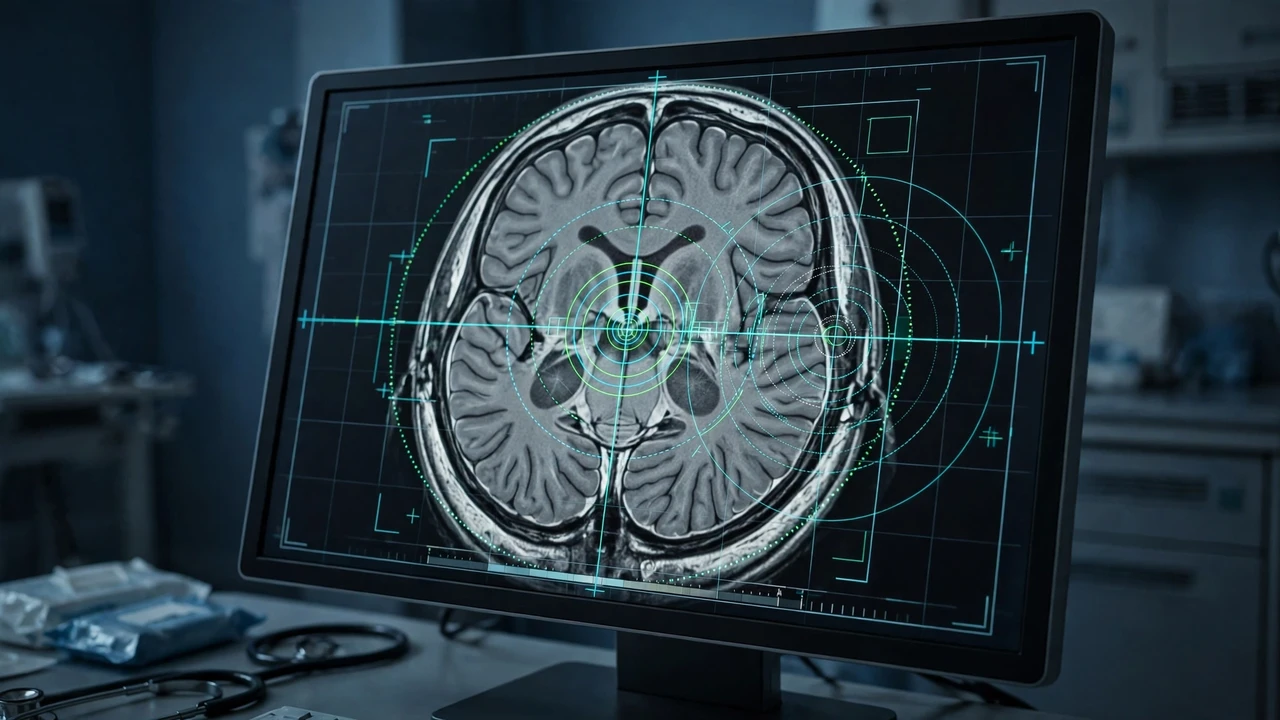
Illustration: A brain MRI scan with a radiotherapy targeting overlay. The ROAM trial tested radiotherapy after complete surgical removal of atypical meningioma. (AI-generated illustration)
What Happened
Results from the ROAM/EORTC-1308 trial, presented at the 21st Annual Meeting of the European Association of Neuro-Oncology (EANO 2026) and published in The Lancet, could change treatment for patients with atypical meningioma, The Walton Centre NHS Foundation Trust announced this week. The trial was led by The Walton Centre and the University of Liverpool.
Between 2016 and 2021, 157 patients were randomly assigned to receive either radiotherapy or observation following complete surgical removal of their tumour. After a median five-year follow-up, 35 participants had their brain tumour recur — 14% in the radiotherapy group compared with 30% in the observation group. At five years, around 80% of patients who received radiotherapy remained free of recurrence, compared with around 60% of those who underwent observation alone.
Crucially, there were no differences between the groups in terms of health-related quality of life and neurocognitive function, and there was minimal serious radiation toxicity, according to the findings. The study was awarded "EANO Best Oral Presentation for Clinical Research" at the EANO annual meeting in September 2026.
Illustration: A modern hospital radiotherapy treatment suite. The trial found radiotherapy halved recurrence risk without harming quality of life. (AI-generated illustration)
Background
Meningiomas are the commonest primary brain tumour, and up to 2,000 people undergo surgery each year in the UK alone. Atypical meningiomas account for around a quarter of meningiomas and are more likely to return than lower-grade meningiomas. Until now, there has been uncertainty about whether patients should receive radiotherapy immediately after surgery or instead be monitored with regular brain scans and treated only if the tumour comes back.
ROAM/EORTC-1308 is the first randomised controlled trial evaluating the role of radiotherapy compared with observation for reducing the risk of recurrence in patients who have undergone complete resection of atypical meningioma. It was carried out in 11 countries around the world as a collaboration between the University of Liverpool, The Walton Centre NHS Foundation Trust, the European Organisation for Research and Treatment of Cancer (EORTC), and the Trans Tasman Radiation Oncology Group (TROG Cancer Research). The trial was coordinated and analysed by the Liverpool Clinical Trials Centre, and funded by the National Institute for Health and Care Research Health Technology Assessment Programme, the EORTC Brain Tumour Group and Radiation Oncology Group, and the National Health and Medical Research Council of Australia.
Chief investigator and first author, neurosurgeon Professor Michael Jenkinson of The Walton Centre and the University of Liverpool, said the trial tackles a question debated for many years: "I'm proud that our team has been able to generate robust evidence that can help patients and clinicians make better-informed decisions." Professor Damien Weber, radiotherapy co-lead at the Paul Scherrer Institute in Villigen, Switzerland, added: "ROAM provides the first randomised evidence that early radiotherapy substantially reduces the risk of the tumour returning."
Why It Matters
For patients, a tumour recurrence can mean further surgery, further treatment and considerable anxiety — so a treatment that halves that risk without damaging quality of life or thinking skills is a meaningful advance. The findings are expected to inform how neuro-oncology teams around the world counsel patients after complete resection of an atypical meningioma, ending years of genuine clinical uncertainty.
The trial also matters beyond meningioma: it demonstrates that long-running, multinational randomised trials can answer practical questions in neuro-oncology where observational data has left doctors guessing. With brain tumours remaining a major challenge for patients, families and clinicians, researchers say robust evidence of this kind is exactly what is needed to change clinical practice.
Illustration: An international neurosurgery research team reviewing trial results. ROAM was carried out in 11 countries with 157 patients. (AI-generated illustration)
What Happens Next
The researchers say the findings should now inform discussions about treatment following complete resection of an atypical meningioma — meaning patients and their clinicians can weigh a clear, quantified benefit against minimal demonstrated harm. Medical guideline bodies in the UK, Europe and beyond will now consider whether to formalise that advice in updated treatment recommendations.
Longer-term follow-up of the ROAM participants will continue, and researchers are expected to examine whether the benefit holds over even longer periods and across subgroups — but for now, the trial has delivered the answer neuro-oncologists have been waiting for.
Sponsored: explore today's featured sponsored offers
FAQ
What is atypical meningioma?
Atypical meningioma is a type of meningioma — the commonest primary brain tumour. Atypical meningiomas account for around a quarter of meningiomas and are more likely to return after surgery than lower-grade meningiomas.
What did the ROAM trial find?
The ROAM/EORTC-1308 trial found that radiotherapy after complete surgical removal of atypical meningioma halved the risk of the tumour returning: 14% recurred in the radiotherapy group versus 30% in the observation group, with around 80% versus 60% recurrence-free at five years.
Did radiotherapy cause serious side effects?
According to the trial findings, there were no differences between the groups in health-related quality of life and neurocognitive function, and there was minimal serious radiation toxicity.
Who led the trial?
The trial was led by The Walton Centre and the University of Liverpool, with chief investigator Professor Michael Jenkinson and radiotherapy co-lead Professor Damien Weber of the Paul Scherrer Institute in Switzerland. It ran in 11 countries with the EORTC and TROG Cancer Research.
Will this change treatment for patients?
The researchers say the results provide the strongest evidence to date that patients with completely resected atypical meningioma should be offered radiotherapy rather than observation alone, and the findings should now inform treatment discussions and future guidelines.
Sources
- The Walton Centre NHS Foundation Trust, October 2026 — "Radiotherapy halves the risk of brain tumour returning after surgery, major UK-led trial finds"
- The Lancet, 2026 — ROAM/EORTC-1308 study (Radiation versus Observation following surgical resection of Atypical Meningioma)
- European Association of Neuro-Oncology, EANO 2026 — 21st Annual Meeting
Comments
Post a Comment