
Romania Ends Six Months of Political Deadlock as Parliament Confirms Luca Niculescu as Prime Minister
Romania's parliament confirmed Luca Niculescu as the country's new prime minister on October 20, 2026, ending nearly six months of political deadlock that had weighed on the European Union member state's investment-grade rating and investor confidence.
The 55-year-old independent won a parliamentary vote of confidence with 280 votes, comfortably above the 233 required, and will lead a minority government of leftists and technocrats tasked with tackling one of the EU's largest budget deficits and a contracting economy.
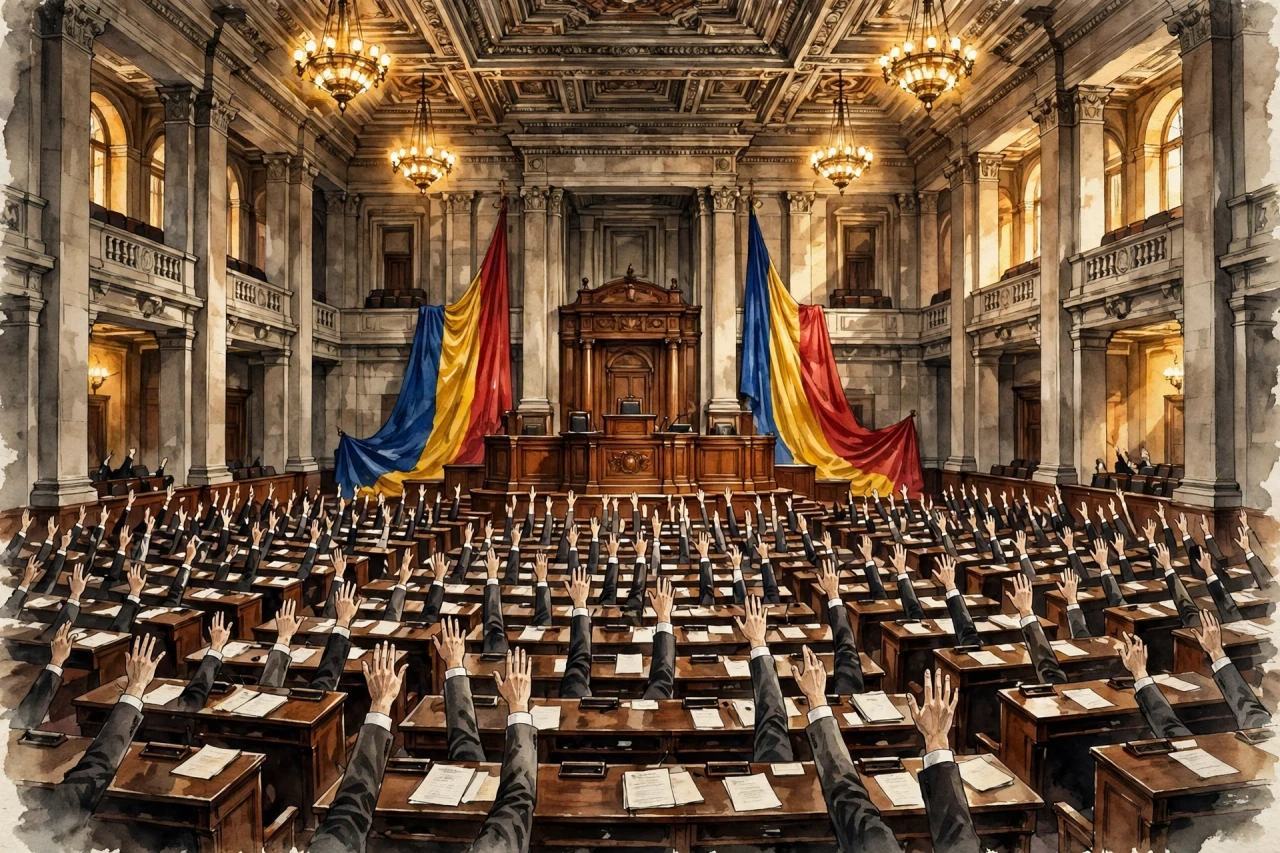
Illustration: a parliament chamber vote with raised hands and national flags.
What Happened
According to Reuters reporting on October 20, 2026, independent Luca Niculescu was confirmed as Romania's prime minister by parliament on Tuesday, after putting together a minority government of leftists and technocrats following his nomination by centrist President Nicușor Dan.
It was President Dan's fourth attempt to install a government in the NATO and EU member state since a pro-European broad coalition cabinet collapsed in early May, leaving Romania without a fully empowered executive for nearly half a year.
Niculescu, who has served as a diplomat and deputy foreign minister and was formerly a journalist, secured 280 votes in parliament — well above the 233 needed for confirmation. Ahead of the vote he told lawmakers: "I am not asking for a blank check. I am asking you to understand Romania needs a government with full powers after so many months of crisis."
Background
Romania, one of the European Union's largest eastern members and a NATO ally on the Black Sea, has been mired in political instability since the spring. The collapse of the pro-European broad coalition cabinet in early May set off a prolonged period of caretaker governance, during which the country lacked a government with full powers to pass budgets, cut spending or reassure markets.
The deadlock put pressure on Romania's investment-grade sovereign rating and dented investor confidence, Reuters reported, at a time when the country is wrestling with one of the EU's largest budget deficits and a contracting economy.
President Nicușor Dan, a centrist, went through three failed attempts to install a government before Niculescu's nomination succeeded. The new premier is an independent without a party power base — a former diplomat and deputy foreign minister who also worked as a journalist earlier in his career — which may explain both his acceptability across the political divide and the fragility analysts see in his position.
His mandate is heavily economic. Romania must make further cuts to close one of the bloc's widest fiscal gaps, eliminate an additional turnover tax on companies, and raise pensions that have been frozen for two years amid fiscal constraints.
The prolonged vacuum also left Bucharest struggling to speak with one voice inside EU and NATO forums at a sensitive moment — with the war in Ukraine continuing on Romania's border, alliance summitry and EU budget negotiations have both needed a fully empowered Romanian government at the table.

Illustration: a government leader silhouette before a waving Romanian flag.
Why It Matters
A functioning government in Bucharest matters well beyond Romania's borders. The country sits on NATO's eastern flank, shares a long border with Ukraine, and is a key EU economy in southeastern Europe — its stability is a European concern.
The months-long vacuum had concrete costs: policy paralysis on the deficit, frozen pensions for vulnerable citizens, and the slow erosion of investor confidence in an economy already contracting. Ending the deadlock with a confirmed government — even a minority one — gives markets and EU institutions a clear interlocutor again.
Politically, the choice of an independent diplomat-technocrat signals an attempt to keep the administration above the partisan fray that collapsed the previous coalition. But minority governments live or die on ad hoc parliamentary support, and analysts cited by Reuters warned that Niculescu's cabinet could be short-lived if it loses the backing of the parties that confirmed it.
His own words before the vote captured the fragility: he was not asking for a "blank check," but for parliament to acknowledge that "Romania needs a government with full powers after so many months of crisis."
What Happens Next
The immediate test is economic. Niculescu must try to make further cuts to one of the EU's largest budget deficits while propping up a contracting economy — two goals that frequently pull in opposite directions. Eliminating the extra turnover tax on companies and unfreezing pensions will both require legislation and fiscal room he does not yet have.
Market watchers will be watching Romania's sovereign rating reviews and bond spreads for signs that the new government is restoring confidence. A credible budget and deficit-reduction path could stabilise investor sentiment; failure could put the investment-grade rating under fresh pressure.
On the political front, the durability of the minority government will be tested at the first contentious parliamentary vote. Each of the parties and technocrat factions supporting Niculescu could withdraw backing, and a short-lived government would return Romania to the very deadlock it has just escaped.
Meanwhile, Bucharest's return to full-capacity government will be watched by EU partners assessing Romania's reliability in regional security arrangements, and by ratings agencies deciding whether the investment-grade status that survived the deadlock can withstand the fiscal adjustment ahead.

Illustration: a neoclassical government building in Bucharest at dusk.
Sponsored: explore today's featured sponsored offers
FAQ
Who is Romania's new prime minister?
Luca Niculescu, a 55-year-old independent, former diplomat and deputy foreign minister, and formerly a journalist. Parliament confirmed him on October 20, 2026, with 280 votes.
Why was Romania without a full government for six months?
A pro-European broad coalition cabinet collapsed in early May 2026, and President Nicușor Dan needed four attempts to install a successor government, leaving Romania under caretaker arrangements without full executive powers.
What kind of government will Niculescu lead?
A minority government of leftists and technocrats. Political analysts note such governments can be short-lived, since they depend on shifting parliamentary support.
What are Romania's biggest economic challenges?
According to Reuters, Romania has one of the EU's largest budget deficits and a contracting economy. The new government must cut spending further, eliminate an additional company turnover tax, and raise pensions frozen for two years.
Why does Romania's political stability matter internationally?
Romania is a NATO and EU member on the alliance's eastern flank, bordering Ukraine. Its stability affects regional security, EU cohesion and investor confidence in southeastern Europe.
Sources
- Reuters (October 20, 2026): Romanian parliament confirms new prime minister after months of deadlock
Comments
Post a Comment