
Qatar Museums will open the first edition of Rubaiya Qatar, a new international visual arts quadrennial, in Doha on November 21, 2026, bringing together more than 120 artists from over 45 countries in what organizers describe as the Gulf state's most ambitious contemporary art project to date. Running through April 30, 2027, the nationwide event features more than 45 new commissions exploring water, global ecology and the maritime histories that link Qatar and the Gulf with the wider world.
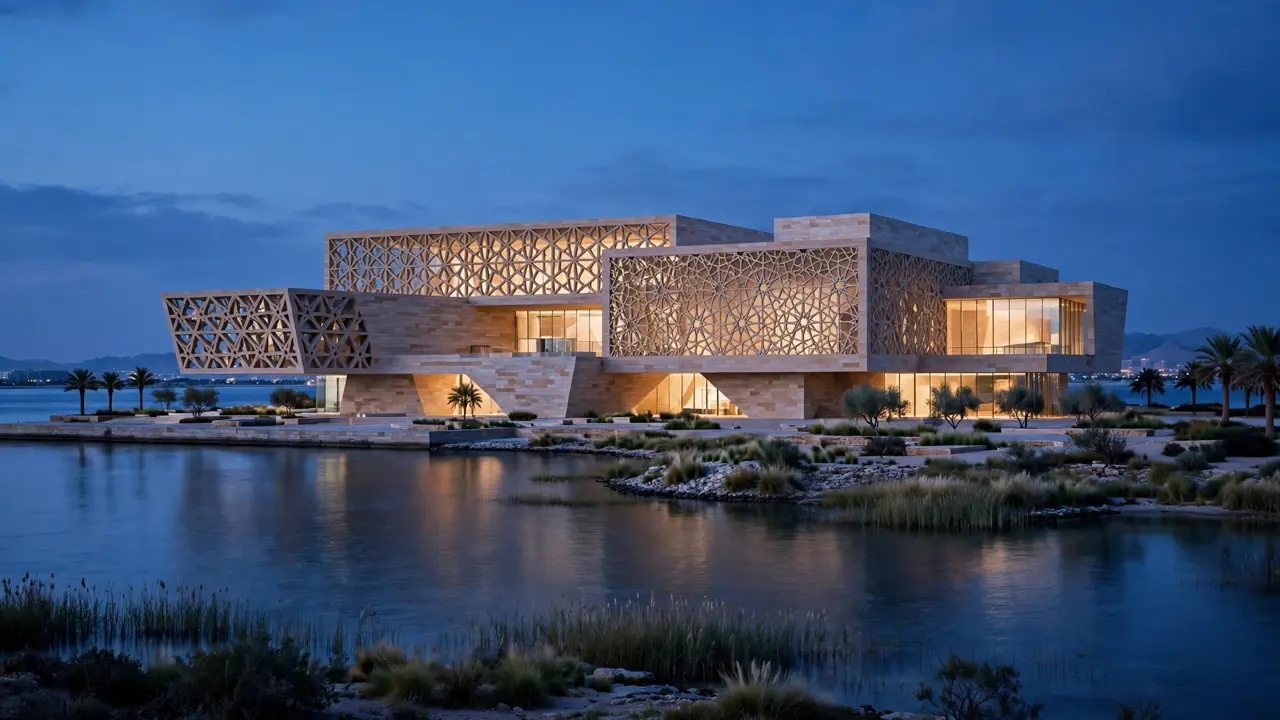
Illustration: a modern art museum in Doha at dusk. This is an AI-generated illustration, not a real photograph.
What Happened
Qatar Museums announced the exhibitions and events programme for the inaugural edition of Rubaiya Qatar on October 13, 2026, via the Qatar News Agency, and revealed the full participating artist lineup on October 21, according to FAD Magazine. The quadrennial is organized by ALRIWAQ Arts + Architecture under the patronage of Sheikha Al Mayassa bint Hamad Al-Thani, Chairperson of Qatar Museums, and is directed by Sheikha Al Anoud Al-Thani. Sheikha Reem Al-Thani, Deputy CEO of Qatar Museums for ALRIWAQ, Public Art and Rubaiya Qatar, has emphasized the initiative's role in fostering artistic research and long-term production.
The first edition unfolds across the newly renovated ALRIWAQ Arts + Architecture, the Museum of Islamic Art and MIA Park, Katara QM Gallery, Mathaf: Arab Museum of Modern Art and public sites across Qatar. Its headline exhibition, Unruly Waters, opens November 21 at ALRIWAQ with additional presentations at the Museum of Islamic Art. Two companion exhibitions — Our Common Currents at Katara QM Gallery and Seething Sea at Mathaf — open November 22. A series of major public art commissions will also appear across the country.
The curatorial frame is water in all its dimensions: ocean currents, seasonal winds and maritime trade routes as shapers of civilization; water's political and economic significance; and the Gulf's own seafaring heritage, from pearl diving to the desalination plants that sustain modern life in the region.
Background
Rubaiya Qatar is the culmination of two decades of investment in arts and education by Qatar, and forms part of the Evolution Nation campaign celebrating the country's fifty-year cultural journey. Since Qatar Museums was established, Doha has accumulated a portfolio of starchitect-designed institutions — the Museum of Islamic Art, the National Museum of Qatar and Mathaf — alongside the Fire Station artist-in-residence programme. The quadrennial format, following the model of recurring mega-exhibitions in Venice, Istanbul and Gwangju, is designed to give Doha a permanent fixture on the international contemporary art calendar rather than one-off blockbuster shows.
The timing reflects a crowded season in the Gulf art world. Art Basel is scheduled to hold a fair in Qatar next February, directed by artist Wael Shawky, who is also curating the Artists Intensive Study Programme exhibition at the Fire Station opening November 6, 2026, with 23 artists. A new museum dedicated to the Indian artist Maqbool Fida Husain is also expected to open in Doha later this month. Rubaiya Qatar's November opening deliberately seeds the run-up to these events, anchoring the winter cultural season.
The name of the quadrennial itself signals intent: the organizers describe it as a platform to bring contemporary art from the region — and perspectives from outside traditionally dominant Western art markets — to global audiences, with non-Western viewpoints placed at the center of the curatorial vision.
Why It Matters
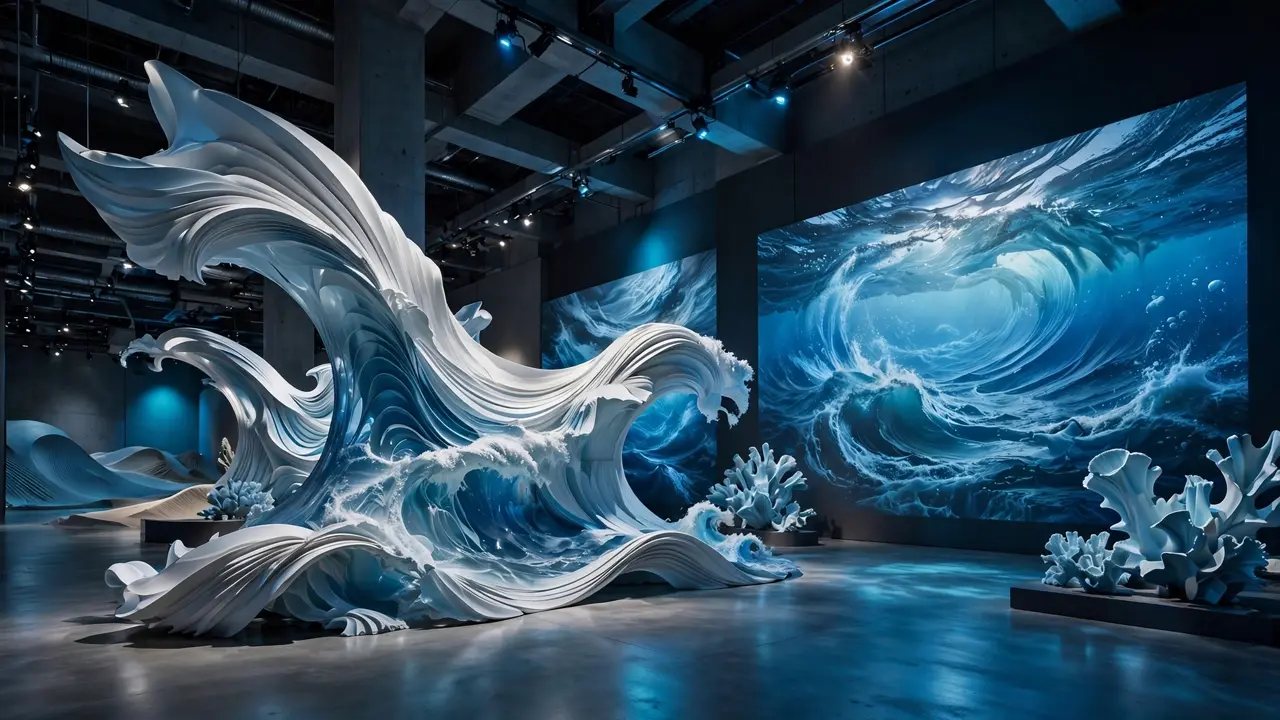
Illustration: an exhibition hall with ocean-themed contemporary art installations. This is an AI-generated illustration, not a real photograph.
New recurring biennials and quadrennials have become one of the most effective instruments of cultural soft power: they attract collectors, critics and tourists, commission work that remains in public collections, and broadcast a nation's image as a center of ideas rather than only commerce. For Qatar, whose international profile has long been tied to energy, sports and diplomacy, Rubaiya Qatar is the clearest bid yet to be taken seriously as a patron of contemporary thought — on the Gulf's own terms, with curatorial leadership drawn largely from the region.
The water theme is strategically astute. It connects Qatar's pearl-diving past to urgent contemporary questions — rising seas, desalination dependence, and the ecology of the Gulf — without requiring the didactic tone that has weighed down some recent large exhibitions. The inclusion of historical artefacts, notably objects recovered from the 10th-century Cirebon shipwreck discovered off the Indonesian island of Java, bridges the ancient Maritime Silk Road and today's ecological urgencies: a thousand years of Indian Ocean trade told in a single gallery sequence.
The artist roster also matters. The Unruly Waters lineup includes Lawrence Abu Hamdan, Sophia Al Maria, Alia Farid, Ayoung Kim, Charles Lim, Yuko Mohri and Cao Fei — figures with genuine international followings — alongside emerging artists, which gives the debut edition curatorial credibility beyond the region. Curators Tom Eccles, Ruba Katrib, Shabbir Hussain Mustafa and Mark Rappolt bring institutional weight from New York, London and the region.
What Happens Next
The quadrennial opens November 21 with Unruly Waters at ALRIWAQ and the Museum of Islamic Art, featuring more than 30 newly commissioned works. Our Common Currents, curated by Lina Patmali, opens the following day at Katara QM Gallery with 12 international artists and collectives and four new commissions — including a sculptural installation and courtyard garden by Taloi Havini, an environmental installation by the Greek collective Latent Community, and a film by Miguel Fernández de Castro examining the connections between Arabian horses, desalination and salt. Also on November 22, Seething Sea, curated by Wadha Al Aqeedi, opens at Mathaf with more than 80 artworks by over 50 artists exploring the Gulf's relationship with the sea through folklore, religion, traditional crafts and regional artistic practices.
The programme extends well beyond gallery walls: public art unveilings, performances, educational initiatives, artist residencies and events will run through April 30, 2027. Works by artists including Jitish Kallat and Minerva Cuevas are expected to transform public spaces across the country. Qatar Museums has also announced that the Fire Station's artist residency exhibition, curated by Wael Shawky, opens November 6, 2026 — effectively making November a month-long launch of Qatar's winter cultural season.
Art Basel's arrival in Doha next February, also directed by Shawky, will be the first major commercial test of the ecosystem Rubaiya Qatar is building. If the quadrennial delivers on attendance and critical reception, it is likely to be renewed as a permanent four-year cycle — joining Venice, Istanbul and Sharjah on the map of the world's defining recurring exhibitions.
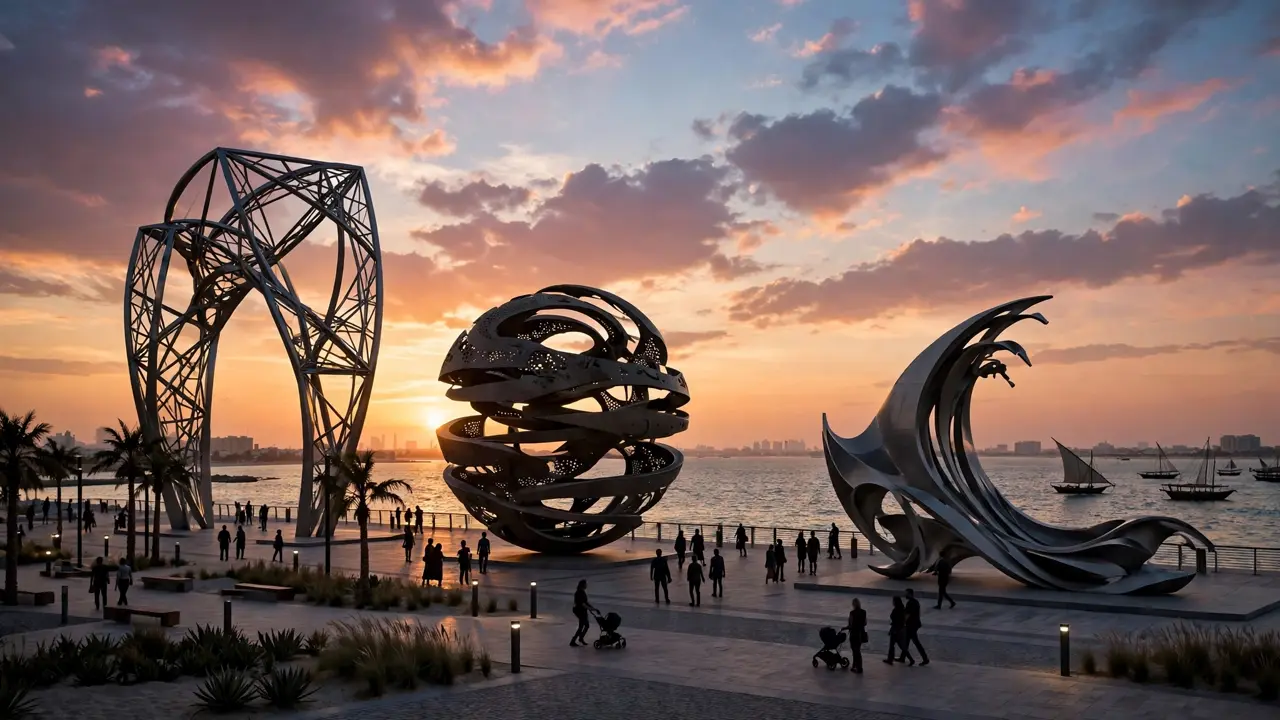
Illustration: public art sculptures along a Gulf waterfront at sunset. This is an AI-generated illustration, not a real photograph.
Sponsored: explore today's featured sponsored offers
FAQ
What is Rubaiya Qatar?
Rubaiya Qatar is a new international visual arts quadrennial in Doha, Qatar, organized by Qatar Museums through ALRIWAQ Arts + Architecture. The inaugural edition runs from November 21, 2026 to April 30, 2027, bringing together more than 120 artists from over 45 countries with more than 45 new commissions.
When and where does it open?
The quadrennial opens November 21, 2026, with its headline exhibition Unruly Waters at ALRIWAQ Arts + Architecture and the Museum of Islamic Art. Two companion shows — Our Common Currents at Katara QM Gallery and Seething Sea at Mathaf: Arab Museum of Modern Art — open November 22, with public art installations across Qatar.
What is the theme of the first edition?
The inaugural edition explores global ecology and the political, economic and cultural significance of water, along with the maritime histories connecting Qatar and the Gulf with the wider world — from pearl diving and trade routes to desalination and rising seas.
Who is organizing and curating it?
The quadrennial is presented by Qatar Museums under the patronage of Chairperson Sheikha Al Mayassa bint Hamad Al-Thani and directed by Sheikha Al Anoud Al-Thani. Unruly Waters is curated by Tom Eccles, Ruba Katrib, Shabbir Hussain Mustafa and Mark Rappolt; Our Common Currents by Lina Patmali; and Seething Sea by Wadha Al Aqeedi.
Which artists are participating?
Participating artists include Bani Abidi, Lawrence Abu Hamdan, Sophia Al Maria, Alia Farid, Ayoung Kim, Charles Lim, Yuko Mohri and Cao Fei, alongside many emerging artists and regional practitioners. The programme mixes newly commissioned contemporary works with historical artefacts such as objects from the 10th-century Cirebon shipwreck.
Sources
- Qatar News Agency (QNA) — "Qatar Museums to Launch First Rubaiya Qatar Visual Arts Quadrennial on Nov. 21," October 13, 2026
- FAD Magazine — "Qatar Museums reveals 120+ artists for inaugural Rubaiya Qatar Quadrennial," October 21, 2026
- FTN News — "Qatar's New Art Festival Reveals More Than 120 Artists," October 2026
- Business Arabia Qatar — "Qatar Museums Announces Rubaiya Qatar Visual Arts Quadrennial," October 2026
- ArtDaily — "Qatar Museums announces fall 2026 exhibitions programme"
- Artsy — "New quadrennial, Rubaiya Qatar, announced for 2026," November 2025
Comments
Post a Comment