
UNITED NATIONS, 31 October 2026 — Russia on Friday vetoed a United States-drafted United Nations Security Council resolution on Western Sahara, blocking Washington's plan to reshape the UN peacekeeping mission in the disputed territory and leaving the mission's future uncertain on the eve of its mandate expiring. The veto, reported by Reuters on 30 October 2026, followed an unusual showdown among major powers over a file long considered procedurally routine, and it came on the same day Russia circulated a rival text that would simply have extended the mission for another year without the changes sought by the United States.
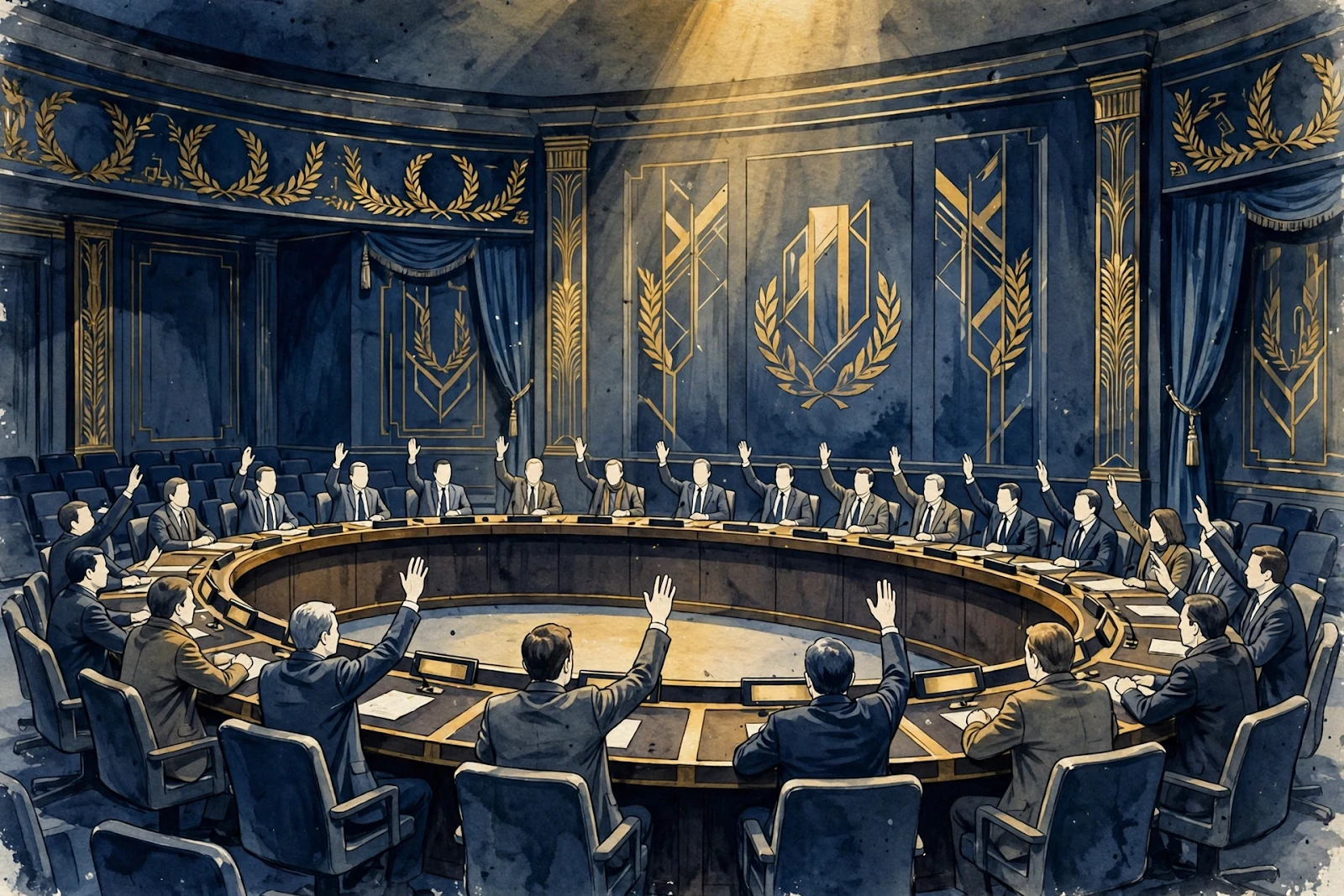
Illustration: The UN Security Council chamber during a vote on Western Sahara, in stylised editorial illustration form.
What Happened
On Friday 30 October 2026, the Security Council considered a US-drafted resolution on Western Sahara, according to Reuters reporting by Antoni Slodkowski and Ahmed Eljechtimi. The draft would have scaled back the military component of the United Nations Mission for the Referendum in Western Sahara, known as MINURSO, and cemented Morocco's autonomy plan as the only basis for negotiating a political settlement to the half-century-old conflict.
Russia vetoed the draft. As a permanent member of the Security Council, Russia's negative vote was sufficient to block the resolution, even though the precise voting alignment beyond the veto itself was not the central point of the reporting provided for this article. The veto therefore stopped the US text from being adopted, and with it stopped the changes Washington had proposed to the mission's shape and to the stated basis for negotiations.
Russia circulated a rival resolution the same day, according to the same reporting. That rival text would simply have extended MINURSO's mandate for another year, without the changes Washington sought. The existence of two competing texts on the same day underlined how far the Council had moved from its usual handling of this file. For years, renewals of the Western Sahara mission had been treated as largely routine business. This time, the Council was divided over both the mission's future form and the political framework within which a settlement should be negotiated.
The US draft, as reported, went beyond a simple renewal. By scaling back the military component of MINURSO, it would have altered the balance of a mission created to monitor a ceasefire and organise a referendum. By cementing Morocco's autonomy plan as the only basis for negotiations, it would have narrowed the negotiating framework in a way that mattered deeply to all parties to the dispute. Those two elements — the mission's composition and the basis for talks — were at the heart of the disagreement that produced the veto.
Reports ahead of the vote had also said the US draft envisaged renaming the mission, dropping the referendum reference, and reshaping it toward a political mission. Those details are presented here as reported, not as confirmed elements of an adopted resolution, because the draft was vetoed and did not become Council policy. The distinction matters: what was proposed is not the same as what was agreed, and the veto means the proposed changes did not take effect through this resolution.
The timing added to the stakes. MINURSO's mandate expires on 31 October 2026, the day after the veto. The Council therefore faced not only a disagreement about the future direction of the mission, but also an immediate deadline. A veto on the eve of expiry does not by itself end the mission, but it leaves the question of what comes next unresolved at the very moment a decision is most urgently needed.
Background
MINURSO was created in 1991 to monitor a ceasefire and organise a referendum that never happened. Disputes over voter eligibility prevented the referendum from taking place, and the mission has remained in place ever since, monitoring the ceasefire and supporting the search for a political settlement. Its long presence reflects both the durability of the ceasefire arrangements and the absence of an agreed political outcome.
The most recent renewal before this week's vote was Security Council Resolution 2797, adopted on 31 October 2025. That resolution renewed MINURSO through 31 October 2026. It backed negotiations taking as basis Morocco's Autonomy Proposal, and it said genuine autonomy could be the most feasible outcome, while also calling for a solution providing for self-determination of the people of Western Sahara. Resolution 2797 passed by 11 votes to none, with China, Pakistan and Russia abstaining and Algeria not participating.

Illustration: A desert landscape in Western Sahara with a UN peacekeeping patrol, in stylised editorial illustration form.
Morocco submitted its autonomy plan in 2007. Under the plan, domestic affairs would be managed locally, while Rabat would retain responsibility for defence, foreign relations and sovereignty. Morocco has presented autonomy as a realistic and workable basis for settling the dispute, and the language of Resolution 2797 reflected that position in part, while retaining the reference to self-determination.
The Polisario Front, backed by Algeria, seeks self-determination and independence for the Sahrawi people, and it has opposed abandoning the referendum. For the Polisario Front, the referendum was the original promise at the heart of the UN process, and any framework that removes it or treats autonomy as the only option raises fundamental questions about the future status of the territory and its people. That difference — between autonomy within Morocco and a vote on self-determination — has defined the dispute for decades.
Diplomacy continued right up to the vote. Morocco's Foreign Minister, Nasser Bourita, met Russia's Foreign Minister, Sergei Lavrov, in Moscow on 28 October 2026, ahead of the vote. The meeting illustrated the intensity of the diplomacy surrounding the renewal, with key capitals engaged directly in the days before the Council acted. It did not, in the end, produce agreement on the US draft, and Russia proceeded to veto it two days later.
The dispute itself is half a century old, and its history explains why even a renewal resolution can become contentious. The territory's status has never been settled by an agreed political process, the promised referendum never took place, and successive rounds of negotiation have not bridged the gap between autonomy and self-determination. Each renewal therefore carries not only the practical question of keeping peacekeepers in place, but also the political question of what framework the Council endorses for the talks that are supposed to resolve the dispute.
Why It Matters
The veto matters first because it leaves MINURSO's future in doubt at the moment its mandate runs out. A peacekeeping mission does not operate in a vacuum: its authority, its size, its tasks and its funding all depend on a Security Council mandate. When that mandate expires without a replacement, the Council must find a new path quickly, and the parties on the ground are left waiting to see what, if anything, will take its place.
It matters second because it reveals a sharp disagreement among major powers over the political framework for Western Sahara. The US draft would have cemented Morocco's autonomy plan as the only basis for negotiations. Russia's rival text would have extended the mandate without that change. The gap between those two positions is not a technical detail. It goes to the central question of the dispute: whether talks should proceed on the basis of autonomy alone, or on a broader basis that preserves the question of self-determination.

Illustration: Diplomats negotiating at United Nations headquarters, in stylised editorial illustration form.
It matters third because the file had long been treated as routine. When a subject that normally passes with limited controversy instead produces competing drafts and a veto, that is a signal in itself. It suggests that the consensus that sustained previous renewals, including Resolution 2797 in 2025, has frayed, at least for this round. It also raises the question of whether future renewals will become similarly contested, with each round reopening the political framework rather than simply extending the mission.
For the people of Western Sahara, the stakes are the most direct. The dispute is about their political future, and the framework the Council endorses shapes the negotiations that are meant to decide it. A framework centred solely on autonomy points in one direction; a framework that retains self-determination points in another. The veto does not settle that question, but it ensures that the question remains open — and that the mission charged with supporting the process is itself now the subject of urgent negotiation.
For the wider United Nations system, the episode is also a reminder of how the veto shapes Council action. A single permanent member can block a resolution, even when other members support it, and that power applies just as much to peacekeeping renewals as to more visibly dramatic crises. The result in this case is not a new policy, but a gap: the old mandate expiring, the proposed replacement blocked, and a rival proposal not adopted in its place.
What Happens Next
With the mandate expiring on 31 October 2026, the Council must find a new path. The options, in broad terms, include a fresh resolution, a short technical rollover that extends the mandate briefly while negotiations continue, or further negotiation aimed at bridging the gap between the positions that produced the veto. No outcome has been asserted here, because none has happened at the time of writing, and any of these paths would require agreement that was not reached on 30 October.
What happens next will depend on whether the Council can find language acceptable to the permanent members and to the parties most directly concerned. That may involve revisiting the question of the mission's composition, the question of the negotiating framework, or both. It may also involve a compromise that separates the practical question of keeping the mission in place from the political question of the framework for talks, allowing the former to proceed while the latter continues to be negotiated.
Observers will also watch for reactions from Morocco, the Polisario Front and Algeria, as well as from the United States and Russia, in the days after the veto. Their public positions may indicate whether a new text is likely soon, or whether the disagreement will persist into a longer negotiation. Until a new resolution is adopted, however, the central fact remains: the mandate has expired, the US draft has been vetoed, and the mission's future awaits a decision the Council has yet to make.
Sponsored: explore today's featured sponsored offers
FAQ
What did Russia veto on 30 October 2026?
Russia vetoed a US-drafted UN Security Council resolution on Western Sahara. The draft would have scaled back the military component of MINURSO and cemented Morocco's autonomy plan as the only basis for negotiating a political settlement.
What is MINURSO?
MINURSO is the United Nations Mission for the Referendum in Western Sahara. It was created in 1991 to monitor a ceasefire and organise a referendum that never happened because of disputes over voter eligibility.
When does MINURSO's mandate expire?
MINURSO's mandate expires on 31 October 2026, under Security Council Resolution 2797, adopted on 31 October 2025. The veto on 30 October 2026 came the day before that expiry.
What did Russia propose instead?
Russia circulated a rival resolution the same day that would simply have extended MINURSO's mandate for another year, without the changes Washington sought in its draft.
What happens next for Western Sahara?
The Council must find a new path, which could include a fresh resolution, a short technical rollover, or further negotiation. No outcome has been decided yet, and this article does not assert one.
Sources
Reuters, 30 October 2026 — report by Antoni Slodkowski and Ahmed Eljechtimi on Russia's veto of the US-drafted Security Council resolution on Western Sahara and Russia's rival resolution.
United Nations Security Council Resolution 2797, 31 October 2025 — background on the renewal of MINURSO through 31 October 2026, its negotiating language, and its adoption by 11 votes to none with China, Pakistan and Russia abstaining and Algeria not participating.
Reuters pre-vote background reporting — background on the reported elements of the US draft, including the reported proposal to rename the mission and reshape it toward a political mission, presented in this article as reported rather than confirmed.
Comments
Post a Comment