
BELGRADE — Serbia woke on Monday, October 26, 2026, to a new political era after a student-backed movement defeated longtime leader Aleksandar Vucic in a landslide parliamentary election, winning 52.7 percent of the vote and 139 of the 250 seats in parliament, according to the State Election Commission, with almost 99 percent of votes counted.
Tens of thousands of people took to the streets of Belgrade and other cities and towns after Vucic conceded defeat late on Sunday, capping two years of peaceful anti-government protests that had called for the populist ruler to step down. The result ends a period in which Vucic dominated Serbian politics as prime minister or president since 2014, and hands power to a movement that began on university campuses and has never governed before.

Illustration: A large crowd gathers outside a parliament building after an election result.
What Happened
With almost 99 percent of votes counted, the students' candidates secured a commanding 52.7 percent of the vote, the State Election Commission said, against 39.2 percent for Vucic's Serbian Progressive Party (SNS)-led alliance. That translated into 139 seats in the 250-seat parliament, leaving the SNS alliance with 97 seats and the remainder held by minority parties, Reuters reported on October 26, 2026.
Vucic conceded defeat late on Sunday, and celebrations spread across the country. "I thought it was unbelievable, I still do not believe it. It was too long, and (Vucic) was pressuring us for a long, long time," university administrator Marijana Radovanovic Pajovic told Reuters.
The scale of the win matters because it gives the student-backed list an outright parliamentary majority, rather than forcing it into a coalition negotiation from a position of weakness. A majority of 139 seats means the movement can, in principle, choose a prime minister and pass legislation without relying on the SNS or on minority parties. What it does not yet have is a settled answer to the most basic question of government: who, exactly, will lead it.
Reuters reported that the movement, whose candidates include university professors, actors and farmers, has no clear leaders, and that it is unclear who it will appoint as prime minister and to other key positions. That uncertainty is now the central drama of Serbian politics. The movement's domestic agenda, as reported by Reuters, aims to root out graft and improve schooling — goals that are easy to chant at a rally and difficult to turn into budgets, laws and appointments.
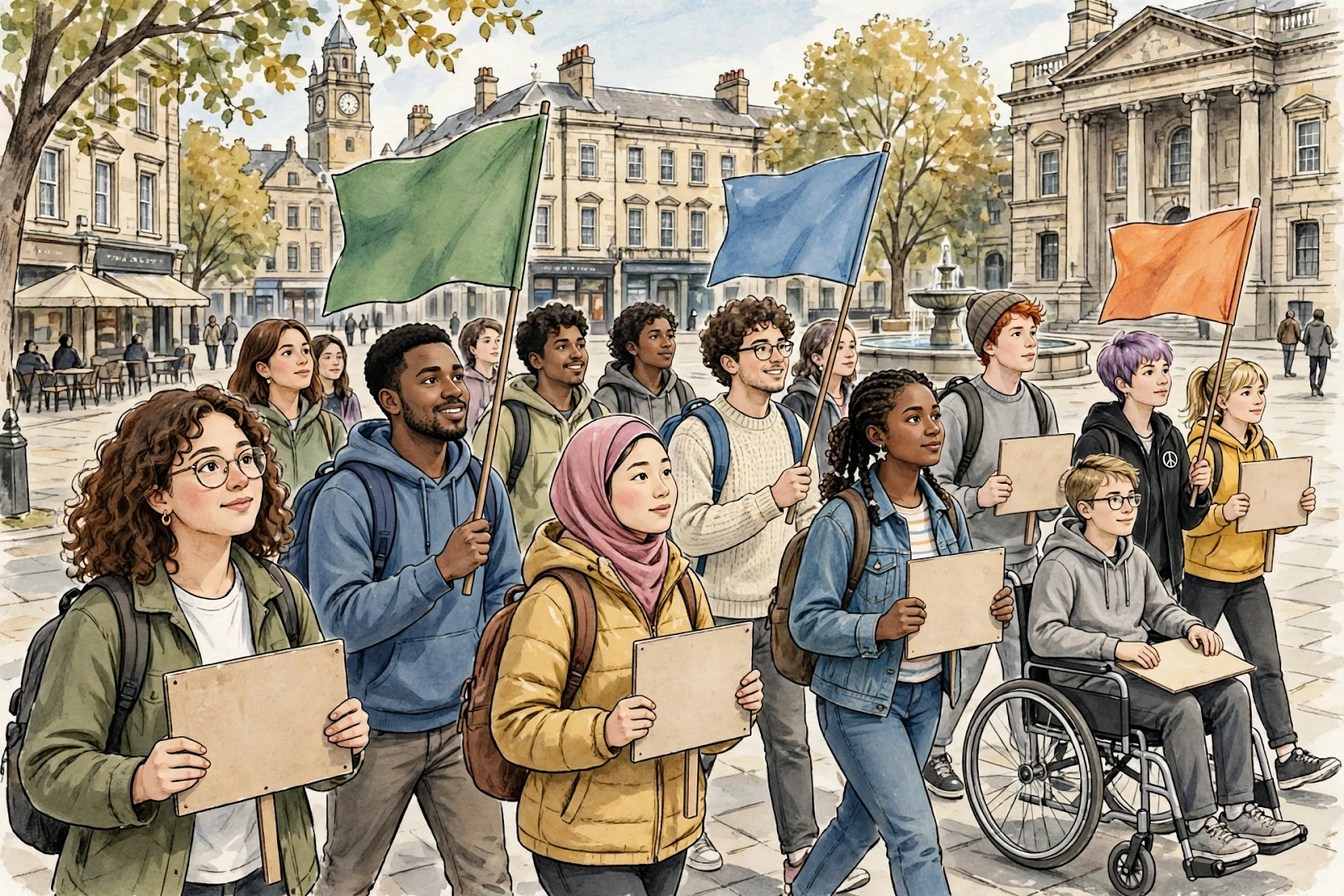
Illustration: Students marching peacefully through a city square during a protest movement.
Background
The movement was born out of anti-corruption protests following the deaths of 16 people in the collapse of a train station canopy in the city of Novi Sad, Reuters reported. That disaster became a symbol, for protesters, of what they described as corruption and negligence in public life. Vucic and the SNS repeatedly denied accusations of repression and corruption, Reuters noted.
For two years, peaceful protests called for Vucic to step down. The movement that emerged from those protests is unusual in European politics: it is not a traditional party with a long-standing leader, a manifesto hammered out over years, or a network of local branches built election by election. It is a list of candidates drawn from civic life — including, Reuters reported, cardiologist Ilija Srdanovic, who heads the students' candidate list, former central bank governor Dejan Soskic, and Radomir Sajcic, a professor at Belgrade University who spoke on behalf of the students following their victory.
That breadth was an asset in an election. Professors, actors and farmers could each speak to a different part of a country of some 6 million people, and the absence of a single dominant leader made it harder for opponents to personalise the campaign. In government, however, breadth can become a liability: a cabinet must make decisions, take responsibility for them, and defend them in parliament and in public. A movement held together by opposition to one leader must now find agreement among itself.
Reuters also placed the result in a wider European context, describing it as a profound political shift reminiscent of the defeat of Hungary's Viktor Orban in April, and noting that it may offer inspiration to other student movements that have cropped up across Europe in recent weeks demanding better education standards and prospects. Whether inspiration translates into imitation will depend heavily on what happens next in Belgrade.
Why It Matters
First, the result is a test of whether a protest movement can become a government without losing what made it popular. Voters backed the students' list not only to remove Vucic but, according to the accounts gathered by Reuters, in the hope of a different kind of public life. "This corruption that has entered into all pores of our lives... of course it will change, we are hoping we are going to slowly go into that direction of a normal community," 60-year-old insurance worker Svetlana Karagkozidou told Reuters.
Second, the result matters because the transition will be watched far beyond Serbia. A peaceful transfer of power after two years of protest is, in itself, a significant democratic moment. But a messy or paralysed transition would be watched just as closely, and could be cited by sceptics elsewhere as evidence that movements built on protest cannot govern.
Third, not everyone welcomed the change, and that unease is part of the story. "Changing the country like that so suddenly and all at once, I don't like it. I don't even know who is standing behind, who those people are, who will be leading the country," 60-year-old civil worker Senka Radakovic told Reuters. A new government that ignores that anxiety — from voters who backed the SNS alliance with 39.2 percent of the vote — would start its term with a large, sceptical minority.

Illustration: Inside a parliament chamber, where the new majority must now choose a government.
What Happens Next
The immediate task is the formation of a government: the selection of a prime minister and ministers, and the presentation of a programme to parliament. Reuters reported that it remains unclear who the movement will appoint to those roles, so the coming days of internal discussion will be as consequential as the election itself. Observers will be watching for whether the movement chooses a technocratic figure, a prominent academic such as those already associated with the list, or a compromise candidate who can hold its different strands together.
The next test will be the anti-corruption agenda itself. Promises to root out graft will be measured against concrete steps: investigations, appointments to oversight bodies, transparency in public contracts, and reforms to the institutions that protesters said had failed. Each of those steps will create winners and losers, and each will test the movement's unity.
Education, the other pillar of the reported agenda, will also come into focus. Students who marched for better schooling will expect changes they can feel, and the government will need to show that it can fund and deliver them while managing the rest of the state.
Beyond Serbia's borders, European capitals and neighbouring governments will be watching how the new majority handles the transition, and whether the change of government changes Serbia's foreign policy direction. For now, the honest answer to most of those questions is that nobody outside the movement's inner discussions knows — and, by Reuters' account, few inside it had a clear picture on the morning after the vote either. That uncertainty is not a footnote to this story. It is the story.
Sponsored: explore today's featured sponsored offers
FAQ
Who won Serbia's parliamentary election?
According to the State Election Commission, as reported by Reuters on October 26, 2026, the student-backed candidates won 52.7 percent of the vote, against 39.2 percent for Aleksandar Vucic's SNS-led alliance, with almost 99 percent of votes counted.
How many seats did the student-backed list win?
The students won 139 seats in the 250-seat parliament, leaving the SNS alliance with 97 seats and the remainder held by minority parties, Reuters reported.
What sparked the protest movement?
The movement grew out of anti-corruption protests following the deaths of 16 people in the collapse of a train station canopy in Novi Sad, Reuters reported. Vucic and the SNS repeatedly denied accusations of repression and corruption.
Who are the prominent figures in the student-backed list?
Reuters named cardiologist Ilija Srdanovic, head of the students' candidate list, former central bank governor Dejan Soskic, and Belgrade University professor Radomir Sajcic, who spoke on behalf of the students after the victory.
What is still unclear after the election?
Who the movement will appoint as prime minister and to other key government positions, and how it will turn its agenda of rooting out graft and improving schooling into legislation, Reuters reported.
Sources
- Reuters, "After Vucic defeat, Serbia waits to see how student-backed leaders will govern," October 26, 2026.
Comments
Post a Comment