
Siemens and Nvidia Bet on AI to Run the Factory of the Future
Germany's industrial giant Siemens and US chipmaker Nvidia have unveiled artificial intelligence-driven manufacturing technology that could cut planning costs by up to 20% — the clearest sign yet that AI is moving out of the data center and onto the factory floor.
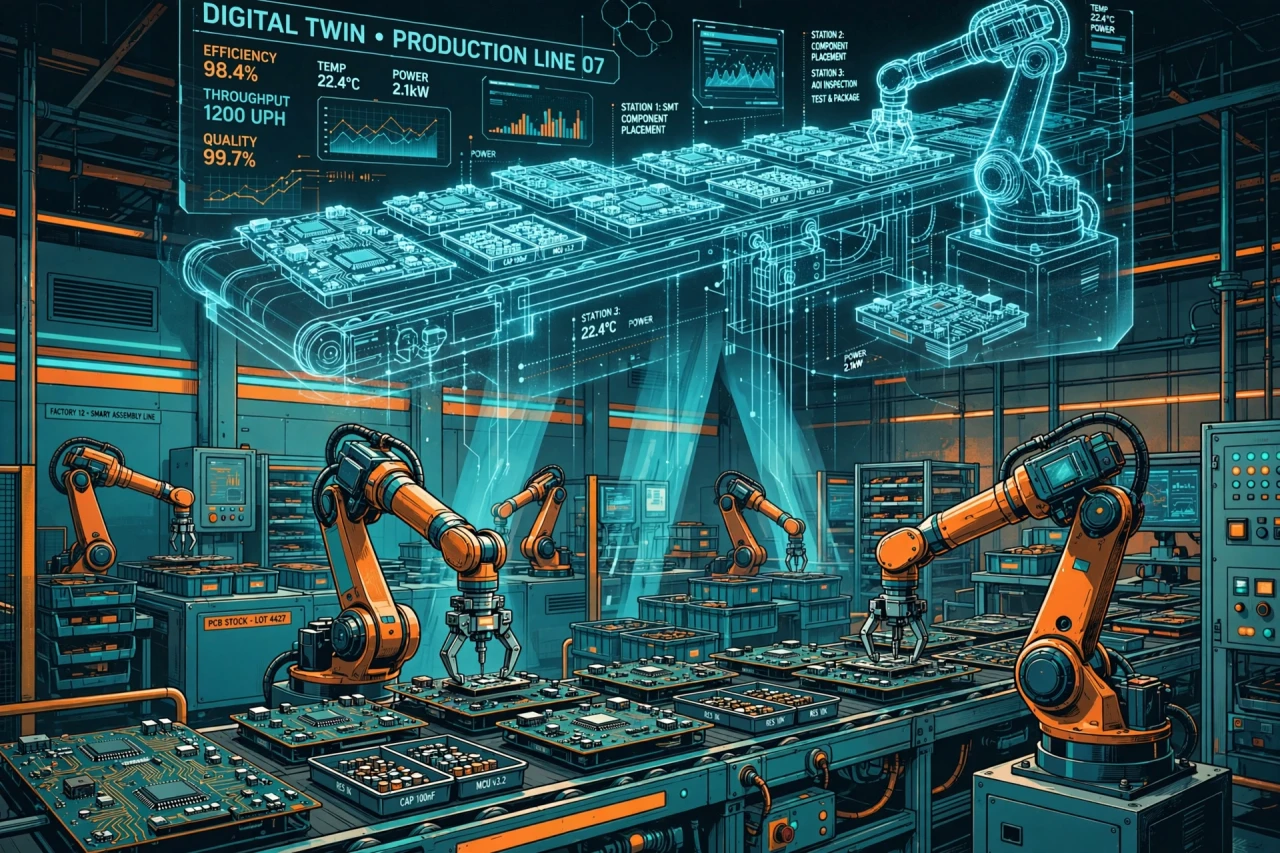
Illustration: a futuristic electronics factory with robotic arms assembling circuit boards beneath a glowing digital-twin hologram.
What Happened
Siemens unveiled new AI solutions at its electronics factory in Erlangen, Germany, on Monday, October 19, 2026, according to a Dow Jones Newswires report by Michael Hennessey. The technology was developed under a partnership with Nvidia first outlined in January, and it combines artificial intelligence with digital twins — virtual replicas of factory systems — to accelerate production ramp-up and improve planning.
The headline numbers are striking. Siemens says a fully virtual production ramp-up — where a manufacturing line is tested and optimised digitally before it is switched on in the real world — cuts engineering effort for new printed circuit board assemblies by up to 85% and reduces time-to-market by up to 40%. Meanwhile, AI agent-based production planning, which adapts schedules to shortages and demand changes on the fly, allows cost savings of up to 20%.
"The historic opportunity for Germany and Europe lies in bringing artificial intelligence out of the data centers and into the factories — and applying it on an industrial scale," said Cedrik Neike, a member of Siemens' managing board, according to the Dow Jones report.
The announcement coincided with an investment summit in Berlin between Nvidia, the German government and German business leaders. The German government said a partnership to promote AI in German industry would be announced, making the Siemens-Nvidia unveiling the opening act of a broader German push into industrial AI.
Background
The Siemens-Nvidia partnership is part of a wider shift the industry calls "physical AI": artificial intelligence models applied to the physical world of machines, logistics and production lines, rather than to text, images or chatbots. Instead of simply automating repetitive motions the way traditional industrial robots do, physical AI systems perceive their environment, simulate it, and plan around problems before they happen.
Digital twins are the backbone of that vision. By building an exact virtual copy of a factory — every machine, conveyor, sensor and workflow — engineers can test changes, train inspection systems and rehearse production runs entirely in simulation. At the Erlangen plant, for example, AI-generated simulations can train visual inspection systems to spot defects on circuit boards before physical prototypes even exist.
The timing is deliberate. Germany, Europe's industrial engine, has watched much of the consumer-AI boom flow to American and Chinese tech firms. Berlin sees industrial AI — applying machine intelligence to the factories, cars and machinery Europe still leads in — as its best route back into the race. Siemens, with deep roots in factory automation software and hardware, is the natural standard-bearer.
Nvidia brings the computing muscle. Its graphics processing units power the vast majority of AI training worldwide, and the company has spent the past two years pushing its hardware and simulation platforms deeper into manufacturing, robotics and autonomous systems. For Nvidia, every AI-run factory is a potential showcase — and a potential customer.
The broader AI investment climate gives the partnership extra momentum. On the same day as the Erlangen unveiling, Salesforce announced a $1 billion investment in Spain over the next five years to build AI implementation capacity across its EMEA South operations, while Singapore-based neocloud Aolani signed letters of intent for up to 500 megawatts of AI data centre capacity in Malaysia. The capital flooding into AI infrastructure worldwide is increasingly finding its way from data centers toward the industrial edge.
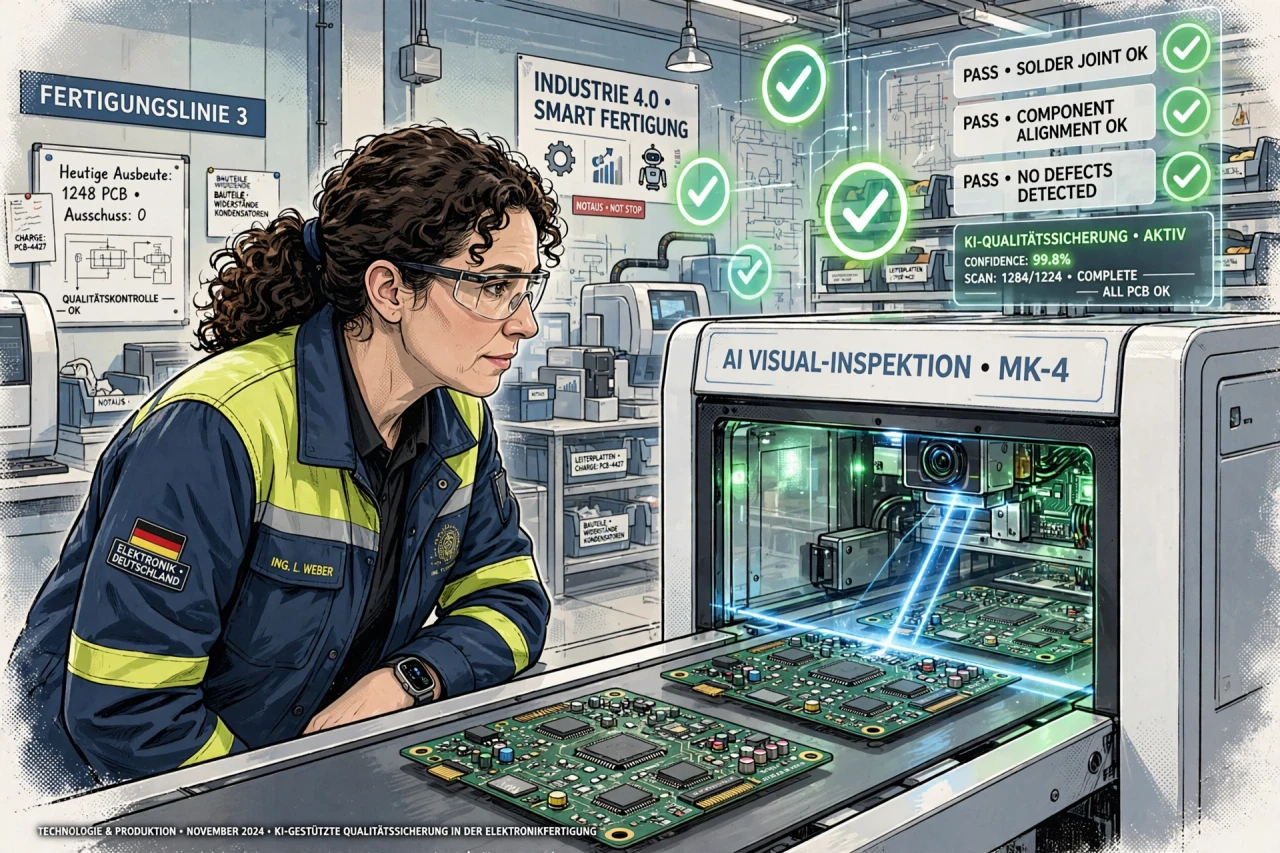
Illustration: an engineer watching an AI visual-inspection system scan circuit boards in a modern German factory, with green checkmarks.
Why It Matters
Manufacturing is one of the largest sectors on the planet, and its automation level has been stuck for years. According to industry analysis cited by Analytics Insight, AI could allow manufacturers to automate 70% to 80% of production processes, up from around 30% to 40% today. That kind of jump would be one of the biggest productivity shifts in modern industrial history.
For high-wage economies like Germany, the stakes are existential. Siemens has said the shift could help factories in high-wage countries remain competitive against lower-cost rivals — potentially supporting industrial jobs by making domestic production cheaper rather than by cutting headcount. Whether that promise holds will determine how warmly Europe's unions and politicians embrace the technology.
The cost figures, if they hold at scale, are enormous. An 85% cut in engineering effort for new product ramp-ups and a 40% shorter time-to-market would let manufacturers launch products faster and cheaper, reshaping competition in electronics, automotive and machinery. A 20% saving on planning costs would land directly on the bottom line of factories already squeezed by energy prices and supply-chain volatility.
There is also a geopolitical dimension. As the United States and China pour resources into AI infrastructure, Europe has struggled to find its lane. Industrial AI — where Europe's engineering heritage meets its manufacturing base — is increasingly seen in Brussels and Berlin as the continent's most credible answer. The Berlin summit, and the promised German industry partnership with Nvidia, signal that this is becoming national industrial policy, not just corporate strategy.
What Happens Next
Siemens says further applications of the technology are planned in the coming months, suggesting the Erlangen unveiling is a first deployment rather than a finished product. The real test will be whether the 85%, 40% and 20% figures — achieved on specific printed-circuit-board production lines — survive contact with the messier reality of full-scale factories across different industries.
The Berlin summit's promised partnership between Nvidia, the German government and German business leaders will be the next milestone to watch. If it comes with funding commitments or procurement deals, it could accelerate adoption across the Mittelstand — Germany's vast network of mid-sized manufacturers — which collectively account for a huge share of the country's exports but often lack the resources of a Siemens.
Competitors will not stand still. Industrial automation rivals in Japan, Switzerland and the United States are pursuing their own AI manufacturing platforms, and the race to define the standards for AI-driven production — data formats, safety protocols, interoperability — is only just beginning. Whoever sets those standards will shape the factory floor for a generation.
Finally, expect scrutiny from regulators and workers' representatives. AI agents that reschedule production autonomously raise questions about accountability when things go wrong, and about what happens to the human planners, engineers and inspectors whose roles the technology promises to shrink. Siemens' pitch — that AI will support industrial jobs rather than replace them — will be tested in union negotiations and, likely, in political debate across Europe in the months ahead.
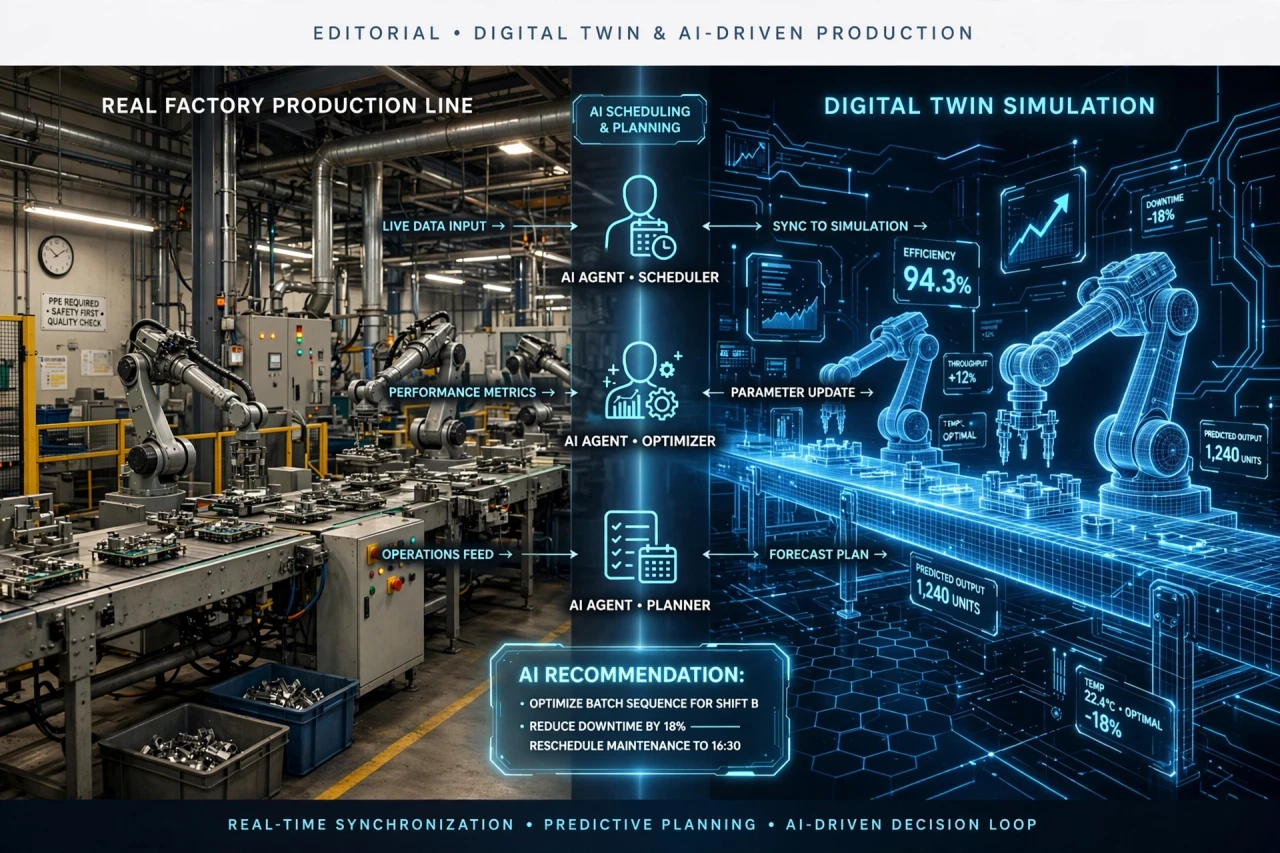
Illustration: a split view of a real factory production line and its glowing blue digital twin, with AI planning icons between them.
Sponsored: explore today's featured sponsored offers
FAQ
What is "physical AI"?
Physical AI is the application of artificial intelligence models to the physical world — machines, robots, factories and logistics — rather than to text, images or conversations. It combines AI with digital twins, robotics and sensor data so machines can perceive their environment, simulate changes and plan around problems before they happen on the real factory floor.
What did Siemens and Nvidia actually announce?
On October 19, 2026, Siemens unveiled AI-driven factory automation technology developed with Nvidia at its electronics factory in Erlangen, Germany. The package includes fully virtual production ramp-up — testing manufacturing lines digitally — and AI agent-based production planning that adapts schedules to shortages and demand changes.
How big are the claimed savings?
Siemens says virtual ramp-up cuts engineering effort for new printed circuit board assemblies by up to 85% and shortens time-to-market by up to 40%, while AI-based production planning can save up to 20% of planning costs. These figures apply to the systems demonstrated at Erlangen; the real test is whether they hold at scale across industries.
Why is this a big deal for Germany?
Germany has watched the consumer-AI boom flow largely to American and Chinese firms. Industrial AI is seen in Berlin as Europe's best route back into the AI race, since it plays to the continent's strength in engineering and manufacturing. A German government partnership with Nvidia and business leaders to promote AI in industry is expected to be announced following a Berlin summit.
Will AI replace factory workers?
Siemens says the technology is aimed at helping factories in high-wage countries stay competitive and supporting industrial jobs, not eliminating them. But AI-driven automation that could take factories from 30–40% automation today to 70–80% will inevitably reshape roles for planners, inspectors and engineers — and unions and regulators are expected to scrutinise how that transition is managed.
Sources
- Dow Jones Newswires (via Morningstar), October 19, 2026 — Siemens and Nvidia develop AI-driven factory automation technology, reporting by Michael Hennessey.
- Analytics Insight, October 19, 2026 — Could AI run 80% of a factory? Siemens, NVIDIA are betting on it.
- Salesforce press release, October 19, 2026 — $1 billion investment in Spain to accelerate AI leadership (regional AI investment context).
Comments
Post a Comment