
SEOUL — South Korean chipmaker SK Hynix reported a record third-quarter operating profit on Wednesday, 28 October 2026, as booming demand for the memory chips that power artificial intelligence sent its earnings more than sevenfold higher and lifted Seoul's stock market by about 6 per cent.
According to Yonhap News Agency, reporting on 28 October, SK Hynix posted third-quarter operating profit of 83.3 trillion won, a rise of about 631 per cent from a year earlier, on sales that soared 327.9 per cent to 104.61 trillion won. The world's second-largest memory chip maker also announced an additional 60 trillion won in shareholder returns, taking its total planned returns for 2026 to about 100 trillion won — roughly $75 billion. Shares in SK Hynix rose about 9 per cent in Seoul, while the benchmark Kospi index jumped about 6 per cent, as investors celebrated the strongest evidence yet that the AI infrastructure boom is still generating extraordinary profits for its suppliers.
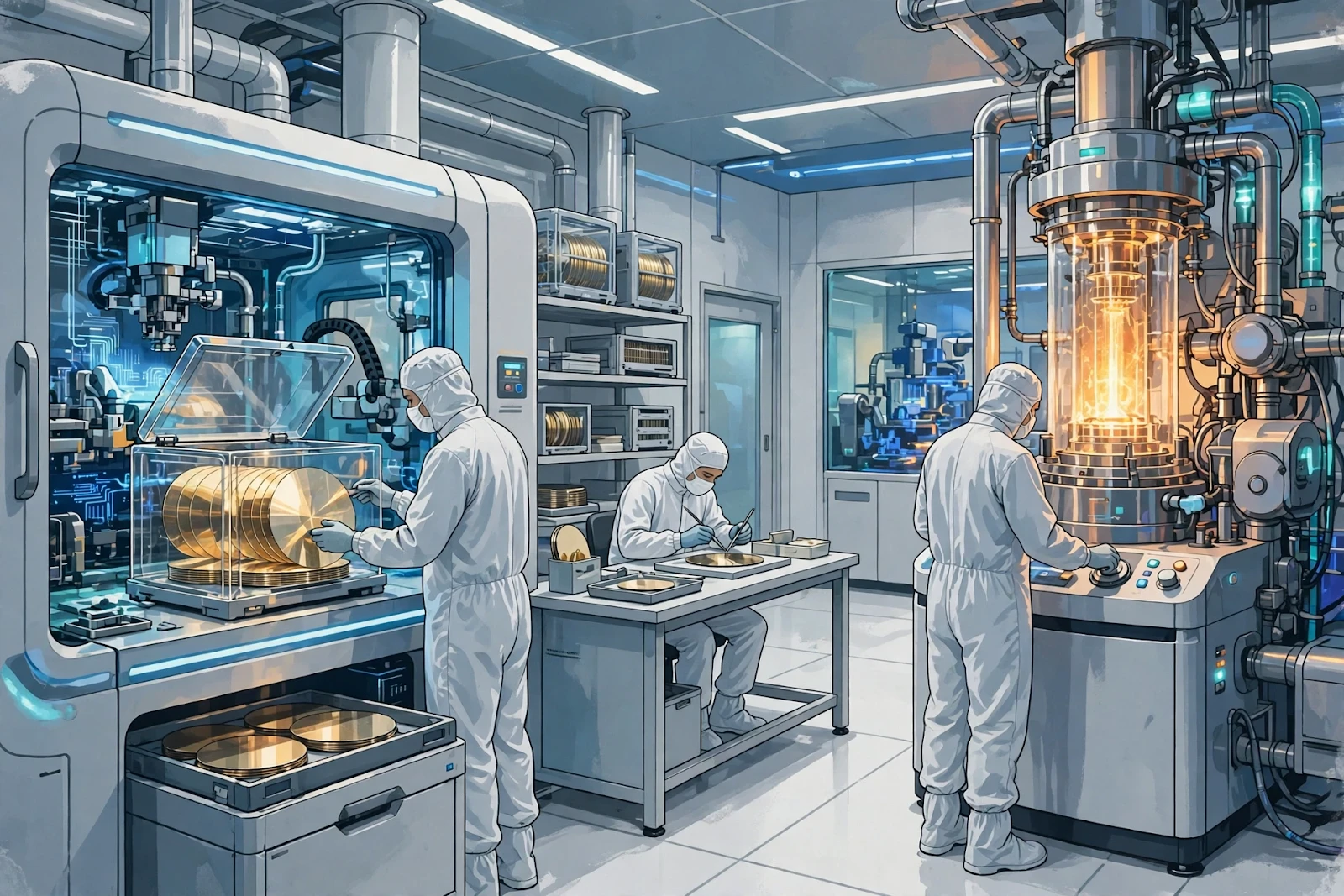
Illustration: Engineers working with silicon wafers in a semiconductor clean room — an artist's impression, not a photograph of an SK Hynix facility.
What Happened
SK Hynix announced its third-quarter results before the Seoul market opened on Wednesday, and the numbers beat even the high expectations that had built up around the company. Operating profit of 83.33 trillion won comfortably exceeded the market consensus of about 76.7 trillion won compiled by LSEG, according to market reporting on the results, while revenue of 104.61 trillion won was more than four times the year-earlier figure. The profit surge was driven, the company said, by sustained demand for AI memory and higher prices for its key products, as data centre operators race to build the computing capacity that large AI models require.
The shareholder return plan was almost as striking as the profit itself. SK Hynix said it would return about 100 trillion won to shareholders during fiscal 2026, comprising at least 30 trillion won in cash dividends and at least 60 trillion won in share buybacks and cancellations. The additional 60 trillion won announced on Wednesday builds on a 40 trillion won buyback announced in August, which the company said was completed last week, with the shares expected to be cancelled soon. The plan also raises SK Hynix's shareholder return target to more than 50 per cent of cumulative free cash flow for 2025 to 2027, according to reporting on the announcement.
Markets reacted immediately. SK Hynix shares rose about 9 per cent in Seoul trading, and the Kospi index surged, at one point trading above 6,000 points — a level that would have seemed fanciful only a few years ago. Samsung Electronics, the world's largest memory maker, rose more than 5 per cent, while other index heavyweights including LG Energy Solution, Hyundai Motor and KB Financial also advanced. The rally tracked overnight gains on Wall Street, where the Nasdaq Composite climbed 1.18 per cent and the Philadelphia Semiconductor Index jumped 3.6 per cent, according to TradingView's market report on 28 October.
The broader context mattered too. Investors were also looking ahead to the US Federal Reserve's interest rate decision, due early on Thursday, for signals about the future path of American monetary policy. But on Wednesday, at least, the earnings story overwhelmed the caution: AI demand, not interest rates, set the tone for Asian markets.
Background
SK Hynix sits at the centre of the AI hardware boom because of one product in particular: high-bandwidth memory, or HBM. These are specialised memory chips stacked in layers and placed alongside graphics processors, allowing AI systems to move vast amounts of data at the speeds that training and running large models demand. As AI companies have scaled up their models, demand for HBM has exploded, and SK Hynix — an early leader in the technology and a key supplier to Nvidia — has been one of the biggest beneficiaries.
The shift towards HBM has reshaped the whole memory industry. Because HBM uses far more wafer capacity per bit than conventional DRAM, the industry's pivot to AI memory has tightened supply across the board, pushing up prices for memory of all kinds. SK Hynix said it expects memory demand to exceed supply through 2030, and that virtually all of its DRAM and HBM production through 2029 is already sold out, according to summaries of the company's remarks. To lock in that demand, the company has signed long-term supply agreements with 14 major customers, covering more than half of its total production capacity in both 2027 and 2028, and it is discussing extensions to agreements that typically run for five years.
The company's product transition is also accelerating. SK Hynix expects its newest generation of high-bandwidth memory, HBM4, to surpass the previous HBM3E generation in both shipments and revenue in the fourth quarter of 2026 — a near-term test of whether the latest technology can carry the company's growth into next year. Server DDR5 memory shipments rose more than 40 per cent from the previous quarter, according to reporting on the results, another sign that data centre demand remains strong.

Illustration: A stock market trading screen in Seoul showing rising charts — an artist's impression, not a photograph of live trading data.
South Korea's stock market has been one of the world's strongest performers during the AI boom, and SK Hynix is a large part of the reason. Together with Samsung Electronics, the chipmakers dominate the Kospi, so a record quarter from SK Hynix lifts the whole index — and, through index funds and global portfolios, the retirement savings and investments of people far beyond Korea. The Kospi's surge past 6,000 points on Wednesday, reported by market data providers during the session, captures how far that story has run.
Yet the boom has also raised questions that Wednesday's results did not settle. Investors have grown increasingly concerned about whether the enormous sums being committed to AI infrastructure — data centres, chips, power — will generate returns commensurate with their scale. Recent weeks have seen volatility in AI-related shares precisely because of that doubt, and analysts have warned that debt-funded data centre expansion carries financing risks. SK Hynix's answer, in effect, is that the demand is real, contracted and sold out years ahead. The market's answer, on Wednesday, was to believe it.
Why It Matters
The results matter first for the AI industry itself. For months, sceptics have asked whether the AI boom is a bubble built on spending that will never pay off. A record quarter from one of the boom's core suppliers — with production sold out through 2029 and long-term contracts covering most of the next two years' output — is the strongest counter-evidence available. It suggests that at least the hardware layer of the AI economy is generating real, contracted revenue, not just speculative investment.
They matter second for South Korea. Semiconductors are the country's most important export industry, and SK Hynix's success feeds directly into national income, tax revenue, employment and the broader technology ecosystem. A Kospi above 6,000 points also matters for household wealth: millions of Koreans hold shares directly or through pension funds, and a rising market lifts confidence and spending. The government's own economic outlook is closely tied to the chip cycle, which is why a single company's earnings can move national headlines.
They matter third for the global technology supply chain. Memory shortages affect everyone who builds or buys computing equipment, from smartphone makers to cloud providers to car manufacturers. If SK Hynix is right that shortages persist through 2030, component costs will stay high, product prices may follow, and companies will keep competing fiercely for guaranteed supply. That is why the long-term agreements matter: they are not just sales contracts but a map of who will have access to scarce capacity in the years ahead.
Finally, the shareholder return plan matters for investors everywhere. Returning about 100 trillion won — roughly $75 billion — in a single year is an extraordinary distribution, and it signals that SK Hynix's management believes the cash generation is durable enough to share rather than hoard. For global investors weighing whether AI stocks are overvalued, a company returning cash on this scale, while still investing in next-generation products, is a powerful argument that the profits are real.
What Happens Next
The next data points arrive quickly. Samsung Electronics was scheduled to report third-quarter results on Thursday, 29 October, with Kioxia's earnings due on Friday, according to market reporting. Those results will show whether SK Hynix's boom is company-specific or industry-wide, and whether Samsung's memory business is enjoying the same pricing power. Investors will also watch for any guidance on HBM4 ramp-up and on capital spending plans for 2027.
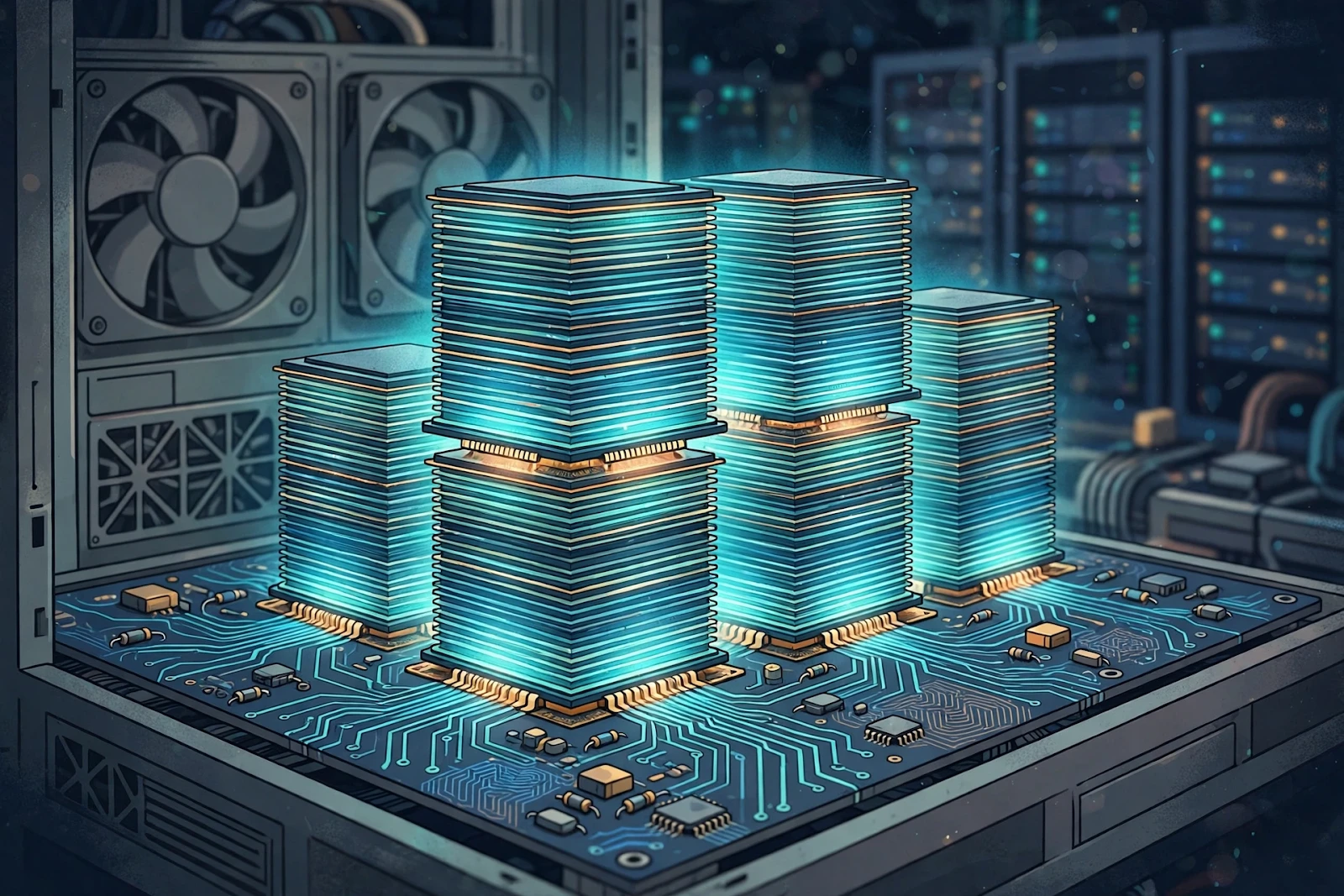
Illustration: High-bandwidth memory chips glowing on a circuit board — an artist's impression, not a photograph of SK Hynix products.
The Federal Reserve's decision, due early on Thursday, is the other near-term catalyst. A signal that US rates will stay higher for longer could cool the rally, while a dovish tone could extend it. Markets have already shown they can hold both thoughts at once — celebrating AI earnings while remaining cautious about borrowing costs — and Thursday's decision will test which impulse dominates.
Longer term, the questions are structural. Can SK Hynix convert its sold-out order book into sustained margins as competitors expand capacity? Will HBM4 deliver the performance gains that justify its premium? And will the data centre build-out, funded in part by large amounts of debt, generate the customer revenue needed to service that debt? Wednesday's results suggest the answers, for now, are yes — but the market will keep asking, quarter by quarter, and the next test comes with Samsung's numbers and the Fed's decision within days.
Sponsored: explore today's featured sponsored offers
FAQ
What did SK Hynix report for the third quarter of 2026?
According to Yonhap News Agency on 28 October 2026, SK Hynix reported operating profit of 83.3 trillion won, up about 631 per cent from a year earlier, on revenue of 104.61 trillion won, up 327.9 per cent, driven by demand for AI memory chips.
How much will SK Hynix return to shareholders?
The company plans about 100 trillion won (roughly $75 billion) in shareholder returns for fiscal 2026, including at least 30 trillion won in cash dividends and at least 60 trillion won in share buybacks and cancellations, building on a 40 trillion won buyback announced in August and completed last week.
Why did Seoul's stock market surge?
SK Hynix shares rose about 9 per cent and the Kospi index jumped about 6 per cent, at one point trading above 6,000 points, as investors celebrated the record earnings and revived optimism about AI demand, alongside overnight gains in US technology shares.
What is high-bandwidth memory, and why does it matter?
High-bandwidth memory (HBM) is specialised memory stacked in layers beside graphics processors, letting AI systems move huge amounts of data at high speed. Because HBM uses far more wafer capacity per bit than conventional memory, the industry's pivot to it has tightened overall memory supply and pushed up prices.
What should investors watch next?
Samsung Electronics was due to report third-quarter results on Thursday, 29 October, with Kioxia's earnings due on Friday, while the US Federal Reserve's interest rate decision, also due early Thursday, will shape sentiment on borrowing costs and AI spending.
Sources
- Yonhap News Agency via Korea JoongAng Daily, "Kospi jumps as SK hynix earnings fuel AI chip optimism," 28 October 2026.
- TradingView News, "South Korean Shares Rally on SK Hynix Earnings," 28 October 2026.
- TokenPost, "SK Hynix Sets Record Quarterly Profit, Plans $75.4 Billion Shareholder Return," 28 October 2026.
- KuCoin News (Huo Xing Finance), "SK Hynix Q3 operating profit reaches record 83.33 trillion won, plans 100 trillion won in shareholder returns," 28 October 2026.
- Particle News, "SK Hynix Reports Record Q3 Profit and Pledges More Than 100 Trillion Won to Shareholders," 28 October 2026.
Comments
Post a Comment