
Storm Adam Devastates Eastern Spain: Deadly Floods, Rooftop Rescues and Rainfall Not Seen Since 1987
Storm Adam Devastates Eastern Spain: Deadly Floods, Rooftop Rescues and Rainfall Not Seen Since 1987
Helicopters rescued people stranded on rooftops as torrential rains from Storm Adam swept across eastern Spain on Monday, October 19, 2026, causing floods that have killed at least two people and prompted authorities to issue shelter-in-place orders for more than 800,000 residents — in a deluge meteorologists say is the heaviest some areas have seen in nearly four decades.
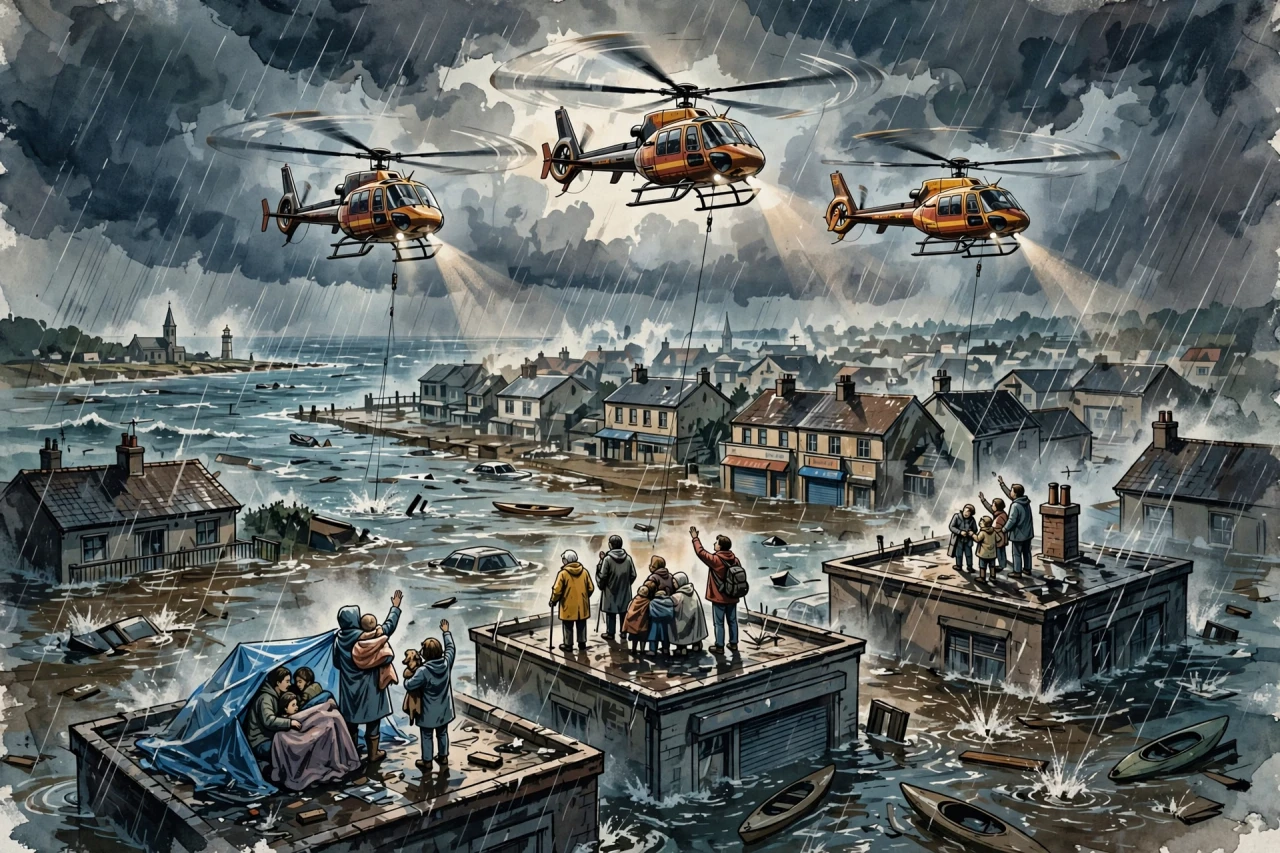
Illustration: Illustration of rescue helicopters over a flooded coastal town with residents on rooftops
What Happened
The downpour from Storm Adam cut off several towns along Spain's Mediterranean coast on Monday as rivers burst their banks and streets turned into torrents, Reuters reported on October 19. According to local officials, the bodies of two women who drowned were found over the weekend: one was washed up on a beach in Sagunto, in the Valencia region, while the other died after being swept away by floodwaters in Cabrera de Mar, near Barcelona.
The scenes were reminiscent of the catastrophic flooding that killed more than 230 people in the Valencia region two years ago — a disaster still fresh in the region's collective memory and one that has made authorities far quicker to issue mass alerts this time. On Monday, more than 800,000 residents were under shelter-in-place orders as the storm ground on.
Spain's national weather agency, AEMET, described conditions as "extremely adverse." Rainfall in some areas exceeded 600 millimetres — roughly 24 inches — over 48 hours, the most recorded since 1987. The agency issued several red alerts, the highest warning level, urging local people to avoid all travel and seek higher ground.
In the town of Pego, all access routes were blocked and even heavy-duty military vehicles were unable to move forward in some areas. Mayor Enrique Moll told regional radio station A Punt that several people were still waiting to be evacuated by helicopter from their rooftops on Monday. In the coastal town of Oliva, deputy mayor Salvador Llopis told state broadcaster TVE that emergency services were rescuing trapped residents, particularly elderly people stuck inside homes with water up to their waists. "They have to stay on top of tables and furniture to avoid getting wet," he said, adding that the rains had started to ease after causing extensive damage to infrastructure.
The storm also disrupted daily life across the wider region: schools and university campuses were closed in parts of the Valencian Community and across Mallorca, Ibiza and Formentera, with tens of thousands of students facing cancelled or restricted classes on Monday, according to reports. Emergency units from the military and national police were deployed to assist.
Background
Storm Adam is a weather system known as a DANA — a Spanish acronym for an isolated high-altitude depression — which forms when a pocket of cold air becomes cut off high in the atmosphere. When that cold pocket meets warm, moist air from the Mediterranean, it can trigger violent thunderstorms and torrential rain that dumps months' worth of precipitation in hours. AEMET officially named the storm on October 16, making it the first high-impact DANA of the 2026–27 season, according to The Sun.
Spain's Mediterranean coast is particularly exposed to this phenomenon in autumn, when the sea is still warm from summer and the atmosphere begins to cool. The same mechanism drove the catastrophic Valencia floods of two years ago, which killed more than 230 people and became one of the deadliest natural disasters in Spain's modern history. That tragedy prompted soul-searching about warning systems, land use and climate preparedness — questions that Storm Adam has now put back on the agenda.
Meteorologists say human-driven climate change is making such extreme weather events more frequent and more destructive, Reuters reported. Warmer air holds more moisture, and a warmer Mediterranean feeds DANA systems more energy — a combination that turns once-rare rainfall totals into recurring threats. The 600mm-plus totals recorded this week, the heaviest since 1987, fit a pattern of escalating extremes seen across southern Europe in recent years.
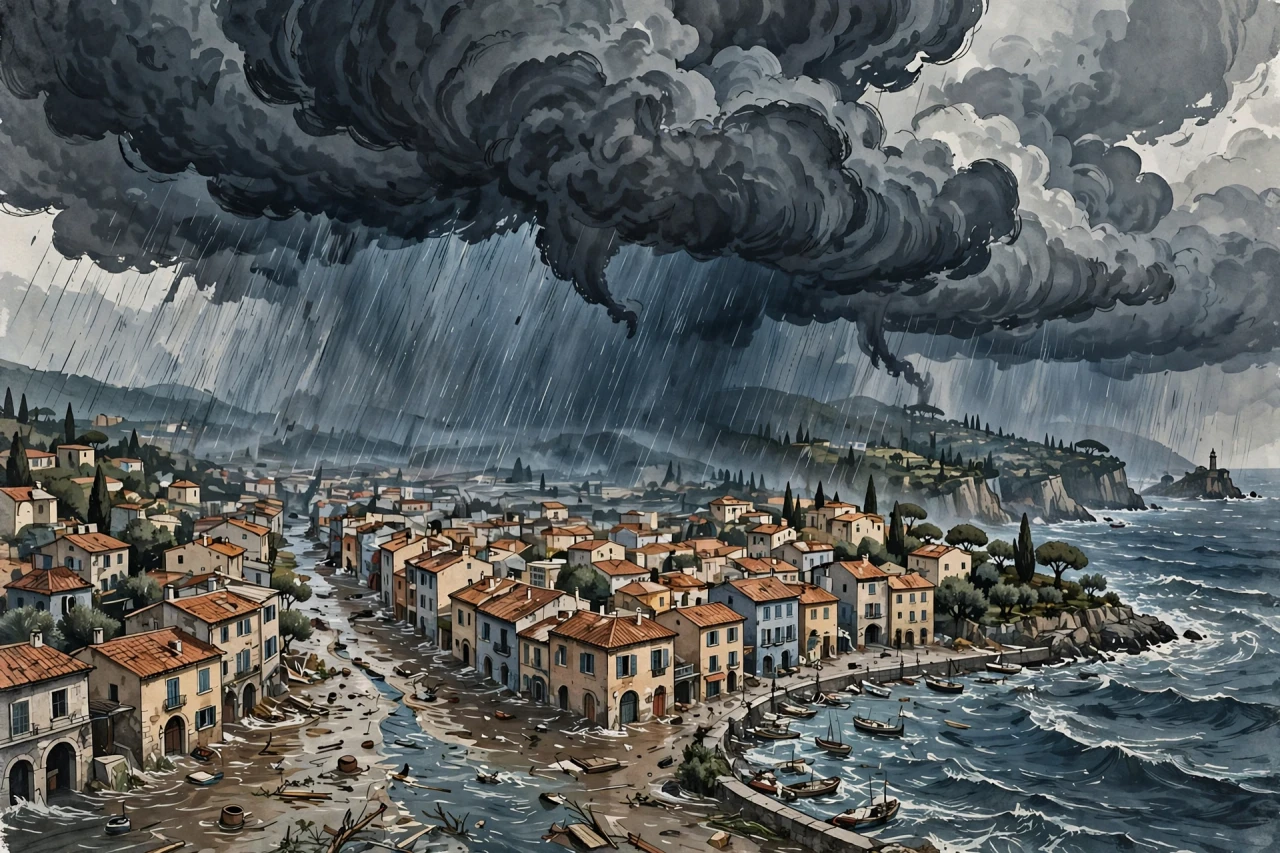
Illustration: Illustration of a giant storm cloud pouring torrential rain over a Mediterranean coastline
Why It Matters
Storm Adam is the first major test of Spain's post-2024 flood preparedness — and the verdict so far is mixed. On one hand, the mass shelter-in-place orders, red alerts and early school closures show a system that has learned from the Valencia catastrophe, when late and confusing warnings cost lives. More than 800,000 people told to stay home is a sign of a country taking no chances.
On the other hand, the deaths of two women and the scenes of residents plucked from rooftops show the limits of even the best warning systems against rainfall of this intensity. When 600mm falls in 48 hours — a figure that shatters records going back to 1987 — no drainage system, however well designed, can cope. The question is no longer just whether warnings go out in time, but whether towns built on floodplains can be protected at all against the new extremes.
The economic stakes are also significant. The affected regions — Valencia, Alicante, Catalonia, the Balearic Islands — are among Spain's most important for tourism and agriculture. Flooded roads, stranded lorries, grounded flights and damaged infrastructure translate quickly into losses for businesses and supply chains, and the clean-up bill for storms of this magnitude runs into the hundreds of millions of euros.
And the storm is not finished with Europe. Storm Adam's upper-air centre was positioned over France on Monday, and Meteo-France warned that up to 300mm of rain could fall in parts of Gard and Herault, with five French departments under orange weather warnings and the severe weather expected to spread east toward Provence and Corsica on Tuesday, according to The Sun. What began as a Spanish emergency is becoming a western Mediterranean one.
What Happens Next
The immediate outlook offers cautious hope: Spain's State Meteorological Agency expects conditions to begin improving on Tuesday, October 20, though more downpours are forecast before the worst fully passes. Heavy showers are expected to shift toward Catalonia during the afternoon, threatening Barcelona and other coastal communities with flash flooding even as the hardest-hit areas begin to drain.
The recovery will be the long phase. With rivers having burst their banks, infrastructure extensively damaged and towns like Pego cut off from all access routes, the clean-up will take weeks. Authorities will need to assess damaged roads, bridges and water systems before evacuated residents can fully return — and with more rain forecast on already saturated ground, the risk of secondary flooding remains.
The longer-term reckoning will be about adaptation. After the 2024 Valencia disaster, Spain pledged to rethink floodplain development, early-warning systems and emergency coordination. Storm Adam — with rainfall unseen since 1987 and a death toll that, while far lower than 2024, is still a tragedy — will test whether those reforms are enough. Meteorologists' warning that climate change is making such events more frequent means this is not a once-in-a-generation event to be filed away, but a preview of the autumns to come.
For the rest of Europe, the lesson is equally sharp: as Storm Adam moves east toward southern France, the question is whether other Mediterranean regions — with their own floodplains, their own tourists and their own infrastructure — are any better prepared than eastern Spain was.
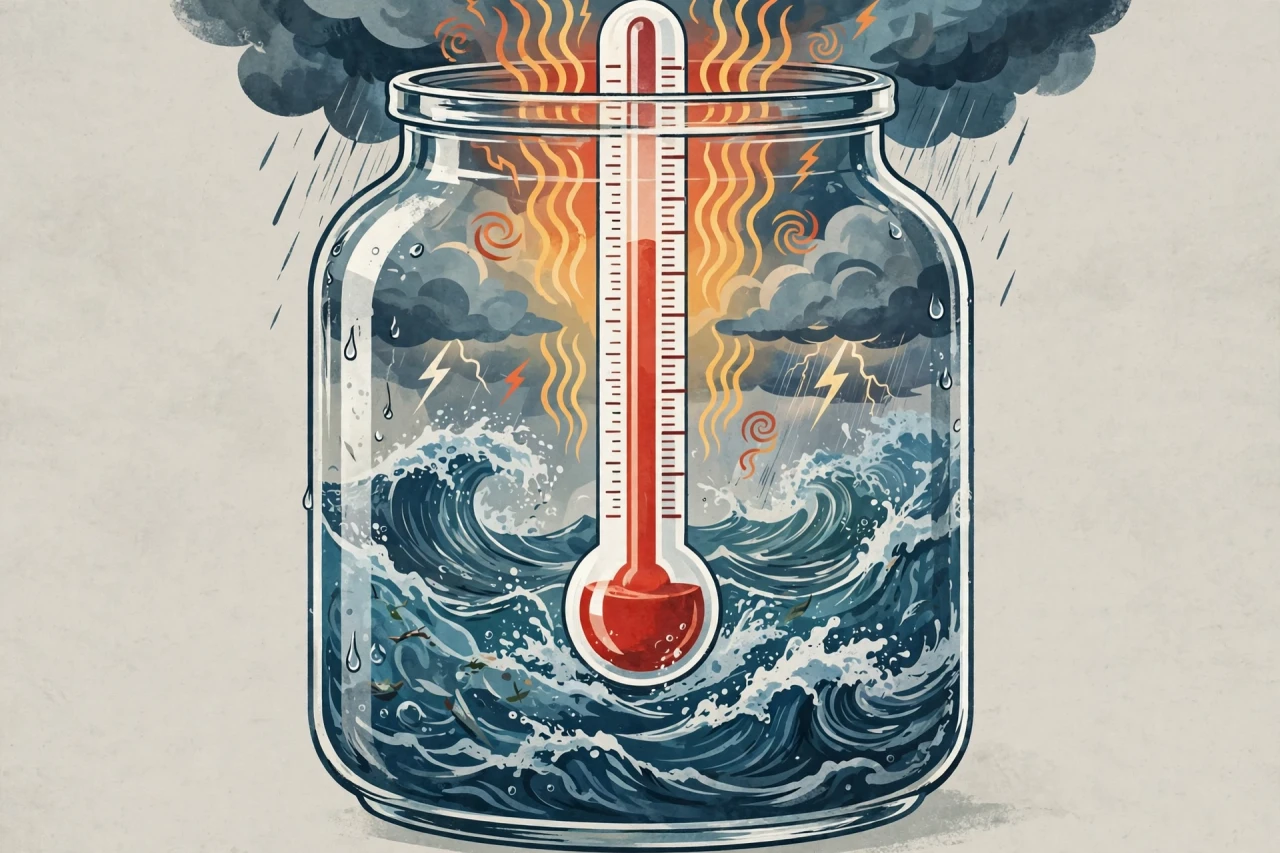
Illustration: Illustration of a thermometer rising inside a glass jar filled with flood waves and storm clouds
Sponsored: explore today's featured sponsored offers
FAQ
What is Storm Adam?
Storm Adam is a DANA — an isolated high-altitude depression, a Spanish meteorological term for a system where a pocket of cold air becomes cut off in the upper atmosphere. When it meets warm, moist Mediterranean air, it triggers violent thunderstorms and torrential rain. AEMET named it on October 16, the first high-impact DANA of the 2026–27 season.
How many people have died?
At least two people, according to Reuters' reporting on October 19. The bodies of two women who drowned were found over the weekend — one washed up on a beach in Sagunto, Valencia, and the other swept away by floodwaters in Cabrera de Mar near Barcelona. More than 800,000 residents were placed under shelter-in-place orders.
How extreme was the rainfall?
Extremely. AEMET said rainfall in some areas exceeded 600 millimetres (about 24 inches) in 48 hours — the most recorded since 1987. The agency described conditions as "extremely adverse" and issued several red alerts, its highest warning level.
Is this connected to climate change?
Meteorologists say human-driven climate change is making such extreme weather events more frequent and more destructive, according to Reuters. Warmer air holds more moisture and a warmer Mediterranean feeds DANA systems more energy — a combination behind the escalating rainfall extremes across southern Europe.
Is the storm over?
Not quite. Spain's meteorological agency expects conditions to begin improving on Tuesday, October 20, but more downpours are forecast before the worst passes, with heavy showers shifting toward Catalonia. Storm Adam is also threatening southern France, where five departments are under orange warnings and up to 300mm of rain could fall in parts of Gard and Herault.
Sources
- Reuters, "Helicopters rescue people stranded on rooftops as torrential rains flood towns in eastern Spain" (October 19, 2026) — reuters.com
- The Sun, "Where is Storm Adam now? Latest Spain weather forecast after flooding in Ibiza, Valencia and other holiday hotspots" (October 19, 2026) — thesun.co.uk
- HeyDay News, "Storm Adam: Two dead in Spain as flood closures continue" (October 19, 2026) — heyday.news
Comments
Post a Comment