
Texas Proves the Point: Renewables Carried America's Biggest Power Grid Through a Summer Stress Test
TEXAS — In the first nine months of 2026, electricity demand in Texas grew by roughly 4 percent on the previous year, yet fossil-fuel generation rose by less than 1 percent, because clean power supplied most of the extra electricity, according to a Reuters analysis published on 6 October 2026 — a summer stress test that challenges the assumption that fast-growing demand must mean fast-growing fossil-fuel use.

Illustration: A Texas power grid landscape at sunset, with solar panel arrays and wind turbines supplying electricity to a city skyline.
What Happened
The figures come from the Electric Reliability Council of Texas, known as ERCOT, which operates the power grid serving most of Texas. Reuters reported that ERCOT recorded load growth of roughly 4 percent during the first nine months of 2026 compared with the same period a year earlier. Over the same period, clean-power generation rose by more than 11 percent, far outpacing total demand growth. Solar generation alone expanded by roughly 26 percent, while wind output climbed by more than 8 percent. Because clean sources grew so much faster than demand, generators were able to curb fossil-fuel generation growth to less than 1 percent even as total consumption reached all-time highs, Reuters reported.
Texas matters as a test case because it is the top power-consuming state in the United States, combining rapid population growth, expanding industrial activity, massive fossil-fuel production basins and some of the largest proposed data-centre developments in the country. If any market appeared likely to require large increases in fossil generation to keep the lights on, Reuters argued, it was Texas. Instead, renewables supplied most of the incremental electricity. The analysis described the outcome as remarkable for a grid often portrayed as a bellwether for how future electricity demand will evolve across the country.
The result is not a claim that Texas has stopped using fossil fuels. Gas and coal plants still form a large part of the system, and the reported figures describe growth rates — how much each source expanded — rather than total shares of generation. What changed in 2026, according to the ERCOT data cited by Reuters, is the direction of the marginal megawatt: when Texans used more electricity, the additional supply came mostly from clean sources, not from burning more fossil fuel.
Background
Texas has built solar and wind capacity at extraordinary speed in recent years, helped by abundant land, strong sunshine and wind resources, and a market design that lets developers connect new projects comparatively quickly. Solar, in particular, has become the fastest-growing source on the Texas grid, and its output peaks in the middle of the day and in summer, when air-conditioning demand is highest. That timing is part of why the 2026 numbers look the way they do: the months when demand grows fastest are also the months when solar produces most.
The wider context is a global one. The United Nations Environment Programme's Emissions Gap Report 2026, published on 21 October 2026, reported that renewable power capacity additions between 2013 and 2025 were three times the level anticipated in 2015, with solar additions seven times the expected amount, and that solar and wind together accounted for 4.1 billion tonnes of carbon dioxide abatement in 2025. Texas is therefore not an isolated experiment; it is one of the clearest national examples of a trend the UN report documents worldwide. Still, the same UN report warned that global greenhouse-gas emissions have yet to peak and that current policies put the world on course for about 2.8 degrees Celsius of warming this century — a reminder that rapid renewable growth in one grid does not by itself close the global emissions gap.
Texas also carries a distinctive recent history. The state's grid has faced intense scrutiny over reliability in extreme weather, and its operators have spent recent years adding capacity and improving winter and summer preparedness. The 2026 stress test is significant precisely because it combined strong demand growth with extreme summer conditions and still ended with fossil generation almost flat. Reliability and decarbonisation are often presented as competing goals; the Texas numbers suggest that, at least in this period, they moved together.

Illustration: Engineers in a power grid control room watching screens that show solar and wind output rising while fossil-fuel output stays nearly flat.
Why It Matters
The Texas experience matters for three reasons. First, it speaks directly to the data-centre debate. Across the United States, utilities and policymakers are wrestling with how to serve rapidly growing electricity demand from data centres, factories and electrified transport without triggering a new wave of fossil-fuel plants. Texas shows that a grid can absorb roughly 4 percent demand growth in nine months while holding fossil generation growth below 1 percent, provided clean capacity is built fast enough. That is a practical precedent, not just a modelling result.
Second, ERCOT is widely viewed as a possible blueprint for other American power systems, Reuters noted, because its market structure and its scale make it a useful comparison for grids elsewhere. If Texas can integrate large volumes of variable solar and wind while meeting record demand, other grids have one more reason to examine which of its market rules, transmission planning and forecasting practices could be adapted to their own circumstances. No grid is identical, and Texas's isolation from the wider American grid system limits direct comparison, but the direction of travel is informative.
Third, the result reframes the economics of the energy transition. Clean power is often discussed as a cost imposed on consumers for the sake of future climate benefits. The Texas figures show it functioning as the cheapest way to meet new demand in real time: when demand rose, the system turned mainly to the sources that had been built most recently and most cheaply. That does not settle debates about storage, transmission or backup capacity, but it does weaken the argument that meeting higher demand automatically requires more fossil fuel.
What Happens Next
Several questions will determine whether 2026 proves to be a turning point or a favourable year. One is whether solar and wind construction in Texas keeps pace with demand in 2027 and beyond, particularly as data-centre projects move from announcement to operation. Another is storage: batteries, which charge when solar output is abundant and discharge in the evening, will become more important as solar's share grows, and their deployment will shape how far fossil generation can be pushed down during evening peaks.
Transmission is a third question. New solar and wind farms are often built far from cities, and moving their power to where it is needed requires wires, planning permission and time. Grid operators and regulators in Texas will also face decisions about how to reward reliability — paying plants to be available in extreme weather — without locking in fossil capacity that the system no longer needs for most of the year.
Finally, observers will watch the full-year 2026 figures when they are published, to see whether the nine-month pattern held through the final quarter, and whether other American grids report similar results. If they do, the Texas stress test may come to be seen as the year the argument changed: not whether renewables can meet growing demand, but how quickly the rest of the system — storage, wires and markets — can be built to let them.
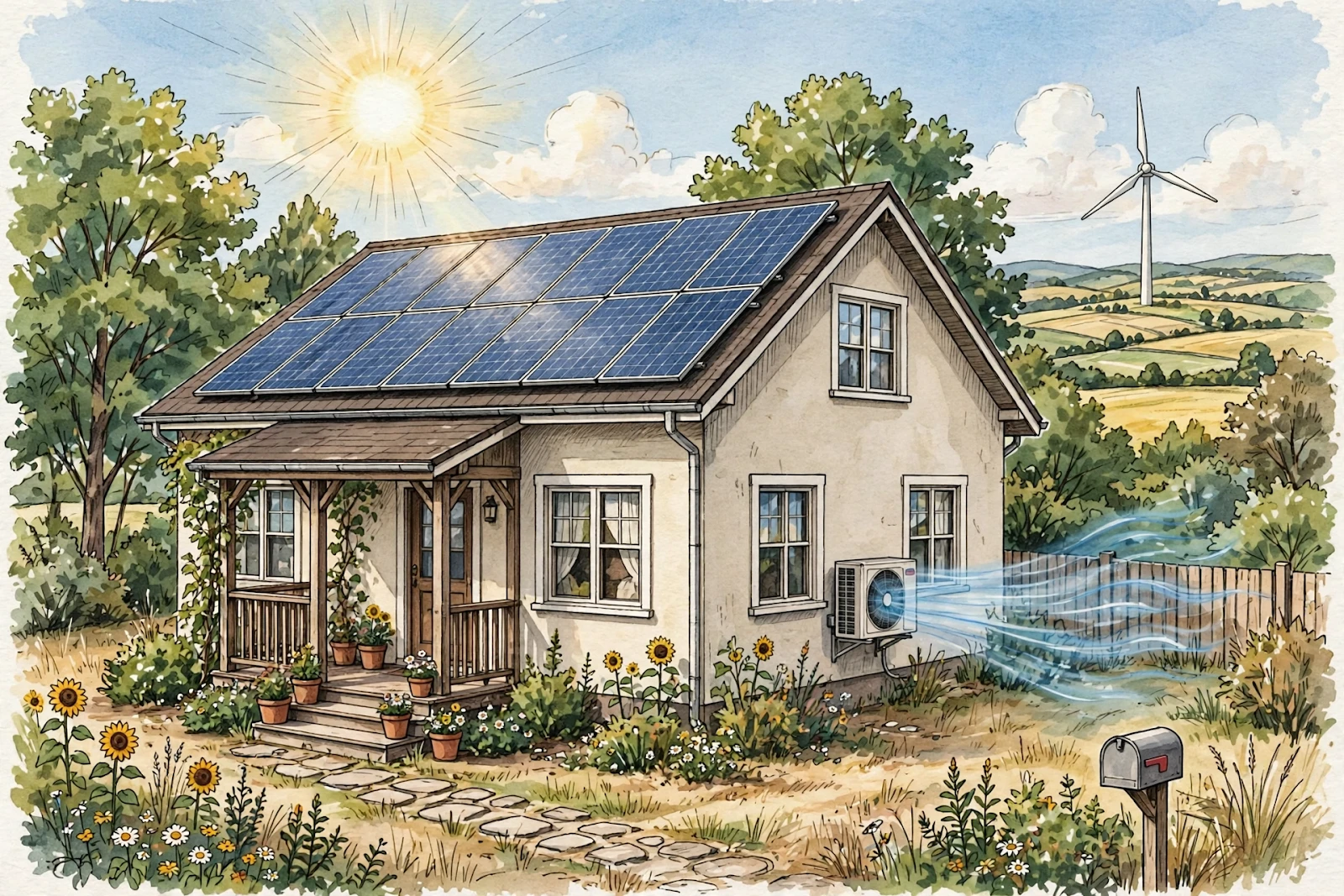
Illustration: A family home with rooftop solar panels on a hot summer day, with a wind turbine in the distance, representing household clean energy.
Sponsored: explore today's featured sponsored offers
FAQ
What did the Texas grid figures for 2026 actually show?
According to ERCOT data reported by Reuters on 6 October 2026, electricity demand in Texas grew by roughly 4 percent in the first nine months of 2026, clean-power generation rose by more than 11 percent, solar generation grew by roughly 26 percent, wind output rose by more than 8 percent, and fossil-fuel generation increased by less than 1 percent.
Does this mean Texas no longer uses fossil fuels?
No. The figures describe growth rates, not total shares. Fossil-fuel plants still supply a large part of Texas electricity; what changed is that most of the additional electricity needed in 2026 came from clean sources rather than from burning more fossil fuel.
Why is Texas considered an important test case?
Texas is the top power-consuming American state, with fast population and industrial growth and large proposed data-centre developments. Reuters described its grid as a bellwether for how other power systems might accommodate rising demand, so its results are watched well beyond the state.
What role did solar power play?
Solar generation expanded by roughly 26 percent, the fastest growth of any major source. Because solar output peaks in daytime and summer, when air-conditioning demand is highest, it matched well with the periods of strongest demand growth.
What should readers watch next?
The full-year 2026 figures, the pace of new solar, wind and battery construction, transmission expansion, and whether other American grids report a similar pattern of demand growth with almost flat fossil-fuel generation.
Sources
- Reuters, "Renewables help US power system survive summer stress test," 6 October 2026 — https://www.reuters.com/commentary/reuters-open-interest/renewables-help-us-power-system-survive-summer-stress-test-2026-10-06/
- United Nations Environment Programme, Emissions Gap Report 2026: The Point of Return, published 21 October 2026, as reported by Reuters on 21 October 2026 — https://www.reuters.com/sustainability/cop/un-sees-higher-global-warming-even-best-case-scenario-2026-10-21/
Comments
Post a Comment