
'Doomsday Glacier' May Keep Melting for 150 Years Even If Oceans Cool, Scientists Find — and Could Raise Seas Twice as Fast as Feared
October 20, 2026 — Two new scientific studies have delivered a one-two punch of warnings about Antarctica's Thwaites Glacier, nicknamed the "Doomsday Glacier." A British Antarctic Survey-led study reported on October 19, 2026, finds that Thwaites will keep losing ice for at least the next 150 years — even under the most extreme ocean cooling imaginable. And a separate study by scientists at the University of California, Irvine and NASA's Jet Propulsion Laboratory, published in the journal Nature Communications on October 12, 2026, estimates the glacier could contribute up to 30 millimeters (1.2 inches) to global sea-level rise by 2100 — roughly twice as much as earlier models suggested.
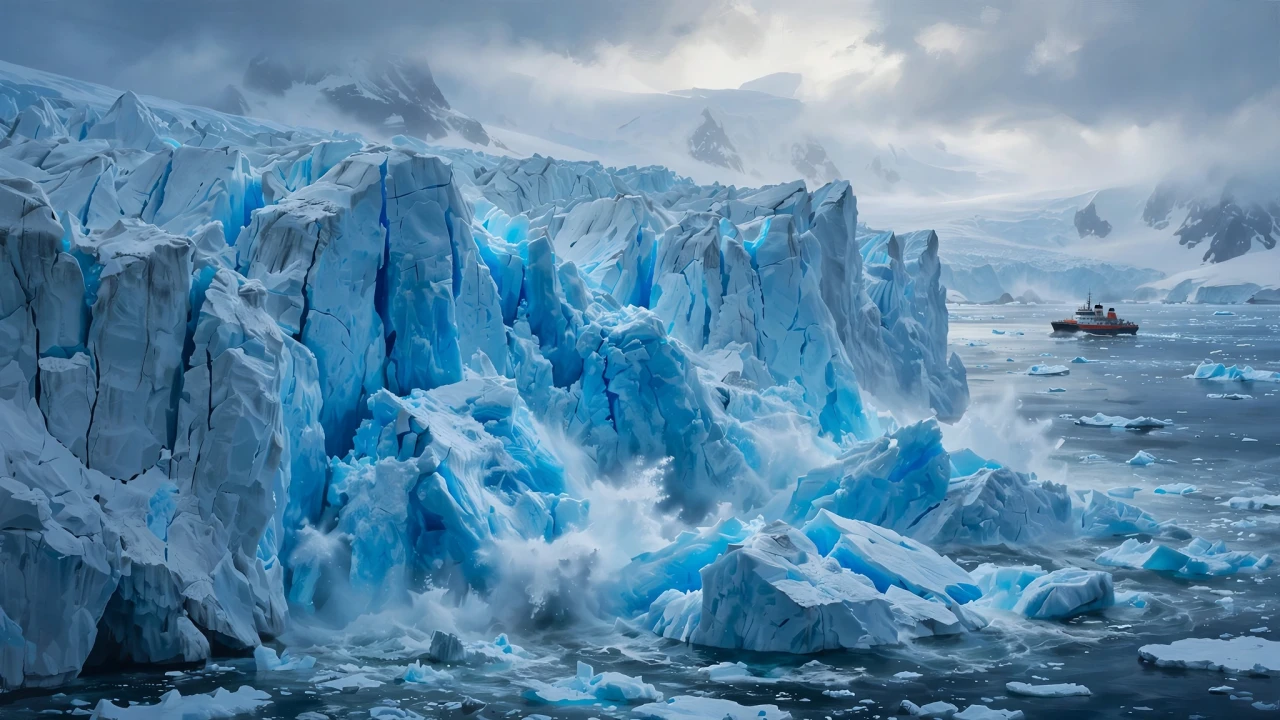
Illustration: The towering front of Thwaites Glacier calving icebergs into the Southern Ocean, symbolizing the accelerating ice loss.
What Happened
In an experiment its lead author called "quite wild," a team led by the British Antarctic Survey (BAS) did something impossible in the real world: they completely switched off all ocean-driven melting beneath both Thwaites and its neighboring Pine Island Glacier in three independent computer models of the ice sheet, then watched what happened over the next 150 years. The aim was to test the glaciers' future trajectory even without warming oceans.
The results, published in the journal Geophysical Research Letters, split sharply between the two glaciers. Pine Island behaved as scientists expected: without any ocean melting, it thickened and began advancing back toward the position it held in the first half of the 20th century. Thwaites, however, continued to lose ice throughout the entire 150-year simulation — albeit at a slowing rate — even with the heat source completely removed. New Scientist, which first reported the study, described the finding as meaning that future ice loss from Thwaites is unavoidable even under the most optimistic climate mitigation scenarios.
"We had hoped that if ocean warming stopped, the ice would thicken and advance again. That is not what happens with Thwaites. This is really unexpected," said Dr Rosie Williams, a glaciologist at the British Antarctic Survey and lead author of the paper. The BAS says the findings are prompting new calls for policymakers to prepare for sea-level rise.
Background
Thwaites Glacier, in West Antarctica, is the world's widest glacier — roughly the size of Great Britain. Together with Pine Island Glacier, it is the area of Antarctica losing the most ice, mainly because relatively warm ocean water is melting the glaciers' floating ice shelves from below, causing the ice inland to thin and retreat. The two are currently the biggest Antarctic contributors to global sea-level rise, and they are losing ice at an increasing rate, according to Williams.
Why does Thwaites keep melting when Pine Island does not? Scientists suspect the enormous glacier is still responding to climate changes that took place decades ago. An extreme El Niño in the 1940s disrupted its balance, and because ice moves so slowly, the effects are still being felt today. On top of that, four decades of human-caused warming have pushed the glacier toward an instability that is difficult to reverse. If Thwaites were to collapse completely, scientists estimate it would contribute about 65 centimeters to global sea level — and could trigger the wider collapse of the West Antarctic Ice Sheet, which holds enough ice to raise seas by around five meters.
The second new study sharpens the near-term picture. Researchers from UC Irvine, NASA's Jet Propulsion Laboratory and partner institutions built an updated ice-sheet model to understand what happens beneath the glacier in West Antarctica — in particular its grounding zone, the region where ice resting on the seabed transitions into floating ice. Rather than treating that transition as a sharp boundary, they modeled it as a zone several kilometers wide. Tides, they found, can push seawater deep into this area, allowing relatively warm ocean water to penetrate beneath the ice and intensify melting. Including these processes helped the model reproduce nearly three decades of observed retreat, thinning and acceleration far more successfully than earlier models.
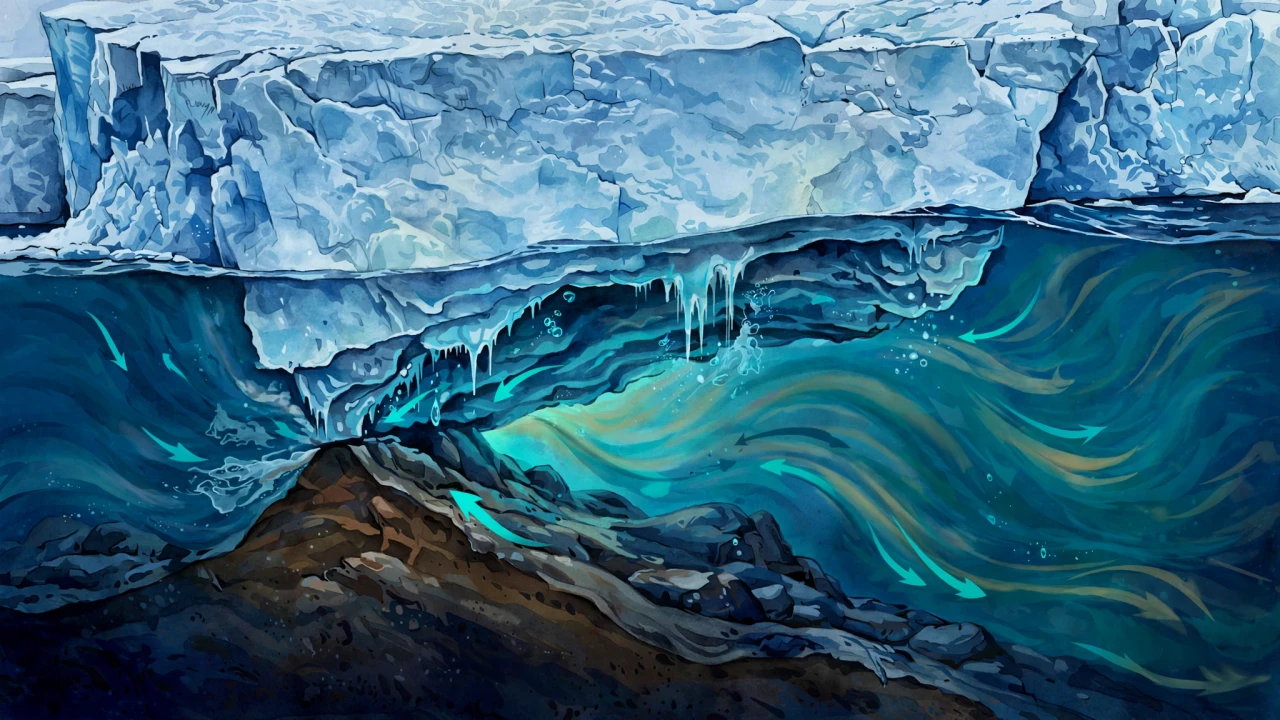
Illustration: Warm ocean water pushed by tides beneath an ice shelf's grounding zone, symbolizing the melting process driving Thwaites' retreat.
Why It Matters
The findings reframe how scientists and planners think about Thwaites. Thwaites currently contributes around 4 percent of global sea-level rise — but the Nature Communications study suggests its contribution by 2100 could be double what previous models assumed under comparable climate scenarios. For coastal communities worldwide — from low-lying island nations to major port cities in Asia, Europe and the Americas — even a few extra centimeters of sea-level rise means more frequent coastal flooding, faster erosion and worse storm-surge damage.
The BAS result carries a different, arguably starker message: a portion of Thwaites' future ice loss is already "locked in" on human timescales. Cooling the ocean — something that cannot actually happen on the required scale — would not reverse the glacier's retreat over the next 150 years. That does not mean efforts to cut emissions are pointless: the researchers stressed that the slower the pace of warming, the slower the glacier will melt, buying time for adaptation. The difference between 30 millimeters and 65 centimeters of sea-level contribution is enormous for coastal planning.
Meanwhile, a separate piece of research reported on October 19 offers a counterpoint to the gloom. A global ice-cliff survey compiling satellite observations across Antarctica found that the continent's tallest ice cliffs fracture and restabilize in fits and starts rather than collapsing steadily — challenging a contested theory that runaway ice-cliff collapse could drive much faster sea-level rise. Scientists say the next step is determining whether this intermittent behavior will materially adjust long-term sea-level forecasts used by climate planners.
What Happens Next
The studies are likely to reshape several agendas at once:
- Coastal planning: City planners and insurers may need to update long-term sea-level projections, since the doubled Thwaites contribution suggests current forecasts could be underestimates for some coastlines.
- Ice-sheet modeling: The grounding-zone insights from the UC Irvine–NASA study are expected to be folded into the next generation of Antarctic models, improving forecasts for other vulnerable glaciers.
- The ice-cliff debate: The global ice-cliff survey's findings will feed into scientific debate over how fast Antarctica can lose ice — a dispute with major implications for sea-level forecasts.
- Adaptation funding: With some Thwaites ice loss now seen as unavoidable for 150 years, researchers say the priority is limiting further warming while preparing for sea-level rise through stronger coastal protection, improved flood planning and restoration of natural barriers such as mangroves.
- Ongoing monitoring: Thwaites remains one of the most intensively studied glaciers on Earth; scientists emphasize that continued satellite and on-the-ground observation is essential to narrow the uncertainty around its future.
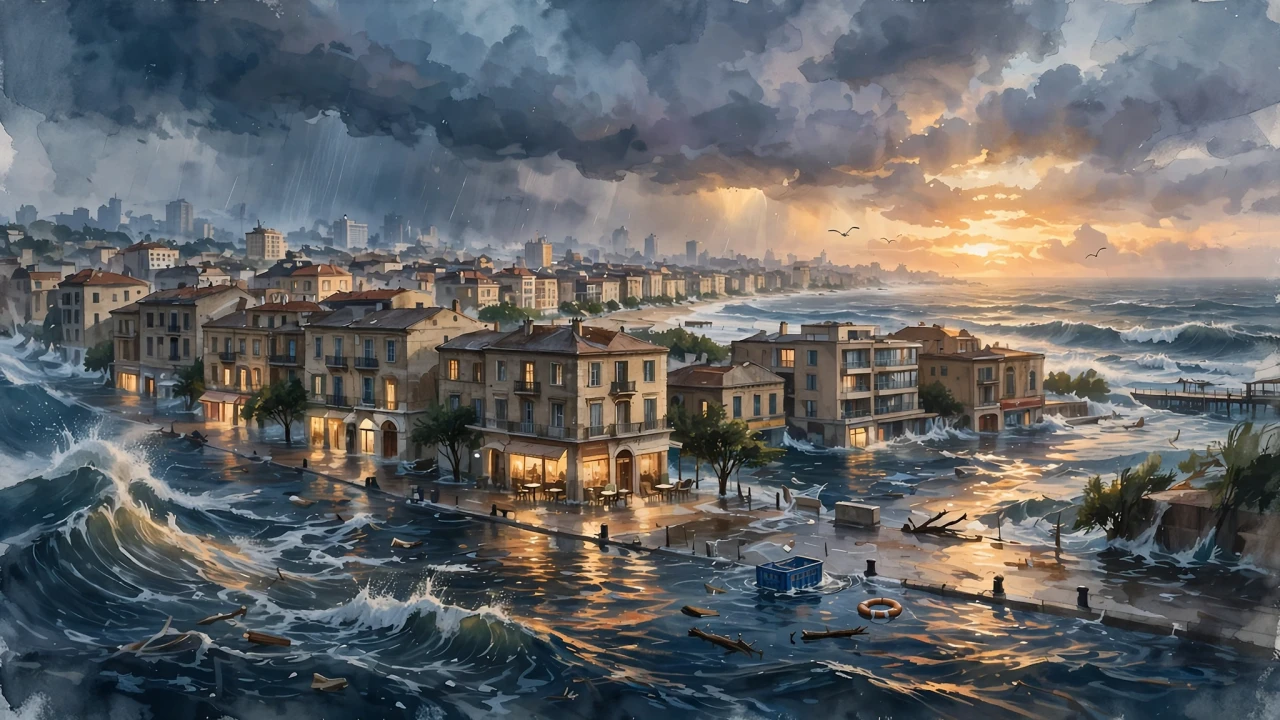
Illustration: Rising seas flooding a coastal city waterfront, symbolizing what is at stake in the Thwaites glacier warnings.
The central takeaway from both studies is sobering but actionable: what happens at Thwaites over the next century is partly already decided — and partly still in humanity's hands.
Sponsored: explore today's featured sponsored offers
FAQ
What is the "Doomsday Glacier"?
Thwaites Glacier in West Antarctica, roughly the size of Great Britain, is nicknamed the "Doomsday Glacier" because its complete collapse could contribute about 65 centimeters to global sea level and potentially trigger the wider collapse of the West Antarctic Ice Sheet, which holds enough ice for around five meters of rise.
Why can't Thwaites be saved even if the oceans cool?
A British Antarctic Survey-led study switched off all ocean melting in three ice-sheet models and found Thwaites still lost ice for 150 years. Scientists suspect it is still responding to a 1940s El Niño disruption, and decades of human-caused warming have pushed it toward a hard-to-reverse instability.
How much could Thwaites raise sea levels by 2100?
A study by UC Irvine and NASA's Jet Propulsion Laboratory, published in Nature Communications on October 12, 2026, estimates Thwaites could contribute up to 30 millimeters (1.2 inches) to global mean sea-level rise by 2100 — roughly double earlier estimates under comparable climate scenarios.
Does this mean cutting emissions is pointless?
No. The researchers stressed that emission cuts remain crucial: the slower the pace of warming, the slower the glacier melts. Less warming means less total ice loss and more time for coastal communities to adapt.
Is all Antarctic ice loss accelerating?
Not uniformly. A separate global ice-cliff survey reported on October 19 found Antarctic ice cliffs fracture and restabilize in fits and starts, challenging theories of runaway collapse. Thwaites and Pine Island are the fastest-losing glaciers, but behavior varies across the continent.
Sources
- British Antarctic Survey, "Thwaites Glacier will keep losing ice even if oceans cool," October 2026
- New Scientist, "Antarctica's 'doomsday' glacier will keep melting even if oceans cool," October 2026
- Williams et al., Geophysical Research Letters, Thwaites/Pine Island modeling study, 2026
- Nature Communications, UC Irvine/NASA JPL Thwaites grounding-zone study, October 12, 2026
- Archynetys trend synthesis, "Global ice-cliff survey tests disputed theory," October 19, 2026
Comments
Post a Comment