
Titian's Venus Comes to Verona: A Renaissance Masterpiece Anchors Castelvecchio's Musical Exhibition
VERONA, Italy — Titian's Venus with a Dog and an Organist, on loan from Madrid's Prado Museum, goes on display at Verona's Castelvecchio Museum from 31 October 2026 to 31 January 2027, anchoring an exhibition that pairs Renaissance painting with the music its subjects depict.
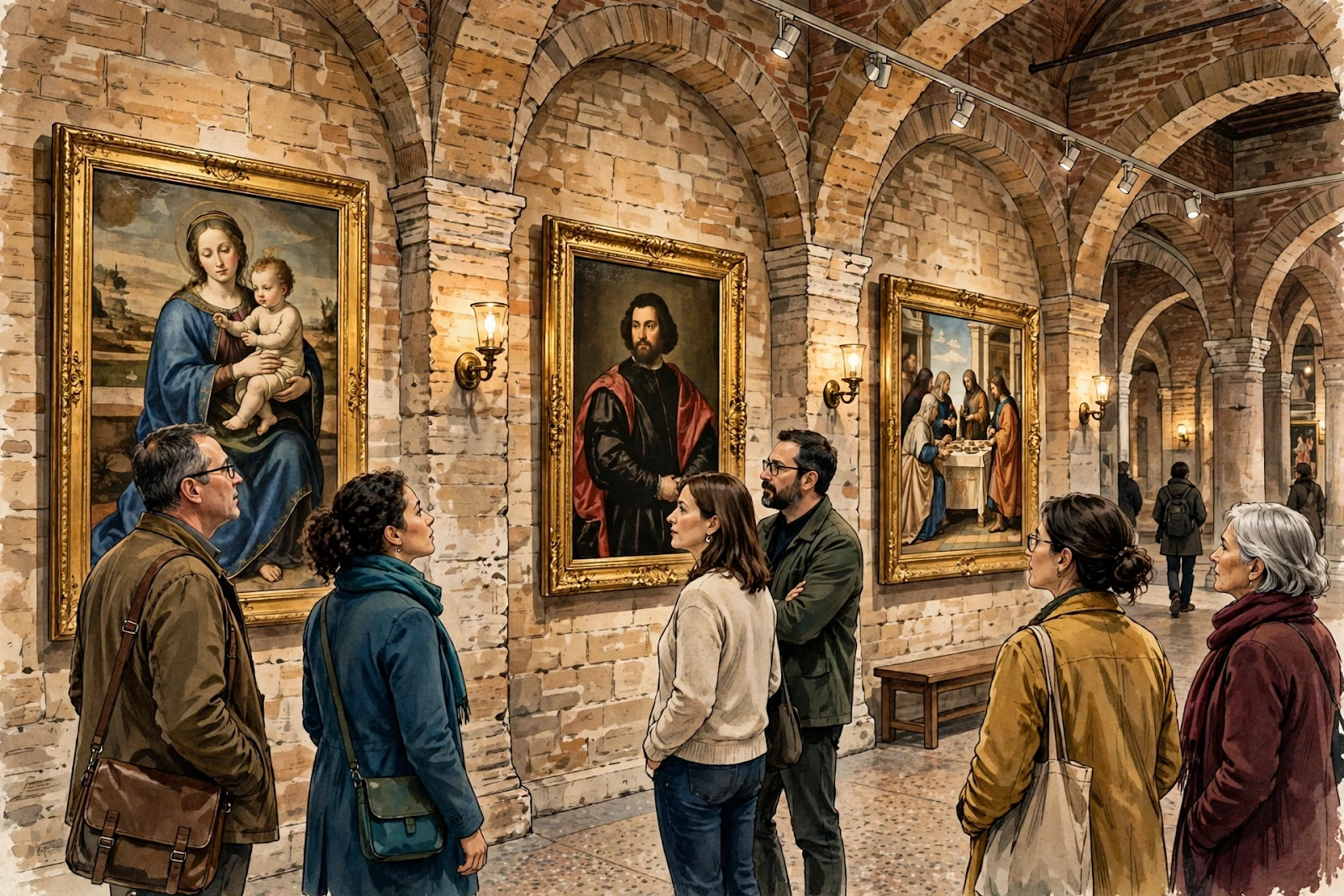
Illustration: Visitors viewing large Renaissance paintings in a historic museum gallery in Verona, Italy.
What Happened
The exhibition, titled La Venere di Tiziano e il Rinascimento musicale — Titian's Venus and the Musical Renaissance — opens on 31 October 2026 in the Sala Boggian at the Castelvecchio Museum (Museo di Castelvecchio) in Verona, and runs until 31 January 2027. Its centrepiece is Titian's Venus with a Dog and an Organist, painted in about 1550 and measuring 148 by 217 centimetres, which has travelled from the Museo Nacional del Prado in Madrid for the show.
The exhibition is promoted by the Municipality of Verona's Civic Museums and the Castelvecchio Museum itself, with the Prado and the Accademia Filarmonica di Verona as scientific partners, and is co-produced by Civita Mostre e Musei. The curators are Francesca Rossi, Luca Fabbri and Michele Magnabosco, according to the exhibition programme reported in October 2026. The show also marks a milestone for its host: it forms part of the programme marking the centenary of the Castelvecchio Museum, which opened in 1926.
Around 30 paintings, sculptures, musical instruments, books and original scores are brought together in the display. Alongside Titian's Venus, visitors will see Jacopo Tintoretto's The Contest of the Muses and the Pierides and Marietta Robusti's Self-Portrait with a Spinet, on loan from the Uffizi Galleries, as well as cornets, Renaissance flutes, madrigal books and musical manuscripts from the Accademia Filarmonica di Verona. The point, the organisers say, is not to treat the instruments as separate museum objects, but to show them as part of the world the paintings depict.
Background
Titian, or Tiziano Vecellio (about 1490–1576), was the leading painter of the Venetian Renaissance, and his reclining Venuses are among the most copied compositions in Western art. The Prado's version — listed by the museum as Venus with an Organist and a Dog — shows the goddess reclining before a large window, an organist playing at her feet and a small dog nearby, a variation on a subject Titian returned to several times for patrons on the Venetian mainland. The Prado notes that the five paintings on this subject are variations on one idea rather than a single commission, and that the Madrid and Berlin versions pair Venus with an organist while the New York and Cambridge versions pair her with a lute player.
That musical thread is what the Verona exhibition pulls on. In Renaissance thinking, music was not background entertainment but a liberal art, tied to ideas about love, knowledge and beauty — the same ideas the exhibition's programme links to Titian's painting. By placing real Renaissance instruments beside the painted ones, and by filling the gallery with madrigal books and original scores, the show asks visitors to hear, in imagination at least, the music the organist is playing.
The setting adds its own history. The Castelvecchio is Verona's civic museum, housed in a castle built between 1354 and 1356, with collections spanning medieval, Renaissance and later art, and a fortified bridge over the Adige. Its Sala Boggian provides the exhibition's single-room stage, and the museum's centenary programme has made the Titian loan its headline event.

Illustration: Renaissance musical instruments and old music manuscripts displayed in a museum case.
Why It Matters
Loans of this calibre are rare. A Titian Venus does not travel lightly, and the Prado's willingness to lend one of its great Venetian canvases to a civic museum in Verona — rather than to a national capital — says something about how major museums now share their treasures. For Verona, a city better known for its Roman arena and its Shakespearean associations, the exhibition is a chance to assert its standing as a Renaissance city in its own right.
The show also matters for how museums are thinking about old paintings. Too often, a masterpiece is presented as a beautiful object on a wall, with its subject matter left to speak for itself. By reuniting Titian's painted organ with real instruments, and by programming live music in the same room, Verona is trying a more immersive approach: the painting becomes a doorway into a whole culture of music-making, from court entertainments to the conservatory classroom.
There is a practical draw, too. The exhibition runs for three full months, through the quieter winter season, giving Verona a cultural anchor at a time when many Italian cities compete for off-season visitors. Paired with the museum's permanent collections and the city's Roman and medieval sites, a single celebrated loan can carry a whole winter programme.

Illustration: Castelvecchio castle and its fortified bridge over the river in Verona, Italy.
What Happens Next
After the 31 October opening, the exhibition's music programme brings the gallery to life. Classes from the E. F. Dall'Abaco Conservatory's Early Music Department are due to perform in the Sala Boggian on 21 November, 5 December and 19 December 2026, and on 9 January 2027, playing historical instruments in the same room as the paintings. Guided visits on selected dates are also part of the programme, according to the official exhibition listing published by Visit Verona, the city's official destination site.
Visitors planning a trip have until 31 January 2027 to see the show, after which Titian's Venus returns to Madrid. The Castelvecchio Museum, at Corso Castelvecchio 2 in Verona, sits within the historic castle complex beside its fortified bridge, and the exhibition route runs through the museum's galleries rather than a separate modern hall — worth knowing for anyone expecting a single large exhibition space.
For the wider museum world, the show will be watched as a test of the loan-and-performance model. If audiences respond to hearing Renaissance music beside Renaissance painting, other civic museums may follow Verona's lead, pairing their own celebrated loans with the sounds, instruments and manuscripts that bring a painted world back to life.
Sponsored: explore today's featured sponsored offers
FAQ
When does the Titian exhibition in Verona run?
La Venere di Tiziano e il Rinascimento musicale runs from 31 October 2026 to 31 January 2027 in the Sala Boggian at the Castelvecchio Museum, Verona.
What is the exhibition's centrepiece?
Titian's Venus with a Dog and an Organist, painted in about 1550 and measuring 148 by 217 centimetres, on loan from the Museo Nacional del Prado in Madrid.
What else is on display?
Around 30 works in total, including Tintoretto's The Contest of the Muses and the Pierides, Marietta Robusti's Self-Portrait with a Spinet from the Uffizi, and Renaissance instruments, madrigal books and scores from the Accademia Filarmonica di Verona.
Are there live performances?
Yes. Students from Verona's E. F. Dall'Abaco Conservatory Early Music Department are due to perform in the Sala Boggian on 21 November, 5 December and 19 December 2026, and 9 January 2027.
Why is the exhibition significant for Verona?
It marks the centenary of the Castelvecchio Museum, which opened in 1926, and brings a celebrated Prado loan to a civic museum, pairing Renaissance painting with the musical culture it depicts.
Sources
- Visit Verona exhibition listing for La Venere di Tiziano e il Rinascimento musicale, reported October 2026
- Museo Nacional del Prado collection page, "Venus with an Organist and a Dog," Titian, about 1550
- Exhibition programme details (curators, partners, concert dates), reported October 2026
Comments
Post a Comment