
WASHINGTON — President Donald Trump's sweeping tariffs have reshaped America's trade deficit without shrinking it, according to a new study by the German Economic Institute (IW) published on 30 October 2026, days before voters head to the polls in the US midterm elections. The report, titled "US midterm elections: Unfulfilled promises," finds that the goods trade deficit stood at $130 billion in August 2026 — higher than in the same month two years earlier — even though the countries behind that deficit have changed sharply, with Mexico and Vietnam now each accounting for a fifth of the total.

Illustration: A busy container port at dusk, with stacked containers, cranes and a cargo ship being loaded. AI illustration, not a real photograph.
What Happened
The IW study, seen by Reuters on 30 October, assesses the first two years of Trump's second term, which began in January 2025, against the administration's own economic promises. It focuses on three pillars of that agenda: a loose fiscal policy that reduced tax burdens, a trade policy built around unilateral tariffs, and an effort to revitalise domestic manufacturing while supporting investment in artificial intelligence.
On the central promise of cutting the goods trade deficit, the verdict is blunt. Reducing that deficit was, in the institute's words, one of the central aims of the administration, pursued through a wide range of import tariffs. But, the report says, "since there are dominant macroeconomic factors driving the US goods trade deficit, the tariffs have not led to a sustained reduction so far."
The headline number tells that story in a single figure. In August 2026, the monthly total US goods trade deficit amounted to $130 billion, according to the IW, higher than in August 2024. The US Census Bureau's advance release, reported by Reuters on 30 September, put the August goods shortfall at $132.6 billion, up $13.7 billion, or 11.5%, from $118.9 billion in July, after imports jumped $17.4 billion to $336.1 billion while exports rose $3.7 billion to $203.4 billion — a reminder that the August gap was wide on either measure, and wider than economists polled by Reuters had forecast.
What changed, the IW stresses, is the composition of the deficit rather than its size. Tariffs vary by country and by product group, so trade has been rerouted more than it has been reduced. The European Union accounted for only 7% of the total US goods trade deficit in August 2026, down from 20% in August 2024. China accounted for 14%, down from 29% two years earlier. In their place, Mexico and Vietnam now each account for 20% of the total. The absolute value of the US goods trade deficit with Germany, by contrast, remained relatively stable throughout the first two years of Trump's second term, the report says.
The institute adds an important qualification on Europe. The EU's falling share is, it says, less because of a significant reduction in US imports from the EU than because the United States is exporting more goods to the EU, especially energy products. In other words, the map of the deficit moved partly because American sales abroad grew, not only because foreign sales into America fell.
Background
Cutting the trade deficit has been a signature goal of Trump's economic programme in both of his terms, and the tariff programme of his second term is its most visible instrument. The logic, as the administration has presented it, is that tariffs make imports more expensive, encourage consumers and firms to buy American, and push foreign companies to build factories in the United States rather than ship goods across its borders. The IW report tests that logic against what actually happened to trade, investment and jobs.
Its broader assessment is mixed rather than uniformly negative. Gross domestic product growth remained solid and investment increased substantially, the institute says, and investment in AI is indeed dynamic and drives overall GDP growth. But the labour market added fewer jobs than under the previous administration, and inflation has been well above the Federal Reserve's 2% target, adding to what the report calls an ongoing affordability crisis in the United States.
The report also warns that the growth model itself is fragile. AI investment's outsized importance in the US economy, it says, contributes to fragility that might backfire through wealth concentration and financial market volatility — a caution that echoes the market turmoil of late October, when heavy AI spending by big technology companies unsettled investors even as those companies reported strong demand.
The second half of the reshoring promise — bringing manufacturing investment home — also falls short in the IW's reading. Using data from the US Bureau of Economic Analysis, the institute finds that total foreign direct investment (FDI) inflows to the United States amounted to $248 billion in 2025, a reduction of 8.2% on the previous year and 18% below the average for 2015–2024. FDI from the EU rose slightly, by 1.4% in 2025 compared with 2024, but was still 12% below the average of the previous ten years. The trend for German companies is unclear, the report notes: US data indicate a 40% increase in 2025, while data from the German Bundesbank record a 21% decrease.
Manufacturing investment tells a similar story. Worldwide manufacturing FDI flows to the United States rose slightly, by 3.3%, to $114 billion in 2025 compared with 2024, but that was still around 20% below the 2015–2024 average, and the negative trend also holds for EU manufacturing FDI flows, according to the IW.

Illustration: A stylised world map with trade routes linking North America, Europe and Asia, showing how trade flows have shifted. AI illustration, not a real photograph.
Why It Matters
The findings matter first because they arrive as a referendum, not just a report. The IW frames its study explicitly around the midterm elections on 3 November 2026, described as the first nationwide referendum on Trump's second term, and asks whether the elections can or will change the direction of US economic and foreign policy. Voters will therefore be judging the tariff experiment at the very moment an independent European institute concludes that its headline goal remains unmet.
Second, the shift in the deficit's composition matters for American consumers and businesses even if the total has not fallen. A deficit concentrated in Mexico and Vietnam rather than the EU and China changes which supply chains, prices and diplomatic relationships are most exposed to the next round of tariff decisions. It also shows how quickly trade can be rerouted around country-specific tariffs: when duties differ by origin, importers can switch suppliers without necessarily buying American, leaving the overall gap intact while redrawing its geography.
Third, the investment numbers cut against the claim that tariffs alone can rebuild manufacturing. If foreign investment into the United States fell in 2025, and manufacturing investment remains well below its ten-year average, then tariffs may need to be paired with other policies — on skills, energy costs, permitting and tax — before factories follow. The IW does not prescribe that package, but its data suggest the tariff lever, on its own, has not delivered the investment surge the reshoring argument promised.
Fourth, the fiscal backdrop constrains what comes next. The report notes that the US-Israeli war against Iran is adding to already high government debt and pushing up interest rates further, forcing lenders to question whether the United States can sustain outstanding debt of $40 trillion. A trade policy that was supposed to strengthen America's economic position is thus being judged alongside a debt burden that, in the institute's assessment, is itself becoming a source of market concern.
Finally, the report is a useful corrective to a simple scoreboard. A falling deficit with one partner is not the same as a falling deficit overall, and a rising export figure can shrink a partner's share without any fall in imports. The IW's August snapshot — $130 billion in total, with the EU at 7%, China at 14%, and Mexico and Vietnam at 20% each — captures both halves of that lesson at once.
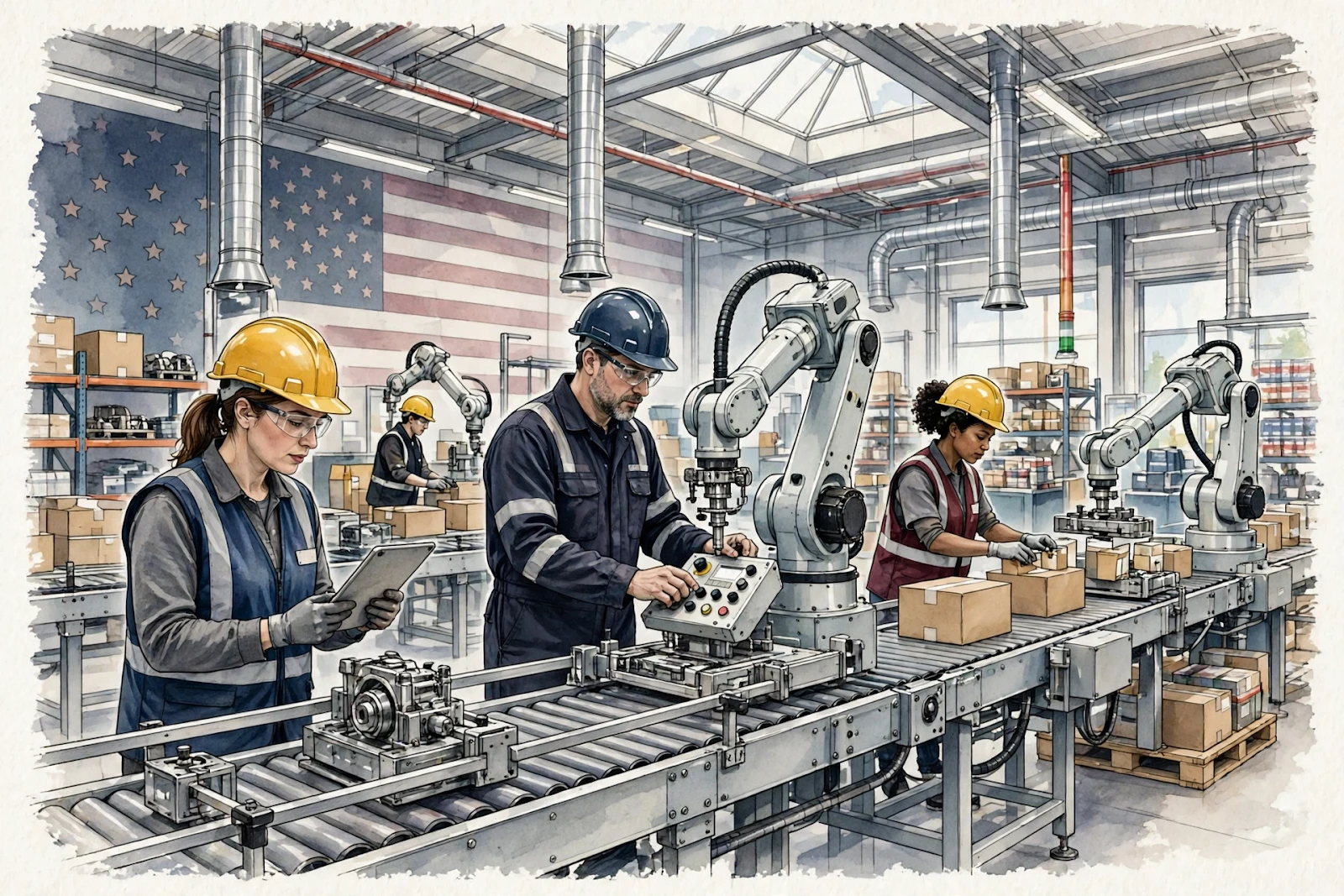
Illustration: A modern American factory interior, with workers and machinery producing goods. AI illustration, not a real photograph.
What Happens Next
The immediate test is political. Voters go to the polls on 3 November 2026, and the IW report asks, without answering, whether the elections can or will change the direction of US economic and foreign policy. A Congress more hostile to the administration could constrain future tariff or fiscal moves; a Congress that backs the programme could leave it intact. Either way, the report gives both sides a common set of numbers to argue over: a deficit that is still $130 billion a month, a reshaped map of trading partners, and investment inflows below their recent average.
The next economic test is statistical. Fresh trade and investment data in the coming months will show whether August was an outlier or part of a pattern — whether imports stay elevated, whether exports to Europe keep growing, and whether the Mexico and Vietnam shares hold. The Census Bureau's September advance figures already showed trade subtracting from GDP for three straight quarters, according to Reuters, so the direction of the next releases will matter for growth as well as for the tariff debate.
Watch, too, for the administration's response. The IW study is an outside assessment, not an official verdict, and the White House has previously pointed to solid GDP growth and buoyant AI investment — both acknowledged in the report itself — as evidence that its programme is working. If the administration disputes the institute's reading, expect it to emphasise those strengths, and the export growth behind Europe's shrinking share, rather than the headline deficit figure.
For readers outside the United States, the stakes are practical. Tariff rates that vary by country will keep pushing supply chains toward lower-duty origins, and any post-midterm shift in US trade policy will ripple through exporters in Mexico, Vietnam, Europe and China alike. The deficit may not have shrunk, but the map it draws is already redrawing the world's trade routes.
Sponsored: explore today's featured sponsored offers
FAQ
What did the German Economic Institute report find?
It found that President Donald Trump's tariffs have not led to a sustained reduction in the US goods trade deficit, which stood at $130 billion in August 2026, higher than in August 2024, even though the deficit's composition changed sharply.
Which countries now account for the largest shares of the US goods deficit?
According to the IW, Mexico and Vietnam each accounted for 20% of the total US goods trade deficit in August 2026, while the EU accounted for 7% (down from 20% in August 2024) and China for 14% (down from 29%).
Why did the EU's share fall if imports did not collapse?
The IW says the EU's falling share is less because US imports from the EU fell significantly than because the United States exported more goods to the EU, especially energy products.
Did foreign investment into the United States rise under the tariff programme?
No, on the IW's reading of Bureau of Economic Analysis data: total FDI inflows were $248 billion in 2025, down 8.2% on the previous year and 18% below the 2015–2024 average, while manufacturing FDI remained around 20% below its ten-year average.
Why does the report appear just before the midterms?
The IW frames the study around the midterm elections on 3 November 2026, the first nationwide referendum on Trump's second term, and asks whether the elections can or will change the direction of US economic and foreign policy.
Sources
Reuters, "Trump's tariffs fail to cut US trade deficit, IW report shows," 30 October 2026 — https://www.reuters.com/business/trumps-tariffs-fail-cut-us-trade-deficit-iw-report-shows-2026-10-30/
German Economic Institute (IW), "US midterm elections: Unfulfilled promises," by Daniel James Muncaster, Thomas Obst and Samina Sultan, 30 October 2026 — https://www.iwkoeln.de/en/studies/daniel-james-muncaster-thomas-obst-samina-sultan-us-midterm-elections-unfulfilled-promises-eng.html
Reuters, "US goods trade deficit widens sharply in August," 30 September 2026 — https://wncy.com/2026/09/30/us-goods-trade-deficit-widens-sharply-in-august/
Comments
Post a Comment