
ANKARA, 27 October 2026 — Türkiye has set out a global waste-cutting target for the COP31 climate summit, aiming to halve the projected increase in municipal waste generation by 2035, as the country prepares to host the United Nations climate conference in Antalya from 9 to 20 November.

Illustration: The coastal city of Antalya in Türkiye, with turquoise sea, mountains and conference banners ahead of a climate summit.
What Happened
Türkiye's environment, urbanisation and climate change minister, Murat Kurum, who is also president of COP31, announced the target on Tuesday, 27 October 2026, while delivering the opening address at a panel discussion in Ankara titled "From Zero Waste to COP31: Türkiye's Climate Diplomacy", organised by the Directorate of Communications of the Turkish Presidency.
Under the COP31 Action Agenda, Türkiye aims to reduce the projected increase in global municipal waste generation by at least half by 2035, and to encourage partnerships to raise the circular material use rate to at least 15 per cent by the same year. Kurum said climate commitments must translate into tangible, practical action, adding: "If the devastating impacts of the climate crisis are being felt in our daily lives, then the results of our pledges to address climate change must also be clearly visible."
Kurum said Türkiye wants COP31 to be a conference focused on concrete action, with ten key priorities, and warned that the need to address climate change must not be overlooked amid wars, political instability and economic uncertainty. He noted that while political and economic conditions may continue to change, some damage to nature could be irreversible.
The waste target sits alongside other measurable goals in the COP31 Action Agenda: raising the share of electricity in final energy consumption to 35 per cent by 2035, reducing energy-use intensity in buildings by at least 25 per cent by 2035, and connecting climate projects with financing through a mechanism called the Climate Implementation Bridge, or BRIDGE. The presidency also plans to prioritise protecting seas and oceans by preventing pollution at its source and strengthening coastal resilience.
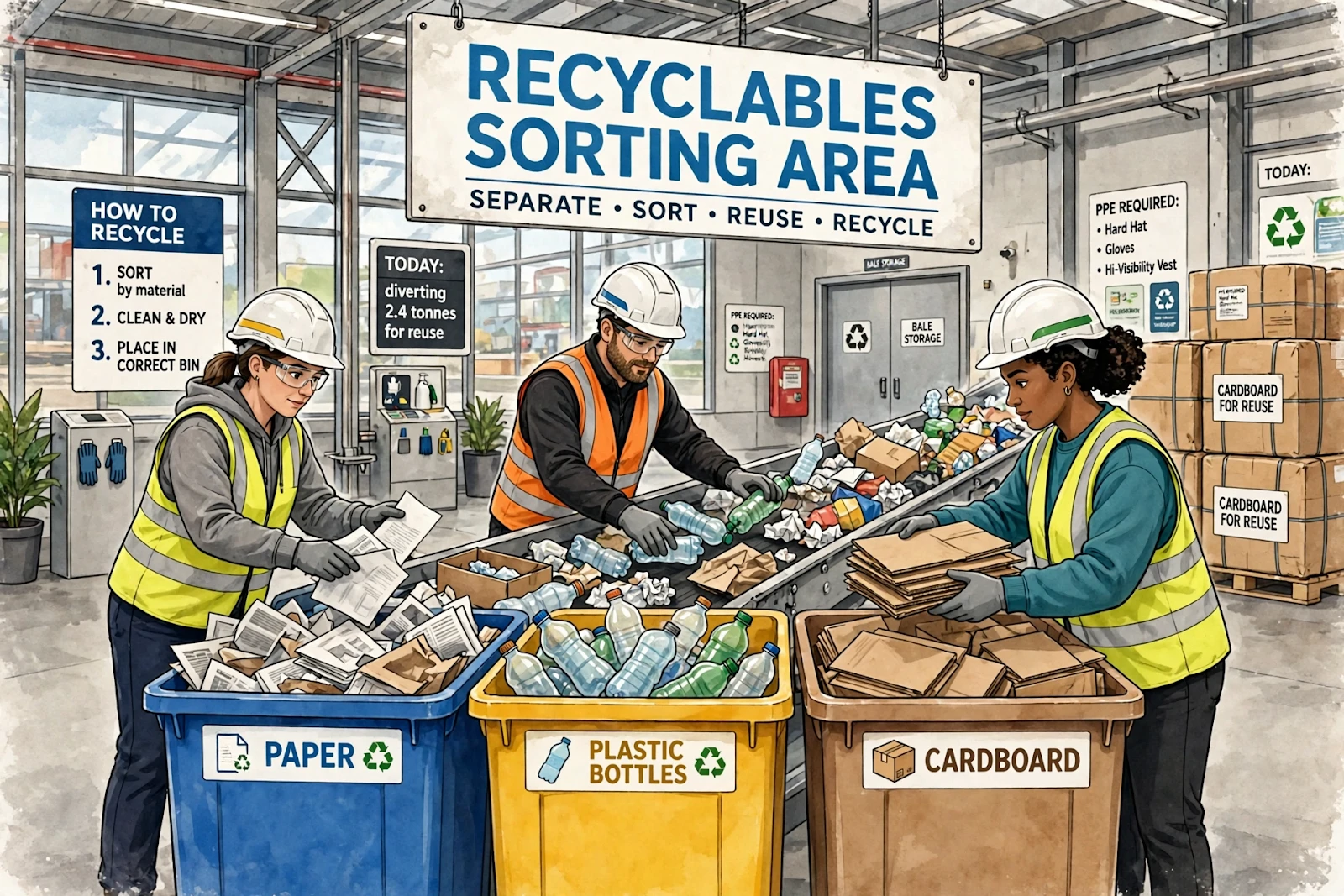
Illustration: Workers sorting recyclable waste into colour-coded bins at a modern recycling facility.
Background
Türkiye's pitch rests on its own Zero Waste Movement, launched in 2017 under the leadership of First Lady Emine Erdoğan. Kurum said the initiative had grown into a nationwide mobilisation reaching individuals and families, schools, municipalities, businesses and public institutions, and described it as a call for people to view nature as a partner rather than a rival, reflecting a culture of conserving resources and rejecting excessive consumption.
According to Kurum, Türkiye increased its recycling rate from 13 per cent in 2017 to 37 per cent in 2025, recovering 90 million tons of waste and contributing approximately 365 billion Turkish lira, about $8.4 billion, to the economy over the period. The country's Deposit Return System, known as DOA, has returned 520 million packages to the economy for reuse and recycling, he said.
The global stakes are large. The official COP31 presidency site describes the waste sector as the third largest source of human-caused methane, responsible for 30 per cent of global warming since the Industrial Revolution, and says global waste generation is projected to increase by 50 per cent by 2050. The United Nations Environment Programme has projected that global municipal waste will rise from 2.1 billion tonnes today to 3.8 billion tonnes by 2050 if current trends continue, according to reporting on the COP31 agenda. Most of the climate damage from waste comes not from the rubbish itself but from methane released when organic waste rots in landfills, a gas that traps far more heat than carbon dioxide over the short term but breaks down within roughly a decade, making cuts unusually fast-acting.
COP31 arrives at a difficult moment for climate diplomacy. The conference, held in Antalya from 9 to 20 November 2026, follows a year in which greenhouse gas concentrations hit new records and current national pledges were judged far short of what is needed to limit warming. Türkiye has presented its presidency as an "implementation COP", focused on turning existing commitments into funded projects rather than announcing new pledges. The waste target is designed to be one of the few goals that can be measured in tonnes, recycling rates and methane cuts, rather than in diplomatic language alone.
Why It Matters
Waste is one of the most overlooked climate levers, and also one of the cheapest. Cutting landfill methane delivers faster near-term cooling than many other measures, because methane's warming effect is intense but short-lived. Better sorting, composting, recycling and food-waste prevention can therefore slow warming within years, not decades, while also saving cities money and reducing pollution.
The target also matters because it is testable. Halving the projected increase in waste by 2035, lifting circular material use to 15 per cent and cutting building energy intensity by a quarter are numbers that can be checked against real data when 2035 arrives. That measurability is the point of Türkiye's approach: after years in which climate summits were criticised for producing promises without delivery mechanisms, the presidency wants outcomes that can be audited.
For developing countries, the waste agenda carries a different promise. Many fast-growing cities lack the collection, sorting and landfill-gas infrastructure that richer countries take for granted, and their waste volumes are rising fastest. If COP31 pairs the waste target with financing and technical help through the BRIDGE mechanism, it could give those cities practical support rather than just another target to miss. If it does not, the target risks becoming another headline that fades once the summit leaves Antalya.

Illustration: A landfill site with methane gas rising above waste piles at sunset, with green fields and wind turbines in the distance.
What Happens Next
The test comes in Antalya, where negotiators and governments will decide whether to endorse, strengthen or ignore the presidency's Action Agenda. Because the waste target is part of the presidency's agenda rather than a negotiated treaty outcome, its authority will depend on how many countries and companies sign up to it during the summit, and on whether concrete partnerships and funding follow.
Watch for three things in November: which countries back the waste and circular-economy goals in their own national climate plans, whether the BRIDGE mechanism produces investment-ready waste projects rather than pilot announcements, and whether the summit's final decisions mention waste-related methane at all. A target that enters national climate plans would have lasting force; one that stays in presidency speeches would not.
Beyond COP31, the longer question is whether Türkiye's own record can be replicated. A recycling rate that rose from 13 to 37 per cent in eight years shows rapid change is possible, but it was driven by a national mobilisation, deposit-return rules and sustained political backing. Other countries will need their own versions of that combination, adapted to very different waste systems, if the global goal of halving the projected waste increase by 2035 is to be met.
Sponsored: explore today's featured sponsored offers
FAQ
What waste target did Türkiye announce for COP31?
Türkiye aims to halve the projected increase in global municipal waste generation by 2035, and to raise the circular material use rate to at least 15 per cent by the same year, under the COP31 Action Agenda announced on 27 October 2026.
When and where is COP31?
COP31, the United Nations climate conference, takes place in Antalya, Türkiye, from 9 to 20 November 2026, with Türkiye holding the presidency.
Why does waste matter for the climate?
The waste sector is the third largest source of human-caused methane, according to the COP31 presidency, and methane traps far more heat than carbon dioxide in the short term, so cutting landfill methane can slow warming relatively quickly.
What is Türkiye's own zero-waste record?
Minister Murat Kurum said Türkiye raised its recycling rate from 13 per cent in 2017 to 37 per cent in 2025, recovering 90 million tons of waste, while its deposit return system returned 520 million packages for reuse and recycling.
Is the waste target already agreed by all countries?
No. It is part of the COP31 presidency's Action Agenda, not a negotiated treaty outcome, so its force will depend on how many countries and companies endorse it and fund waste projects during and after the Antalya summit.
Sources
- BeyondHeadlines, "Türkiye to Set Global Waste Reduction Target at COP31, Push for Action Through Climate Diplomacy", 27 October 2026
- COP31 Türkiye official site, "Zero Waste" Action Agenda page, accessed 29 October 2026
- EuropeSays / Daily Sabah reporting, "Türkiye advances zero waste, electrification goals at COP31", 27 October 2026
Comments
Post a Comment