
The United Arab Emirates has completed its first entirely home-built space probe: a 10-kilogram autonomous lander, designed, assembled and tested in Abu Dhabi in less than two years, that will ride the Emirates Mission to the Asteroid Belt across some five billion kilometers of space before plunging onto the surface of the reddish asteroid 269 Justitia in the mid-2030s. The unveiling, announced on October 1, 2026 and attended by Dubai's Crown Prince Sheikh Hamdan bin Mohammed, marks the moment the UAE's space program moved from assembling other nations' designs to engineering its own deep-space hardware.
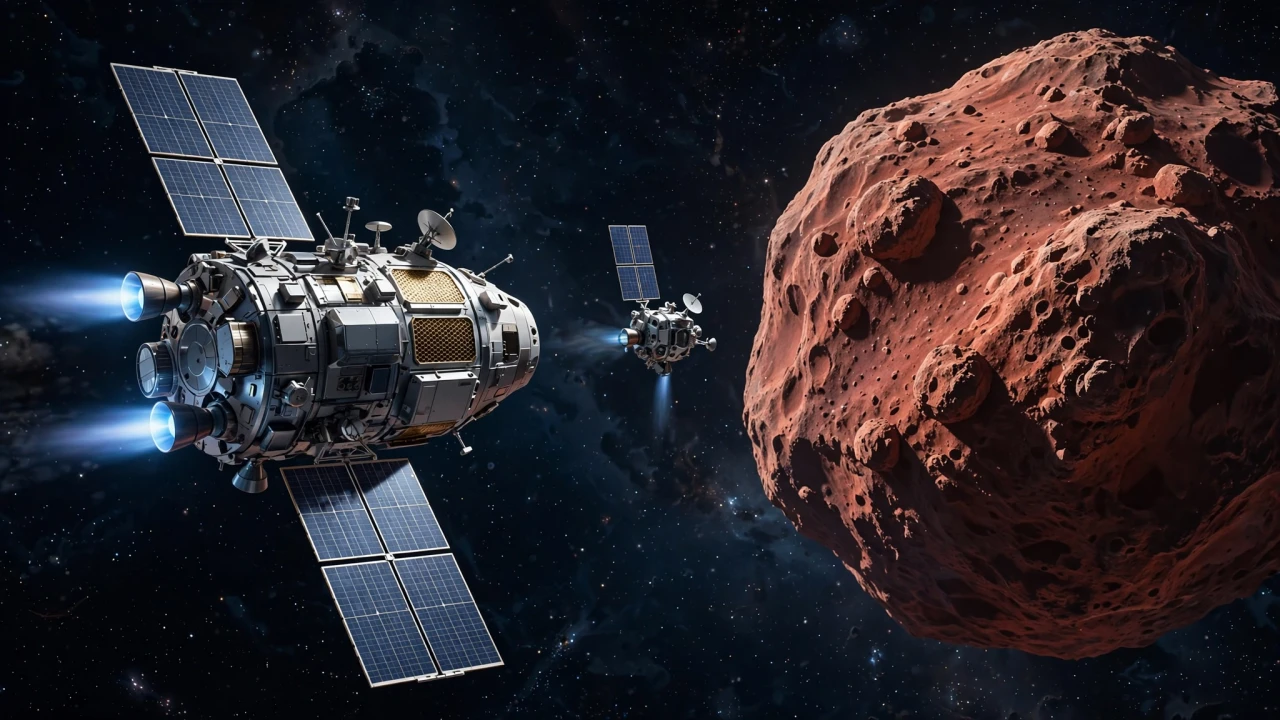
Illustration: the MBR Explorer spacecraft approaching the reddish asteroid Justitia, with a landing probe detaching. This is an AI-generated illustration, not a real scene.
What Happened
The Technology Innovation Institute (TII), the UAE's government-backed advanced-research agency, revealed the completed probe in a press release on October 5, 2026, days after its unveiling at an Abu Dhabi event on October 1. According to TII, the probe is the mission's only deployable payload: it will separate from the main MBR Explorer spacecraft during a low-altitude pass over 269 Justitia, make direct physical contact with the surface, excavate material and transmit close-range imagery back to the orbiter to investigate organic compounds believed to have originated in the outer reaches of the Solar System.
The announcement drew international attention when Nature reported it on October 8, describing the device as the Arab world's first solo space probe. More than 150 engineers and scientists worked on the mission, and Sheikh Hamdan bin Mohammed — Dubai's Crown Prince, Deputy Prime Minister and Minister of Defence — attended the unveiling, saying in a post on X that the probe had achieved flight readiness in less than two years. He added that the UAE's space sector is now valued at more than 44 billion dirhams, with a national goal of doubling the returns of the space economy by 2031 and entering the world's top 10 space economies.
The probe's next stop is not space but Colorado: it will soon travel to the University of Colorado Boulder, where US collaborators will integrate it with the main MBR Explorer spacecraft ahead of a planned launch in March 2028.
Background
The Emirates Mission to the Asteroid Belt (EMA) is the UAE's second interplanetary voyage, following its Hope Mars orbiter. It is an ambitious itinerary: the MBR Explorer will fly past six asteroids in the main belt, studying each with cameras and spectrometers that can analyze material composition remotely, and will also observe Venus and Mars along the way. The grand finale comes in the mid-2030s, when the spacecraft dispatches the tiny probe to its final destination — 269 Justitia.
Justitia is no ordinary space rock. Its unusual red color suggests it contains materials more commonly found much farther out in the Solar System than its current orbit between Mars and Jupiter. Scientists think it may have formed in the distant Kuiper Belt and migrated inward over billions of years — an ancient "traveller from the past" that could preserve clues to how water and organic material were distributed during the formation of the planets, according to Elias Tsoutsanis, chief researcher for the Propulsion and Space Research Center at TII, speaking at the October 1 event.
If the landing succeeds, Justitia would become only the seventh asteroid in history to be reached on its surface by a probe — and the UAE would become the fourth space power to touch an asteroid, according to scientists and engineers involved in the program cited by Nature. The mission supports the UAE's National Space Strategy 2031, and the Supreme Space Council approved a 1-billion-dirham International Space Cooperation Program in May 2026 to foster partnerships and train specialized engineers.
The achievement is also a statement about how the UAE builds space hardware. TII says the probe was designed, built and tested entirely in the Emirates, operating fully autonomously around and on Justitia — making onboard decisions about imaging, image retention and power management without continuous commands from Earth. As Nature noted, some researchers see this as a milestone on the road to full independence: while the main MBR Explorer spacecraft is being built jointly with US partners, the landing probe itself is a purely Emirati creation.
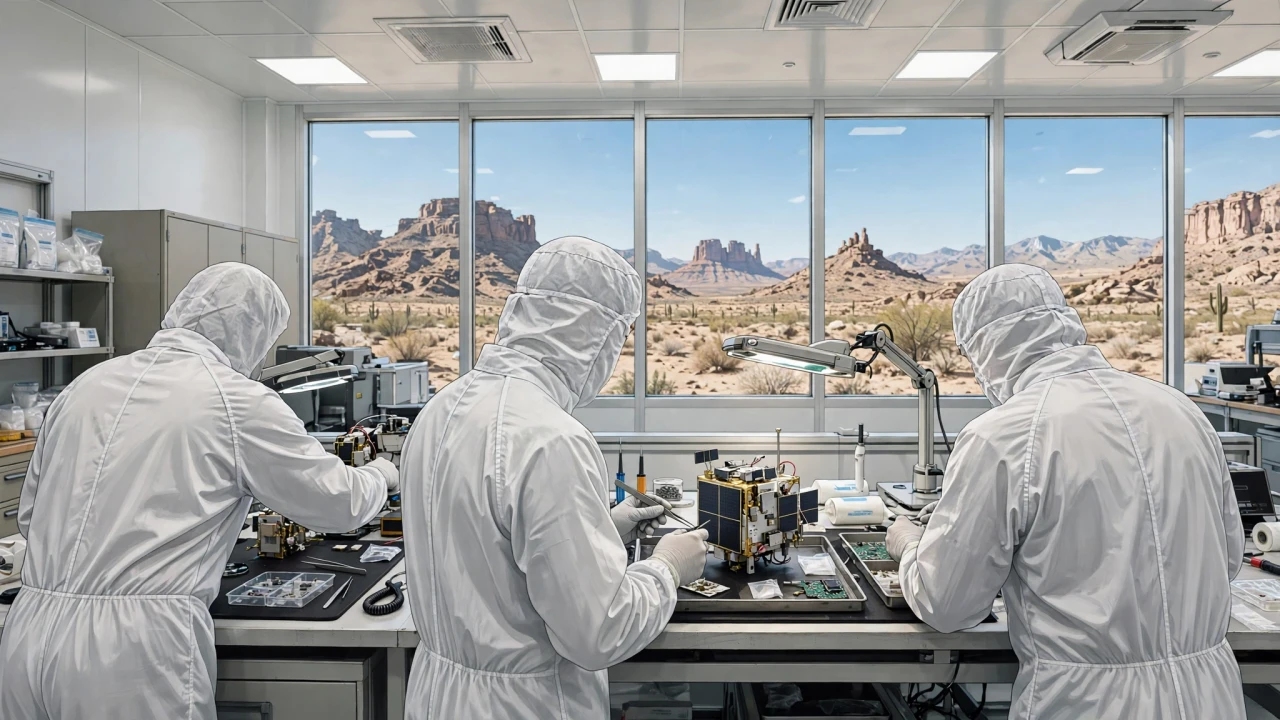
Illustration: engineers assembling a small space probe in a clean room. This is an AI-generated illustration, not a real scene.
Why It Matters
Touching down on an asteroid is one of the hardest maneuvers in spaceflight. Only a handful of missions — by the United States and Japan — have ever made physical contact with an asteroid's surface. Gravity on a small body like Justitia is almost nonexistent, so a lander cannot simply drop: it must be steered, gently, onto a surface whose exact topography is only partially mapped, in near-total communication delay. Doing it autonomously, with a 10-kilogram probe built by a space program barely a decade old, would be a genuine engineering feat.
The science matters as much as the symbolism. Justitia's red spectrum sets it apart from the typical gray asteroids of the main belt. If it really is a captured refugee from the Kuiper Belt, its surface material could contain some of the most primitive chemistry in the Solar System — organic compounds and water-bearing minerals dating to the era when the planets themselves were assembling. A successful landing would give planetary scientists their first close-up look at this class of object.
For the UAE, the probe is proof that its strategy of converting research funding into domestic engineering capacity is working. TII chief executive Najwa Aaraj said the project "translates advanced research into operational space engineering designed to withstand extreme thermal and radiation environments billions of kilometers from Earth." The under-two-years development timeline is, by deep-space standards, strikingly fast.
And for the broader space community, the mission adds another player to the deep-space roster. A successful Emirati asteroid landing would demonstrate that ambitious interplanetary missions are no longer the exclusive domain of the traditional space powers — and could encourage other emerging space programs to attempt similarly bold missions.
What Happens Next
The immediate next step is integration. The probe travels to the University of Colorado Boulder, where it will be married to the MBR Explorer spacecraft — the larger mothership built jointly by the UAE and US teams — for final testing ahead of the March 2028 launch.
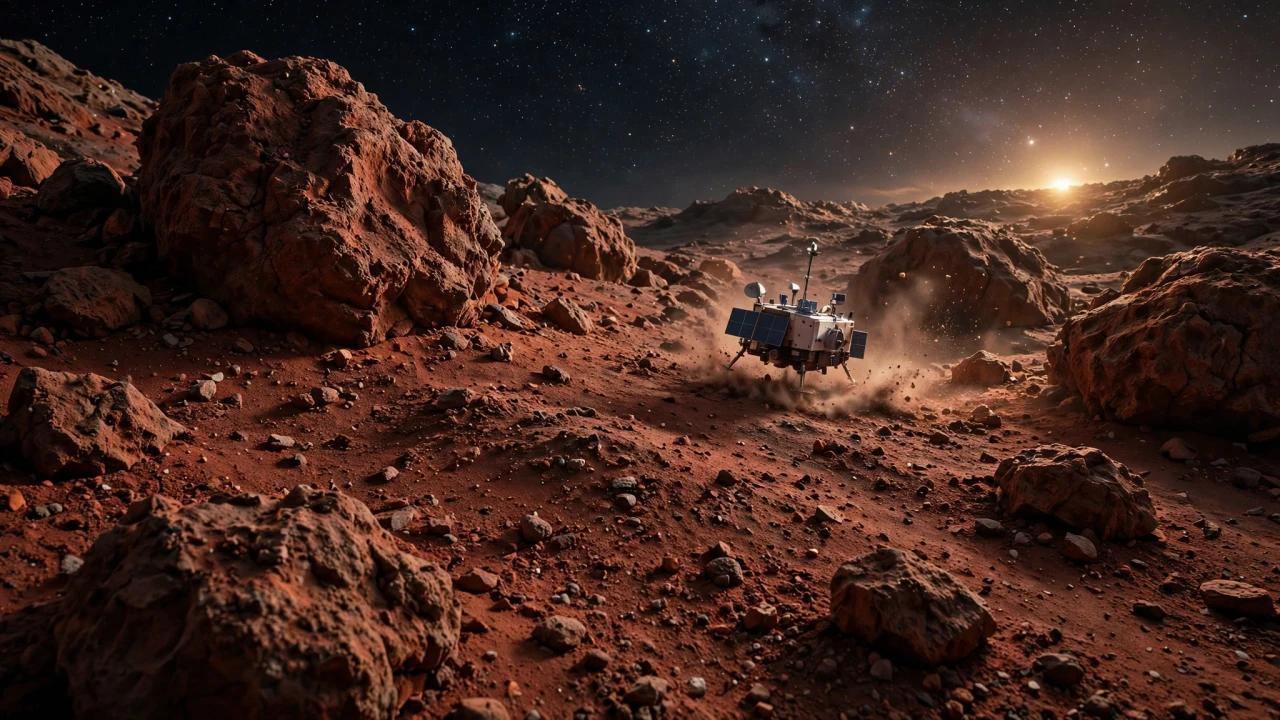
Illustration: a small landing probe touching down on the red-tinged surface of asteroid Justitia. This is an AI-generated illustration, not a real scene.
After launch, the long cruise begins: roughly five billion kilometers of travel, six asteroid flybys, and observations of Venus and Mars. The MBR Explorer is expected to reach Justitia in the mid-2030s, where it will spend about seven months descending from an initial orbit of 250 kilometers before releasing the probe during a low-altitude pass for its historic touchdown.
The stakes of that final maneuver are high. An asteroid landing has no margin for improvisation — but if the little Emirati probe sticks its landing on the red rock, it will write the UAE into the short list of nations that have touched another world, and open a new window onto the Solar System's most ancient chemistry.
Sponsored: explore today's featured sponsored offers
FAQ
What did the UAE just unveil?
The Technology Innovation Institute (TII) completed a 10-kilogram autonomous asteroid-landing probe, announced October 1–5, 2026. Designed, built and tested in Abu Dhabi in under two years, it is described by Nature as the Arab world's first solo space probe, and it will fly aboard the Emirates Mission to the Asteroid Belt.
What is 269 Justitia?
269 Justitia is an asteroid in the main belt between Mars and Jupiter with an unusual red color. Scientists believe it may have formed in the distant Kuiper Belt and migrated inward, making it a potential time capsule of the water and organic material present when the planets formed.
When will the mission reach the asteroid?
The MBR Explorer is scheduled to launch in March 2028. After a cruise of about five billion kilometers — including flybys of six other asteroids and observations of Venus and Mars — it is expected to reach Justitia in the mid-2030s, with the probe separating for its landing during a low-altitude pass.
Why is landing on an asteroid so difficult?
Asteroids have almost no gravity, so a probe cannot simply drop onto the surface — it must be carefully steered to a soft contact. The probe must also operate fully autonomously, making its own decisions about imaging and power, because radio signals take many minutes to travel between Earth and the asteroid belt.
How significant would a successful landing be?
Justitia would be only the seventh asteroid ever reached on its surface by a probe, and the UAE would become the fourth space power to touch an asteroid. It would also validate the UAE's push to build deep-space hardware domestically under its National Space Strategy 2031.
Sources
- Nature — "UAE completes Arab world's first solo space probe – and sets course for an asteroid" (October 8, 2026; reporting by Elizabeth Gibney)
- Technology Innovation Institute / BusinessWire — "Technology Innovation Institute Completes Asteroid-Landing Probe for Landmark Emirates Mission to the Asteroid Belt" (October 5, 2026)
- Virgin Radio Dubai — "H.H. Sheikh Hamdan attends unveiling of UAE asteroid mission probe" (October 4, 2026)
- hitechub.com — "UAE Completes Arab World's First Solo Space Probe and Sets Course for an Asteroid" (October 8, 2026)
- Saudi Shopper — "Asteroid-Landing Probe Built for EMA" (October 5, 2026)
Comments
Post a Comment