
Ukraine Wants Customs Checks Moved Inside Poland and Slovakia to Shield Grain Trucks From Russian Drones
Ukraine is in talks with EU member states Poland and Slovakia about moving customs checks on lorries carrying grain exports from the border to inside those countries, in a bid to halt Russian drone attacks on the trucks, the Financial Times reported on Friday — a move driven by what Kyiv calls a "new security environment where Russia is deliberately trying to strike our borders."
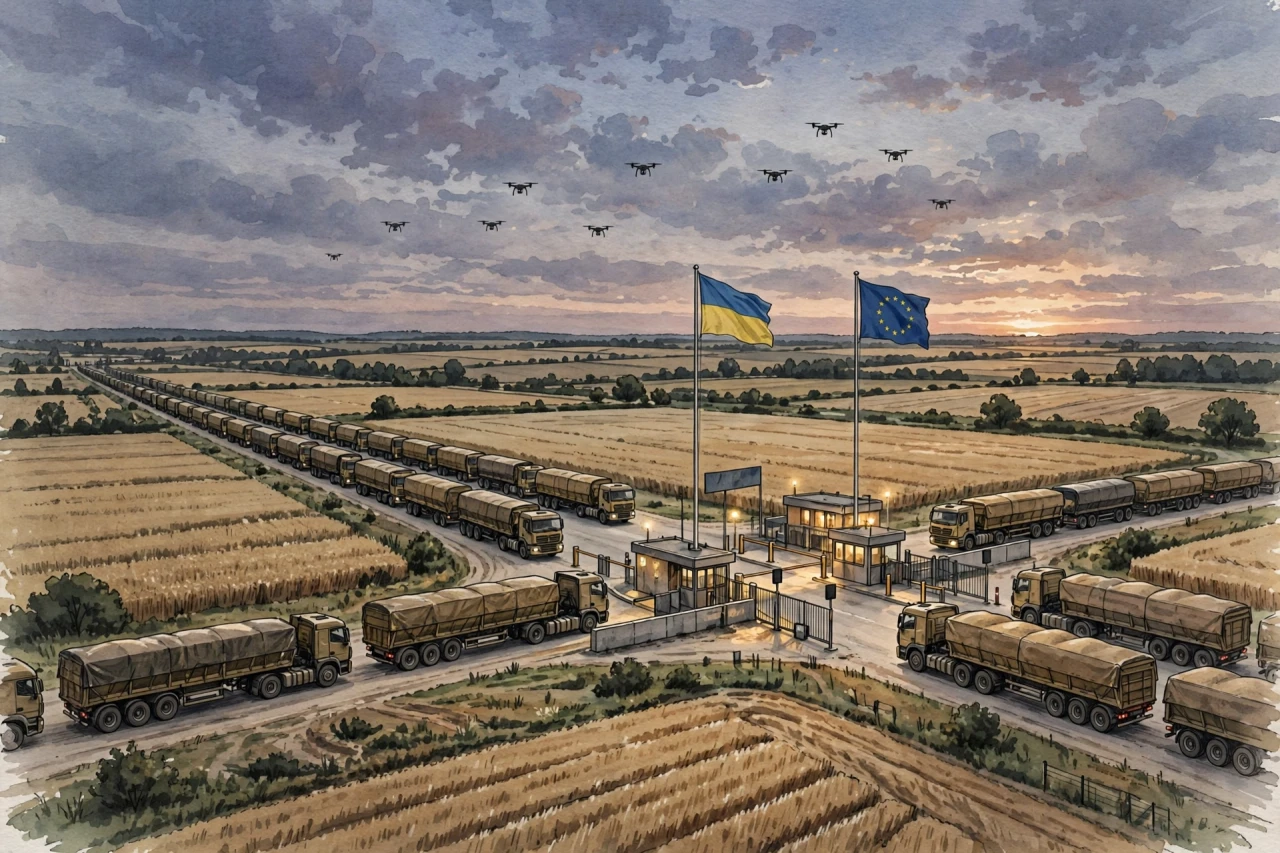
Illustration: Ukraine wants grain-export lorries checked inside Poland and Slovakia rather than at the border, to shield them from Russian drone attacks.
What Happened
Ukraine has opened negotiations with Poland and Slovakia on relocating customs inspections for grain-export lorries from the border crossing points to locations inside the two EU countries, Reuters reported on October 23, 2026, citing the Financial Times, which based its report on people familiar with the matter.
The proposal is a direct response to a new Russian tactic: drone strikes targeting the trucks themselves. Foreign ministry spokesperson Heorhii Tykhyi told the FT that the move was driven by a "new security environment where Russia is deliberately trying to strike our borders" — and said Kyiv wanted to finalize an agreement with Poland as soon as possible.
Ukraine's foreign ministry said it had already set up joint border control points with Moldova and wanted to "scale up" the initiative with other neighbours, including Poland. Moving the inspection queues and paperwork inland would remove the concentrations of slow-moving, easily targeted lorries that currently form at the frontier crossings.
Grain exports are the lifeline of Ukraine's wartime economy and a significant component of global food supply. Ukraine is one of the world's largest exporters of wheat, corn and sunflower oil, and keeping that grain flowing — by sea, rail and road — has been a central economic and diplomatic battle since Russia's full-scale invasion disrupted Black Sea shipping routes.
The Reuters report, filed from Bengaluru by Rajveer Singh Pardesi and edited by Jacqueline Wong, carried a Friday dateline, underscoring how fresh the development is: this is a negotiation actively underway, not a finished deal — which is precisely why its outcome will shape headlines in the days and weeks to come.
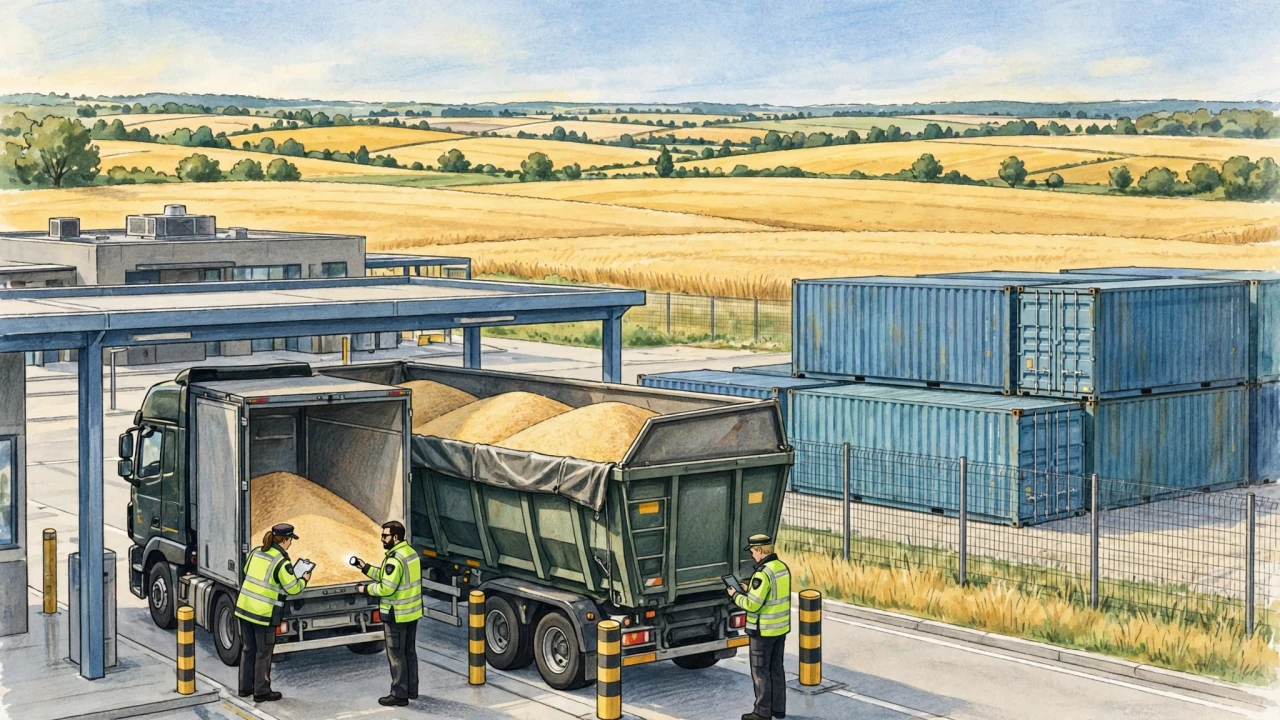
Illustration: Joint border control points with Moldova are already in place; Kyiv now wants to scale the model up with Poland and Slovakia.
Background
The border between Ukraine and Poland has been one of the most politically charged frontiers in Europe for years. Polish farmers have repeatedly protested and blockaded crossings over the influx of cheaper Ukrainian grain, arguing it undercuts domestic prices — a dispute that has strained relations between two otherwise close allies and occasionally escalated into diplomatic confrontations.
That history makes the current talks significant beyond their immediate security logic. Any agreement to move customs checks inside Poland would require close operational cooperation between Ukrainian and Polish authorities — joint procedures, shared facilities, and political trust — at a border that has more often been a site of friction than of collaboration in recent years.
The Moldovan precedent matters here. Kyiv says joint border control points with Moldova are already functioning, suggesting the model is workable: customs and phytosanitary checks performed once, jointly, rather than duplicated on both sides of a frontier. Extending that approach to Poland — Ukraine's largest western land corridor — would be the most consequential version of the experiment yet.
The drone threat itself reflects how the war has evolved. Russian strikes have increasingly targeted not just military assets but the logistics of Ukraine's economy — ports, grain terminals, energy infrastructure and now, according to Kyiv, the trucks that carry its harvests to market. Forcing inspection queues to form far from the border would deny Russian drones the concentrated, predictable targets they currently offer.
The grain corridor question has global stakes. Disruptions to Ukrainian exports in the past have pushed up world food prices and threatened food security in import-dependent regions of Africa, the Middle East and Asia. Every lorry held up or destroyed at the border is grain that does not reach those markets.
Why It Matters
This is the war expanding into the mechanics of trade. For most of the conflict, the battle over Ukraine's grain has played out at sea — the Black Sea corridor, naval drones, port strikes. The proposal to move customs checks inland marks the land corridors becoming a front in their own right, with Russia apparently treating the trucks as legitimate targets and Ukraine reorganizing its entire border apparatus in response.
The talks are also a test of the EU's solidarity machinery under pressure. Poland and Slovakia would need to host foreign customs operations on their territory, ceding a degree of sovereign control over their own border procedures. That is a big ask in normal times — and these are not normal times, with farmers' lobbies in both countries historically hostile to anything that eases Ukrainian grain transit.
For Ukraine, success would do more than protect drivers. Faster, safer border crossings would lower the cost of exports, reduce spoilage and delays, and strengthen the country's economic resilience at a moment when every source of revenue matters. The foreign ministry's urgency — an agreement with Poland "as soon as possible," in Tykhyi's words — reflects how directly the drone threat is biting.
There is a precedent-setting dimension too. If Kyiv, Warsaw and Bratislava can make joint inland customs work under wartime drone threat, the model could be extended to other neighbours and other goods — effectively redesigning how a country at war conducts its trade with the world.
Illustration: Kyiv describes a "new security environment" in which Russia is deliberately trying to strike at its borders and trade routes.
What Happens Next
The immediate milestone is the Poland agreement. Tykhyi said Kyiv wants to finalize it "as soon as possible," and the FT's sourcing suggests active, detailed talks rather than exploratory contacts. Watch for announcements of pilot locations — which crossings, which inspection facilities inside Poland, and on what timeline the first relocated checks begin operating.
Slovakia is the second track. Talks there appear to be at an earlier stage, but a Polish deal would create momentum — and a template — for Bratislava to follow. Moldova's existing joint control points provide the proof of concept both governments can point to.
The Russian response will also be revealing. If drone strikes on border infrastructure continue or shift to follow the relocated checkpoints, the contest could become a cat-and-mouse game of logistics versus targeting — and Ukraine may need to go further, dispersing checks across multiple inland sites rather than concentrating them at a few.
Finally, watch the farmers. Any arrangement that touches grain flows across the Polish and Slovak borders will be scrutinized by agricultural lobbies that have shown they can shut crossings down. The security argument — protecting trucks from drones — may buy political goodwill, but the underlying economic tensions over grain prices have not gone away.
Sponsored: explore today's featured sponsored offers
FAQ
What is Ukraine proposing?
Ukraine is in talks with Poland and Slovakia about moving customs checks on lorries carrying grain exports from the border crossings to locations inside those EU countries, to protect the trucks from Russian drone attacks.
Why move the checks inland?
According to foreign ministry spokesperson Heorhii Tykhyi, Russia is "deliberately trying to strike our borders" in a "new security environment." Inspection queues at frontier crossings create concentrated, predictable targets for drones; moving them inland removes those targets.
Has this been done before?
Yes — Ukraine's foreign ministry says joint border control points with Moldova are already set up, and Kyiv wants to "scale up" the model with other neighbours, starting with Poland.
When could an agreement be reached?
Tykhyi told the Financial Times that Kyiv wanted to finalize an agreement with Poland "as soon as possible." The talks were reported by Reuters on October 23, 2026, citing the FT's sources familiar with the matter.
Why does this matter beyond Ukraine?
Ukraine is a major global grain exporter, and disruptions to its exports affect world food prices and food security in import-dependent regions. The proposal also tests EU solidarity, since it requires Poland and Slovakia to host foreign customs operations on their territory.
Sources
- Reuters — "Ukraine seeks to move customs checks inside EU to avoid Russian drones, FT reports," October 23, 2026.
- Financial Times — reporting on Ukraine-Poland-Slovakia customs talks, October 2026 (via Reuters; sources familiar with the matter).
- Ukrainian Foreign Ministry — statements via spokesperson Heorhii Tykhyi, October 2026 (via the Financial Times).
Comments
Post a Comment