
COPENHAGEN — The ocean, humanity's greatest climate ally, is losing some of its power to protect us, according to a United Nations report released on Wednesday, October 28, 2026, which warns that climate change has already reduced the ocean's ability to absorb carbon by about six percent — just weeks before governments gather for the COP31 climate conference in November.

Illustration: Deep blue ocean waves with swirling currents of light above a coral reef.
What Happened
The UN's 2026 Climate Technology Progress Report, released on October 28 by the UN Environment Programme (UNEP), calls for urgent investment in what it terms "Ocean Carbon Intelligence" — a framework linking ocean science, monitoring technologies, data infrastructure and analytical tools to improve understanding of how the ocean stores carbon and to support evidence-based climate action.
The numbers behind the warning are stark. According to the report, the ocean absorbs around 30 percent of human-caused carbon dioxide emissions and approximately 90 percent of the excess heat trapped by greenhouse gases. But rising temperatures, acidification, deoxygenation, pollution and ecosystem degradation are disrupting the ocean processes that enable that climate-regulating function. UN News reported that climate change has already reduced the ocean's capacity to absorb carbon by approximately six percent.
"A weaker ocean carbon sink leaves more carbon dioxide in the atmosphere and makes climate goals harder and more costly to achieve. The ocean has helped buy humanity time in the fight against climate change. We cannot afford to take that role for granted," said Martin Krause, Director of UNEP's Climate Change Division.
The report was produced by the UNEP Copenhagen Climate Centre in collaboration with the Climate Technology Centre and Network (CTCN) and the Technology Executive Committee of the UN Framework Convention on Climate Change. It arrives alongside other sobering UN findings released this week: the World Meteorological Organization's Greenhouse Gas Bulletin reported on October 28 that global carbon dioxide concentrations reached a record 426.8 parts per million in 2025 — 153 percent of the pre-industrial level of 1750 — while a UN synthesis of national climate pledges released on October 27 found current pledges would cut emissions by only six percent below 2019 levels by 2035.
Background
The ocean is one of the world's largest carbon sinks, and it has quietly absorbed a huge share of the consequences of fossil-fuel burning. Without it, atmospheric carbon dioxide — and therefore warming — would already be far higher. But that service is under strain from the very warming it helps to restrain: warmer water holds less dissolved gas, changing chemistry weakens the organisms that build the marine carbon cycle, and damaged ecosystems such as mangroves and seagrass meadows store less carbon than healthy ones.
The report highlights both the opportunities and the limits of ocean-based climate technologies, including blue carbon ecosystem restoration and emerging approaches to marine carbon dioxide removal. Its central caution is that these technologies can complement, but not replace, rapid and sustained reductions in greenhouse gas emissions — and that they must be guided by strong science, transparency, environmental safeguards and effective governance.
The stakes are highest for Small Island Developing States, which contribute less than one percent of global emissions yet sit, in UN News's words, "on the front line of ocean and climate impacts." The report calls for greater access to finance, technology transfer and capacity-building so island nations can develop ocean solutions tailored to their needs. Some already show what works: in 2015, Seychelles restructured part of its foreign debt in exchange for marine conservation commitments, creating a trust fund for marine conservation and climate resilience; in the Pacific, Fiji, Papua New Guinea, Solomon Islands and Vanuatu received support to map seagrass meadows and mangrove forests and measure the carbon they store, training more than 100 people in blue carbon assessment.
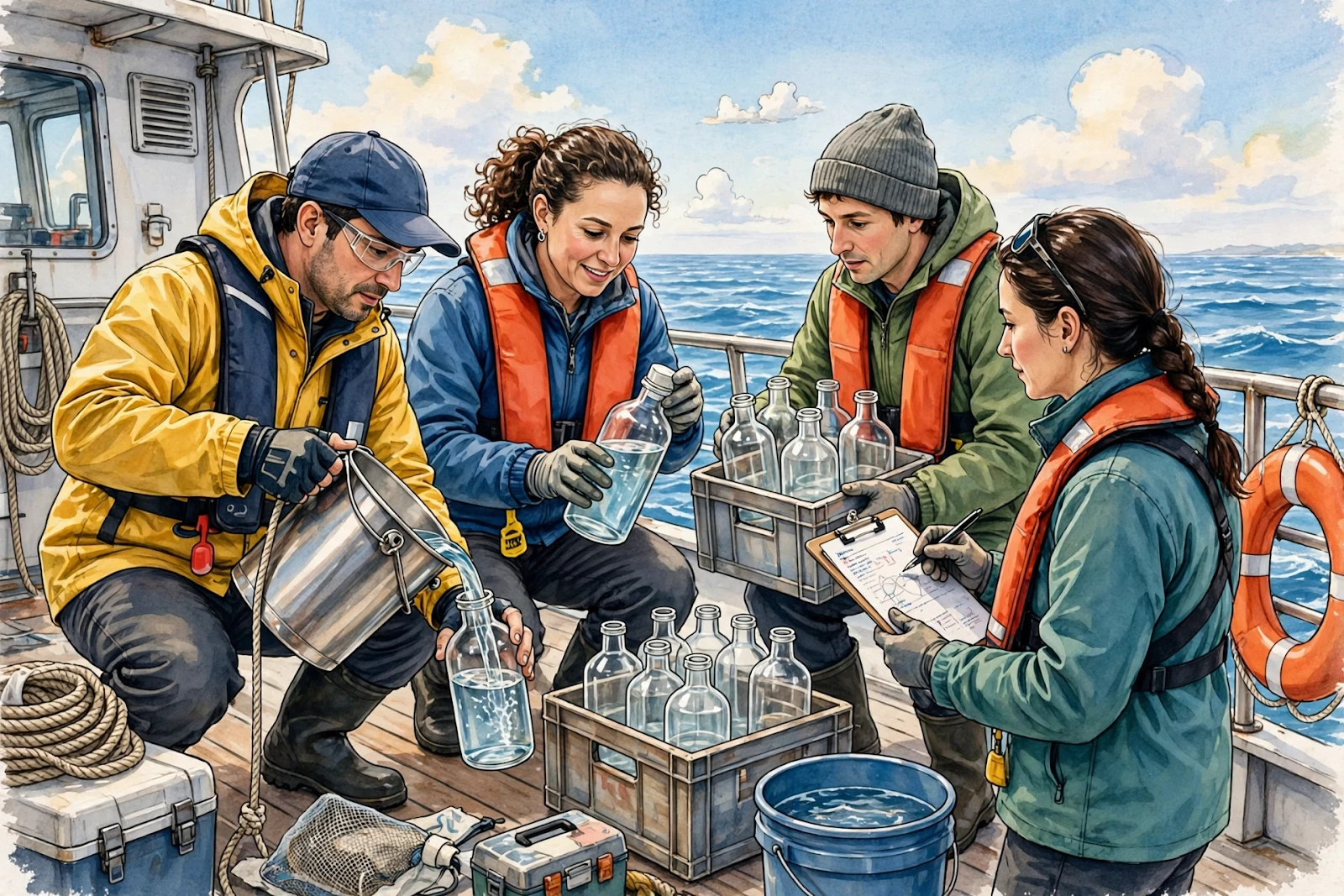
Illustration: Scientists on a research vessel collecting ocean water samples for analysis.
Why It Matters
A weakening ocean sink creates a feedback loop with direct consequences for every climate target. If the ocean absorbs less carbon, more stays in the atmosphere, warming accelerates, and the ocean itself warms further — making future absorption harder still. That is why Krause's warning that climate goals become "harder and more costly to achieve" matters for negotiators heading to COP31: the carbon budget they are working with is not fixed, and it shrinks as the ocean's capacity erodes.
The report also exposes a knowledge gap at the heart of climate policy. Despite the ocean's central role, major gaps in ocean observations, data systems and scientific understanding continue to limit the ability of governments and investors to assess climate risks and make informed decisions. The proposed Ocean Carbon Intelligence framework is designed to close that gap — connecting monitoring, modelling and data infrastructure so that decisions about ocean-based solutions rest on evidence rather than optimism.
There is also an equity dimension. The countries that contributed least to the problem are being asked to pioneer ocean solutions with the least finance and data. As the Honorable Inia Seruiratu, Pacific COP31 Envoy for the Ocean, put it: "We have both an opportunity and a responsibility to place the ocean where it belongs: at the heart of global climate action. This will require bold leadership, stronger partnerships and sustained investment, while recognizing that science, innovation and Indigenous knowledge together offer our best pathway towards a more resilient future."
What Happens Next
All eyes now turn to COP31 in November, where the report is expected to shape negotiations on ocean action, climate finance and the rules governing emerging marine carbon removal technologies. The report's authors argue that the priority must be ensuring ocean-based climate solutions are guided by science, equity and transparency — a test that will apply to every project claiming ocean carbon credits.
"With pressures on the ocean increasing and the need for effective climate action growing, the priority must be ensuring ocean-based climate solutions are guided by science, equity and transparency," Krause concluded. "Ocean innovation has significant potential, but its success will depend on strong governance, public trust and sustained investment in knowledge, capacity and international cooperation."
For island nations and coastal communities, the practical next steps are finance and data: funding to restore mangroves and seagrass, support to map and monitor blue carbon, and technology transfer to turn local knowledge into national climate plans. For the rest of the world, the message is simpler — the ocean has been buying humanity time, and that time is no longer free.

Illustration: A lush mangrove forest and seagrass meadow along a tropical coastline at golden hour.
Sponsored: explore today's featured sponsored offers
FAQ
What is the UN's 2026 Climate Technology Progress Report?
It is a United Nations report released on October 28, 2026, by the UN Environment Programme's Copenhagen Climate Centre with the Climate Technology Centre and Network and the UN climate convention's Technology Executive Committee, focused on the ocean's carbon system.
How much carbon and heat does the ocean absorb?
According to the report, the ocean absorbs around 30 percent of human-caused carbon dioxide emissions and approximately 90 percent of the excess heat trapped by greenhouse gases.
By how much has the ocean's carbon capacity weakened?
UN News reported that climate change has already reduced the ocean's capacity to absorb carbon by approximately six percent, citing the new report ahead of COP31.
What is "Ocean Carbon Intelligence"?
It is a framework proposed by the report that connects ocean science, monitoring technologies, data infrastructure and analytical tools to improve understanding of ocean carbon dynamics and support evidence-based climate action.
Can ocean technologies replace cutting emissions?
No. The report stresses that ocean-based climate technologies, including blue carbon restoration and marine carbon dioxide removal, can complement but not replace rapid and sustained reductions in greenhouse gas emissions.
Sources
- UNEP, "UN report urges investment in Ocean Carbon Intelligence to safeguard the ocean's climate role," October 28, 2026 (Copenhagen)
- UN News, "Ocean's ability to absorb carbon is weakening as climate change intensifies, UN warns," October 28, 2026
- World Meteorological Organization, Greenhouse Gas Bulletin 2026, October 28, 2026 (via UNB/tob.news)
- UNFCCC, 2026 Nationally Determined Contributions (NDC) Synthesis Report, October 27, 2026 (via The Hindu BusinessLine)
Comments
Post a Comment