
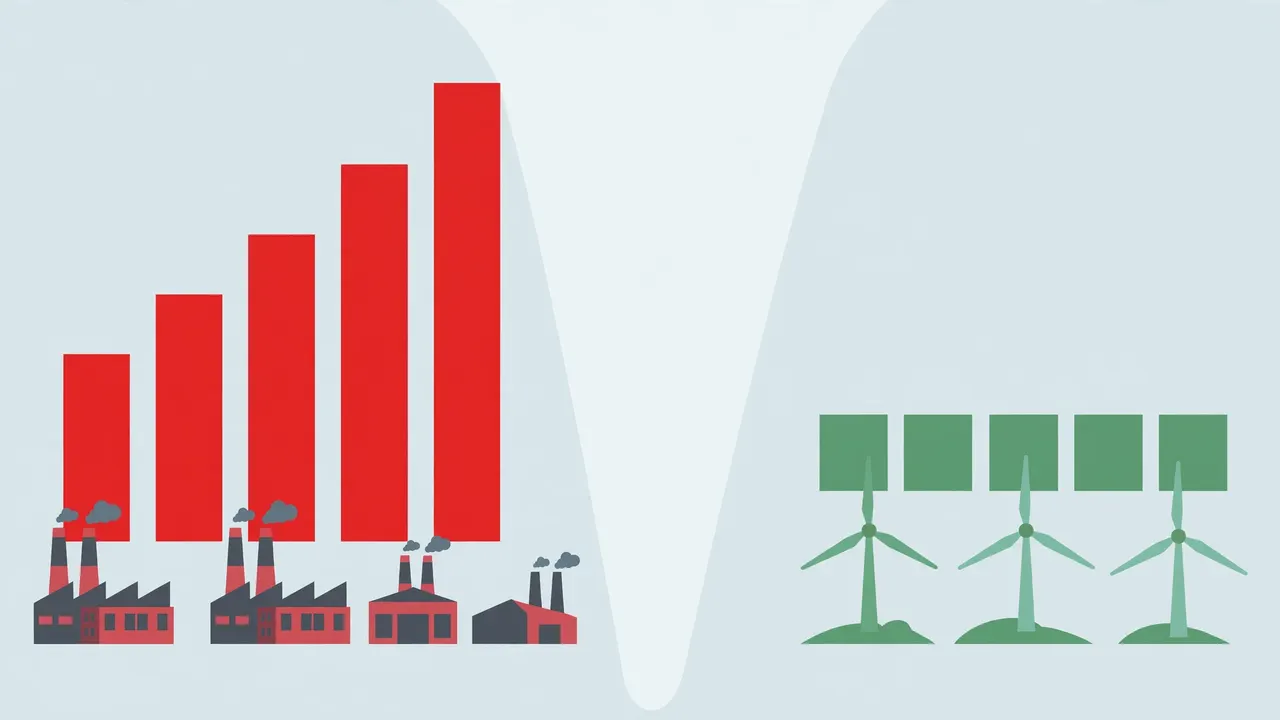
Illustration: the "emissions gap" — the distance between where emissions are headed and where they must be.
NAIROBI — The world can no longer prevent global warming from substantially exceeding 1.5°C, the United Nations Environment Programme declared on Wednesday, October 21, in its flagship Emissions Gap Report 2026 — a landmark assessment that reframes the entire climate fight around a new question: not whether temperatures will overshoot the Paris Agreement's most ambitious target, but by how much, and for how long.
What Happened
The report, titled The point of return, concludes that decades of insufficient action have made exceeding the Paris Agreement's 1.5°C threshold unavoidable. But it insists rapid emissions reductions could still limit the extent and duration of the overshoot: in the report's new "lowest possible" overshoot scenario, global temperatures peak at around 1.7–1.8°C above pre-industrial levels around mid-century, before potentially returning to 1.5°C or below by 2100 — with roughly a 50 percent chance, according to Reuters.
Achieving even that best case would require global greenhouse gas emissions to fall by 18 percent by 2030, 45 percent by 2035 and 69 percent by 2040, compared with 2025 levels. By contrast, full implementation of countries' latest climate pledges — their nationally determined contributions, or NDCs — would deliver reductions of just 5–8 percent by 2030 and 11–15 percent by 2035, UNEP found.
Even if all current commitments are fulfilled, UNEP estimates global temperatures are heading toward approximately 2.6°C of warming by 2100 — and 2.8°C under current policies. Both estimates are higher than last year's projections, reflecting the US withdrawal from the Paris Agreement and revised assessments of historical emissions, Reuters reported.
The report's bleakest finding may be about momentum: climate plans submitted since last year have made virtually no difference to future warming projections. And returning to 1.5°C would depend on large-scale carbon removal — technology whose feasibility, UNEP cautioned, remains uncertain.
UN Secretary-General António Guterres, speaking as countries prepare for the COP31 climate talks in Turkey next month, said it was crucial not to give up on efforts to rein in the emissions fuelling floods, fires and other natural disasters. "Overshoot is not surrender. We can still keep it as small and as short as possible – and bring temperatures back below 1.5 degrees by the end of the century," he said, as quoted by Reuters.
Background
Under the 2015 Paris Agreement, countries agreed to try to keep the average temperature increase at well below 2 degrees and ideally 1.5°C above pre-industrial levels. For a decade, 1.5°C served as both a scientific guardrail and a political rallying cry. The new UNEP report formally retires the idea of holding the line there without overshoot: limiting warming to 1.5°C with no or limited overshoot is no longer considered possible, the agency said.
The raw numbers show why. Global greenhouse gas emissions reached an estimated 58.4 billion tonnes of carbon dioxide equivalent in 2025, broadly unchanged from the previous year, according to the report's summary in Envirotec Magazine — too early, UNEP cautions, to conclude that global emissions have peaked.
One country stands out as the outlier. The United States is the only major economy where planet-warming pollution increased dramatically last year, according to the report's coverage by WCMU Public Media on October 21. The US was tied with Russia as the G20 countries with the most per-capita emissions of carbon dioxide and other warming gases. American emissions grew because of increased electricity demand and Trump administration policies supporting fossil fuels: coal-fired power plants ordered to stay open longer than planned, rolled-back fuel-efficiency standards for vehicles, and ended tax credits for solar and wind projects.
"Right now, everybody is scrambling a little bit regarding energy security," said Inger Andersen, the executive director of the UN Environment Programme, pointing to oil and gas disruptions from the wars in Ukraine and Iran. Despite the upheaval, she noted, "several G20 members have shown sustained emissions reduction" — including the European Union, which has invested heavily in energy efficiency and wind and solar power.
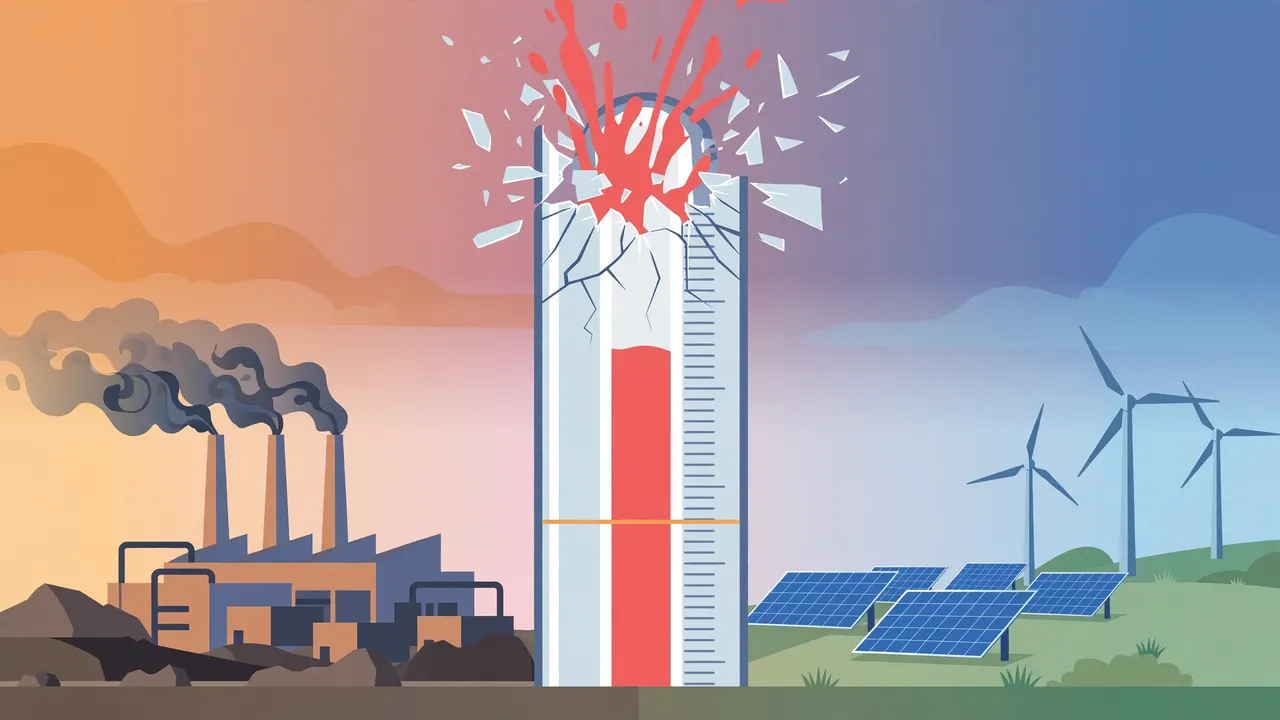
Illustration: global temperatures are now expected to overshoot 1.5°C even in the best-case scenario, the UN says.
Why It Matters
The shift from "avoid overshoot" to "minimize overshoot" is more than semantics — it rewrites the economics and politics of climate action for the next decade. Every fraction of a degree of overshoot translates into more intense heatwaves, heavier floods, longer droughts and faster sea-level rise, with the worst impacts falling on the countries least responsible for emissions. The report's message to negotiators heading to COP31 is blunt: the pledges on the table are not remotely close to what the physics now demands.
The timing is deliberate. The report lands less than three weeks before COP31 opens on November 9 in Antalya, Turkey, where the Turkish presidency under Environment Minister Murat Kurum has said the summit should focus on implementation of existing commitments rather than new pledges. Agenda items are expected to include the $300 billion annual climate-finance commitment from developed countries, the Loss and Damage Fund established at COP27, methane emissions, green industrialization and a first progress report under the Global Implementation Accelerator, according to Anka English.
The US-shaped hole in the projections also matters for the talks. With Washington having withdrawn from the Paris Agreement, other major emitters face a harder path to the 18-percent-by-2030 cut the report demands — and developing countries will arrive in Antalya asking, with fresh UN numbers behind them, who pays for an overshoot they did not cause.
There is a harder-edged reading too: the report's dependence on large-scale carbon removal to return below 1.5°C by 2100 amounts to betting the century on technologies that do not yet exist at scale — a caveat UNEP itself flags as uncertain.
What Happens Next
COP31 runs November 9-20 in Antalya, with Australia leading the formal negotiating process under an arrangement that gives Turkey responsibility for the presidency and action agenda, Reuters reported in September. The Emissions Gap Report will be the scientific backdrop to every corridor conversation: expect the 18/45/69 percent figures to be quoted relently, and expect pushback from major emitters over the pace UNEP demands.
Key tests will include whether countries submit strengthened NDCs before the summit, how the Global Implementation Accelerator's first progress report is received, and whether the Loss and Damage Fund moves from pledges to actual disbursement. The pre-COP ministerial consultations — including a meeting in Fiji — will set the tone in the coming days.
Beyond Antalya, the report sets up a decade of accountability moments: 2030 is only four years away, and the gap between the 18 percent cut required and the 5–8 percent pledged will be measured and published in every subsequent UNEP assessment.

Illustration: negotiators head to COP31 in Antalya, Turkey, on November 9 with the UN's warning fresh in hand.
Sponsored: explore today's featured sponsored offers
FAQ
What is the UN Emissions Gap Report?
It is the UN Environment Programme's annual flagship assessment of the difference between where global greenhouse gas emissions are headed and where they need to be to meet the Paris Agreement goals. The 2026 edition, titled The point of return, was released on October 21, 2026.
What does "1.5°C overshoot is unavoidable" mean?
UNEP now considers it impossible to hold warming to 1.5°C above pre-industrial levels without temporarily exceeding it. The new goal is to keep the overshoot as small and as short as possible: peaking at 1.7–1.8°C around mid-century, then returning to 1.5°C or below by 2100 — a path with roughly a 50 percent chance of success.
How fast must emissions fall?
Global emissions must drop 18 percent by 2030, 45 percent by 2035 and 69 percent by 2040, measured against 2025 levels. Current national pledges would deliver only 5–8 percent by 2030 and 11–15 percent by 2035 — leaving a massive gap.
Why are the projections worse than last year?
UNEP cites two main reasons: the United States' withdrawal from the Paris Agreement, and revised assessments of historical emissions. Under current policies the world is now headed for 2.8°C of warming by 2100; even full implementation of all pledges only brings that to about 2.6°C.
What happens at COP31?
The UN climate summit runs November 9–20, 2026, in Antalya, Turkey, under the presidency of Environment Minister Murat Kurum, with Australia leading formal negotiations. Expect the Emissions Gap Report's figures to dominate debates on climate finance, the Loss and Damage Fund, methane and implementation of existing pledges.
Sources
- Reuters — "UN sees higher global warming, even in best-case scenario" (October 21, 2026): UNEP Emissions Gap Report 2026 findings — 1.7–1.8°C mid-century peak, 18%/45%/69% reduction pathway, 2.8°C/2.6°C projections, Guterres quote.
- Envirotec Magazine — "UN warns 1.5°C climate overshoot now unavoidable" (October 21, 2026): report summary — 58.4 GtCO₂e emissions in 2025, NDC shortfalls of 5–8% by 2030.
- WCMU Public Media — "United Nations report highlights significant increase in U.S. climate pollution" (October 21, 2026): US as the only major economy with dramatically increased emissions; Inger Andersen quotes; Trump-era policy rollbacks.
- Anka English — "COP31 aims to shift global climate talks from pledges to implementation" (October 2026): COP31 Antalya agenda — Loss and Damage Fund, $300 billion climate finance, Global Implementation Accelerator.
- Reuters — "Turkey's COP31 President lays out summit's agenda at UN" (September 22, 2026): Murat Kurum's agenda; Antalya November 9–20 dates; Australia's negotiating role.
Comments
Post a Comment