
The world will unavoidably blow past the Paris Agreement's 1.5-degree Celsius warming limit within the next few years, the United Nations said on Wednesday, October 21, 2026 — the first time its annual Emissions Gap Report has declared the breach imminent and unavoidable. But in a new "point of return" pathway, the report argues the overshoot can still be kept small and short: with emissions falling 18 percent by 2030, 45 percent by 2035 and 69 percent by 2040, peak warming could be held to around 1.7 to 1.8 degrees by mid-century and brought back to 1.5 degrees by the end of the century.
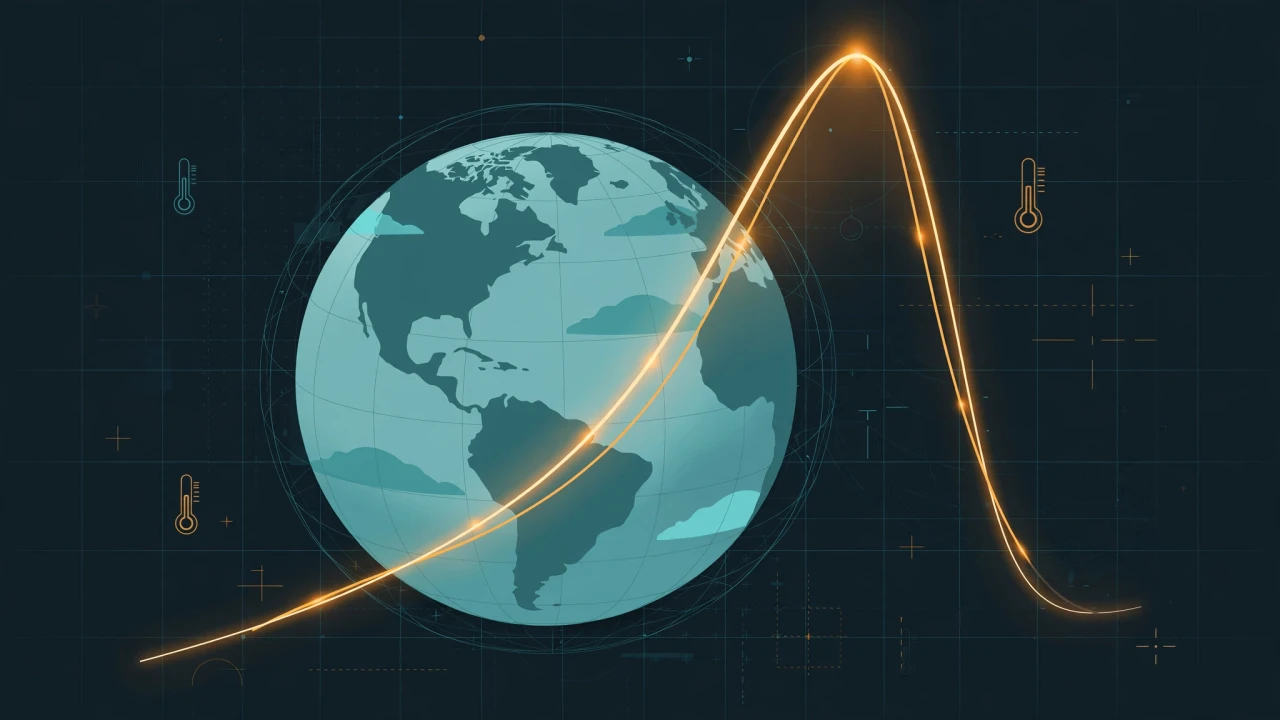
Illustration: Earth with a temperature curve that overshoots and bends back down, symbolizing the UN emissions gap pathway. This is an AI-generated illustration, not a real scene.
What Happened
The UN Environment Programme (UNEP) released its Emissions Gap Report 2026: The Point of Return on Wednesday in Nairobi, less than a month before governments gather in Turkey for the COP31 climate talks. Unlike past editions, which measured the distance between countries' pledges and the 1.5C goal, this year's report redefines the gap entirely: it asks what it would take to limit the period of overshoot and find a way back.
To follow the report's "lowest possible" overshoot scenario — roughly a 50 percent chance of returning to or below 1.5C by 2100 — global emissions would need to fall 18 percent by 2030, 45 percent by 2035 and 69 percent by 2040 against 2025 levels: average annual cuts of about 5.7 percent, an even faster pace than the old pathways laid out by the IPCC.
By contrast, the full implementation of existing national climate plans (NDCs) would only cut emissions by 5 to 8 percent by 2030 and 11 to 15 percent by 2035. The report found that climate plans submitted since last year made virtually no difference to future warming projections.
The report also revised its warming projections upward. Under current policies, global temperatures are now projected to reach 2.8 degrees Celsius above pre-industrial levels by 2100; even if all existing pledges are fully implemented, warming would hit 2.6 degrees. Both estimates are higher than last year's, reflecting the United States' withdrawal from the Paris Agreement and revised assessments of historical emissions.
UN Secretary-General Antonio Guterres struck a defiant tone in a message accompanying the release: "Overshoot is not surrender. We can still keep it as small and as short as possible — and bring temperatures back below 1.5 degrees by the end of the century."
Background
Published annually since 2010 to tell governments how far their collective promises fall short of the Paris goals, the gap report long argued the 1.5C target was slipping away but could still — in theory — be held without overshoot. This year marks a turning point: the authors, led by UNEP Executive Director Inger Andersen, say that window has now closed.
"We are now saying this window has closed, but we can open it again by making the overshoot as brief as possible," Andersen said on a call with reporters. "This is about how to find a way back as shortly and as quickly as possible with as limited an overshoot as possible."
The shift comes after a year of punishing climate impacts. Floods, heatwaves and wildfires have plagued nations on every continent in 2026, and scientists have warned that the 1.5C threshold could be crossed in the next few years on an annual basis. The report makes clear that every additional fraction of a degree above 1.5C "raises the risk of irreversible changes including in ice sheets, permafrost carbon, ocean circulation, and coral systems, along with devastating human impacts."
There is, however, a more hopeful thread running through the report. Since the Paris Agreement was adopted in 2015, renewable energy has boomed, total energy supply from coal and oil has grown more slowly than projected, and climate policies have delivered real emission reductions across countries and sectors. "The report argues that there are more opportunities than ever to step up action," UN News reported. The problem is scale: proven solutions exist, but the report says a massive global scale-up is required to get on track.

Illustration: delegates gathered in a global climate summit plenary hall ahead of COP31. This is an AI-generated illustration, not a real scene.
The report also faults fossil-fuel producers. Climate Analytics chief executive Bill Hare said governments must move beyond pledges to policies that actually cut fossil-fuel consumption, singling out the United States and Saudi Arabia — together 20 to 25 percent of global fossil-fuel production. He warned every additional 0.1 degrees of warming could expose another 140 million people to dangerous heat, and that continued fossil-fuel dependence risks the irreversible collapse of Greenland's ice sheet, which could eventually add about seven meters to global sea levels.
Why It Matters
The reframing of the climate target matters for how governments, investors and campaigners plan the next decade. A world that accepts a brief, limited overshoot is different from one still pretending 1.5C can be held cleanly — and from one that gives up entirely. The report is explicit: overshoot does not mean the Paris Agreement has failed, but the size and duration of the overshoot will define how much damage is locked in.
Small fractions of a degree translate into enormous human consequences. The difference between 1.5C and 1.8C peak warming is measured in flooded coastlines, failed harvests, dead coral reefs and hundreds of millions more people exposed to extreme heat. The report's pathway effectively sets a new ceiling for acceptable climate policy: hold the mid-century peak as close to 1.7C as possible, then engineer the descent.
That descent depends on something the report treats cautiously: large-scale carbon removal. Returning to 1.5C by 2100 would require removing enormous quantities of carbon dioxide late in the century, and the feasibility at that scale is uncertain. The report presents carbon removal as a necessity, not a substitute for cutting emissions now — a distinction advocates stress, warning that vague promises of future removal can delay action today.
For developing nations, the report's math carries a particular edge. The annual reduction rates it demands — 5.7 percent per year — must be achieved while economies grow and energy access expands. How the costs and responsibilities are shared will be one of the most contentious questions when negotiators meet in Turkey next month.
What Happens Next
All eyes now turn to COP31 in Turkey, where the report is designed to inform negotiators. The key battleground will be whether countries strengthen their national climate plans for 2035 — the report's verdict that plans submitted since last year made "virtually no difference" puts governments on notice that incremental updates will not suffice.

Illustration: industrial emissions contrasted with reforestation and carbon-removal facilities. This is an AI-generated illustration, not a real scene.
Fossil-fuel phaseout language will be fiercely contested, as at recent summits. The report's call for policies that cut fossil-fuel consumption — not pledges alone — arms campaigners and vulnerable nations, while producers push back; the United States' absence from the Paris framework will shape the dynamics.
Beyond the negotiating halls, the report sets a de facto scoreboard for the coming years: emissions must start falling sharply and immediately. UNEP will publish next year's gap report ahead of COP32, and the 2030 milestone — an 18 percent cut from 2025 levels — is now the number against which every country's progress will be judged. As Guterres put it, the task is to make the overshoot "as small and as short as possible." The countdown to 2030 has effectively begun.
Sponsored: explore today's featured sponsored offers
FAQ
What is the UN Emissions Gap Report 2026?
It is the annual assessment by the UN Environment Programme, released October 21, 2026, that compares countries' climate pledges with the emission cuts needed to meet the Paris Agreement goals. This year's edition, titled "The Point of Return," is the first to declare that breaching 1.5C without overshoot is imminent and unavoidable, and instead maps the fastest plausible path back to 1.5C by 2100.
What emission cuts does the report say are needed?
To follow its best-case overshoot pathway, global greenhouse gas emissions must fall 18 percent by 2030, 45 percent by 2035 and 69 percent by 2040, relative to 2025 levels — implying average annual reductions of about 5.7 percent from 2025 to 2035.
How far short do current national plans fall?
Even if all current national climate pledges (NDCs) were fully implemented, emissions would fall only 5 to 8 percent by 2030 and 11 to 15 percent by 2035. The report found that plans submitted since last year made virtually no difference to projected warming.
What warming is projected under current policies?
The report projects 2.8 degrees Celsius of warming by 2100 under current policies, or 2.6 degrees if all existing pledges are implemented. Both figures are higher than last year's projections, partly because of the US withdrawal from the Paris Agreement and revised historical emissions data.
Why does the report depend on carbon removal?
Returning temperatures to 1.5C by 2100 after an overshoot would require large-scale removal of carbon dioxide from the atmosphere later this century. The report is explicit that the feasibility of doing this at the required scale is uncertain — which is why it stresses cutting emissions as fast as possible now rather than relying on future removals.
Sources
- Reuters — "UN sees higher global warming, even in best-case scenario" (October 21, 2026; reporting by Simon Jessop)
- CNN — "As climate summit approaches, UN reports existing 1.5C warming limit is no longer achievable" (October 21, 2026)
- UN News — "Global warming will breach 1.5°C – but deep, fast cuts can still bring it back" (October 21, 2026)
- UNEP — "New UNEP report lays out emission cuts needed for return to 1.5°C," press release (October 21, 2026)
- BusinessToday — "UNEP Warns Fossil Fuel Phase-Out Urgent As Climate Risks Mount" (October 21, 2026)
Comments
Post a Comment