
"We All Play a Part": UNESCO's Global Media and Information Literacy Week 2026 Puts Everyday Citizens at the Centre
PARIS, 28 October 2026 — UNESCO's Global Media and Information Literacy Week 2026 is under way around the world, running from 24 to 31 October under the theme "We All Play a Part – Media and Information Literacy for the People", with schools, universities, broadcasters and community groups staging events designed to help ordinary citizens navigate an information environment reshaped by artificial intelligence, social media and fast-spreading falsehoods.
Unlike a single conference in one city, this year's observance is deliberately decentralised. According to UNESCO, regional and thematic events organised by its offices and partners across the world are bringing together policymakers, educators, researchers, journalists, young people, content creators, regulators and parents to tackle what the organisation describes as today's most pressing information challenges.
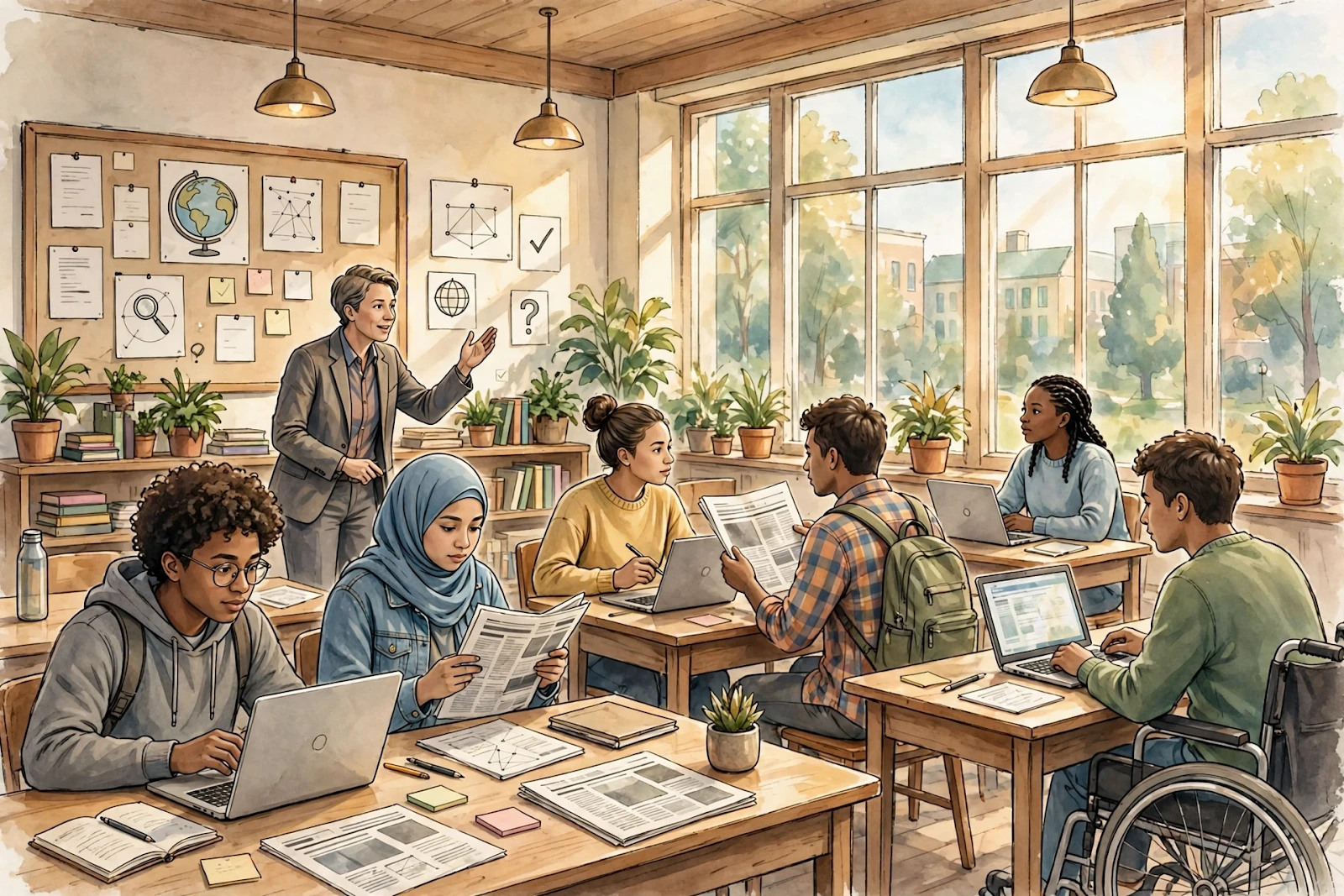
Illustration: Students in a classroom learning to check news stories and spot misinformation, in the spirit of the week's school and university events.
What Happened
The week opened on 24 October and runs through 31 October, a slot UNESCO reserves every year for the observance. Its 2026 edition puts the spotlight on practical skills: how to verify a claim before sharing it, how to recognise manipulated images and AI-generated false content, and how to take part in public conversation without amplifying rumours. Events listed by UNESCO stretch from South Asia to Europe, Africa and Latin America, and many continue into November.
In Bangladesh, East West University in Dhaka launched its week of activities on 25 October, in collaboration with the UNESCO Dhaka Office and the Media and Information Literacy Network Bangladesh. According to a press release reported by The Business Standard on 26 October, the inauguration began with an awareness rally in front of the university's Alor Minar, followed by the opening of an awareness campaign booth. The programme includes a competition on students' views of media literacy in the age of AI, an awareness-building campaign on 27 and 28 October, a keynote on assessing nationwide media literacy competency, and a panel discussion on the week's theme.
University leaders used the launch to frame the stakes. Professor Dr Mohammed Farashuddin, chairperson of the university's board of trustees, emphasised the fair use of information for societal development, while acting vice-chancellor Professor Dr Mohammad Ashik Mosaddik highlighted the importance of media literacy in the age of artificial intelligence, the report said. Dr Susan Vize, head of office and UNESCO representative to Bangladesh, reaffirmed UNESCO's support for promoting the skills in the country, and Professor Dr Dilara Begum underlined the role of media literacy in developing critical thinking, verifying information and identifying misinformation and disinformation.
Elsewhere in Asia, a sustained action anchored in Beijing and connected online runs from 28 October to 30 November under the title "MIL Capacity Building in Action: Bridging Civilizations", organised by the CloudRiver International MIL Volunteer Platform and the Communication University of Zhejiang. Its listing describes it as a multi-city effort bringing together youth, educators, media professionals, cultural and educational institutions, digital platforms and policymakers to strengthen media and information literacy as a practical response to misinformation, AI-generated false content, deepfakes and declining confidence in information.
Background
Media and information literacy, often shortened to MIL, is UNESCO's umbrella term for the combined ability to find, evaluate, use and create media content and information responsibly. It covers old skills, such as telling a reliable newspaper from a rumour sheet, and new ones, such as questioning a video that may have been altered or generated by software. UNESCO has promoted the concept for years through curricula, teacher training and policy guidance, arguing that it underpins learning, civic participation and informed decision-making.
The 2026 theme arrives at a moment when the information environment is changing unusually fast. Generative AI tools can now produce convincing text, images, audio and video in seconds, and algorithmic feeds decide much of what people see first. UNESCO's concept note for its South Asia regional event, held in New Delhi on 26 and 27 October, notes that education systems in the region are navigating digital transformation at scale, and that strengthening media literacy in education has become increasingly urgent. The note also points to UNESCO's ongoing work in South Asia, including a partnership with Indira Gandhi National Open University and the South Asian Centre for Teacher Development to weave media literacy into teacher education.
That regional focus is mirrored in individual country programmes. In Bhutan, the week's celebrations from 24 to 31 October include a youth hackathon in Thimphu, a student reel-making competition and a national dialogue on strengthening media literacy, with the launch of Bhutan's National Media and Information Literacy Strategy as a highlight, according to UNESCO's listing. In Afghanistan, UNESCO's office is working with Shuja Radio, a station led by people with disabilities, on public service announcements, graphic messages and radio roundtables promoting access to reliable information and responsible media use.

Illustration: A globe connected by glowing networks of people sharing information, symbolising the week's worldwide, decentralised programme.
Why It Matters
The week's decentralised design is itself part of the argument. In previous years, a single flagship conference could feel remote from classrooms and newsrooms. By contrast, the 2026 programme is built from dozens of local activities: an Oxford-style debate in Linz, Austria, on 22 October asked whether AI should ever be used in higher education; events in Sarajevo, Bosnia and Herzegovina, on 26 and 27 October presented research on AI literacy, audience trust in AI-generated content and children's experiences online; and in Porto, Portugal, an intergenerational autumn school on 27 and 28 October brought different generations together to exchange experiences of media.
For ordinary readers, the practical payoff is straightforward. False claims now travel faster than corrections, and a single misleading post can shape opinions about health, elections or disasters before fact-checkers can respond. Media literacy does not make everyone a journalist, but it gives people habits — pausing before sharing, checking a second source, looking for the original context of a clip — that slow the spread of bad information. UNESCO's framing also stresses creation, not just consumption: young people making reels in Bhutan, students running a television station in Shanghai, and school pupils reporting through Rio de Janeiro's ANDAR student news agency are all learning by producing media themselves.
The theme also carries a quiet challenge to institutions. Governments, platforms, schools and newsrooms all shape the information environment, and the week invites them to act together rather than in isolation. That is why the participant list is so broad, spanning regulators and parents as well as researchers and journalists. If only one group changes its habits, the system as a whole barely moves; if many groups move at once, the effect compounds.
What Happens Next
The core week closes on 31 October, but several strands run on. The Beijing capacity-building action continues through 30 November, Rio de Janeiro's MultiRio launches new media literacy platforms for teachers and student journalists on 3 and 4 November, and the MeLCi Lab autumn school on AI research practice in media and communication is scheduled online for 10 to 13 November. UNESCO's worldwide listing also records a Shanghai school television anniversary celebration on 10 December under the same theme.
For schools and community groups that missed the week itself, the materials it generates — lesson resources, debate formats, hackathon projects and strategy documents such as Bhutan's national strategy — are expected to outlast the calendar dates. The real test, as organisers in Dhaka and elsewhere have stressed, is whether the habits practised this week survive into everyday scrolling, sharing and classroom discussion once the banners come down.

Illustration: Young people in a library fact-checking stories on their phones, a habit the week's organisers hope will outlast the events themselves.
Sponsored: explore today's featured sponsored offers
FAQ
What is Global Media and Information Literacy Week?
It is UNESCO's annual observance, held from 24 to 31 October, that mobilises stakeholders worldwide to raise awareness of media and information literacy, encourage countries to adopt it, and celebrate progress towards media literacy for all.
What is the theme for 2026?
The 2026 theme is "We All Play a Part – Media and Information Literacy for the People", reflecting the idea that advancing media literacy is a shared responsibility across all sectors of society, not only educators or journalists.
What kinds of events are taking place?
Events range from university launches and rallies in Dhaka to a youth hackathon and national strategy launch in Bhutan, debates in Austria, research presentations in Bosnia and Herzegovina, radio campaigns in Afghanistan and school media projects in Brazil.
Why is media literacy especially important now?
Generative AI, algorithmic feeds, deepfakes and fast-spreading false content have made it harder to judge what is trustworthy at a glance, so skills such as verifying claims and checking original context matter more than ever.
Does the week end on 31 October?
The core observance ends on 31 October, but related activities continue into November and December, including a Beijing capacity-building action to 30 November and an online autumn school on AI research practice from 10 to 13 November.
Sources
- UNESCO, "Global Media and Information Literacy Week 2026", accessed 28 October 2026 — https://www.unesco.org/en/articles/global-media-and-information-literacy-week-2026
- UNESCO, "Global MIL Week 2026 – Celebrations around the World", accessed 28 October 2026 — https://www.unesco.org/en/weeks/media-information-literacy/around-world-2026
- The Business Standard, "East West University launches Global Media and Information Literacy Week 2026", 26 October 2026 — https://www.tbsnews.net/economy/corporates/east-west-university-launches-global-media-and-information-literacy-week-2026
- MeLCi Lab, "Two MeLCi Lab autumn schools featured in UNESCO's Global MIL Week 2026 celebrations", October 2026 — https://melcilab.cicant.ulusofona.pt/news/two-melci-lab-autumn-schools-featured-in-unescos-global-mil-week-2026-celebrations/
Comments
Post a Comment