
PARIS — Sixty-four living traditions from 82 countries will come under review in Xiamen, China, this December, as UNESCO's heritage committee meets to decide which practices — from crafts and rituals to music and foodways — join the world's list of protected intangible cultural heritage.
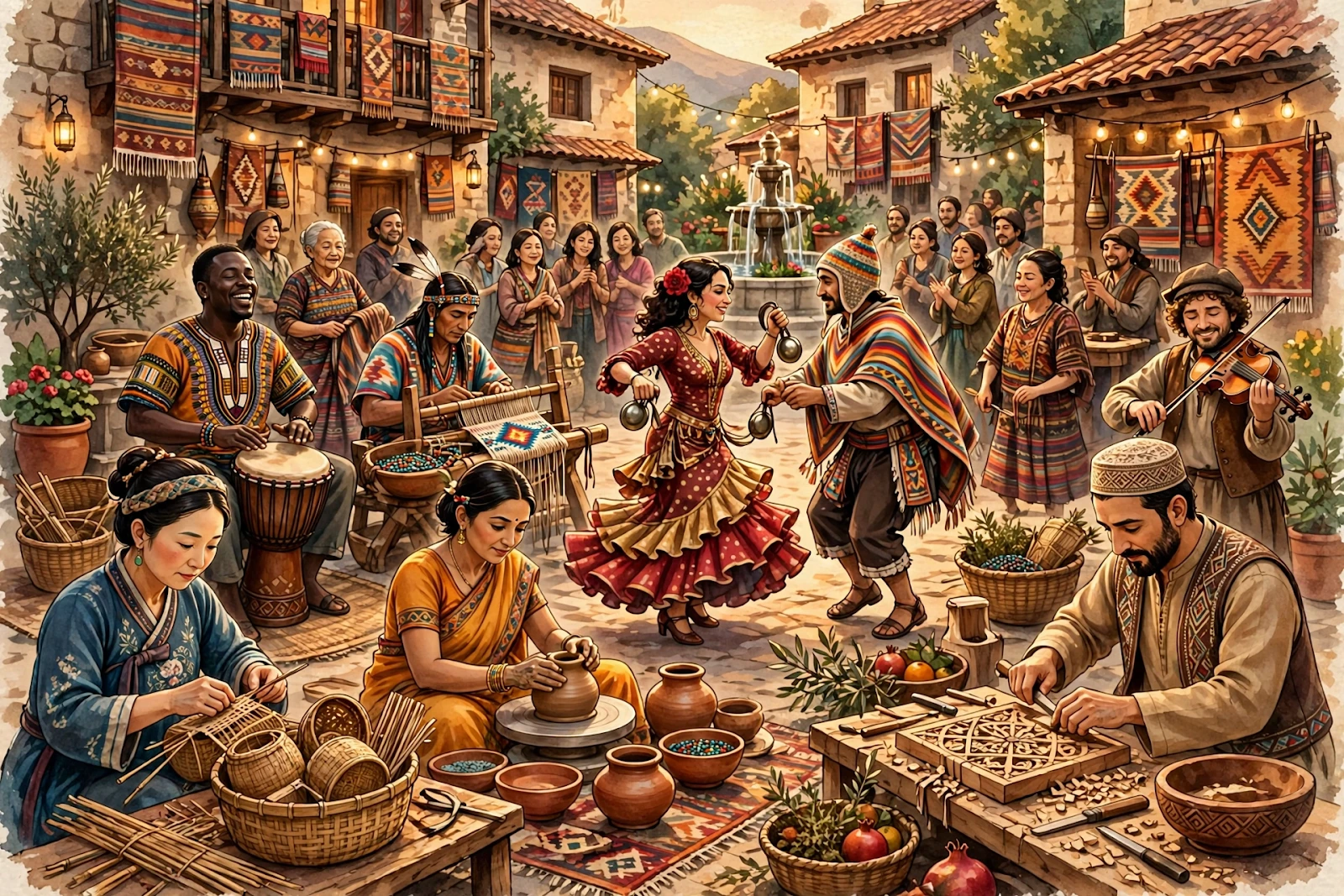
Illustration: Artisans and performers from many cultures sharing crafts, music, and dance, keeping living traditions alive.
What Happened
UNESCO announced on 21 October 2026 that its Intergovernmental Committee for the Safeguarding of the Intangible Cultural Heritage will hold its twenty-first session in Xiamen, China, from 30 November to 5 December 2026, with an opening event on 29 November. The committee will examine 64 nominations submitted by 82 countries.
Eighteen of those nominations were submitted jointly by several countries — twice as many as last year — a sign, UNESCO said, of growing commitment to safeguarding living heritage that crosses borders and strengthens ties among communities. The session will also consider potential first inscriptions for four African countries, and a nomination from a Small Island Developing State.
According to reporting on UNESCO's announcement, the four African countries in line for possible first inscriptions are Eswatini, Lesotho, South Sudan, and Tanzania. No decision on any nomination has been announced yet; the committee's rulings must not be anticipated, and each element is assessed against established criteria.
Background
Intangible cultural heritage is different from the monuments and historic sites most people associate with UNESCO. It covers the practices, expressions, knowledge, and skills that communities themselves recognise as part of their cultural inheritance: oral traditions, performing arts, rituals, festive events, social customs, and traditional craftsmanship. Unlike a building, a living tradition survives only while people practise and teach it.
The system rests on the 2003 Convention for the Safeguarding of the Intangible Cultural Heritage, adopted after globalisation, rapid social change, and urbanisation put many traditions at risk. The convention deliberately puts communities, groups, and individual practitioners — not governments alone — at the centre of safeguarding, and it created the lists the Xiamen committee will add to.
The scale has grown steadily. At its twentieth session in New Delhi in December 2025, the committee inscribed 67 elements proposed by 77 countries, bringing the living heritage lists to 849 practices across 157 countries, according to UNESCO's account of that session. The 2025 session also marked first inscriptions for seven countries, including Barbados, Chad, and the Comoros — a precedent the four African hopefuls in Xiamen will be hoping to follow.

Illustration: The coastal city of Xiamen, China, host of UNESCO's twenty-first heritage committee session in December 2026.
Why It Matters
A UNESCO inscription does not, by itself, guarantee money or protection — a point UNESCO and its partners stress. What it does is bring international attention, encourage documentation and education, and give communities a stronger voice in debates about their own traditions. For many bearers, the practices are also livelihoods: instruments, textiles, foods, and performances rooted in skilled handwork support families as well as identities.
The rise in joint nominations is the most telling trend in the Xiamen list. When several countries nominate a shared tradition together, safeguarding becomes cooperation rather than competition — a practical reminder that culture rarely respects national borders. UNESCO presented the doubling of joint nominations, from nine multinational files in the previous cycle's reporting to eighteen now, as evidence of that shift.
First inscriptions matter for a different reason: visibility. Countries that have never appeared on the lists gain a first formal entry point into the global heritage conversation, along with the networks, expertise, and safeguarding assistance that come with it. For communities in Eswatini, Lesotho, South Sudan, and Tanzania, a successful nomination would put traditions long sustained at home onto a world stage.

Illustration: African musicians and dancers performing traditional music outdoors, part of the living heritage under review by UNESCO.
What Happens Next
The committee meets in Xiamen from 30 November to 5 December 2026 at the Xiamen International Conference Center, with sessions broadcast live. Media registration for in-person attendance is compulsory, and UNESCO has set up messaging groups so the public can follow decisions in real time.
Over the week, the committee will work through the 64 files, debating each against the convention's criteria and hearing from the communities and states concerned. Decisions are announced as they are taken, and the newly inscribed elements will join the lists alongside the 849 practices recognised to date.
Whatever the outcomes, the session will set the tone for the next cycle: which traditions the world chooses to honour, which shared heritages countries choose to nominate together, and whether the list keeps widening to include countries and communities it has never recognised before.
Sponsored: explore today's featured sponsored offers
FAQ
What is intangible cultural heritage?
It is the living side of heritage: practices, expressions, knowledge, and skills — such as oral traditions, performing arts, rituals, and craftsmanship — that communities recognise as part of their cultural inheritance.
When and where does the UNESCO committee meet?
The twenty-first session of the Intergovernmental Committee for the Safeguarding of the Intangible Cultural Heritage takes place in Xiamen, China, from 30 November to 5 December 2026.
How many nominations will be examined?
Sixty-four nominations submitted by 82 countries, including 18 joint nominations from several countries — twice as many joint files as last year, according to UNESCO.
Which countries could gain their first inscriptions?
UNESCO said four African countries could secure first inscriptions; reporting on the announcement names them as Eswatini, Lesotho, South Sudan, and Tanzania. No decision has been made yet.
Does inscription guarantee funding or protection?
No. Inscription brings international recognition and can encourage documentation, education, and safeguarding work, but the traditions themselves survive only through the practitioners and communities who sustain them.
Sources
- UNESCO, "Intangible Cultural Heritage: 64 practices to be examined, as countries join forces to safeguard living heritage," 21 October 2026.
- UNESCO, "Intangible Cultural Heritage: 67 cultural practices inscribed," December 2025 session report.
- Towncrier Africa, "Four African Countries Could Secure First UNESCO Intangible Heritage Inscriptions," 22 October 2026.
- UNESCO, "China to host the 21st session of the Committee in 2026," ICH news, February 2026.
Comments
Post a Comment