
UNESCO and TUI Back Zanzibar's Taarab: A Community Inventory to Keep a Living Musical Heritage Singing
ZANZIBAR — UNESCO and the TUI Care Foundation have completed a community-based inventory of Taarab music in Zanzibar, a week-long effort from 12 to 19 October 2026 that documented one of the Swahili coast's most cherished living traditions with the people who perform and sustain it.

Illustration: Taarab musicians performing with oud, violin and drums in a historic Stone Town courtyard, celebrating Zanzibar's living musical heritage.
What Happened
UNESCO reported on 19 October 2026 that it had partnered with the TUI Care Foundation to support a community-based inventory of Taarab music in Zanzibar, the Tanzanian archipelago whose historic Stone Town district has long been a crossroads of the western Indian Ocean. The fieldwork ran from 12 to 19 October 2026 and brought together government authorities, cultural stakeholders, practitioners and heritage bearers — the singers, musicians, poets and organisers who keep Taarab alive.
The inventory combined community consultations with field-based engagement, recording not only the music itself but the knowledge, experiences and perspectives of the people who practise, perform and sustain it. UNESCO described the work as a contribution to safeguarding the island's living cultural heritage and to strengthening the connection between culture, communities and sustainable tourism.
The effort forms part of Sounds & Stories of Stone Town: Connecting Culture and Community through Sustainable Tourism, a 24-month initiative supported by UNESCO and the TUI Care Foundation. Its stated purpose goes beyond documentation: it seeks to connect heritage protection with participation in sustainable tourism, so that the communities who carry a tradition also benefit from the visitors it attracts.
Background
Taarab is far more than background music in Zanzibar. Its compositions, poetic lyrics and performance traditions reflect centuries of historical interaction along the Swahili coast, blending African, Arab, Indian and European influences into a sound that is unmistakably Zanzibari. Orchestras built around the oud, violin, qanun and percussion accompany singers whose lyrics move between romance, moral reflection and sharp social commentary.
Beyond its artistic value, UNESCO notes, Taarab provides a space for storytelling, social commentary and the transmission of cultural knowledge and values across generations. Weddings, community celebrations and public gatherings have long been its stages, and its songs have carried news, gossip and debate through Zanzibari society for well over a century.
That living quality is also what makes Taarab vulnerable. Living heritage survives only while it is practised and taught, and rapid social change, shifting tastes and the economics of performance can quietly erode a tradition even when its recordings remain. Inventorying — systematically recording what exists, who carries it and how it is transmitted — is the first, unglamorous step in safeguarding, and it is the step UNESCO's 2003 Convention for the Safeguarding of the Intangible Cultural Heritage asks countries to take before anything else.
Stone Town itself, known in Swahili as Mji Mkongwe, provides the setting. Its coral-stone houses, carved wooden doors and winding alleys have made it one of East Africa's most recognisable historic districts, and its musical life is inseparable from its streets, courtyards and community halls.
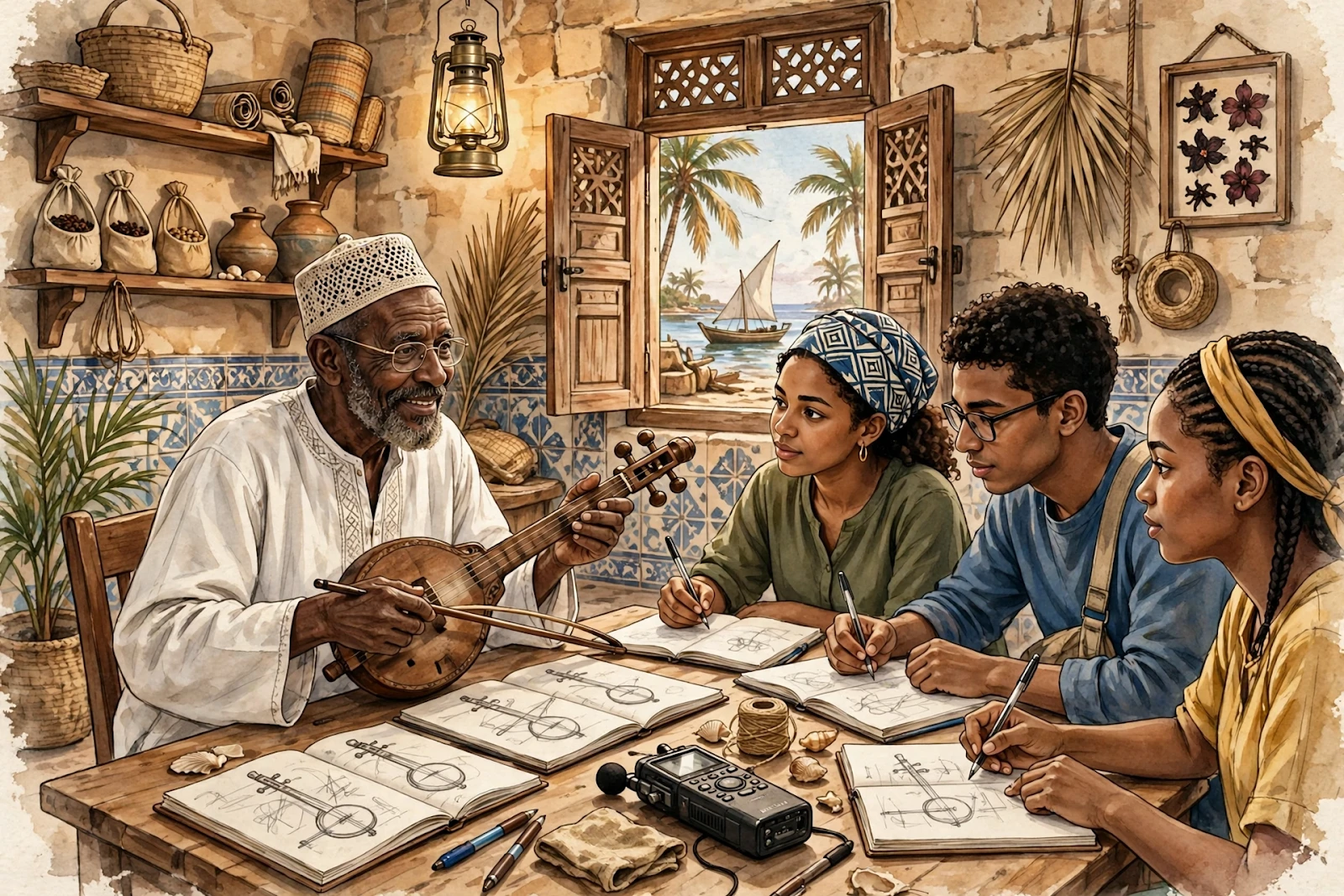
Illustration: An elderly musician teaching young performers during a community heritage workshop, symbolizing how Taarab is passed between generations.
Why It Matters
The inventory matters because it treats heritage bearers as experts rather than subjects. By centring community consultations and field engagement, the project recorded Taarab as its practitioners understand it — its repertoire, its performance customs, its social meanings — rather than as outsiders might catalogue it. Boniface Kadili, Director of Culture at Tanzania's Ministry of Information, Culture, Arts and Sports, said the inventory was an important step towards strengthening efforts to safeguard Tanzania's intangible cultural heritage, adding that by inventorying cultural expressions and recognising the knowledge of the communities that sustain them, Tanzania is contributing to the preservation of its national identity while ensuring traditions continue to be transmitted to future generations.
There is a practical dimension too. Heritage tourism is one of Zanzibar's economic engines, and a tradition that is documented, understood and visibly alive is far easier to present honestly to visitors than one that exists only in archives. Linking safeguarding to sustainable tourism — the explicit aim of the Sounds & Stories of Stone Town initiative — offers a model in which visitors' interest supports the musicians and communities themselves, rather than reducing their art to a backdrop.
The work also arrives at a moment of wider attention to living heritage. UNESCO's heritage committee meets in Xiamen, China, from 30 November to 5 December 2026 to consider 64 nominations from 82 countries for its intangible heritage lists, with potential first inscriptions for four African countries. The Zanzibar inventory is a separate, ground-level effort, but it belongs to the same movement: a recognition that the world's heritage is not only monuments and sites, but the songs, skills and stories people carry.

Illustration: A traditional wooden dhow sailing past the Stone Town waterfront at sunset, symbolizing Zanzibar's historic Swahili coast culture.
What Happens Next
With the fieldwork complete, the inventory's findings will feed into Tanzania's broader safeguarding efforts for Taarab and other living traditions. The next steps, according to the project's framing, include using the documented material to support community-led safeguarding plans and to deepen the link between heritage and sustainable tourism in Stone Town over the remaining course of the 24-month initiative.
For the musicians and bearers themselves, the hope is simpler: that the attention brings audiences, students and support. A tradition that is inventoried but not performed is only half saved, and Taarab's future will be decided in rehearsal rooms, wedding halls and community gatherings as much as in reports.
UNESCO's broader calendar will keep living heritage in the spotlight through the end of the year, with the Xiamen committee session in late November and early December set to inscribe new elements from around the world. For Zanzibar, the October inventory is a reminder that global recognition begins at home, with the people who sing the songs.
Sponsored: explore today's featured sponsored offers
FAQ
What is Taarab music?
Taarab is a musical tradition of Zanzibar and the Swahili coast, blending African, Arab, Indian and European influences. Its orchestras, poetic lyrics and performances are central to weddings, celebrations and social life, and its songs carry storytelling and social commentary.
What did the October 2026 inventory involve?
From 12 to 19 October 2026, UNESCO and the TUI Care Foundation supported a community-based inventory of Taarab in Zanzibar, with community consultations and field engagement involving government authorities, cultural stakeholders, practitioners and heritage bearers.
Why inventory a living tradition instead of just recording it?
Inventorying documents what exists, who carries it and how it is transmitted. It is the foundational step in safeguarding under UNESCO's 2003 convention, and it gives communities a recognised basis for planning how a tradition is taught, supported and presented.
What is the Sounds & Stories of Stone Town initiative?
It is a 24-month UNESCO and TUI Care Foundation initiative that connects culture and community through sustainable tourism in Stone Town, aiming to link heritage protection with benefits for the communities who sustain it.
Does the inventory mean Taarab is now on UNESCO's heritage lists?
No. The inventory is a national safeguarding step, not an inscription decision. UNESCO's intangible heritage committee considers formal nominations separately, including at its session in Xiamen, China, from 30 November to 5 December 2026.
Sources
- UNESCO, "UNESCO and TUI Care Foundation support the safeguarding of Taarab music in Tanzania," 19 October 2026.
- UNESCO, "UNESCO Intangible Cultural Heritage: 64 practices to be examined," 21 October 2026 (Xiamen session, 30 November–5 December 2026).
- Ad-hoc News, "UNESCO reports Taarab inventory ending on 19 October," October 2026.
- Towncrier Africa, "Four African Countries Could Secure First UNESCO Intangible Heritage Inscriptions," 22 October 2026.
Comments
Post a Comment