
WASHINGTON — The United States reported 4,852 measles cases in 2026 as of October 29, the Centers for Disease Control and Prevention (CDC) said on Friday, October 30, 2026, an increase of 264 cases from its previous update, Reuters reported. Hospitalizations linked to measles this year stood at 511, representing 11% of all reported cases, according to the CDC.
The latest count extends an outbreak year that has already tested public health systems across the country. Measles is one of the most contagious diseases known, and it can spread quickly in communities where vaccination coverage is low. The new figures show that the rise has not stopped: hundreds more cases were added in a single reporting interval, and more than one in ten reported cases this year has led to a hospital stay.
This article reports public health data. It is general information, not medical advice, and anyone with questions about measles vaccination should discuss them with their own clinician or local health authority.
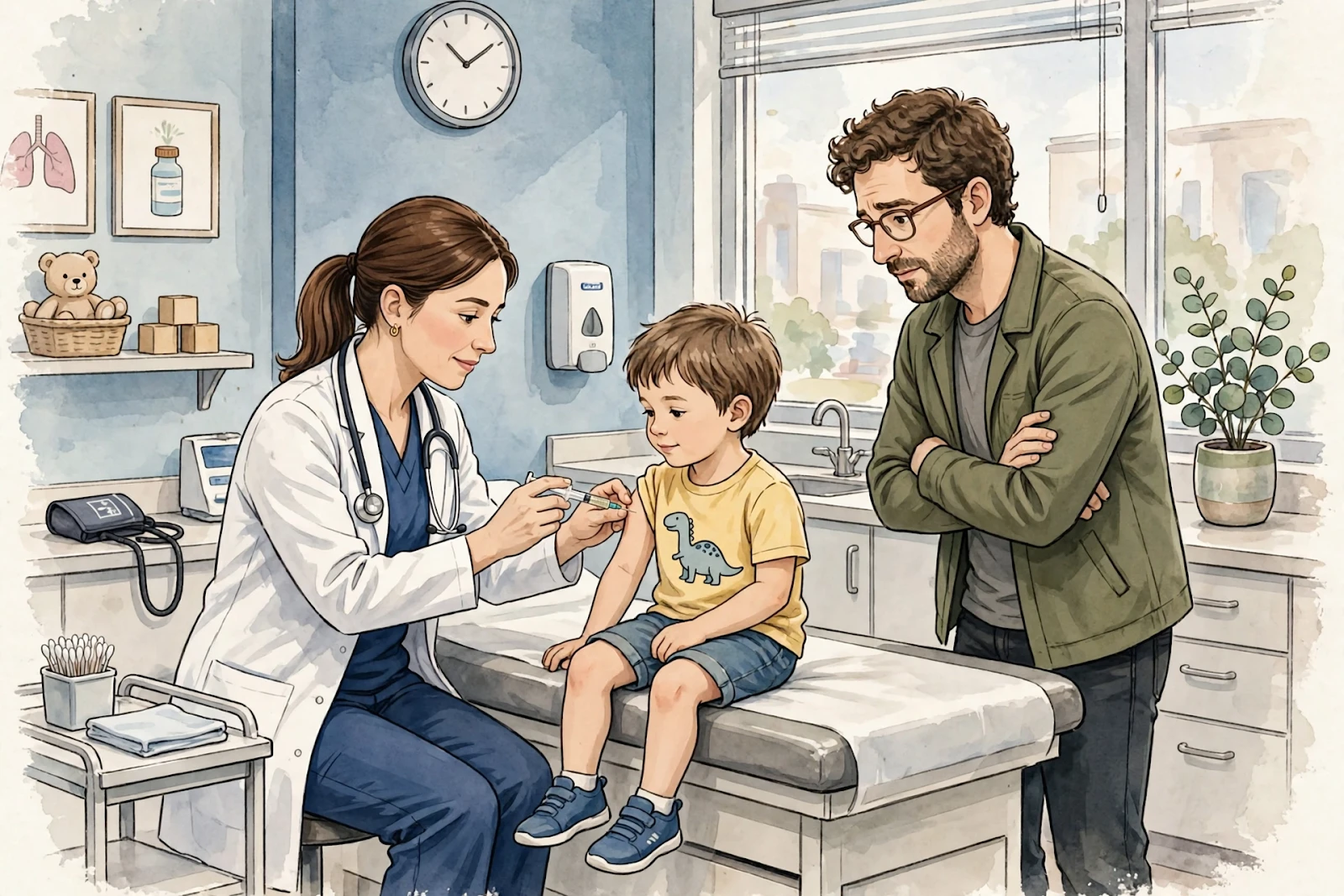
Illustration: A nurse gives a measles vaccine to a child at a clinic while a parent watches. This is an AI-generated illustration, not a real photograph.
What Happened
The CDC reported the updated national total on Friday, October 30, 2026, covering cases recorded through October 29. The total of 4,852 cases was up 264 from the previous update, Reuters reported, citing the CDC's latest figures.
Hospitalizations linked to measles this year stood at 511, or 11% of all reported cases, the CDC said. That share matters because measles is often described as a childhood illness, yet a hospitalization rate of more than one in ten shows how serious it can be, particularly for young children and for people whose immune systems are weaker.
The CDC's age breakdown showed that people aged 5 to 19 accounted for 2,010 cases this year, followed by 1,996 cases among adults aged 20 and older and 812 cases in children under 5, Reuters reported. In other words, the outbreak has touched every age group, but school-age children and teenagers make up the largest reported group.
The vast majority of infections were among people who were unvaccinated or whose vaccination status was unknown, accounting for 96% of cases in 2026, up from 93% in 2025, according to CDC data cited by Reuters. That pattern is the central public health message in the update: the cases are concentrated overwhelmingly among people without documented protection.
Background
Measles spreads through the air when an infected person coughs or sneezes, and the virus can linger in the air for some time after the person has left a room. Symptoms typically include fever, cough, red eyes and a rash, and complications can include pneumonia, brain swelling and, in rare cases, death. Health authorities recommend the measles, mumps and rubella (MMR) vaccine as the main protection, with two doses offering strong protection for most people.
The United States has been tracking a large measles year throughout 2026. Earlier CDC counts reported during October put the national total above 4,000 cases, and Pennsylvania emerged as one of the hardest-hit states. The new update shows that state still carrying a heavy burden: Pennsylvania has reported 1,398 measles cases so far, according to the state health department, as cited by Reuters.
There is also a discrepancy in the death toll that health officials have not fully reconciled in public reporting. The Pennsylvania state health department has reported five measles-related deaths so far in 2026, Reuters reported. The CDC, however, has confirmed only three measles-associated deaths and has not specified where they occurred. That difference does not change the direction of the outbreak, but it shows why readers should treat state and federal counts as complementary rather than identical: states and the CDC can classify and confirm deaths on different timelines.

Illustration: Medical staff care for a measles patient in a hospital ward. This is an AI-generated illustration, not a real photograph.
Why It Matters
The jump of 264 cases in one update matters for two reasons. First, it shows transmission is continuing rather than fading: new cases are still being identified and added to the national count late in October. Second, the hospitalization figure — 511 people, or 11% of cases — is a reminder that measles is not only a matter of case counts. Every hospitalization represents a person who needed inpatient care, with costs and strain for families and hospitals alike.
The age breakdown matters too. With 2,010 cases among people aged 5 to 19, schools and youth settings remain a key front in the response. Children under 5, who accounted for 812 cases, are among those most at risk of severe complications, which is why health authorities place particular emphasis on keeping young children up to date on vaccination and on keeping sick children away from others.
The vaccination-status figure is perhaps the most telling number in the update. At 96% of cases among people who were unvaccinated or whose status was unknown — up from 93% in 2025 — the data point to gaps in coverage rather than to vaccine failure as the main driver of this year's outbreak. Public health officials have long said that measles can be controlled when vaccination coverage in a community is high, because the virus struggles to find enough susceptible people to keep spreading. When coverage falls, outbreaks can take hold and grow.
Pennsylvania's experience illustrates that point at state level. With 1,398 cases reported by the state health department, Pennsylvania alone accounts for well over a quarter of the national total. The state's reported deaths, whether counted as five by the state or three confirmed by the CDC, also show that measles deaths, while rare compared with total cases, are still occurring in 2026.
What Happens Next
The CDC is expected to continue updating its national measles count as states report new cases, and the next update will show whether the pace of 264 additional cases is sustained, slows, or quickens. Health departments in affected areas are likely to keep urging people to check their vaccination records, particularly parents of school-age children and adults who are unsure whether they received two MMR doses.
For families, the practical steps health authorities recommend are straightforward: check vaccination status, keep children with measles symptoms at home and away from others, and seek medical advice promptly if a rash with fever develops after possible exposure, calling ahead so clinics can take precautions. For hospitals, the continued hospitalization rate means measles readiness — isolation rooms, staff immunity checks and clear triage guidance — remains important even as the year draws toward its end.

Illustration: Public health officials track measles cases on a map of the United States. This is an AI-generated illustration, not a real photograph.
Longer term, the 2026 outbreak is likely to renew debate about vaccination coverage, school-entry requirements and how quickly health systems detect and respond to clusters. The CDC's figures give that debate a concrete anchor: 4,852 cases, 511 hospitalizations, and a share of cases among unvaccinated or status-unknown people that has risen, not fallen, compared with 2025.
Sponsored: explore today's featured sponsored offers
FAQ
How many US measles cases have been reported in 2026?
The CDC reported 4,852 measles cases in the United States as of October 29, 2026, up 264 cases from its previous update, according to Reuters reporting on October 30, 2026.
How many people have been hospitalized?
Hospitalizations linked to measles this year stood at 511, representing 11% of all reported cases, according to the CDC.
Who is most affected by age?
People aged 5 to 19 accounted for 2,010 cases, followed by 1,996 cases among adults aged 20 and older and 812 cases in children under 5, the CDC said.
Were most cases among vaccinated people?
No. The vast majority of infections were among people who were unvaccinated or whose vaccination status was unknown, accounting for 96% of cases in 2026, up from 93% in 2025, according to CDC data.
How many measles cases and deaths has Pennsylvania reported?
Pennsylvania has reported 1,398 measles cases so far, according to the state health department. The state has reported five measles-related deaths in 2026, while the CDC has confirmed only three measles-associated deaths and has not specified where they occurred.
Sources
- Reuters, "US measles cases rise to 4,852, CDC says," October 30, 2026.
- US Centers for Disease Control and Prevention, measles case data as of October 29, 2026, as reported by Reuters on October 30, 2026.
- Pennsylvania Department of Health, measles case and death figures, as reported by Reuters on October 30, 2026.
Comments
Post a Comment