
SEOUL — A team of South Korean astronomers says it has pinpointed the exact night sky — July 22, 1889 — that inspired Vincent van Gogh's The Starry Night, challenging the long-accepted June dating of one of the world's most famous paintings, in a study published this week in the journal Scientific Reports, Smithsonian magazine reported on October 23.
Using astronomy software to reconstruct every night sky van Gogh could have seen from southern France in the summer of 1889, the researchers matched the painting's most prominent celestial features — stars, a crescent moon and Venus — to a single night: a clear July evening when the moon sat above Venus and the V-shaped Hyades star cluster fit neatly into the frame.
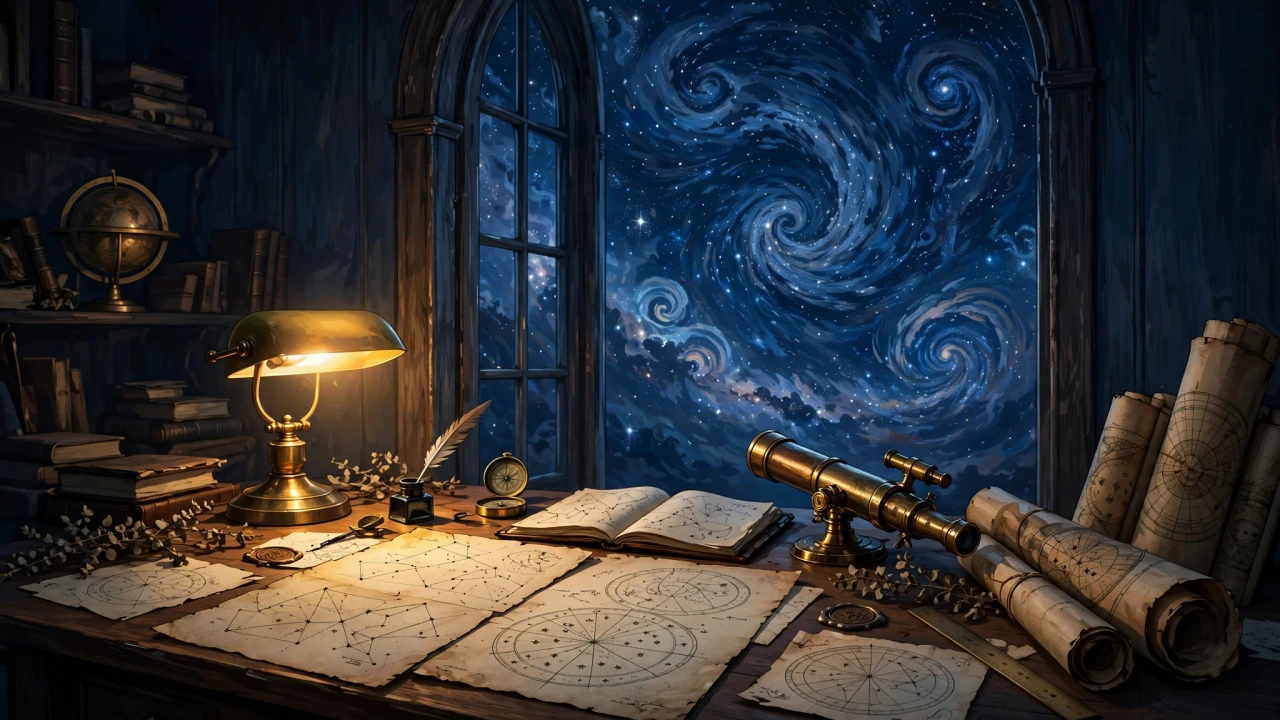
Illustration: An astronomer's study desk with star charts and a telescope beneath a swirling starry night sky.
What Happened
The new study, led by Elijah Jeong-hyun Kim — the CEO of a Seoul telescope maker and an astronomy doctoral candidate at Kyung Hee University — approaches The Starry Night as a problem in forensic astronomy. The theory rests on the idea that van Gogh painted the actual sky rather than stars he imagined, Smithsonian reported.
To test it, the researchers recreated every night sky over Saint-Rémy-de-Provence during June and July 1889 with astronomy software, then compared the three-dimensional geometry of the painting's dominant celestial features — the arrangement of stars, the crescent moon and Venus — with the real sky, deliberately eliminating variables such as size and color, which the artist may have embellished.
They found that the Hyades — a V-shaped cluster of five stars within the Taurus constellation — were the best fit for the stars in van Gogh's painting. That finding disputes conclusions from previous studies, which had suggested that Aries was the painting's dominant constellation. "At dawn, when van Gogh was known to paint, the stars of Aries are relatively faint, hardly enough to inspire a painter," Kim told Scientific American.
July 22, 1889, was the date that matched all the conditions, according to the study: the moon was a crescent shape and sat above Venus in the sky, the Hyades would have fit within the frame, and a weather analysis indicated the night was clear enough for van Gogh to see the stars.
"No two skies are the same. Something always changes. I believe Vincent noticed those changes and put them into the painting," Kim told Marcia Dunn of the Associated Press (AP) in an email. "I am confident that July 22 is the better date. I will bet on this date."
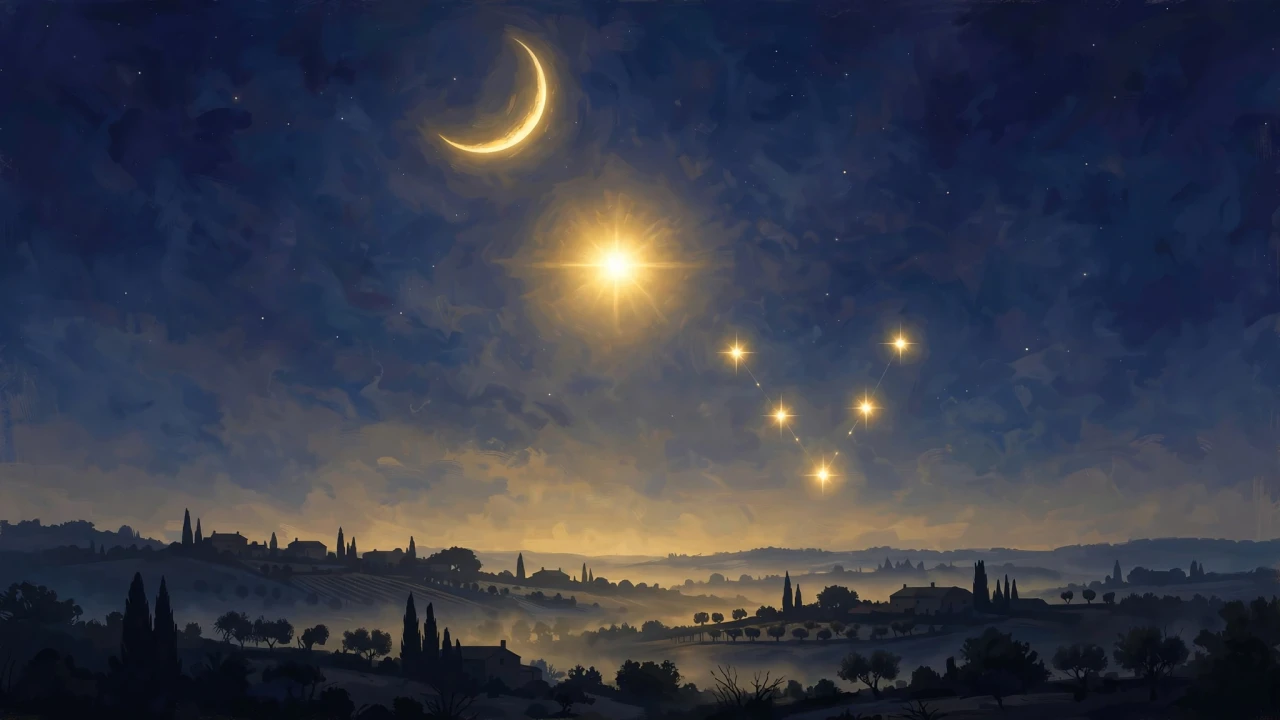
Illustration: The crescent moon above Venus with the V-shaped Hyades star cluster in a pre-dawn sky.
Background
On a clear summer night in 1889, the 36-year-old van Gogh gazed through his asylum window at the bright pre-dawn sky above Saint-Rémy-de-Provence, France, where he was recovering from several mental health crises, Smithsonian reported. In a letter from around early June, he wrote to his brother Theo: "This morning I saw the countryside from my window a long time before sunrise, with nothing but the morning star, which looked very big." In mid-June, he wrote that he had completed "a new study of a starry sky."
Art historians have long used those letters and other documentary clues to date the painting of The Starry Night — now held at the Museum of Modern Art in New York — to June 1889. The new study proposes a different sequence: "What we propose is the possibility that Vincent conceived the idea in June and completed the painting after July 22," Kim told Space.com.
It is not the first time scientists have read the painting as an astronomical record. Earlier studies attempted to identify the constellations in the swirling canvas, with some pointing to Aries — a conclusion the Korean team says fails the dawn-visibility test.
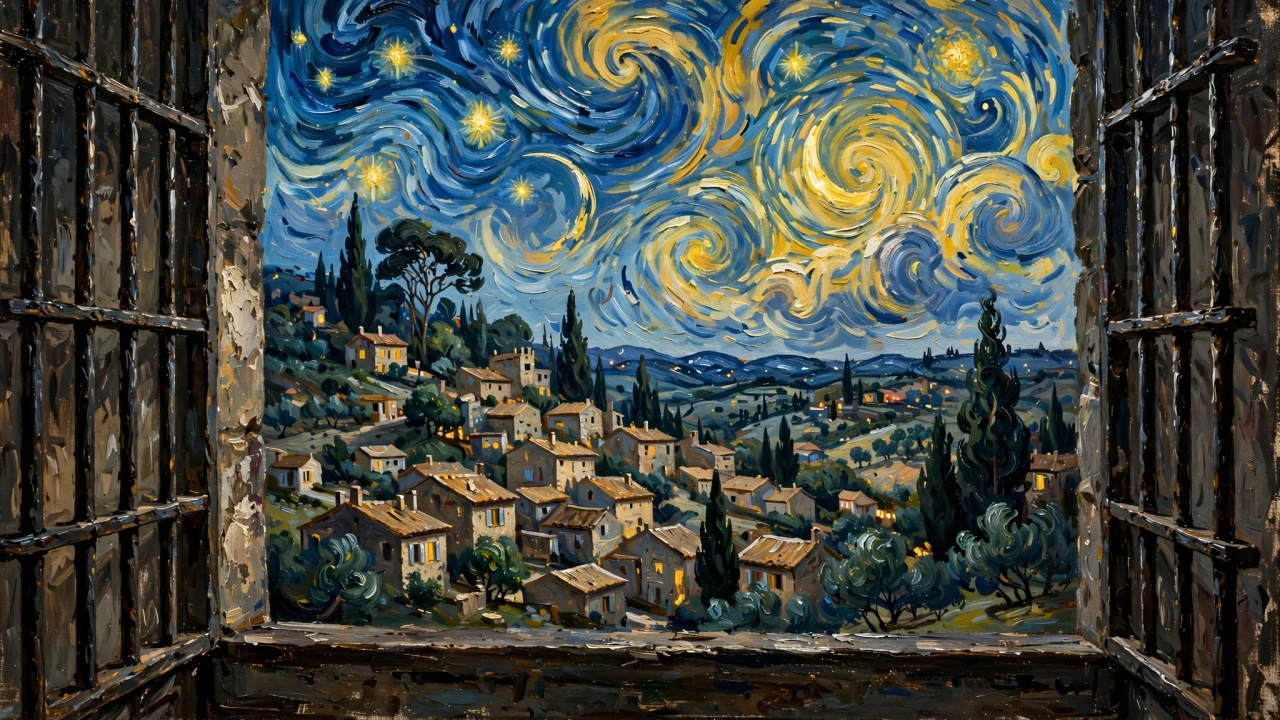
Illustration: A painter's view from a 19th-century asylum window over a Provençal village under a swirling starry sky.
Why It Matters
The claim lands at the intersection of two disciplines that rarely meet — and not everyone in the art world is convinced. A spokesperson for Amsterdam's Van Gogh Museum told the Guardian that "van Gogh was not concerned with exact likenesses. The positions of the celestial bodies depicted can therefore not form a reliable basis for dating the work." The museum also pointed out that van Gogh suffered a serious breakdown around July 22 that left him unable to paint for about a month.
That objection goes to the heart of the forensic-astronomy approach: it assumes van Gogh faithfully recorded the sky, when painters routinely rearrange, embellish or imagine. Still, even a skeptical voice in the coverage found value in the exercise. "Still, I would see the July date as an intriguing hypothesis rather than a settled answer," said Jose Luis Aragon, a physicist at the National Autonomous University of Mexico who was not involved in the study but has studied van Gogh paintings, in comments to the AP. "What I find most convincing is the broader message: The painting is not pure fantasy. Van Gogh watched the real sky very closely."
Whether or not July 22 holds up, the study adds to a growing field that uses astronomy software to test what artists actually saw — a reminder that one of modern art's most recognizable images may have a precise origin in the night sky of a specific evening in 1889.
What Happens Next
The debate now moves to art historians, who will weigh the reconstruction against van Gogh's letters, his medical history and the museum's caution that his brush was not a camera. Independent astronomers may also re-run the team's reconstructions to test how sensitive the July 22 match is to the study's assumptions about which brushstrokes correspond to which stars.
Kim is unbowed: "I am confident that July 22 is the better date. I will bet on this date," he told the AP. And whatever the verdict on the date, the study has already sharpened a broader question — how closely the great observers of the night sky, from astronomers to painters, were watching the same heaven.
Sponsored: explore today's featured sponsored offers
FAQ
What did the new study claim about The Starry Night?
A team of South Korean astronomers, in a study published this week in Scientific Reports, argues that the exact night sky behind Vincent van Gogh's The Starry Night was July 22, 1889 — about a month later than the June 1889 date art historians have traditionally assigned based on van Gogh's letters.
How did the researchers date the painting to July 22, 1889?
They used astronomy software to recreate every night sky over Saint-Rémy-de-Provence in June and July 1889, then compared the three-dimensional geometry of the painting's stars, crescent moon and Venus with the real sky — ignoring size and color, which van Gogh may have embellished. The Hyades cluster in Taurus was the best match, and July 22 was the only night when the crescent moon sat above Venus with the Hyades fitting the frame on a clear night.
Why do some experts dispute the finding?
The Van Gogh Museum told the Guardian that "van Gogh was not concerned with exact likenesses," so star positions cannot reliably date the work, and noted that van Gogh suffered a serious breakdown around July 22 that left him unable to paint for about a month. Physicist Jose Luis Aragon, who was not involved in the study, called the July date "an intriguing hypothesis rather than a settled answer."
Where is The Starry Night now?
The Starry Night (1889) is held at the Museum of Modern Art in New York. It is distinct from van Gogh's 1888 painting Starry Night Over the Rhône, a calmer riverside scene.
What is forensic astronomy?
Forensic astronomy applies astronomical calculations to historical questions — such as reconstructing the sky above a specific place on a specific past date — to test whether artists, writers or witnesses recorded what was really visible. The approach has also been used to date other artworks and historical events.
Sources
- Smithsonian Magazine, "A Team of Astronomers Thinks They Have Identified the Exact Night Sky That Inspired Vincent van Gogh's 'Starry Night.' Not Everyone Is Convinced," by Christian Thorsberg, October 23, 2026 — study publication in Scientific Reports; July 22, 1889 date; Kim's role at Kyung Hee University; methodology (software reconstruction of June–July 1889 skies, 3D geometry, eliminating size/color); Hyades vs Aries; Van Gogh Museum's objection; Aragon's comments; van Gogh's letters to Theo.
- Associated Press, reporting by Marcia Dunn (via Smithsonian, October 23, 2026) — Kim's quotes: "No two skies are the same. Something always changes. I believe Vincent noticed those changes and put them into the painting" and "I am confident that July 22 is the better date. I will bet on this date"; Aragon's "intriguing hypothesis rather than a settled answer" and "The painting is not pure fantasy."
- Scientific American (via Smithsonian, October 23, 2026) — Kim on Aries: "at dawn, when van Gogh was known to paint, the stars of Aries are relatively faint, hardly enough to inspire a painter."
- Space.com (via Smithsonian, October 23, 2026) — Kim's proposal: "what we propose is the possibility that Vincent conceived the idea in June and completed the painting after July 22."
- The Guardian (via Smithsonian, October 23, 2026) — Van Gogh Museum spokesperson: "van Gogh was not concerned with exact likenesses. The positions of the celestial bodies depicted can therefore not form a reliable basis for dating the work"; van Gogh's breakdown around July 22.
Comments
Post a Comment