
HANOI, Vietnam — Vietnam cut its average retail electricity price by 2% and removed the special consumption tax on gasoline from 1 November 2026, launching a five-month energy-cost relief package aimed at easing pressure on households and businesses while the country chases an ambitious full-year growth target of more than 10%.
The government announced the measures on Saturday, 31 October, saying they were intended to help maintain macroeconomic stability while supporting social welfare and business activity. The average retail electricity tariff falls to 2,159.9 dong (about $0.085) per kilowatt-hour, excluding value-added tax, while the special consumption tax on gasoline drops to zero from rates of 7% to 10% until the end of March next year, Reuters reported.

Illustration: Electricity transmission towers over Hanoi rooftops as Vietnam cuts average retail power prices by 2%.
What Happened
State electricity provider Electricity of Vietnam (EVN) applied the 2% reduction to the average retail electricity price from 1 November. Vietnam's government news service reported the revised average at 2,159.9037 dong per kilowatt-hour, excluding value-added tax, down from the previous average of 2,204.07 dong per kilowatt-hour that had been in effect since 10 May 2025. The figure is an average retail price, not a promise that every household's next bill will fall by exactly 2%, since individual tariffs vary by usage band and customer group.
Separately, government resolution 45/2026/NQ-CP, dated 31 October, sets the special consumption tax rate on gasoline at 0% from 1 November 2026 through 31 March 2027. Under the 2025 law, the ordinary rates had been 10% for conventional mineral gasoline, 8% for E5 and 7% for E10, according to reporting of the resolution. Cutting this particular tax to zero does not remove all taxes, distribution costs or other retail-price components, and it does not establish a permanent zero-tax policy after March 2027.
Vietnamese authorities also announced lower pump prices for widely used gasoline grades effective 1 November. The government news service reported a reduction of 1,804 dong per litre for E5 RON92 and 1,575 dong per litre for E10 RON95-III. Deputy Prime Minister Nguyen Van Thang said the government expected to allocate a further 4 trillion dong from November through the end of 2026 to support the gasoline tax cut, alongside an advance from the state budget to the Petroleum Price Stabilisation Fund, a continued 2% value-added tax reduction through the end of 2026, and measures to keep prices of state-regulated goods and services stable.
The measures cap a week of preparation. On 27 October, Thang chaired a meeting at the Government Office on scenarios for managing fuel and electricity prices, directing EVN to urgently review its costs, maximise savings and draw up a plan to reduce the average retail price. The Ministry of Industry and Trade was told to lead the review of EVN's plan so the cut could take effect on 1 November, while the Ministry of Finance was tasked with urgently reviewing the legal basis and feasibility of the zero gasoline tax before the same deadline.
Background
Vietnam enters the final quarter of 2026 with strong headline growth but a demanding arithmetic problem. According to the National Statistics Office, gross domestic product grew an estimated 9.95% year on year in the third quarter, the fastest pace since the third quarter of 2022, taking growth for the first nine months to 9.01%. Industry and construction grew 11.21% over the first nine months, while services expanded 8.69%, according to the statistics office's figures.
Those results still leave the government's full-year target of more than 10% growth short of assured. With nine-month growth at 9.01%, the economy would need to grow by around 12.5% in the fourth quarter to reach the target, a figure officials and analysts alike describe as highly demanding. Prime Minister Le Minh Hung told the National Assembly in October that the government would strive for the highest possible outcome, combining double-digit growth with macroeconomic stability and inflation control.
Inflation is the constraint that makes the energy package politically attractive. Consumer prices rose 5.1% year on year in September, above the official average target of 4.5%, according to Commerzbank Research's summary of the data, with elevated oil prices and rapid credit growth limiting the central bank's room for additional monetary support. The statistics office calculates that household electricity accounts for about 4.8% of the consumer price index basket, so a cut in power prices feeds directly, if modestly, into the inflation measure. Officials have said the electricity and gasoline measures together could provide an additional margin of around 0.07 percentage points for inflation control.
Energy costs have also been volatile for reasons outside Vietnam's control. Brent crude settled near $117 a barrel on 30 October, according to market reports, after supply fears linked to attacks on shipping in the Strait of Hormuz pushed prices higher. Singapore-based bank UOB listed potential energy price spikes linked to the unresolved US-Iran conflict among the risks to Vietnam's outlook, alongside tougher US tariff measures, electricity supply and infrastructure constraints, and delays in public investment.
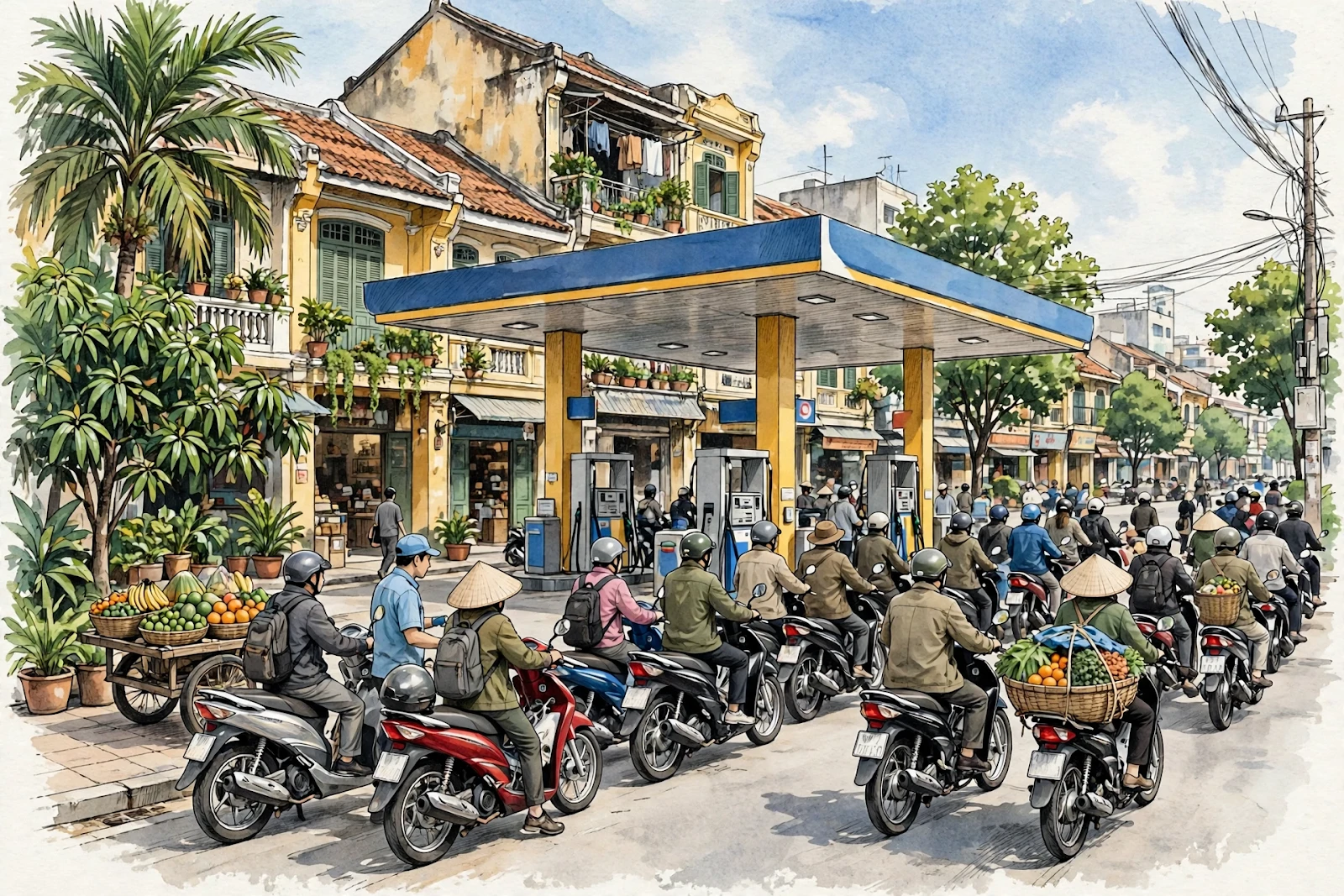
Illustration: Motorbikes queue at a gasoline station in Vietnam as the special consumption tax on gasoline falls to zero until March 2027.
Why It Matters
For households, the package is a direct, visible reduction in two everyday costs at the start of the year-end consumption season. Electricity and fuel feed into almost every other household expense, from food transport to small-business operating costs, so even a modest cut can soften the effect of higher prices elsewhere. For businesses, particularly manufacturers and logistics firms, lower energy costs arrive just as factories push to meet year-end export orders.
For the government, the measures are a fiscal lever used in place of monetary easing. With inflation already above target, cutting interest rates would risk fuelling further price rises, so reducing administered energy costs and a fuel tax offers a way to support demand without loosening monetary policy. It also signals determination to hit the growth target: officials have framed the package explicitly as support for production, business activity and people's livelihoods, not merely as consumer relief.
The package also tests EVN's finances. The utility was directed to fund the electricity cut through cost savings and efficiency gains rather than a subsidy, and it reported profit of more than 12,000 billion dong in the first eight months of 2026. Whether those savings can sustain a five-month price cut without squeezing investment in generation and grid capacity will be watched closely, especially given the infrastructure constraints analysts have flagged.
For the wider region, Vietnam's move is a reminder of how exposed Southeast Asia's export economies remain to energy prices. A government willing to forgo gasoline tax revenue for five months is, in effect, buying insurance against an oil shock derailing its growth target — and betting that the growth it protects will more than repay the forgone revenue.
What Happens Next
The immediate test is whether the measures show up in the data. Vietnam's October and November inflation prints will indicate how much of the electricity and fuel relief reaches consumer prices, while fourth-quarter GDP, due early in 2027, will show whether the economy came close to the 12.5% pace needed for the full-year target. UOB, which raised its 2026 growth forecast to 9.2% from 8.5% after the strong third quarter, expects fourth-quarter growth of about 9.7% — well short of the official requirement — and considers the 12.5% to 13% pace unlikely to be achieved.
A second question is what happens on 1 April 2027, when the gasoline tax cut expires. If oil prices remain elevated, the government will face a choice between restoring the tax and accepting a jump in pump prices, or extending the relief at further fiscal cost. The electricity price is on the same five-month clock: the reduction runs through 31 March 2027, and EVN's cost-saving plan will determine whether a lower price can be sustained beyond that date.
Investors will also watch the interaction with trade policy. UOB cited tougher US tariff measures as a risk to the outlook, and Vietnam's exporters face a fourth quarter in which external demand, energy costs and exchange-rate volatility could pull in opposite directions. The energy package removes one headwind; it does not remove the others. If growth still falls short of 10%, the debate in Hanoi will shift from whether the target was reachable to which constraint — energy, exports, investment or inflation — mattered most.
Sponsored: explore today's featured sponsored offers
FAQ
What exactly did Vietnam cut from 1 November 2026?
Vietnam cut its average retail electricity price by 2%, to 2,159.9 dong per kilowatt-hour excluding value-added tax, and set the special consumption tax on gasoline to zero, down from 7% to 10%, through 31 March 2027.
How long will the measures last?
Both measures run for five months, from 1 November 2026 through 31 March 2027. The gasoline tax cut is not permanent, and its expiry on 1 April 2027 will be a key decision point.
Why is Vietnam cutting energy costs now?
The government said the measures support macroeconomic stability, social welfare and business activity. They arrive as Vietnam chases full-year GDP growth above 10%, which requires fourth-quarter growth of more than 12.5%, while September inflation of 5.1% sits above the 4.5% target.
Will every household's electricity bill fall by exactly 2%?
No. The 2% figure is a cut in the average retail price. Individual bills vary by usage band and customer group, so the saving on any single bill will differ.
What do forecasters expect for Vietnam's growth?
UOB raised its 2026 forecast to 9.2% from 8.5% after third-quarter growth of 9.95%, and expects about 9.7% in the fourth quarter — below the roughly 12.5% pace the official 10% target would require.

Illustration: Workers on a modern Vietnamese factory floor as manufacturers push to meet year-end export orders.
Sources
- Reuters, "Vietnam cuts retail electricity price, removes gasoline tax from November 1," 31 October 2026.
- Vietnam government news service, via NewsNation, "Vietnam Cuts Power Prices 2%, Sets Gasoline Tax at Zero," 1 November 2026.
- Stockbiz, "Deputy Prime Minister Nguyen Van Thang: Government directs EVN to target a 2% reduction in retail electricity prices," 31 October 2026.
- UOB Global Economics & Markets Research, "Vietnam: Growth nears double digits as 3Q26 surprises," 5 October 2026, and Vietstock summary, 15 October 2026.
- Commerzbank Research, via FXStreet, "Vietnam: Strong GDP but rising inflation risks," 7 October 2026.
Comments
Post a Comment