
New York's Village Halloween Parade Returns for Its 53rd Year With 'Body & Soul' Theme and a Firehorse Opening
NEW YORK — New York City is set to turn Sixth Avenue into a moving stage on Saturday night, October 31, 2026, as the 53rd annual Village Halloween Parade marches from Canal Street to 15th Street, bringing one of the world's largest Halloween celebrations back to Greenwich Village. The parade, which steps off at 7 p.m. and runs until about 11 p.m., is free to watch and free to join, and it will go ahead rain or shine. This year's theme is "Body & Soul," and the evening opens with a brand-new dancing puppet-horse performance called "Firehorse!" — a fitting curtain-raiser in the Year of the Horse, according to parade organizers and local reporting.
For one night, the avenue belongs not to traffic but to imagination. Tens of thousands of costumed New Yorkers and visitors are expected to take part, either lining the route or marching in it, continuing a tradition that has grown from a small neighbourhood walk in Greenwich Village in the 1970s into a citywide celebration known around the world. The parade is not a ticketed show with a barrier between performers and public: anyone in costume can join the march, and anyone can watch from the sidewalk for free.
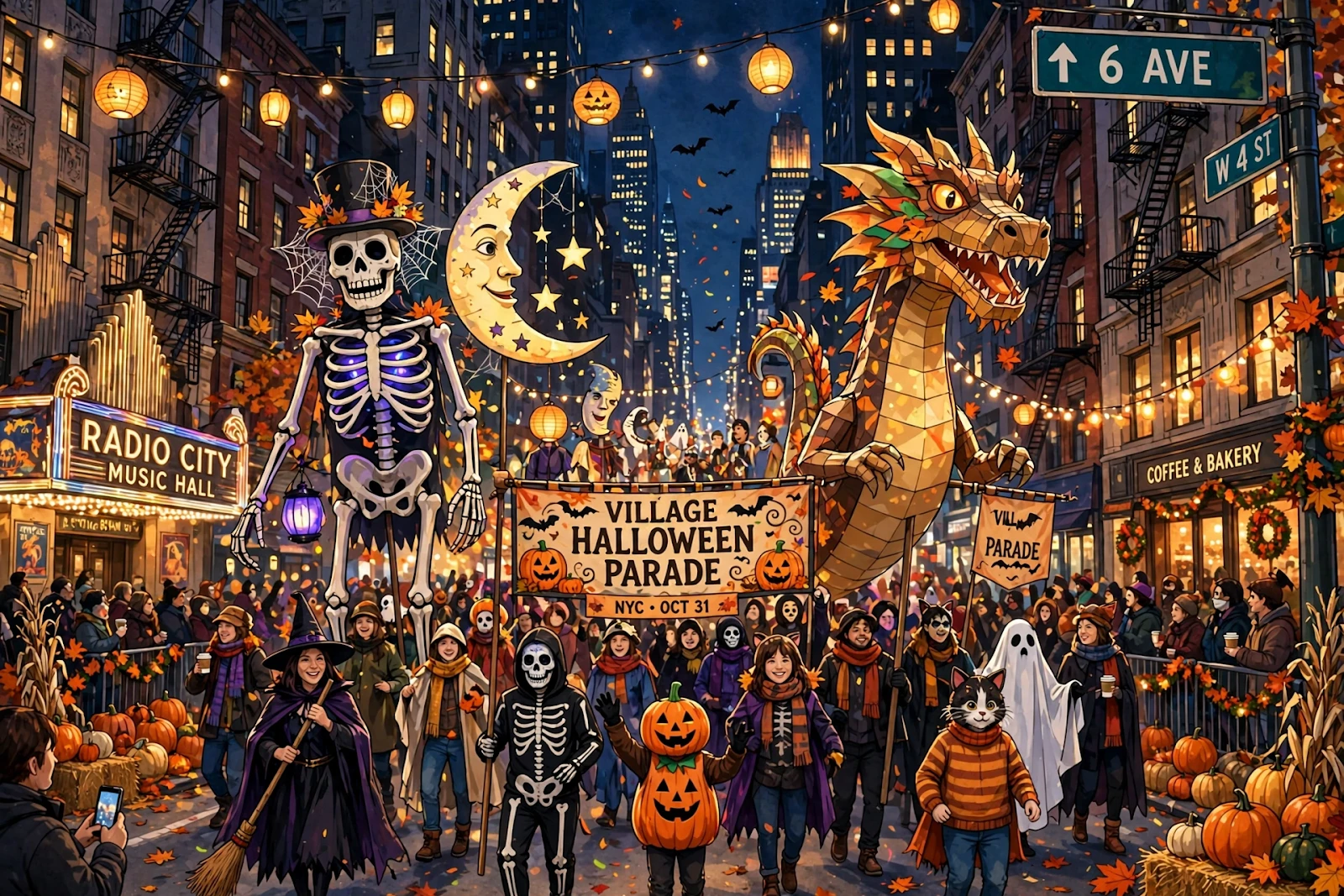
Illustration: An AI-generated illustration of the Village Halloween Parade marching up Sixth Avenue in New York City, not a real photograph of the event.
What Happened
On Saturday, October 31, 2026, the Village Halloween Parade returns for its 53rd year. The procession begins at 7 p.m. on Sixth Avenue at Canal Street and travels north to 15th Street, with the evening expected to run until about 11 p.m. Marchers in costume can join at Canal Street and Sixth Avenue between 6:30 p.m. and 9 p.m., and the event is free both to watch and to march in. Spectrum News NY1 is scheduled to carry the parade live from 8 p.m. for viewers who cannot make it to the route in person.
This year's Grand Marshal is performance artist Joey Arias, a downtown New York figure whose career has long been intertwined with the city's cabaret, theatre and nightlife scenes. His selection continues the parade's tradition of honouring artists who embody the creative spirit of Greenwich Village and the wider city.
The opening act is "Firehorse!", a new dancing puppet-horse performance created by puppeteer Basil Twist, choreographed by Julie Atlas Muz and produced by Barbara Busackino of Tandem Otter Productions. The piece marks the Year of the Horse, and it sets the tone for an evening built around movement, music and spectacle. Giant puppets have long been a signature of the Village Halloween Parade, and a dancing horse — part puppetry, part dance, part street theatre — fits squarely within that tradition while giving this year's edition its own opening image.
The theme, "Body & Soul," invites marchers to interpret the idea in costume. In past years, parade themes have been deliberately open-ended, encouraging everything from the playful to the political, the eerie to the exuberant. That openness is part of the point: the parade is less a single show than a collective work of art, made anew each year by the people who walk in it.

Illustration: An AI-generated illustration of the Firehorse puppet at the Village Halloween Parade, not a real photograph of the performance.
Background
The Village Halloween Parade began in Greenwich Village in the 1970s, when a small group of local artists and residents organized a neighbourhood Halloween walk. Sources differ on the precise founding year, with some accounts pointing to 1973 and others to 1974, but the broader story is not in dispute: what started as a modest, community-led celebration grew steadily as more New Yorkers joined, more puppets and bands took part, and the event became a fixture of the city's cultural calendar.
Over the decades, the parade has survived changes in the city around it — shifts in the neighbourhood, in funding, in public safety planning and in the scale of the crowds — while keeping its core character. It remains organized as a community celebration rather than a commercial spectacle, and it remains open to all. That combination of scale and openness is rare among major city parades, and it is a large part of why the event draws international attention each October 31.
The parade also sits within a wider Halloween weekend in New York. The city's Trick-or-Streets programme, which closes streets to cars so that children and families can trick-or-treat safely, includes 160 car-free sites this year, according to city reporting. Together, the programme and the parade turn Halloween in New York into something larger than a single evening: a citywide, street-level celebration in which public space is temporarily handed over to pedestrians, performers and families.
Halloween itself has deep roots as a festival of costumes, masks and role reversal, and the Village parade draws on that spirit. For one night, the usual rules of the street are suspended. Office workers walk beside drag performers, children beside giant puppets, tourists beside lifelong New Yorkers. The parade's power comes from that mix — from the sense that the city, for a few hours, is performing itself.
Why It Matters
The Village Halloween Parade matters first as a cultural institution. Few public events in the United States combine this level of artistic ambition with this degree of public participation. The giant puppets, the bands, the dance troupes and the thousands of individual costumes amount to a vast, temporary public artwork — one that is created not by a single company or venue, but by the participants themselves. In a city where major cultural events are often expensive and ticketed, the parade's free and open model stands out.
It matters economically, too. Organizers estimate that the parade generates about $120 million in annual tourism spending, as visitors come to New York for Halloween weekend, stay in hotels, eat in restaurants and shop in local businesses. For Greenwich Village and the surrounding neighbourhoods, the parade is one of the busiest nights of the year, and local businesses plan around it.
It also matters as a statement about public space. Closing a major Manhattan avenue to cars for a night of costumes and puppetry is a deliberate choice about what city streets are for. The Trick-or-Streets programme extends that idea across the five boroughs, with 160 car-free sites giving families safe places to celebrate. In a dense city, the decision to set streets aside for play — rather than only for traffic and commerce — is itself a civic act, and Halloween provides a joyful occasion for it.
Finally, the parade matters because it preserves a particular New York tradition: the downtown, artist-led, do-it-yourself spirit that has shaped Greenwich Village for generations. At a time when many neighbourhood traditions have faded or been commercialized, the Village Halloween Parade has kept its community character. Its Grand Marshal choices, its puppetry and its open-march format all reflect that history, and each year's parade is both a celebration and a reminder of it.

Illustration: An AI-generated illustration of costumed marchers at the Village Halloween Parade in New York City, not a real photograph of the event.
What Happens Next
On Saturday night, the parade steps off at 7 p.m. from Canal Street and Sixth Avenue and heads north to 15th Street, running until about 11 p.m., rain or shine. Costumed marchers can join at Canal Street and Sixth Avenue between 6:30 p.m. and 9 p.m. Spectators are advised to arrive early, as the route draws large crowds, and to check local transit and street-closure information before travelling, since Sixth Avenue and surrounding streets will be affected.
For those watching from home, Spectrum News NY1 will carry the parade live from 8 p.m. After the night, attention will turn to how this year's edition is received — whether "Firehorse!" becomes a memorable opening, how marchers interpreted the "Body & Soul" theme, and how the 53rd parade compares with recent editions. Organizers and local coverage typically reflect on the night in the days that follow, and photographs and video from the route will circulate widely.
Looking further ahead, the parade's continued success will depend on the same factors that have sustained it for more than five decades: community participation, artistic ambition and the city's willingness to keep one of its great avenues open, for one night a year, to imagination. If Saturday night follows the pattern of past years, Sixth Avenue will once again belong to the marchers — and to the city that turns out to watch them.
Sponsored: explore today's featured sponsored offers
FAQ
When is the 2026 Village Halloween Parade?
The parade takes place on Saturday, October 31, 2026. It steps off at 7 p.m. and runs until about 11 p.m., rain or shine.
Where does the parade march?
The route runs north up Sixth Avenue in Manhattan, from Canal Street to 15th Street. Costumed marchers join at Canal Street and Sixth Avenue between 6:30 p.m. and 9 p.m.
Is the Village Halloween Parade free?
Yes. The parade is free to watch from the sidewalk and free to march in, provided you are in costume. There are no tickets.
Who is the Grand Marshal in 2026, and what is the opening act?
The 2026 Grand Marshal is performance artist Joey Arias. The opening act is "Firehorse!", a new dancing puppet-horse performance by puppeteer Basil Twist, choreographed by Julie Atlas Muz and produced by Barbara Busackino of Tandem Otter Productions, marking the Year of the Horse.
What is the 2026 theme, and can I watch the parade on television?
The 2026 theme is "Body & Soul." Spectrum News NY1 is scheduled to carry the parade live from 8 p.m. on Saturday night.
Sources
New York Wire, reporting October 2026 on the 53rd annual Village Halloween Parade; Secret NYC, reporting October 2026 on the parade route, theme and Grand Marshal; City Guide NY, reporting October 2026 on the parade's time, route and viewing information; Village Reader, reporting October 2026 on the parade's history and community tradition; Daily Bao News, reporting October 2026 on the parade, the "Firehorse!" opening act and the city's Trick-or-Streets programme. Figures and programme details in this article, including the estimated $120 million in annual tourism spending and the 160 Trick-or-Streets sites, are attributed to organizers and city reporting as cited by these sources.
Comments
Post a Comment