
Webb Confirms the Earliest Supernova Ever Seen: A Star That Exploded 730 Million Years After the Big Bang
BALTIMORE, Oct 2026 — NASA's James Webb Space Telescope has confirmed the earliest supernova ever observed: a massive star that exploded when the universe was only 730 million years old, just 5% of its current age. The find breaks Webb's own record by more than a billion years — and it comes with a surprise: this ancient stellar death looks almost exactly like supernovae exploding in the modern universe.
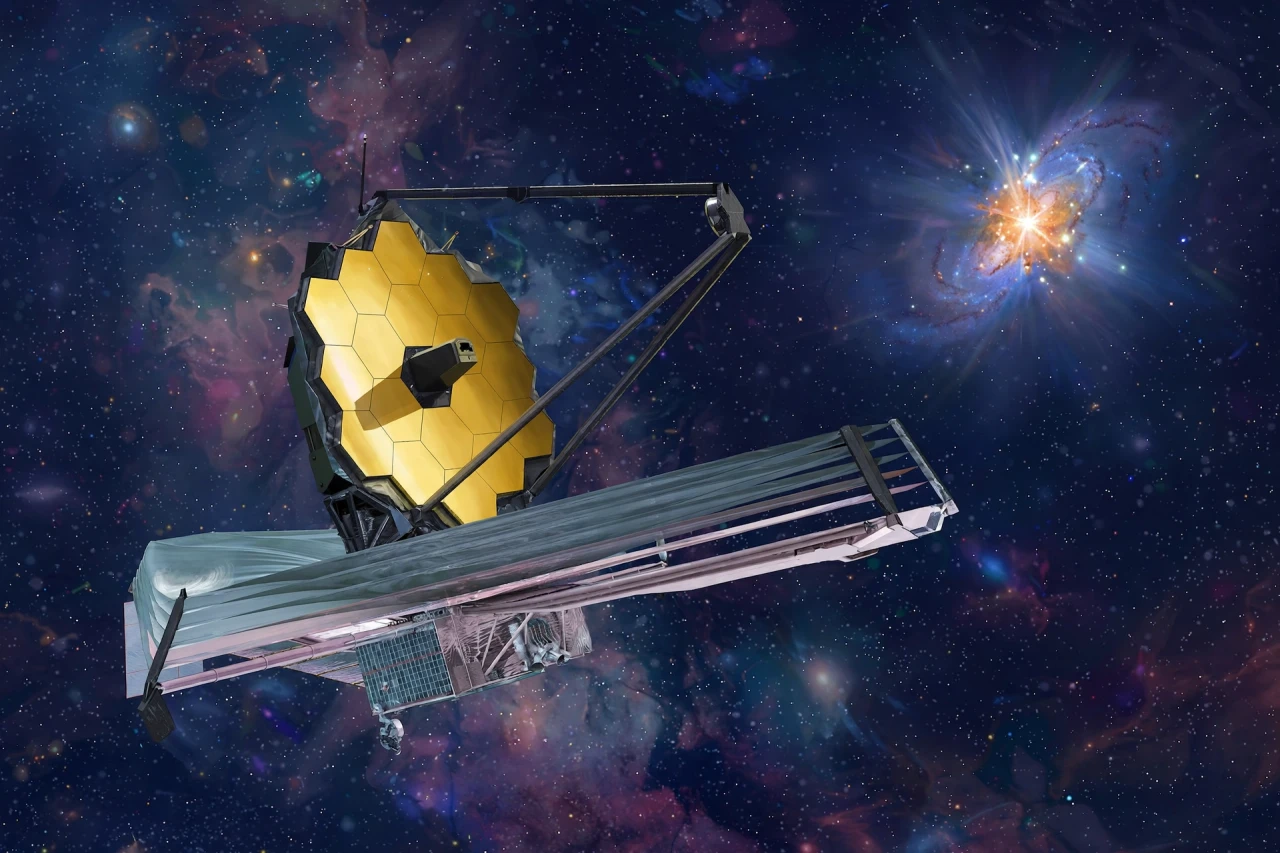
Illustration: NASA's James Webb Space Telescope detecting the earliest supernova ever observed, GRB 250314A, in the distant universe
What Happened
The flash first appeared as a gamma-ray burst, designated GRB 250314A, detected in mid-March 2025 by the Space Variable Objects Monitor (SVOM), a small X-ray telescope built jointly by China and France. Within days, it was flagged as unusually distant. Four hours later, the European Southern Observatory's Very Large Telescope in Chile estimated that the object had existed just 730 million years after the Big Bang, according to NASA.
But a gamma-ray burst alone only tells astronomers that something violent happened — not exactly what. "Only Webb could directly show that this light is from a supernova — a collapsing massive star," said Andrew Levan, the lead author of one of two new papers in Astronomy & Astrophysics Letters and a professor at Radboud University in Nijmegen, Netherlands, and the University of Warwick in the United Kingdom, in a NASA press release. "This observation also demonstrates that we can use Webb to find individual stars when the universe was only 5% of its current age."
Because a supernova at redshift 7.3 evolves in extreme slow motion — Einstein showed that events at high redshift unfold more slowly, and light stretched by cosmic expansion slows the apparent action by a factor of 8.3 — astronomers deliberately waited 3.5 months before pointing Webb at the target. On July 1, 2025, Webb's infrared-sensitive instruments captured the blast's faint glow and a hint of its host galaxy, confirming it as a core-collapse supernova and the earliest stellar death ever observed.
Background
Before this find, the most distant supernova Webb had directly studied came from a star that exploded when the universe was about 1.8 billion years old. The new detection pushes that boundary back by more than a billion years, into the first billion years of cosmic history — a period astronomers call the Era of Reionization, when gas between galaxies was largely opaque to high-energy light and the first stars were still lighting up the darkness.
"There are only a handful of gamma-ray bursts in the last 50 years that have been detected in the first billion years of the universe," Levan said. "This particular event is very rare and very exciting."
Two companion papers in Astronomy & Astrophysics Letters reported the results. One, led by Levan, focused on the supernova itself; the other, led by Bertrand Cordier of CEA Paris-Saclay, studied the flash at redshift 7.3 as an exploding star in the era of reionization. Crucially, for the first time for such a remote event, Webb also detected the supernova's host galaxy — seen only as a reddened smudge of a few pixels, but a genuine detection of an individual galaxy from that epoch.
The gamma-ray burst connection is what makes the science possible. Most long-duration gamma-ray bursts are thought to arise from the collapse of massive stars, which makes them powerful tracers of star formation across cosmic time. In principle, thanks to bursts like this one, astronomers can study the properties of individual stars in the distant universe — even when their host galaxies are too faint to be observed directly through emission lines, even with a facility as sensitive as Webb.
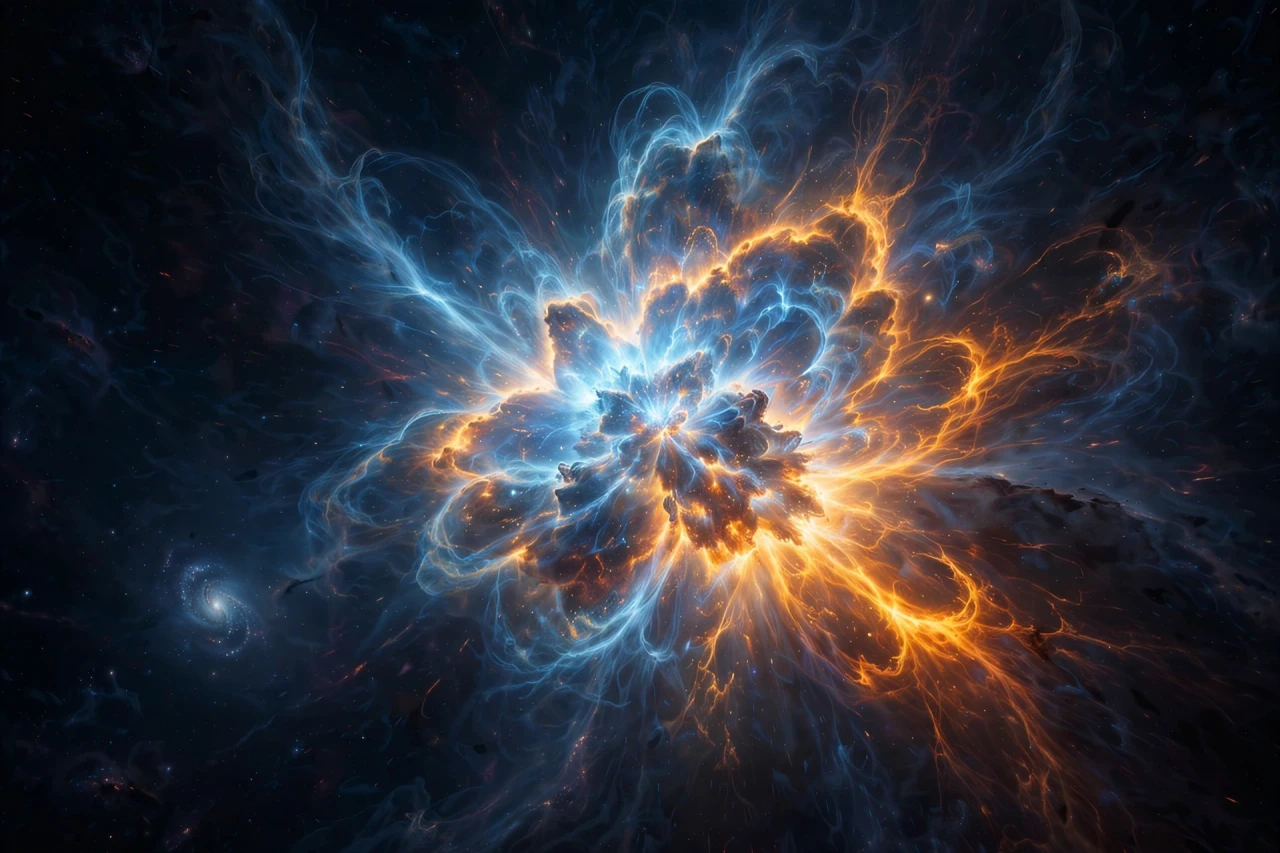
Illustration: supernova GRB 250314A exploding in the early universe, as confirmed by NASA's James Webb Space Telescope
Why It Matters
The surprise is not just the age — it is the familiarity. Astronomers expected the first stars to be more massive, poorer in heavy elements, and shorter-lived than stars today, and they assumed supernovae from that era would behave differently. Instead, the early supernova's spectrum turned out to be remarkably similar to nearby, modern Type II supernovae.
"We went in with open minds," said Nial Tanvir, a co-author and professor at the University of Leicester in the United Kingdom. "And lo and behold, Webb showed that this supernova looks exactly like modern supernovae."
That similarity is itself a powerful result: it means the tools and models astronomers use to study local supernovae can be applied across most of cosmic history. "Webb's observations indicate that this distant galaxy is similar to other galaxies that existed at the same time," said Emeric Le Floc'h, a co-author and astronomer at CEA Paris-Saclay in France. Still, researchers caution that before they can determine why such an early supernova is so similar to nearby ones, more data is needed to pinpoint tiny differences.
The detection also opens a new observational frontier. Webb provided the rapid, sensitive follow-up that was needed — "Webb provided the rapid and sensitive follow-up we needed," said Benjamin Schneider, a co-author and postdoctoral researcher at the Laboratoire d'Astrophysique de Marseille in France. If individual stars can be studied when the universe was only 5% of its current age, astronomers can now begin mapping how the first generations of stars lived and died.
What Happens Next
Researchers must now find and scrutinize other early supernovae to look for the subtle differences this first one did not reveal. The host galaxy — a reddened smudge in a few pixels — is itself a target: seeing such a galaxy at all is a breakthrough, and future Webb observations could tease out more about its structure and chemistry.
For the gamma-ray burst community, GRB 250314A validates a strategy: watch for long-duration bursts at extreme distances, then wait out the cosmic slow motion and send Webb in for confirmation. Each such detection becomes a probe of star formation in the universe's first billion years, when the first heavy elements were being forged and scattered.
And for cosmology, the record itself may not stand long. Webb keeps finding earlier objects than expected — and astronomers will keep asking it to look further back, one ancient explosion at a time.
Illustration: the first billion years of the universe, the Era of Reionization, when GRB 250314A exploded
Sponsored: explore today's featured sponsored offers
Frequently Asked Questions
What is GRB 250314A?
GRB 250314A is a gamma-ray burst detected in mid-March 2025 by the Space Variable Objects Monitor (SVOM), an X-ray telescope built by China and France. Follow-up observations with NASA's James Webb Space Telescope confirmed it was produced by a collapsing massive star — a core-collapse supernova — that exploded when the universe was only 730 million years old.
Why is this the earliest supernova ever seen?
Webb confirmed the supernova occurred at a redshift of 7.3, equivalent to 730 million years after the Big Bang — just 5% of the universe's current age. That breaks Webb's own previous record: the most distant supernova it had directly studied before came from a star that exploded when the universe was about 1.8 billion years old.
How could Webb see something so far away?
Because cosmic expansion stretches light and slows apparent events at high redshift, the supernova brightened over months rather than weeks. Astronomers waited 3.5 months after the gamma-ray burst before observing with Webb's infrared-sensitive instruments, timing the observation for when the supernova was expected to be brightest. Webb was also able to detect the supernova's host galaxy — a reddened smudge of just a few pixels.
What surprised scientists about this supernova?
Researchers expected early-universe stars — more massive, poorer in heavy elements, shorter-lived — to die differently. Instead, the supernova's spectrum looks remarkably similar to modern Type II supernovae. As co-author Nial Tanvir of the University of Leicester put it, Webb showed that "this supernova looks exactly like modern supernovae" — meaning tools used on local supernovae can be applied across most of cosmic history.
What happens next in this research?
Two papers in Astronomy & Astrophysics Letters reported the results (led by Andrew Levan of Radboud University/University of Warwick, and Bertrand Cordier of CEA Paris-Saclay). Astronomers will now hunt for more early supernovae to probe subtle differences, study the faint host galaxy further, and use long gamma-ray bursts as tracers of star formation in the universe's first billion years.
Sources
- NASA Science, "NASA's Webb Identifies Earliest Supernova to Date, Shows Host Galaxy," science.nasa.gov
- Andrew Levan et al. and Bertrand Cordier et al., papers in Astronomy & Astrophysics Letters (via NASA/ESO reporting)
- Astronomy Magazine, "JWST studies a supernova near the dawn of time," by Richard Talcott
- Phys.org / Earth.com coverage of JWST supernova GRB 250314A findings
Comments
Post a Comment