
PARIS — The James Webb Space Telescope has peered through the dust of a stellar nursery 3,300 light-years from Earth and revealed more than 130 stars less than a million years old, showing in a single frame how newborn stars sculpt, heat, and even trigger the birth of their neighbours.

Illustration: Webb's infrared view of the glowing stellar nursery NGC 7129, with golden and red gas clouds shaped by newborn stars.
What Happened
NASA released a new image of NGC 7129, a dense molecular cloud in the constellation Cepheus, on 6 October 2026. Captured by the James Webb Space Telescope's near- and mid-infrared instruments from observations made in December 2025, the image exposes stars that visible-light telescopes cannot see because thick dust scatters or absorbs their light. Infrared light, by contrast, pierces that dust, according to NASA and the European Space Agency.
The picture is far more than a portrait. It shows a working stellar nursery at several stages of development at once: stars that have already cleared space around themselves sit alongside objects still buried deep in cold gas. More than 130 stars have been identified in the cluster, all of them less than a million years old — infants by cosmic standards, given that the Sun is about 4.6 billion years old.
The most eye-catching feature is a large golden cavity on one side of the image. Hot atomic hydrogen gas glows gold there, while cooler molecular hydrogen, shocked by outflows from still-embedded protostars, appears red on the other side. The contrast between the two colours is, in effect, a temperature map of star birth.

Illustration: The James Webb Space Telescope observing deep space in infrared light, its gold mirror gathering light blocked from visible-light telescopes.
Background
Stars are born in cold, dense clouds of gas and dust known as nebulae. Gravity slowly pulls material together until it collapses and a new star ignites. Because the youngest stars remain wrapped in the dust that formed them, astronomers long had to infer much of this process rather than watch it directly. Infrared astronomy changed that, and Webb — operated jointly by NASA, the European Space Agency, and the Canadian Space Agency — carries the most powerful infrared instruments ever flown.
NGC 7129 itself is not new to science. NASA's retired Spitzer Space Telescope observed the region at lower resolution, and earlier images showed a far blurrier scene. Webb's sharper view reveals fine filaments of gas and dust, many background galaxies shining through the cloud, and rich structures that Spitzer could not resolve. The comparison between the two telescopes' images, published alongside the new release, is itself a measure of how far infrared astronomy has come.
The cluster's central star, LkH-alpha 234, dominates the scene. It is a pre-main-sequence star — one that has largely finished gathering mass and is contracting and heating up before it begins fusing hydrogen like the Sun — with an estimated five to eight times the Sun's mass. More massive stars evolve faster than smaller ones, which is why the stars in this single cluster appear at different stages even though they were born from the same cloud.
Why It Matters
The image matters because it captures feedback in action: the process by which stars change the very clouds that created them. Outflows from LkH-alpha 234 carved out the golden cavity, a region roughly 3.5 light-years across. The shock of those outflows dispersed much of the hydrogen gas — but, crucially, it also compressed other pockets of gas into conditions where new stars could form. Star birth, in other words, is not a one-way process; one generation helps trigger the next.
The same story repeats at smaller scales across the image. Several younger pre-main-sequence stars emit stellar winds that create bow shocks — curved ridges where their winds collide with surrounding gas — and smaller cavities of their own. Where the hot, energised environment meets colder, denser gas, a sharp ridge marks a photodissociation region, a boundary where hydrogen molecules are broken apart into individual atoms by stellar radiation.
For astronomers, regions like NGC 7129 are laboratories. Because the cluster contains stars of different masses at different stages, researchers can study how mass shapes a star's early life without waiting millions of years for a single star to evolve. And because the cloud is relatively nearby at 3,300 light-years, details that would be invisible in more distant nurseries can be examined closely.
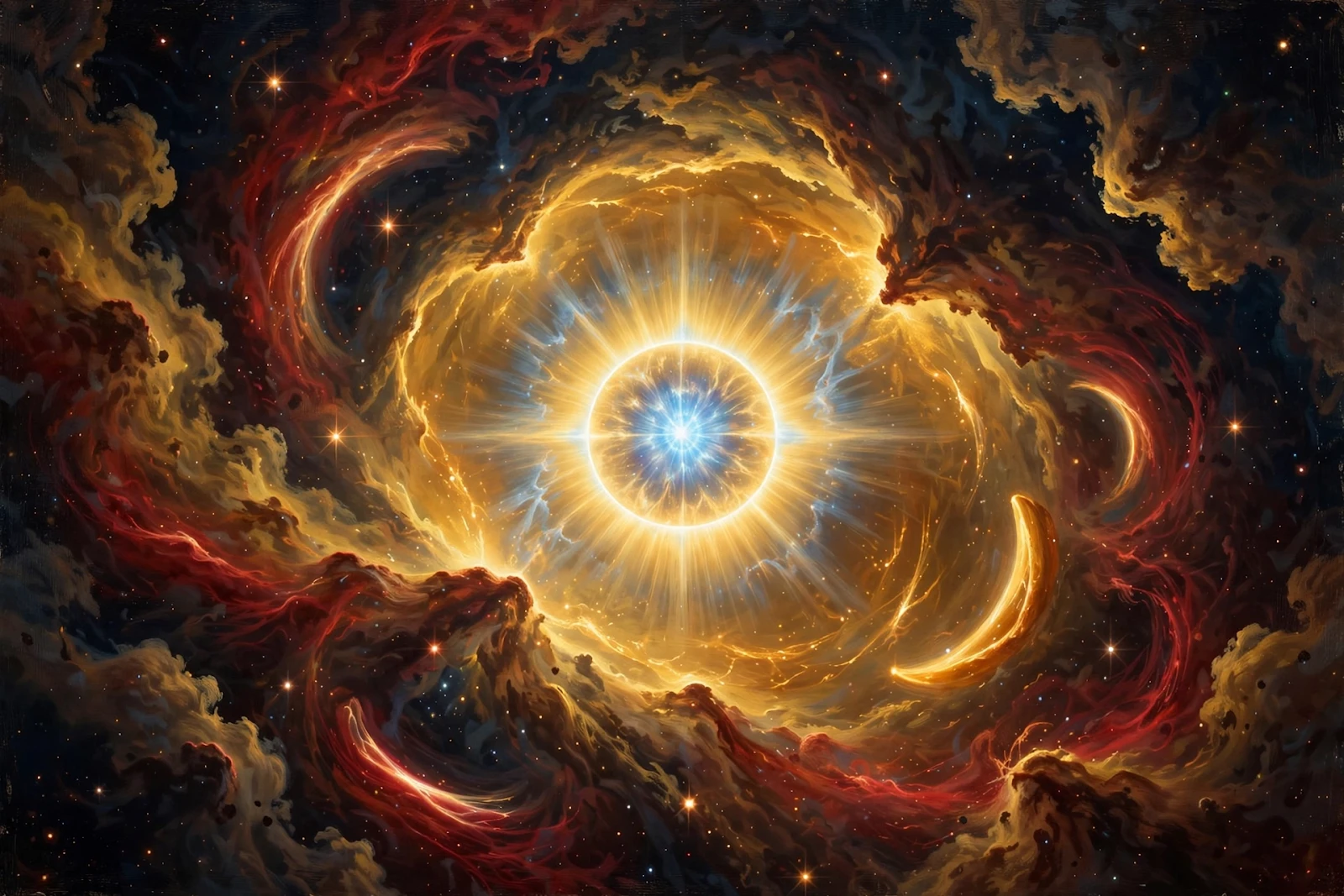
Illustration: A young massive star carving a golden cavity in gas and dust, with smaller stars and bow shocks forming around it.
What Happens Next
According to NASA, the ongoing study of NGC 7129 will offer insight into how young stars and protostars shape their surroundings, eventually eroding their parent molecular clouds over millions of years. That erosion matters for whole galaxies: the gas that stars disperse or consume determines where, and for how long, future generations of stars can form.
Webb's observations of the region are expected to feed into broader studies of star formation, including comparisons with other nurseries observed by the telescope. Researchers will also be able to test models of how stellar winds and radiation interact with cold gas — models that underpin much of what astronomers believe about how galaxies evolve.
For the public, the image is a reminder of what infrared astronomy has unlocked. A cloud that once looked like a dark smudge now resolves into a crowded, violent, creative place — a cauldron, as NASA put it, of cosmic creation, still at work only 3,300 light-years away.
Sponsored: explore today's featured sponsored offers
FAQ
What is NGC 7129?
NGC 7129 is a stellar nursery — a dense cloud of gas and dust where stars are born — located about 3,300 light-years from Earth in the constellation Cepheus.
Why can Webb see stars that other telescopes cannot?
Young stars are hidden by dust that blocks visible light. Webb observes in infrared light, which passes through that dust, revealing the stars inside.
How old are the stars in the new image?
More than 130 stars have been identified in the cluster, all of them less than a million years old, according to NASA's account of the image.
What is LkH-alpha 234?
LkH-alpha 234 is the cluster's most massive and most mature star, a pre-main-sequence star with roughly five to eight times the mass of the Sun, whose outflows carved the image's large golden cavity.
What happens to the cloud as its stars grow up?
Stellar winds and radiation heat, shock, and disperse the surrounding gas, gradually eroding the molecular cloud — while also compressing some pockets enough to trigger further star formation.
Sources
- NASA / ESA / CSA, "Webb Captures Stellar Jets" image article, 6 October 2026.
- Phys.org, "Webb captures stars in the early stages of life in a nearby stellar nursery," 22 October 2026.
- Phys.org, "Webb captures commotion from nebula's stellar jets," 6 October 2026.
Comments
Post a Comment