
MONTREAL — The gas swirling around Sagittarius A*, the supermassive black hole at the center of the Milky Way, carries roughly 1.8 times the Sun's abundance of heavy elements, according to a new study using the James Webb Space Telescope announced by McGill University on October 19, 2026 — a chemical fingerprint suggesting the black hole's fuel supply was enriched by generations of stars that exploded near the galactic center.
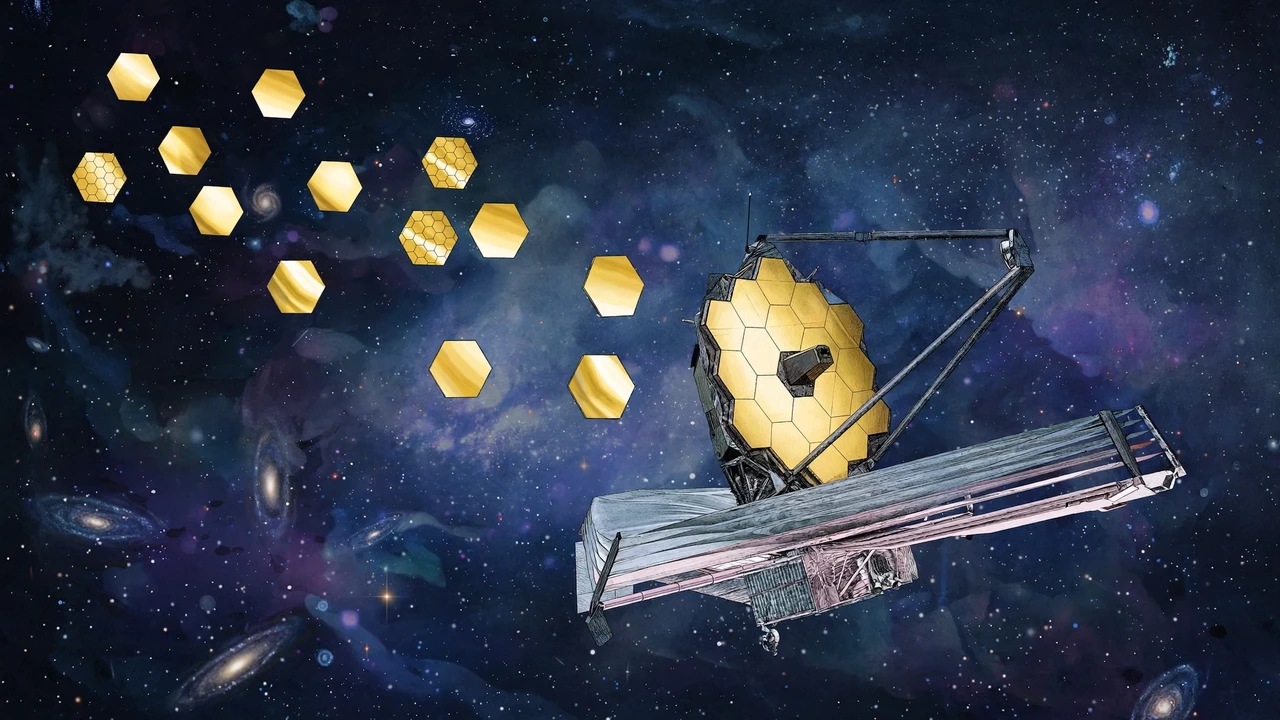
Illustration: The James Webb Space Telescope observing deep space. Its MIRI instrument mapped the gas at the Milky Way's center in unprecedented detail. (AI-generated illustration)
What Happened
The study, led by Nicole Ford, a PhD student at McGill University's Trottier Space Institute, appeared in The Astronomical Journal (Ford et al. 2026, AJ 172, 267), with co-authors Mayura Balakrishnan, Sebastiano von Fellenberg and Daryl Haggard. McGill announced the findings on October 19, 2026, and the work has since been covered widely in science media.
The team used JWST's MIRI MRS instrument to map the central 0.1 parsec around Sagittarius A*, a region that includes the Galactic Center Minispiral — a structure of warm ionized gas and dust. They measured the abundances of neon, argon, sulfur, nickel and iron across three distinct gas structures, distinguished by their radial velocity: the Bar, the Northern Arm, and a group of fast-moving Blue-shifted Compact structures. The headline result: the Minispiral gas is mildly super-solar, at about 1.8 times the Sun's metal abundance.
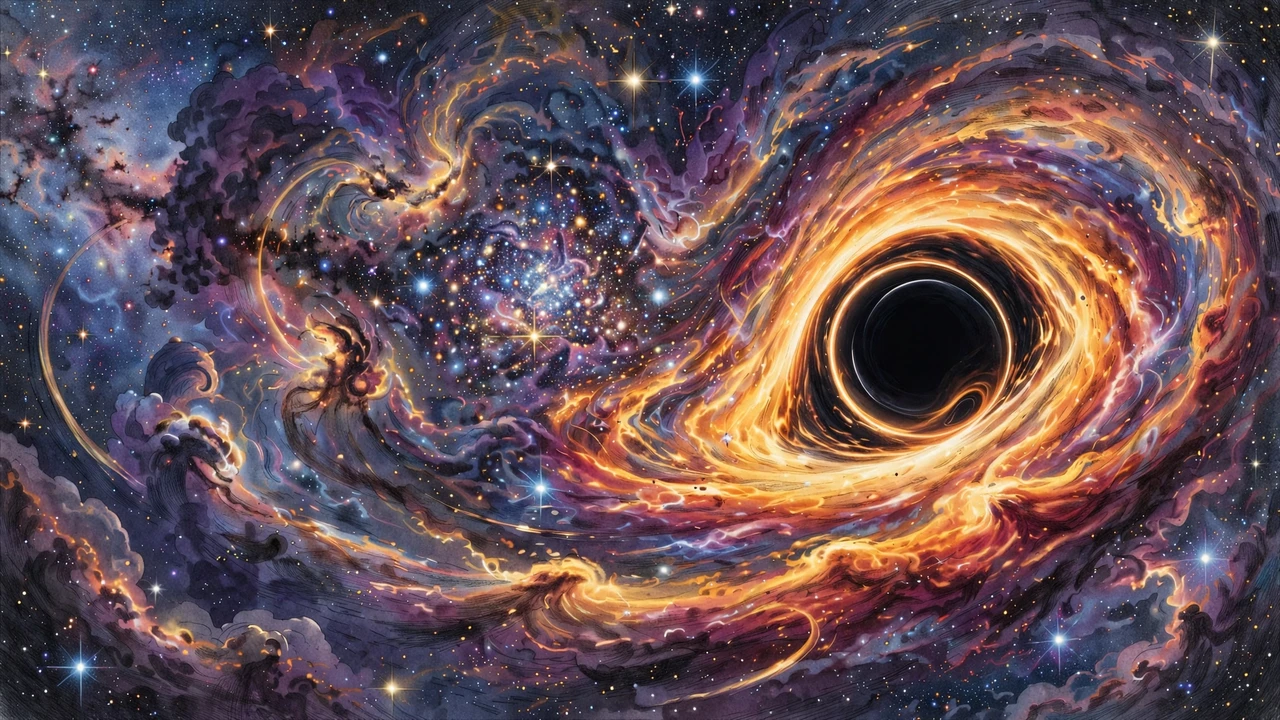
Illustration: The Milky Way's central black hole surrounded by glowing gas. The Minispiral gas holds 1.8 times the Sun's abundance of heavy elements. (AI-generated illustration)
Background
Sagittarius A* has a mass of about 4 million Suns and is the nearest known supermassive black hole — and one of the quietest. Astronomers have long puzzled over how little it eats compared with other supermassive black holes, which is part of what motivated the study. In astronomers' usage, "metals" covers all elements heavier than hydrogen and helium — elements that stars forge in their hearts and return to their surroundings when they die.
The spectra revealed more than enrichment. The gas composition is similar to that of many of the stars orbiting the black hole, which the researchers read as a sign that the gas and those stars may have formed together. The radiation lighting up the gas is consistent with Wolf-Rayet stars — massive, evolved stars — while measurements of nickel and iron revealed significant dust destruction: those elements normally get locked up in dust grains, so seeing them in the gas phase suggests the grains have been broken apart. Some of the most dramatic gas sits closest to the black hole, including a feature known as X7 within about 0.05 parsec that moves with blue-shifted radial velocities of roughly 600 km/s or more — conditions the paper says may involve localized fast shocks.
Why It Matters
The environment around a supermassive black hole sets the menu it eats from. By measuring several elements across distinct gas structures, the JWST data give a chemical fingerprint of that menu — and the researchers read it as the product of exploded stars rather than something unconnected to the stellar neighborhood. The similarity between the gas and the orbiting stars suggests the black hole's fuel supply and its stellar neighbors may share a history.
But the enrichment also has limits. Metals influence how quickly gas cools, which in turn influences how readily it can fall into a black hole — yet a metallicity of 1.8 times solar is only modest, and cannot really explain why Sagittarius A* is fed so sparingly. A companion study in The Astrophysical Journal led by Balakrishnan tested whether the gas preserved evidence of past bursts of energy from the black hole, and found the emission is shaped by local conditions — making it difficult to isolate the black hole's influence. Another recent paper points to the nearby supernova remnant Sgr A East as a source of both metal enrichment and heat in the gas near the black hole.
Illustration: Astronomers mapping the Galactic Center Minispiral gas structures. The study examined the Bar, the Northern Arm and fast-moving compact structures. (AI-generated illustration)
What Happens Next
Ford said understanding how the black hole attracts material will require comparing these observations with simulations of how gas evolves over longer timescales. Because Sagittarius A* is closer to Earth, and therefore easier to see, than any other supermassive black hole, it offers a unique laboratory for studying the fuel supply of a quiet black hole in detail.
The McGill researchers suggest the findings could also advance understanding of how metals are distributed around supermassive black holes in more distant galaxies — where astronomers cannot resolve such fine detail. The full study is available as a preprint (arXiv:2605.13995) for the community to build on.
Sponsored: explore today's featured sponsored offers
FAQ
What is Sagittarius A*?
Sagittarius A* is the supermassive black hole at the center of the Milky Way, with a mass of about 4 million Suns. It is the nearest known supermassive black hole and is notably quiet, feeding on far less material than other supermassive black holes.
What did the James Webb Space Telescope find?
Using Webb's MIRI instrument, researchers mapped gas within 0.1 parsec of the black hole and found it carries about 1.8 times the Sun's abundance of heavy elements — enriched, the team says, by stars that exploded near the galactic center.
What do astronomers mean by "metals"?
In astronomy, "metals" covers all elements heavier than hydrogen and helium, such as oxygen, carbon, iron, neon and nickel. They are forged through nuclear fusion inside stars and released when stars die.
Does the enrichment explain why the black hole eats so little?
Probably not on its own. Metals affect how gas cools, but a metallicity of 1.8 times solar is only modest, and coverage of the study notes it cannot really drive the much slower feeding of Sagittarius A* — the "diet" question remains open.
What happens next?
The researchers plan to compare the observations with simulations of gas evolution over longer timescales, and say the results could help explain metal distribution around supermassive black holes in more distant galaxies.
Sources
- McGill University Newsroom, October 19, 2026 — "The gas around Milky Way's central black hole is rich in metals, study finds"
- The Astronomical Journal — Ford et al. 2026, AJ 172, 267 (arXiv:2605.13995)
- The Astrophysical Journal — Balakrishnan et al., companion study on Sgr A* gas emission
- Universe Today, October 2026 — coverage of the metal-enrichment findings
- Cosmic Herald, October 21, 2026 — "Gas Around the Milky Way's Black Hole Is Metal-Rich, and Dead Stars Likely Made It"
Comments
Post a Comment