
Climate Plans Are Failing Public Health, WHO Finds in Landmark 2026 Review
Almost every country on Earth now mentions health in its national climate plan — but hardly any back it up with targets, funding or monitoring. That is the stark conclusion of a new World Health Organization report marking ten years of the Paris Agreement.
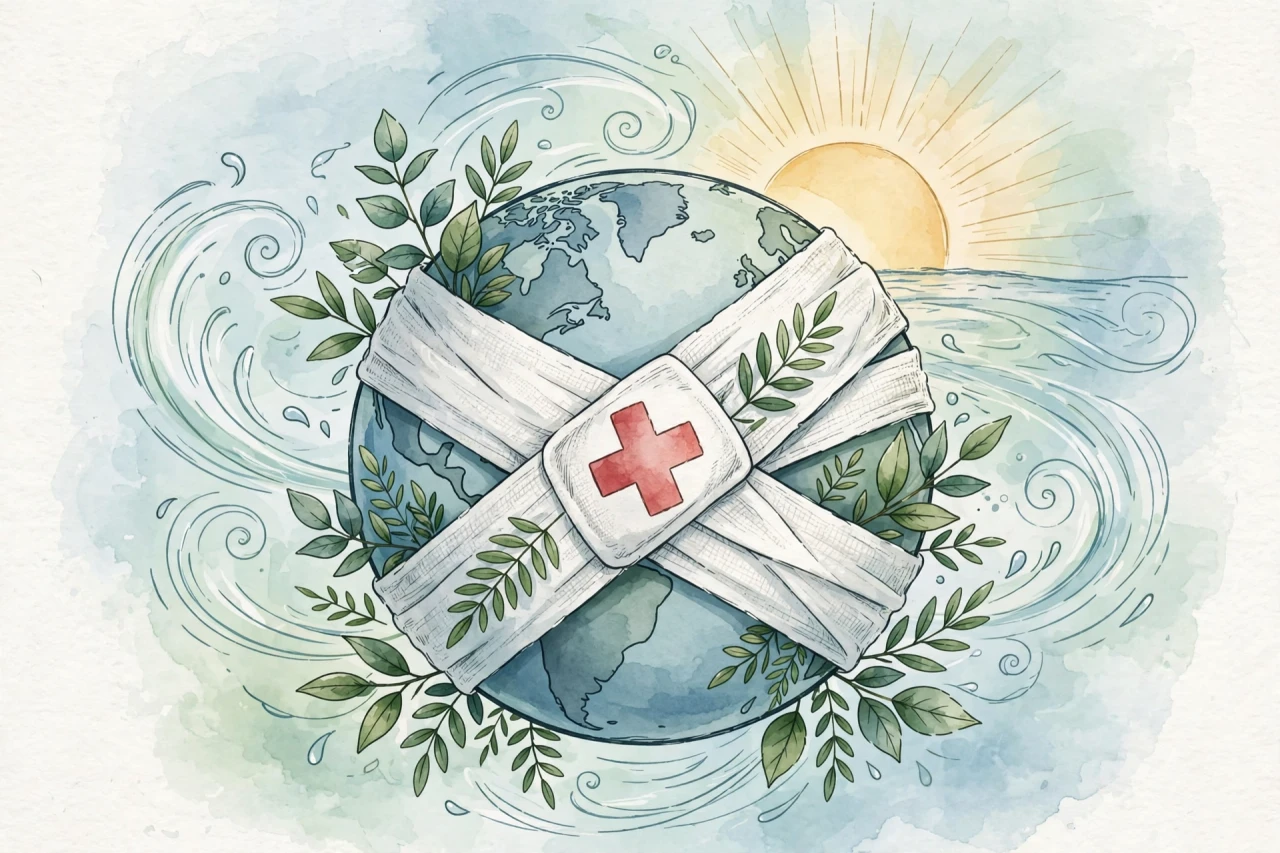
Illustration: planet Earth wrapped in a medical-cross bandage with green leaves and clean-air swirls, symbolising climate and health.
What Happened
The World Health Organization published a new report on October 19, 2026, titled "Ten years of the Paris Agreement: a global review of health in nationally determined contributions" — the most comprehensive assessment yet of how governments factor human health into their climate commitments, as reported by Top Africa News the same day.
The numbers tell a story of recognition without follow-through. Of the 140 countries and other Parties assessed, 128 — representing 91% — mentioned health in their latest nationally determined contributions (NDCs), the national plans through which governments set out their climate commitments under the Paris Agreement.
But when the WHO looked for substance behind the mentions, the picture darkened. Of the 82 Parties that identified health benefits from climate mitigation, only four — just 5% — quantified or monitored those benefits. Few estimated the resources needed to protect people from climate-related health risks or set specific, measurable commitments to address them.
The WHO reviewed 114 climate plan documents representing 140 Parties, including the European Union's submission on behalf of its 27 member states. The assessment examined how governments incorporated health into emissions reduction, adaptation, climate-related loss and damage, governance and financing.
Background
The link between climate change and health is no longer contested science. Extreme heat kills hundreds of thousands of people a year; air pollution from fossil fuels is linked to millions of premature deaths; shifting climate zones are expanding the range of diseases such as dengue and malaria; and floods, droughts and storms destroy health infrastructure and spread disease in their wake.
Climate action, meanwhile, offers enormous health co-benefits. Cutting fossil fuel use reduces air pollution, improving respiratory and cardiovascular health. Cleaner energy, more sustainable transport and healthier diets — lower in emissions-intensive meat — all pay dividends in longer, healthier lives. The WHO and a growing body of research have argued for years that these health gains alone can justify much of the cost of decarbonisation.
Nationally determined contributions are the Paris Agreement's core mechanism: every few years, each country submits a plan describing its emissions targets and climate actions. The current round — the 2035 plans submitted ahead of the August 2026 deadline — is the first since the agreement's ten-year mark, making the WHO's review a natural report card.
The report found genuine progress in recognition. The proportion of Parties identifying health benefits from climate mitigation rose from just 10% in the WHO's 2020 review to 30% in 2023 and 59% in the latest assessment — a remarkable climb in six years. What has not kept pace is quantification, financing and accountability: acknowledging that climate action is good for health is now normal; proving it and paying for it are not.
A separate scorecard released days earlier by the Global Climate and Health Alliance reinforced the pattern. Its 2026 Healthy NDC Scorecard, which rated 132 countries' plans across eight health categories, found Colombia (29 of 32 points), Nigeria (25) and Cambodia (24) leading the world — with 19 of the top 20 scores going to low- and middle-income countries. Major emitters scored far worse: Japan, India and New Zealand managed just two points each, while the EU, China and the UK landed in the low teens or below. The alliance warned that high-emitting economies often fail to match their recognition of health risks with the emission cuts needed to protect health.

Illustration: a family breathing freely under a clear blue sky with wind turbines, leaving a fading smoggy industrial silhouette behind.
Why It Matters
Health is arguably climate policy's most persuasive argument — and its most neglected one. Abstract tonnes of carbon dioxide rarely move voters or treasuries; preventable illness and death do. By failing to quantify health benefits, governments are leaving their most powerful case for climate action off the table, even as they ask citizens to pay for the transition.
The financing gap is the most consequential finding. Adaptation finance for health systems — cooling centres during heatwaves, disease surveillance, resilient hospitals — remains chronically underfunded. Without costed, monitored health targets in national plans, health ministries struggle to claim their share of climate money, and climate money flows to energy projects that rarely track health outcomes.
There is an equity dimension, too. The WHO's findings land a decade into the Paris Agreement with the world still far off its temperature goals — and the health costs of that failure fall hardest on the poorest, who contributed least to the problem. The scorecard's finding that 19 of the top 20 health-integrating countries are low- or middle-income economies shows where the urgency is felt most acutely.
Finally, the report matters because measurement drives action. What gets counted gets funded; what gets funded gets done. The jump from 10% to 59% of countries recognising health co-benefits shows the climate-health agenda has won the argument. The next decade will show whether it can win the budget.
What Happens Next
The WHO report arrives at a crowded moment on the global health and climate calendar. The UN Biodiversity Conference (CBD COP17) is meeting in Yerevan, Armenia, through October 30, 2026, and the annual UN climate conference (COP30) follows, keeping climate governance in the headlines for months. The WHO's findings give negotiators and advocates a concrete benchmark: by the next round of NDC updates, the share of countries quantifying health benefits should be far higher than four out of 82.
Watch for how the report is used in finance debates. A long-standing fight over adaptation funding — and over whether climate finance reaches health systems — is likely to intensify, with the WHO's data arming developing countries' demands for support. Developed countries, meanwhile, face pressure to show that their own plans match health rhetoric with emission cuts, after the alliance's scorecard gave the biggest emitters some of the worst grades.
At the national level, the most immediate impact may be on how countries write their next plans. The WHO's review gives health ministries a template — and political cover — to demand measurable health targets, dedicated financing and monitoring systems in future NDCs. Colombia, Nigeria and Cambodia, the scorecard's top performers, may find themselves held up as models in international forums.
And on October 22, 2026, the WHO is scheduled to publish another major report — "State of inequality: noncommunicable diseases and their risk factors," billed as the most comprehensive global assessment of country-level health inequalities to date. Together, the two reports will frame the year's debate over who gets to be healthy in a warming world — and who is left behind.
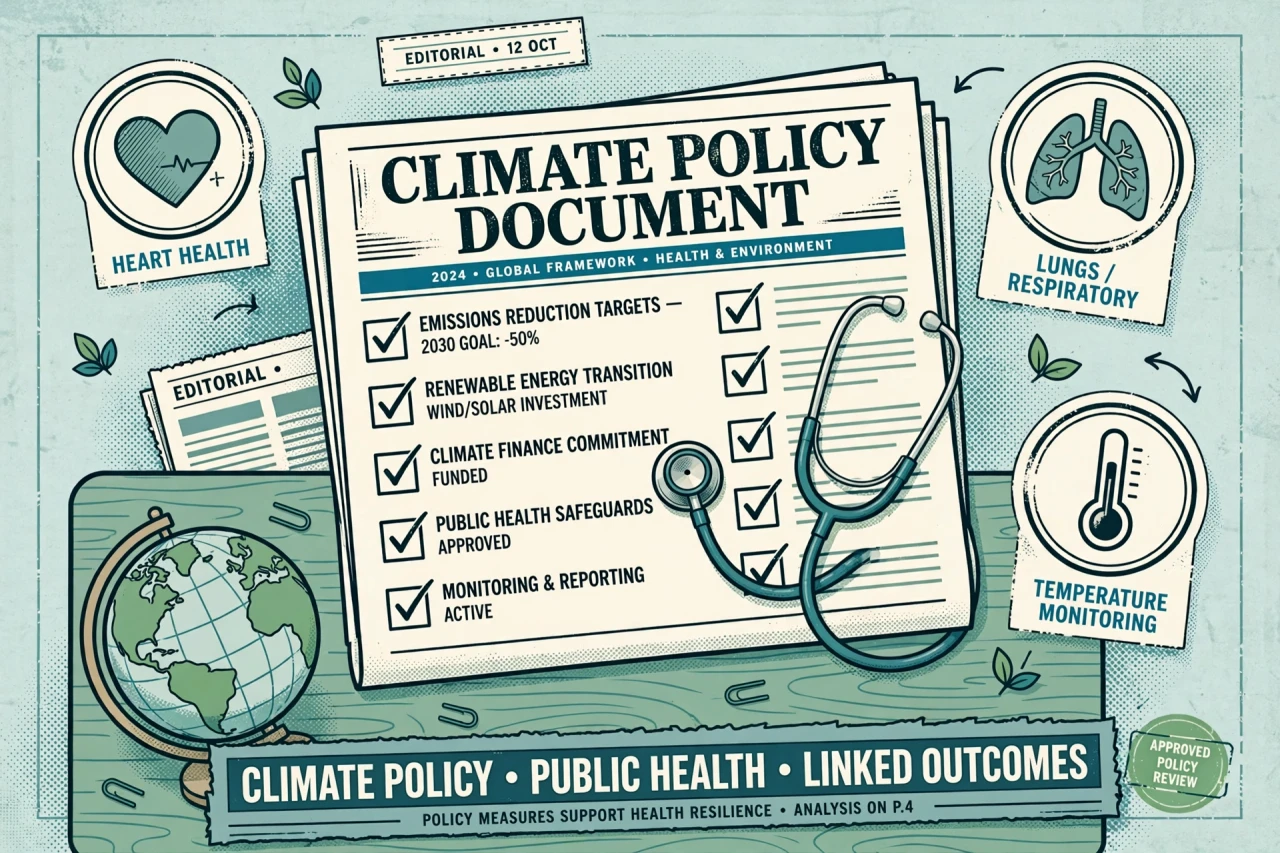
Illustration: a giant climate policy document with checkmarks and a stethoscope, surrounded by heart, lung and thermometer icons.
Sponsored: explore today's featured sponsored offers
FAQ
What are nationally determined contributions (NDCs)?
NDCs are the national climate plans that every country submits under the 2015 Paris Agreement. Each plan sets out the country's emissions-reduction targets and climate actions. Countries submitted a new round of plans — covering targets to 2035 — ahead of an August 2026 deadline, and the WHO reviewed 114 of these documents in its latest assessment.
What did the WHO report find?
Published on October 19, 2026, "Ten years of the Paris Agreement: a global review of health in nationally determined contributions" found that 128 of 140 Parties (91%) mention health in their climate plans — up sharply from previous reviews. But only four of the 82 Parties that identified health benefits from climate action actually quantified or monitored them, and few set measurable, financed health commitments.
Which countries are doing best on health and climate?
The Global Climate and Health Alliance's 2026 Healthy NDC Scorecard, released in October 2026, ranked Colombia first with 29 of 32 points, followed by Nigeria (25) and Cambodia (24); Paraguay and Timor-Leste each scored 22. Notably, 19 of the top 20 scores went to low- and middle-income countries. Major emitters including Japan, India and New Zealand scored just two points each.
What are the health benefits of climate action?
Cutting fossil fuel use reduces air pollution, which improves respiratory and cardiovascular health. Cleaner energy, more sustainable transport, reduced black carbon and healthier diets all deliver health gains. The WHO notes that these co-benefits can be substantial — but because so few countries measure them, they rarely influence policy or funding decisions.
Why don't more countries set measurable health targets?
The WHO report points to gaps in financing, monitoring capacity and cross-government coordination: health ministries often lack the data systems to track climate-health outcomes, and climate finance flows mostly to energy projects rather than health adaptation. Acknowledging health in a plan is easy; costing, funding and monitoring it requires institutional machinery many governments have not built yet.
Sources
- Top Africa News, October 19, 2026 — 91% of countries mention health in climate plans, but few set measurable targets (WHO report).
- Global Climate and Health Alliance, October 2026 — 2026 Healthy NDC Scorecard (132 countries assessed).
- Phys.org, October 2026 — Scorecard: Colombia gets top marks while high-emitting countries do too little to protect health.
- PINA (Pacific Islands News Association), October 15, 2026 — New Zealand scores poorly on health protection in climate plans; Timor-Leste among top performers.
- WHO events calendar — launch of the WHO global report "State of inequality: noncommunicable diseases and their risk factors," scheduled October 22, 2026.
Comments
Post a Comment