
Nearly one in four doctors worldwide is over the age of 55 and could retire within the next decade, the World Health Organization warned in a landmark report, projecting a global shortfall of 11.1 million health workers by 2030 — a gap that threatens access to care as aging populations drive demand for more complex medical services.
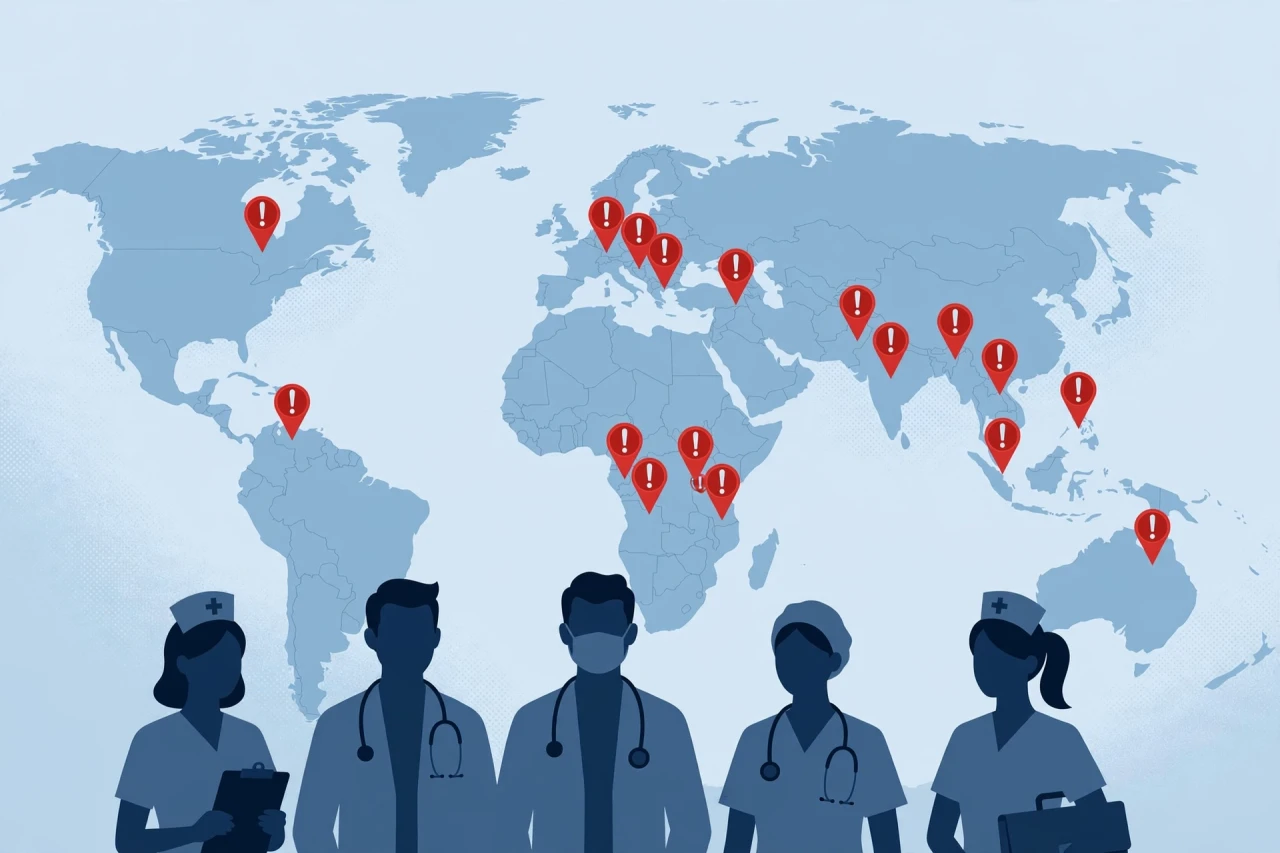
Illustration: a world map marked with alerts over regions facing health worker shortages, with doctors and nurses in the foreground.
What Happened
The World Health Organization published "National Health Workforce Accounts: Health Workforce Levels and Trends 2026," the first in a planned annual series offering the most comprehensive global picture of health workforce levels, trends and challenges, based on official country data shared through the National Health Workforce Accounts (NHWA). The report, released in Geneva, analyzes workforce data from 122 countries and puts a stark number at the center of the global health debate: almost a quarter of the world's physicians are now in the final stretch of their careers.
In high-income countries the picture is even sharper — nearly one in three doctors is approaching retirement age, according to the report. At the same time, the global shortage of health workers is projected to reach 11.1 million by 2030, and 67 countries are expected to lack sufficient health workers to meet their populations' needs. "Aging is the hidden health workforce crisis that requires urgent attention," said Dr Khassoum Diallo, acting unit head of health workforce policies and data at the WHO Academy. "It is creating a double pressure on health systems, primarily in high-income countries."
The findings were reported widely in health trade media on October 20, 2026, underlining that the retirement wave is not a distant forecast but an unfolding demographic shift that is already straining hospitals and clinics.

Illustration: an older doctor departing a hospital as a young medical student arrives — the generational turnover in medicine.
Background
The report is not a story of pure decline. Over the past two decades, the global density of health workers — medical doctors, nursing and midwifery personnel, dentists and pharmacists — has increased by 52 percent, from 44.8 per 10,000 people in 2006 to 67.9 in 2025. There are now more than 70 million health and care workers worldwide, and more than 90 percent of WHO's Member States actively reported workforce data in 2025, a sign of improving surveillance.
But the global improvement masks what WHO describes as deep and persistent inequities. The density of medical doctors is 13 times higher in the WHO European Region than in the African Region, while nursing and midwifery personnel density is six times higher. "Despite gains in workforce production and data reporting, uneven and severe shortages of health and care workers remain, and health worker density remains strongly correlated with national income," Diallo explained. "Addressing these inequities is essential to achieving Health for All."
The shortage trend has been bending in the wrong direction. The global health worker shortfall fell from 20 million in 2013 to 15 million in 2020 and had earlier been projected to shrink to 10 million by 2030 — but newer analysis has revised that estimate upward to 11.1 million, driven largely by the retirement wave and by population aging, which increases demand for services even as the workforce contracts. Each report in the new annual series will include a thematic focus; the first examines how both population and health-worker aging will shape future workforce needs.
Why It Matters
For patients, the retirement wave means longer waits, fewer specialists, and in many places the loss of the most experienced clinicians — the mentors who train the next generation. When a senior physician retires, the gap is not just one doctor: it is the loss of decades of diagnostic skill that cannot be replaced by a new graduate overnight. And as populations age, that lost experience matters more, because older patients typically need more complex, time-intensive care.
For health systems, the WHO report describes a double pressure: rising demand for chronic-disease management colliding with a shrinking senior workforce. High-income countries are the most exposed — they will feel the retirement wave first — but the warning extends globally, because richer countries may respond by recruiting harder from poorer ones. The United States already illustrates the dynamic: foreign-born physicians make up roughly 27 percent of practicing physicians and surgeons, international medical graduates account for about one in six residents and fellows in teaching hospitals, and an estimated 17,000 physicians are training or practicing on J-1 status at any given time, according to analyses cited by Becker's Hospital Review. Nearly 21 million Americans live in areas where foreign-trained physicians make up at least half of the local physician workforce.
The risk, WHO cautions, is that this reliance could destabilize health systems in developing regions that can least afford to lose their doctors — turning a staffing solution in one country into a staffing crisis in another.
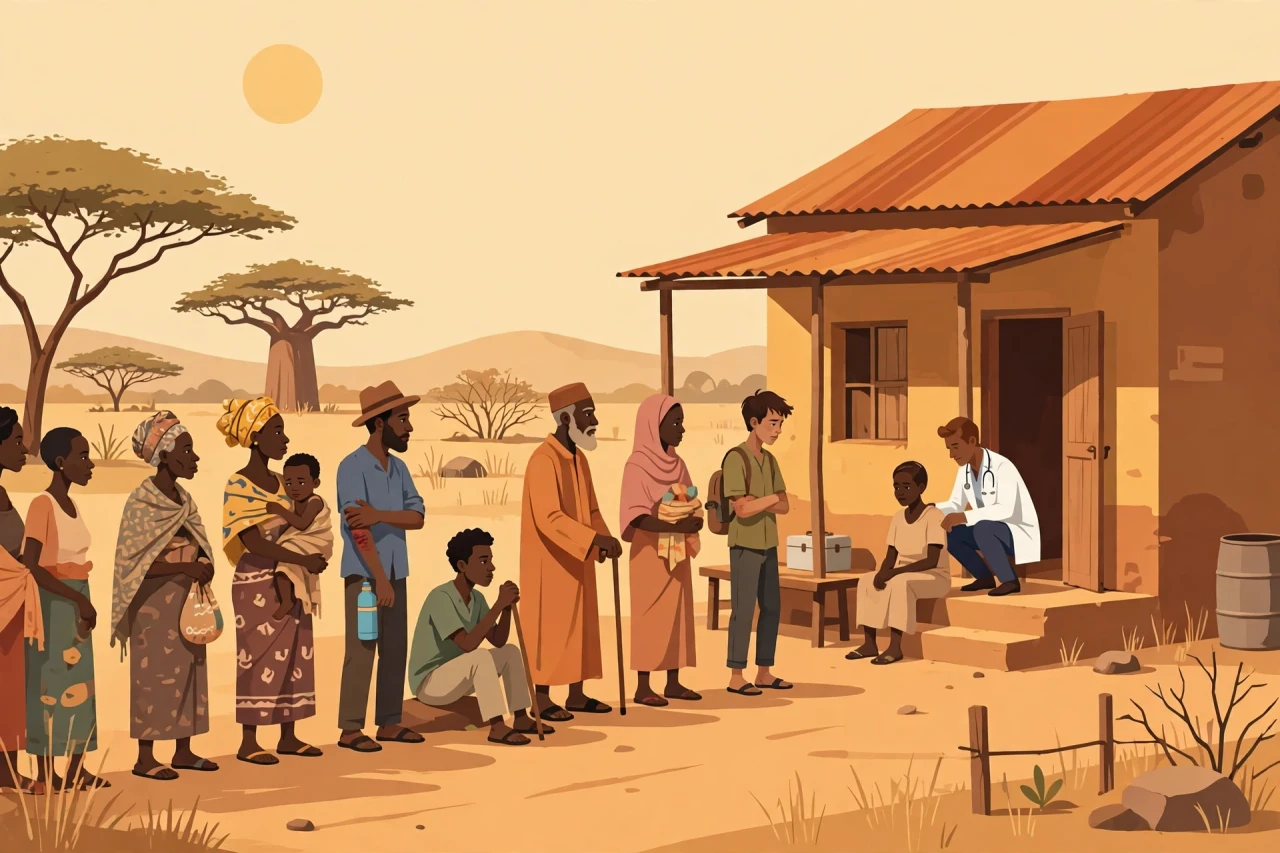
Illustration: a long line of patients at a rural clinic staffed by a single doctor — the front line of the global shortage.
What Happens Next
WHO's prescription is not simply "train more doctors." The organization calls for stronger planning, education, recruitment and retention strategies — a pipeline that keeps clinicians in the systems that need them. Retention matters as much as recruitment: better pay, working conditions, and career development can keep experienced workers in practice longer, while data-driven planning can steer training toward specialties and regions where shortages are worst.
The report itself is designed to be a recurring tool. As the first in an annual series, it will give countries comparable year-over-year evidence to guide long-term workforce policy — an implicit admission that health workforce planning has been too reactive. "We know that better data drives better policy, and these findings reinforce the importance of future-focused action to strengthen health workforce planning, education, employment and retention," Diallo said.
Whether countries act in time is the open question. The 11.1 million figure is a projection, not a destiny — but closing it would require reversing a trend in which the workforce is aging faster than it is being renewed, and in which the regions with the greatest need still have the fewest workers. The next decade, WHO suggests, will be decided by what health systems do now.
Sponsored: explore today's featured sponsored offers
FAQ
What did the WHO report actually find?
The "National Health Workforce Accounts: Health Workforce Levels and Trends 2026" report found that nearly one in four doctors across 122 countries is over 55 and could retire within a decade, projected a global shortage of 11.1 million health workers by 2030, and documented severe regional inequities — doctor density in Europe is 13 times that of Africa.
Why is one in four doctors nearing retirement such a big deal?
Because retirements coincide with rising demand. Aging populations need more complex care, and when senior clinicians leave, their experience is lost at exactly the moment it is most needed — putting a "double pressure" on health systems, as WHO's Dr Khassoum Diallo described it.
Which countries will be hit hardest?
High-income countries face the largest retirement wave, with nearly one in three doctors nearing retirement. But WHO projects 67 countries will lack enough health workers by 2030, and warns that richer nations recruiting doctors from poorer ones could destabilize developing health systems.
Hasn't the global health workforce been growing?
Yes — workforce density rose 52 percent over two decades to more than 70 million workers. The problem is that gains are unevenly distributed and the workforce is aging faster than it is being renewed, which is why the 2030 shortage projection was revised upward from 10 million to 11.1 million.
What does WHO say countries should do?
WHO calls for stronger workforce planning, expanded education and training, better recruitment, and — crucially — retention strategies that keep experienced clinicians in practice. It says better workforce data must drive longer-term policy rather than reactive hiring.
Sources
- World Health Organization, "One in four doctors nearing retirement age as WHO warns of global health workforce gap" (September 18, 2026).
- Becker's Hospital Review, "Aging global workforce could squeeze US's foreign-trained clinician pipeline" (October 20, 2026).
- MedEdge MEA, "WHO Warns of Global Health Workforce Shortage as One in Four Doctors Approaches Retirement" (October 20, 2026).
- WGHN, "WHO Warns Of Healthcare Worker Shortage In New Report" (October 20, 2026).
Comments
Post a Comment