
RIYADH, Saudi Arabia — Asia's biggest football tournament will not start in January after all. The Asian Football Confederation (AFC) announced on Tuesday, November 3, 2026, that the AFC Asian Cup in Saudi Arabia has been postponed by almost a year, moving from January 7 to February 5, 2027, to December 23, 2027, to January 21, 2028, citing exceptional circumstances in the region, logistical complexities and travel disruptions. The decision, taken after consultations with the tournament's local organising committee and the Saudi Arabian Football Federation, ends weeks of speculation about whether the 24-team championship could still go ahead on its original dates — and it comes only a week after organisers had released a final match schedule insisting that planning was on track.

Illustration: A modern football stadium in Riyadh, Saudi Arabia, under floodlights at dusk.
What Happened
According to the AFC, its organising committee for the AFC Asian Cup approved the rescheduling "in light of the current exceptional circumstances arising from developments in the region, including substantial logistical complexities and travel disruptions." The confederation said the decision followed "extensive discussions and close consultation" with the Local Organising Committee of the AFC Asian Cup Saudi Arabia 2027 and the Saudi Arabian Football Federation (SAFF).
The new dates — December 23, 2027, to January 21, 2028 — will be presented to FIFA for approval, the AFC said. Saudi Arabia will remain the host nation; the tournament has not been moved to another country. The AFC added that the postponement was necessary "in the interest of all participating teams, officials, spectators and other stakeholders," in wording reported by Reuters, TNT Sports and other outlets carrying the confederation's statement.
The shift is a delay of almost eleven months for the final, which had been set for February 5, 2027, and will now fall in January 2028. In practical terms, the tournament keeps its place in the northern hemisphere's winter window, but a full year later: instead of opening in the first week of January 2027, it will open in the final week of December 2027 and run into the new year.
The announcement landed on Tuesday morning in Asia, with Reuters reporting the postponement first, followed within hours by detailed coverage from broadcasters and sports outlets in Australia, Britain and elsewhere. For fans, the most immediate consequence is simple: tickets, travel plans and broadcast schedules built around January and February 2027 no longer apply, and organisers have yet to say publicly how existing arrangements will be transferred to the new dates.

Illustration: A football trophy beside a calendar, marking the tournament's move to December.
Background
The road to Tuesday's decision has been marked by a striking reversal. As recently as last week, Saudi organisers released the final schedule and kick-off times for the 2027 tournament in what Inside World Football described as a move aimed at assuring continental federations that planning was on track despite deadly recent attacks in Saudi Arabia by Yemen's Iran-aligned Houthi rebels.
Under that schedule, the tournament was to begin on January 7, 2027, with hosts Saudi Arabia playing Palestine in Group A at Riyadh's King Fahd Sports City Stadium. The group stage was to finish on January 20, the knockout rounds were to begin on January 22, and the final was to return to the same Riyadh stadium on February 5. The 19th edition of the Asian Cup was to feature 24 teams in six groups of four, playing 51 matches across eight stadiums in three host cities: five venues in Riyadh, two in Jeddah and one in Al Khobar. Defending champions Qatar were to begin their title defence against Thailand, while Japan were to open against Indonesia.
That show of confidence followed months of uncertainty. Reuters reported that a strike on Riyadh's international airport last month killed at least 12 people and wounded more than 300, with the Houthi movement claiming responsibility for what was described as the deadliest attack in Saudi Arabia in more than a decade. Other sports events in Saudi Arabia have been cancelled or postponed in recent weeks following Houthi attacks on the country, according to Reuters, and the AFC's own president, Sheikh Salman bin Ibrahim Al Khalifa, had previously said a postponement to 2028 was possible if circumstances required it.
The October schedule release, then, was widely read as an attempt to settle the question. Instead, within about a week, the AFC reached the opposite conclusion: that the competition could not be organised and delivered as originally scheduled. Reporting by the Associated Press, carried by TSN, noted that the decision "ends months of speculation about a postponement which, until recently, had been rejected by local organizers."
Saudi Arabia is hosting the Asian Cup for the first time, seven years before it stages the 2034 FIFA World Cup. That longer horizon matters: the Asian Cup was to be a major dress rehearsal for the World Cup, testing stadiums, transport, security and fan operations at full tournament scale. A postponement does not remove that role, but it compresses the lessons-learned window and puts the spotlight on how the new December 2027 dates interact with domestic leagues, the European club calendar and the build-up to the World Cup itself.
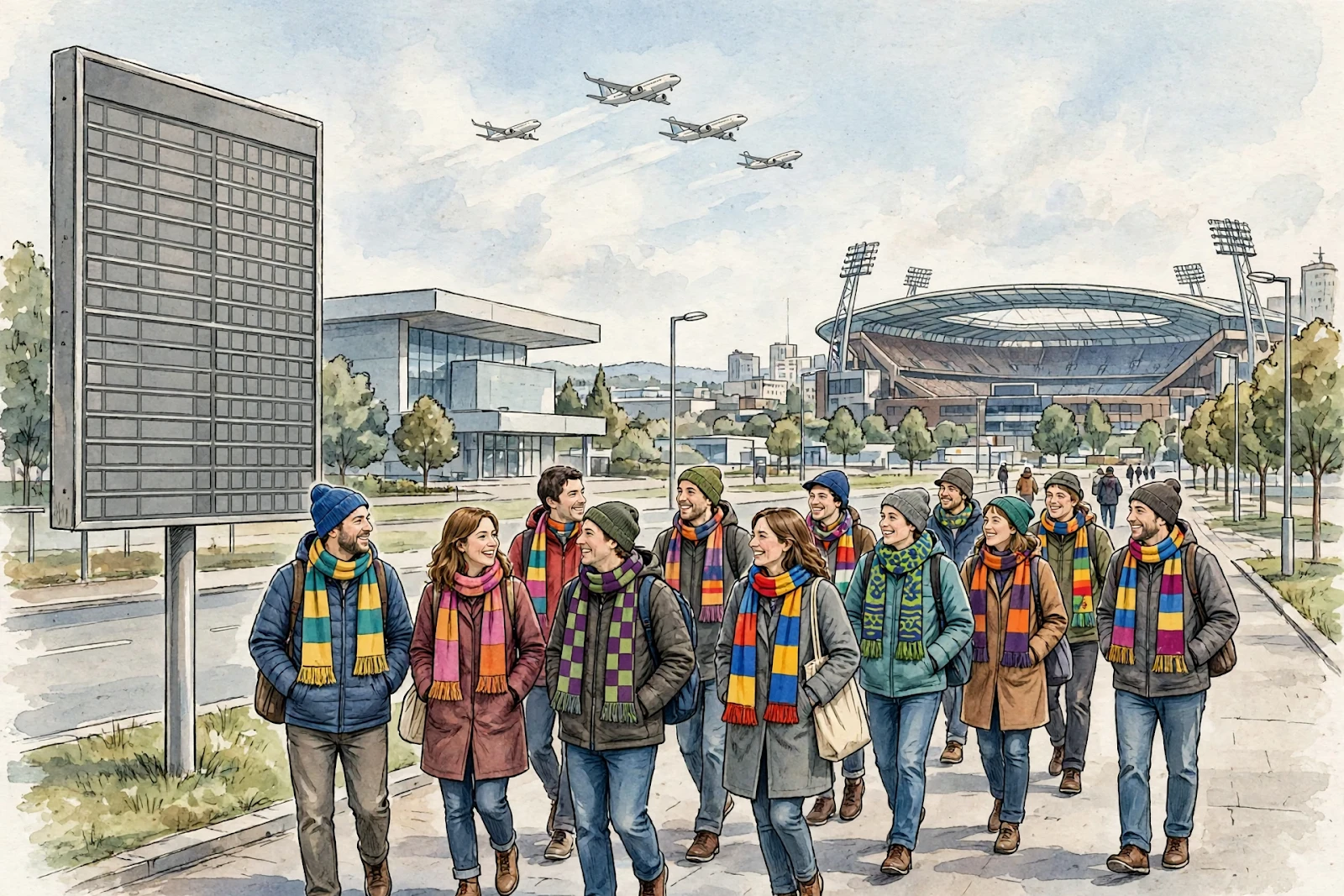
Illustration: Football fans travelling to a stadium, with air travel disrupted by regional tensions.
Why It Matters
First, the postponement is a human story before it is a calendar story. The AFC framed the decision around the safety and logistics of staging a month-long, multi-city tournament involving 24 national teams, their staff, officials, media and tens of thousands of travelling supporters. A tournament that cannot guarantee safe movement between airports, hotels, training grounds and stadiums cannot credibly go ahead, however advanced its stadium preparations may be. By moving the event rather than cancelling it or shifting it to another host, the AFC has chosen to protect the tournament's identity while conceding that its original timing was no longer workable.
Second, the decision ripples far beyond Saudi Arabia. For the 24 qualified teams, a move from January 2027 to December 2027 changes preparation cycles, friendly schedules and player availability. National-team coaches who had built their plans around a January tournament must now re-plan for a December start that straddles the festive period and the mid-season break in many leagues. For clubs, particularly in Europe and Asia, the release of players shifts by almost a year, which changes contract, transfer and fitness calculations that had already been made on the old dates.
Third, the postponement tests the relationship between sport and regional security in a way that will be watched by every future host. Saudi Arabia has invested heavily in becoming a hub for global sport, and the Asian Cup was a flagship test of that strategy. The fact that even a tournament with venues, a draw and a published kick-off schedule could be moved at relatively short notice sends a signal to other rights holders: in a volatile region, contingency planning is not an afterthought but a core part of hosting. How quickly the AFC and FIFA confirm the new dates, and how clearly organisers communicate ticket and travel arrangements, will shape confidence in the rescheduled event.
Finally, there is the sporting context. Qatar arrive as defending champions, Japan remain one of the continent's powerhouses, and hosts Saudi Arabia were to open the tournament in front of a home crowd in Riyadh. An extra eleven months gives some teams time to rebuild and others time for ageing squads to fade; form in late 2027 will look very different from form in early 2027. The tournament that eventually kicks off in December 2027 will be the same competition in name, but not quite the same competition in personnel or momentum.
What Happens Next
The immediate next step is formal: the new dates will be presented to FIFA for approval, as the AFC confirmed in its statement. Until that approval is given, the December 23, 2027, to January 21, 2028, window should be treated as the AFC's confirmed plan rather than a finally ratified calendar, though reporting has treated FIFA approval as the expected next step rather than an open question.
Organisers are also expected to publish a revised match schedule mirroring the original in structure — the same group and knockout format, the same host cities of Riyadh, Jeddah and Al Khobar, and, according to Inside World Football, most probably the same final venue, Riyadh's King Fahd Sports City Stadium. Fans should watch for announcements on tickets already sold for January 2027, on hospitality packages and on broadcast schedules, none of which were detailed in the initial postponement statement.
For the teams, the focus now shifts to the long gap before the rescheduled tournament. Continental qualifiers, friendly windows and domestic seasons will all be re-examined, and coaches will have to decide whether to treat late 2027 as a fresh peak or as an extension of plans first drawn up for early 2027. For Saudi Arabia's organisers, the extra time is both a relief and a challenge: more time to prepare, but also more time under scrutiny, with every security development in the region now read as a signal about December 2027.
What is not in doubt is the tournament's place in Asian football. The Asian Cup remains the continent's flagship national-team competition, and the AFC's statement made clear that it intends to deliver it in Saudi Arabia, in full, with all 24 teams. The question that Tuesday's announcement answers is when — and the answer, after months of speculation and a week of apparent certainty, is almost a year later than anyone had planned.
Sponsored: explore today's featured sponsored offers
FAQ
When will the 2027 Asian Cup now be played?
From December 23, 2027, to January 21, 2028, according to the AFC's announcement on November 3, 2026. The new dates will be presented to FIFA for approval.
When was the tournament originally scheduled?
From January 7 to February 5, 2027, in Saudi Arabia, with the opening match between hosts Saudi Arabia and Palestine and the final both set for Riyadh's King Fahd Sports City Stadium.
Why was the Asian Cup postponed?
The AFC cited "exceptional circumstances arising from developments in the region, including substantial logistical complexities and travel disruptions," following recent attacks in Saudi Arabia, including a strike on Riyadh's international airport last month that Reuters reported killed at least 12 people and wounded more than 300.
Will Saudi Arabia still host the tournament?
Yes. The AFC has not moved the tournament to another country; Riyadh, Jeddah and Al Khobar remain the host cities, and the final is most probably still set for Riyadh's King Fahd Sports City Stadium, according to Inside World Football.
How many teams play in the Asian Cup, and who are the defending champions?
Twenty-four teams play 51 matches across eight stadiums. Qatar are the defending champions, and were due to begin their title defence against Thailand under the original schedule.
Sources
Reuters, "Asian Cup postponed until December 2027, AFC says," November 3, 2026; Reuters, "Asian Cup latest event in Saudi Arabia to be postponed over safety," November 3, 2026; TNT Sports, "Asian Cup 2027: Tournament in Saudi Arabia postponed by almost a year due to 'exceptional circumstances' amid regional conflict," November 3, 2026; Inside World Football, "Safety fears force AFC and Saudi organisers to push 2027 Asian Cup from January to December KO," November 3, 2026; Inside World Football, "AFC shrugs off regional fears with release of Asian Cup 2027 schedule," October 27, 2026; Associated Press via TSN, "Asian Football Confederation postpones 2027 Asian Cup because of conflict in Middle East," November 3, 2026.
Comments
Post a Comment