
ANDORRA LA VELLA — Whose voices are shaping artificial intelligence, and whose are being left out? That question opened the second North-South Intercultural Conference in Andorra on Tuesday, November 3, 2026, as more than 70 policymakers, educators, young people and civil society representatives gathered to discuss how AI is changing the way people learn, communicate and access information.
Held in partnership with the Government of Andorra, the two-day conference, which runs on November 3 and 4, is organised by the North-South Centre of the Council of Europe under the theme “Intercultural Dialogue in the Age of AI: Education for Democratic and Inclusive Digital Societies.” Participants from Europe, Africa and the Middle East are sharing practical experience, addressing common challenges and promoting approaches to AI that uphold human rights, cultural diversity and democratic values, according to the Council of Europe.
The timing is deliberate. AI systems now influence classrooms, news feeds, job applications and public services, and the organisers argue that questions of cultural diversity, inclusion and human rights have therefore become more urgent, not less. The conference is also the closing event of iLEGEND III, a joint programme of the European Union and the Council of Europe that has promoted global education, intercultural learning and dialogue across regions.
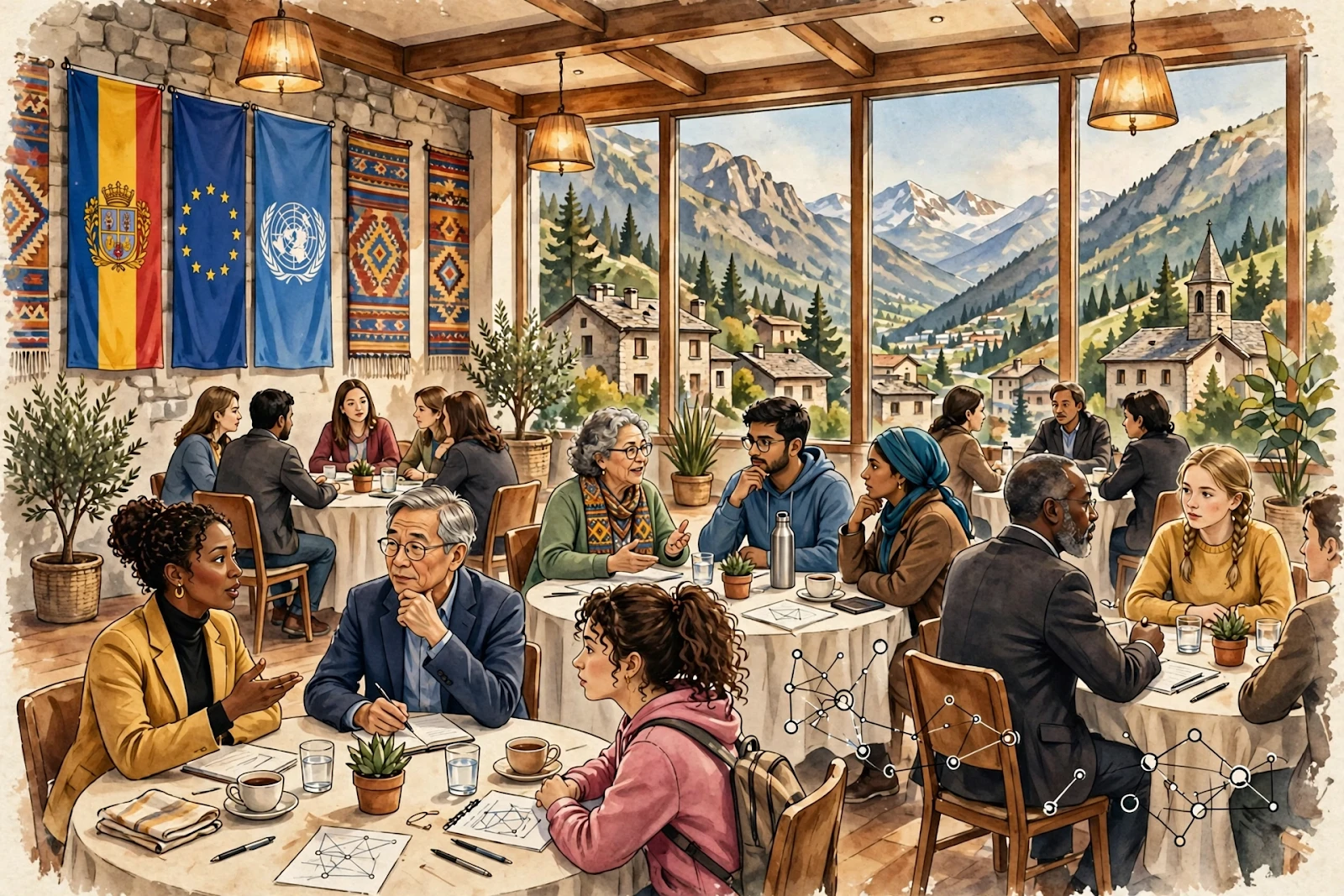
Illustration: A diverse international conference hall in Andorra, with policymakers, educators and young people discussing artificial intelligence and cultural diversity. (AI illustration)
What Happened
The conference opened in Andorra la Vella with remarks by H.E. Imma Tor Faus, Minister of Foreign Affairs of Andorra, who called for an AI that respects democratic values and human rights and serves people. The Council of Europe reported that she recalled that AI is never neutral in its effects: it can reproduce discrimination, amplify stereotypes, facilitate disinformation and become an instrument of manipulation.
That framing set the tone for the opening session. Rather than treating AI as a purely technical subject, speakers presented it as a cultural and democratic one — shaped by the data it is trained on, the languages it understands best, the companies and countries that fund it, and the people who are, or are not, in the room when decisions are made.
The conference takes place while Ambassador Andreu Jordi, Permanent Representative of Andorra to the Council of Europe, serves as President of the North-South Centre's Executive Committee. Members of the Global Education Network are among the participants, bringing experience from civil society organisations, government authorities and academia across Europe, Africa and the Middle East.
Claus Neukirch, Director of Programme Co-ordination at the Council of Europe, highlighted two Council of Europe recommendations in his remarks: the Recommendation on Equality and Artificial Intelligence, which addresses discrimination and calls for equality and meaningful participation throughout the AI lifecycle, and the Recommendation on Artificial Intelligence Literacy. He noted that AI literacy goes beyond technical skills: people need to understand how AI affects their rights, exercise critical judgement and participate in decisions about its use.
Irene Kitsou-Milonas, Special Representative of the Council of Europe Secretary General on antisemitism, anti-Muslim hatred, and all forms of religious intolerance, called for AI to reflect human diversity, including religious communities. She stressed that nothing can replace genuine, person-to-person intercultural engagement and called for more opportunities to connect across differences through education and community initiatives.
Josep Dallerès, publisher, writer and former Ambassador of Andorra to the Council of Europe, warned that computing power, data and AI funding are concentrated in a few countries and companies, risking deeper global inequalities. He called for the benefits of AI to be shared more fairly. He also recalled that during Andorra's 2013 Chairmanship of the Committee of Ministers, the country initiated the work that led to the Council of Europe's Reference Framework of Competences for Democratic Culture, whose core competencies — critical thinking, autonomy, empathy, and critical understanding of language and communication — are, in his view, precisely those needed to navigate the age of AI.
Background
The North-South Intercultural Conference is an initiative designed to bridge the growing divide between the North and the South and to serve as a platform for discussion on the state of North-South relations and opportunities for mutual development, around key Council of Europe standards. Its 2026 edition brings perspectives from Europe, Africa and the Middle East to a question that cuts across all three regions: how can education, youth initiatives and public policies help ensure that AI promotes dialogue, inclusion and mutual understanding rather than division and exclusion?
That question matters because AI does not arrive in every society on equal terms. Systems built mainly with data, languages and cultural references from a small number of countries can misunderstand, misrepresent or simply overlook people elsewhere. A chatbot that handles one language fluently and another poorly, a hiring tool trained on historical patterns, or a content-moderation system that struggles with cultural context can all quietly narrow who is heard and who is helped. The conference organisers present education as the counterweight: not just teaching people to use AI tools, but teaching them to question, compare and contextualise what those tools produce.
The conference also marks the conclusion of iLEGEND III — Intercultural Learning Exchange through Global Education, Networking and Dialogue — a joint programme of the European Union and the Council of Europe, co-funded by both organisations and implemented by the North-South Centre. The programme, which ran from 2022 to 2026, promoted global education by strengthening people's capacities to respond to social, environmental, political and ethical challenges, bringing together people from Europe, the Middle East and Africa to encourage intercultural learning and dialogue.
According to the North-South Centre, iLEGEND has built on its first two phases, which have run since July 2016, and more than 1,050 young people and education practitioners, including representatives of national ministries, have strengthened their skills through courses on global citizenship and sustainable development, media and information literacy, intercultural and interfaith dialogue, environmental issues and human rights. It has also consolidated and expanded the Global Education Network, bringing together 55 national coordinators and four international organisations.
Andorra itself is a fitting host for a conversation about small states and shared standards. A mountain principality between France and Spain, it has long relied on international cooperation and multilateral institutions to amplify its voice. Its role in initiating the democratic-culture framework in 2013, recalled by Dallerès at the opening, links the country's earlier contribution to education policy directly to the AI debate of today.
Illustration: Young people from different cultures and faiths sharing ideas in an education workshop on dialogue and inclusion. (AI illustration)
Why It Matters
The Andorra conference matters first because it reframes AI literacy as a democratic skill, not a technical add-on. If people cannot understand how an AI system reaches a conclusion, challenge it when it is wrong, or take part in decisions about where it is used, then AI risks concentrating power even as it spreads capability. Neukirch's emphasis on critical judgement and participation points to a practical test for any AI policy: does it leave citizens more able to decide for themselves, or more dependent on systems they cannot inspect?
It matters second because it puts culture at the centre of the AI debate, rather than treating it as an afterthought. The warning that AI can reproduce discrimination and amplify stereotypes is not abstract. When training data reflects historical inequalities, automated systems can repeat them at scale — in ways that are harder to see and harder to appeal than a human decision. A conference that brings educators, young people and civil society into the same room as policymakers is an attempt to widen the circle of who gets to define fairness in practice, not just in principle.
It matters third because of who is in the room. A North-South dialogue that includes participants from Africa and the Middle East alongside Europe challenges the idea that AI governance is a conversation for a few technology-producing countries alone. Dallerès's warning about concentrated computing power, data and funding makes the same point from the other side: if the infrastructure of AI is concentrated, its benefits and its rules will be too, unless deliberate effort is made to share them more fairly.
Finally, the conference matters because it connects AI to everyday institutions — schools, youth groups and community initiatives — rather than leaving it to specialist regulators. The workshops led by civil society organisations, including the Fòrum de la Joventut d’Andorra, the Albania Sustainable Development Organization, Cymru Global and MITRA France, are designed to share practical experience: what works in a classroom, a youth centre or a community project when people from different backgrounds meet, disagree and learn together. That practical focus is what distinguishes a dialogue conference from a declaration: the test is whether participants return home with methods they can use, not just ideas they agree with.
For young people in particular, the stakes are direct. They are the heaviest users of AI tools in education and daily life, and they will live longest with the systems being built now. The programme's second roundtable, on how young people can use intercultural and interfaith dialogue to promote peace in the age of AI, recognises that young people are not only an audience for AI policy but actors in it — capable of building bridges across differences that algorithms alone cannot.
What Happens Next
The conference continues on November 4 with its two roundtables: one exploring how education and AI literacy can foster inclusion and constructive engagement with cultural diversity, and one on how young people can use intercultural and interfaith dialogue to promote peace in the age of AI. According to the conference programme, the roundtables will include a presentation of the main results achieved by the iLEGEND III programme and a screening of the short film “On The Other Side Of The Same World” by Vinicius Moraes de Carvalho of Brazil, recipient of the 2026 PLURAL+ Special Recognition on AI for #OneHumanity at the PLURAL+ Youth Video Festival, an initiative of the United Nations Alliance of Civilizations.
Participants will also reflect on iLEGEND III's achievements in digital transformation, inclusion, global citizenship, intercultural dialogue and democratic participation, as the programme concludes. What follows that reflection — whether in new Global Education Network activities, national training cascades or future North-South conferences — will show whether the Andorra meeting becomes a milestone or a moment.
For educators and policymakers watching from elsewhere, the practical questions to carry home are clear: how is AI literacy being taught, not just as coding or tool use but as critical judgement about rights and representation? Whose languages, histories and religious traditions are reflected in the systems schools and public services adopt? And who is invited to shape those systems before they are deployed, rather than asked to adapt afterwards?
The conference does not claim to answer those questions in two days. Its value lies in asking them in a room where North and South, young and old, and policymakers and practitioners can answer together — and in insisting that an inclusive digital society is something societies build through education and dialogue, not something technology delivers on its own.

Illustration: Andorra la Vella in the Pyrenees mountains, host town of the North-South Intercultural Conference. (AI illustration)
Sponsored: explore today's featured sponsored offers
FAQ
What is the North-South Intercultural Conference in Andorra?
It is the second North-South Intercultural Conference, organised by the North-South Centre of the Council of Europe in partnership with the Government of Andorra, held in Andorra la Vella on November 3 and 4, 2026, under the theme “Intercultural Dialogue in the Age of AI: Education for Democratic and Inclusive Digital Societies.”
Who is taking part?
More than 70 policymakers, educators, young people and civil society representatives, including members of the Global Education Network, with participants from Europe, Africa and the Middle East.
Why is AI a cultural and democratic issue, not just a technical one?
According to the opening speakers, AI influences how people learn, communicate and access information, and it can reproduce discrimination, amplify stereotypes and facilitate disinformation. AI literacy therefore includes understanding how AI affects rights, exercising critical judgement and participating in decisions about its use.
What is iLEGEND III?
iLEGEND III — Intercultural Learning Exchange through Global Education, Networking and Dialogue — is a joint programme of the European Union and the Council of Europe, co-funded by both and implemented by the North-South Centre. The Andorra conference marks its conclusion, with participants reflecting on its work in digital transformation, inclusion, global citizenship, intercultural dialogue and democratic participation.
What happens on the second day of the conference?
The programme includes two roundtables on education and AI literacy for inclusion, and on young people using intercultural and interfaith dialogue to promote peace in the age of AI, along with civil society workshops and a presentation of iLEGEND III's main results.
Sources
- Council of Europe, North-South Centre, “North-South Intercultural conference in Andorra explores Intercultural Dialogue in the Age of AI,” November 3, 2026.
- Council of Europe, North-South Centre, “Intercultural Conference 2026” programme page, Andorra la Vella, November 3–4, 2026.
- Council of Europe, North-South Centre, “iLEGEND III” programme page, joint programme of the European Union and the Council of Europe.
Comments
Post a Comment