
DHAKA — Bangladesh will set up a wage board to review garment workers' pay after protests shut dozens of factories and triggered clashes with police, putting fresh strain on the country's most important export industry.
Workers are demanding a minimum monthly wage of 30,000 taka (about $245), more than double the current 12,500 taka, saying rising costs of food, housing, transport and healthcare have sharply eroded their purchasing power, Reuters reported on November 1, 2026. Labour and Employment Minister Ariful Haque Chowdhury said the government would formally constitute the board on Sunday, after discussions with labour leaders and industry representatives aimed at defusing the unrest.

Illustration: Garment workers marching outside a clothing factory in Dhaka, Bangladesh, during protests over pay.
What Happened
Saturday's protests prompted about 30 garment factories in Ashulia, a key manufacturing hub on the outskirts of Dhaka, to declare holidays, Mohammad Mominul Islam Bhuiyan, superintendent of the Ashulia Industrial Police, told Reuters. Hundreds of workers blocked a major intersection in the capital, while demonstrations in other industrial zones disrupted traffic and factory operations.
Clashes between workers and police in Ashulia injured several people, including police officers, police said. Officers used tear gas and sound grenades to disperse protesters, according to Reuters.
Chowdhury urged workers to return to work, saying the government's decision to review the wage structure addressed their key demand. He warned that prolonged factory closures and production disruptions could delay export shipments and payments from international buyers, creating further difficulties for manufacturers and workers alike.
According to The Business Standard, the government formed a six-member wage board, chaired by Sheikh Ashfaqul Rahman, chairman of the Minimum Wage Board and a senior district and sessions judge. The board was formed under the Bangladesh Labour Act, 2006, and will recommend a revised minimum wage after considering stakeholders' views, the industry's capacity and workers' cost of living, the newspaper reported. ABM Shamsuddin, a director of the Bangladesh Garment Manufacturers and Exporters Association (BGMEA), will represent employers, while Babul Akhtar, general secretary of the Bangladesh Garments and Industrial Workers Federation, will represent workers.
The Business Standard also reported that garment workers had been staging protests for several weeks demanding that the minimum monthly wage be raised to 30,000 taka. The demand, an increase of 17,500 taka — about 140 per cent — over the existing minimum, reflects workers' argument that a wage fixed three years ago is no longer sufficient to support a household amid rising prices.
Background
Bangladesh's ready-made garment industry is the world's largest after China, contributes about 10 per cent of gross domestic product, employs about 4 million workers and generates more than 80 per cent of the country's export earnings, Reuters reported. It supplies clothing to many leading Western brands, making any disruption a concern far beyond Dhaka's industrial zones.
The current entry-level minimum of 12,500 taka dates from the last revision in 2023, when the government raised it from 8,000 taka, effective from December 1 that year, The Business Standard reported. That revision also reduced the number of pay grades from seven to four, with the highest-grade minimum set at 15,035 taka. At the time, workers' organisations had demanded between 20,000 and 25,000 taka, but the government settled on 12,500 taka after proposals from factory owners and discussions among stakeholders.
The new board will be the eighth wage-setting exercise since the first board was constituted in 1984, The Business Standard reported. Over four decades, the minimum monthly wage for the lowest-paid workers has risen in nominal terms from 627 taka to 12,500 taka — an almost 20-fold increase that does not account for inflation or changes in purchasing power. The seven previous rounds took place in 1984, 1994, 2006, 2010, 2013, 2018 and 2023.
Manufacturers, however, said the sector is facing mounting challenges, Reuters reported, including rising production costs, periodic gas and electricity shortages, and uncertainty in energy markets linked to tensions in the Middle East. Those pressures sit alongside the higher costs workers face at home: food, housing, transport and healthcare have all become more expensive, eroding the real value of the 2023 wage settlement.

Illustration: Rows of sewing machines inside a Bangladeshi garment factory, the country's largest export industry.
Why It Matters
The stakes extend well beyond a single pay round. Because garments account for more than four-fifths of Bangladesh's export earnings, a prolonged stoppage risks delayed shipments, deferred payments from international buyers and lost orders — the very outcome the labour minister warned against. For an economy where the industry contributes about a tenth of GDP, that is a national economic question, not only a labour dispute.
For workers, the arithmetic is stark. A demand of 30,000 taka against a current minimum of 12,500 taka is not a marginal adjustment; it is a claim that the cost of living has outrun the 2023 settlement by a wide margin. Workers say food, housing, transport and healthcare costs have sharply eroded what the current wage can buy. Whether the board accepts that framing — and how it weighs it against factory costs — will determine whether the review calms the protests or prolongs them.
For manufacturers and buyers, the review arrives at a difficult moment. Factories already face rising production costs and energy shortages, and energy-market uncertainty linked to Middle East tensions adds to the pressure, according to Reuters. Employers, through their BGMEA representative on the board, will argue that any increase must reflect what the industry can sustain without losing orders to rival producing countries. Workers' representatives will argue that an industry built on their labour cannot ask them to absorb rising living costs indefinitely.
For Western brands that source from Bangladesh, the episode is a reminder of how concentrated their supply chains remain. The world's second-largest garment exporter after China supplies clothing to many leading brands, so unrest in Ashulia and other hubs can quickly become a delivery and reputational question for retailers far from Dhaka. How the wage review is handled — and whether it is seen as fair by both sides — matters to those buyers as much as to the factories themselves.
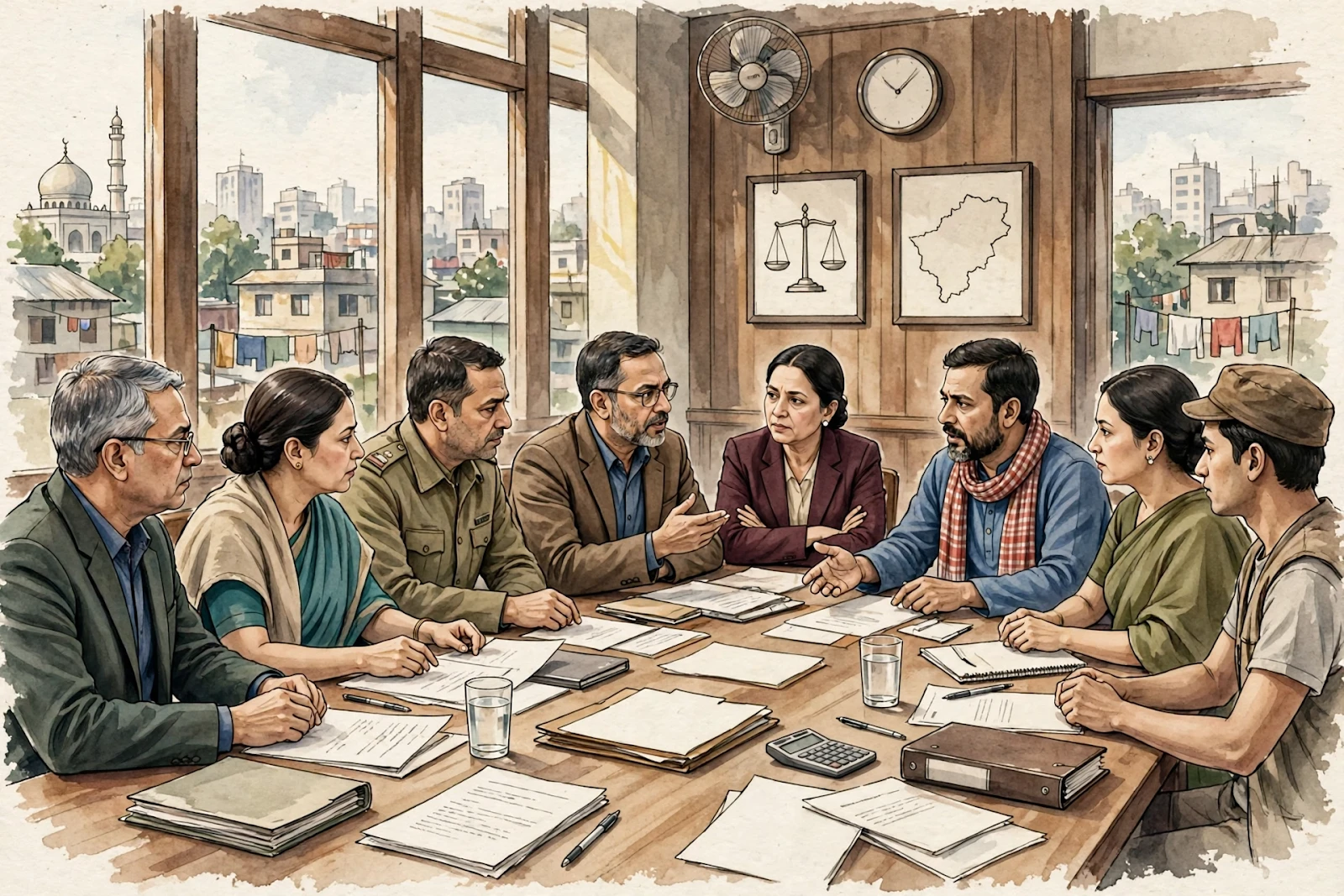
Illustration: A wage board meeting in Dhaka, with officials, factory owners and worker representatives discussing pay.
What Happens Next
The immediate test is whether workers return to work now that the board has been formed. The minister has urged them to do so, presenting the review as an answer to their central demand. If factories reopen and the board begins its work promptly — as the minister urged its members to do — the dispute could move from the streets to the negotiating table.
The board itself must now hear stakeholders, weigh the industry's capacity against workers' cost of living, and recommend a revised minimum wage. No timetable for a recommendation was reported in the initial coverage, and no figure has been agreed: the workers' demand of 30,000 taka stands against employers' concerns about costs, with the final number to emerge from the board's deliberations.
Watch, too, for whether the unrest spreads or subsides. Saturday's protests disrupted traffic and factory operations beyond Ashulia, and several weeks of demonstrations preceded the board's formation. A recommendation seen as too low risks a repeat of past cycles — the 2023 settlement itself followed protests and was rejected as too low by some worker groups — while a sharp increase would test manufacturers' margins and buyers' patience.
For now, the formation of the board marks a pause, not a settlement. The numbers that will define its success — the new minimum, the date it takes effect, and whether factories stay open while it deliberates — are still to come.
Sponsored: explore today's featured sponsored offers
FAQ
Why are Bangladeshi garment workers protesting?
Workers are demanding a minimum monthly wage of 30,000 taka, more than double the current 12,500 taka, saying rising food, housing, transport and healthcare costs have sharply eroded their purchasing power.
What has the government done in response?
Labour and Employment Minister Ariful Haque Chowdhury said the government would formally constitute a wage board on Sunday, November 1, 2026, to review garment workers' pay, and urged workers to return to work.
How big is Bangladesh's garment industry?
It is the world's largest after China, employs about 4 million workers, contributes about 10 per cent of GDP and generates more than 80 per cent of Bangladesh's export earnings, according to Reuters.
When was the minimum wage last revised?
The last revision came in 2023, when the lowest-grade minimum rose from 8,000 taka to 12,500 taka, effective from December 1, 2023, with pay grades reduced from seven to four.
What happens next?
The six-member wage board, chaired by Sheikh Ashfaqul Rahman, will consider stakeholders' views, the industry's capacity and workers' cost of living, and recommend a revised minimum wage. No recommendation or timetable was reported in the initial coverage.
Sources
- Reuters, "Bangladesh to form wage board after garment protests shut factories", November 1, 2026.
- The Business Standard, "Wage board formed, minister urges protesting RMG workers to return to work", November 1, 2026.
- The Business Standard, "From Tk627 to Tk12,500: How garment workers' minimum wages have changed", November 1, 2026.
Comments
Post a Comment