
PATNA, India — The Bihar Museum in Patna has been ranked the ninth-best museum in the world and the best in Asia in the World's 100 Best Museums 2026 list, placing a museum barely a decade old ahead of New York's Metropolitan Museum of Art and the Louvre in Paris. The ranking, published by the Munich-based travel publisher Worth a Journey, makes the Bihar Museum the only Indian institution in the global top ten.
Released on 29 October 2026, the list covers 100 museums across 37 countries and has been widely reported in Indian national media since late October. The Bihar Museum finished ninth overall, one place ahead of the Metropolitan Museum of Art in tenth, while the Louvre — long regarded as the world's most visited museum — came in 31st. For a state museum that opened its first galleries only in 2015, the result has been celebrated in Bihar as a moment of international recognition for a region whose history stretches back to some of the earliest civilisations of the Indian subcontinent.

Illustration: The Bihar Museum in Patna, designed by Pritzker Prize-winning architect Fumihiko Maki, has been ranked ninth among the world's best museums.
What Happened
Worth a Journey, a Munich-based travel publisher that produces international lists of attractions and cultural institutions, published its World's 100 Best Museums 2026 ranking on 29 October 2026. The Bihar Museum in Patna secured ninth place globally and first place in the Asian category, ahead of every other museum on the continent.
The top ten is dominated by some of the most famous institutions on earth. Mexico City's Museo Nacional de Antropología tops the list, followed by the Museo del Prado in Madrid in second place and Denmark's Louisiana Museum of Modern Art in third. The State Hermitage Museum in Saint Petersburg is fourth, the Kunsthistorisches Museum in Vienna fifth, and the Şanlıurfa Archaeology Museum in Türkiye sixth. The Museum of the Second World War in Gdańsk is seventh and the National WWII Museum in New Orleans eighth. The Bihar Museum is ninth, with the Metropolitan Museum of Art completing the top ten.
The publisher says its rankings draw on visitor reviews analysed using language models, with scores assessed through confidence intervals and supplemented by in-person visits. It also says it does not accept nominations, applications or payments for inclusion — a point worth noting, since this is a travel-publishing assessment based on visitor feedback, not an official award or formal accreditation by an international museum body. The list's regional split underlines the scale of the achievement: 55 of the 100 museums are in Europe, 22 in North America, 10 in Asia, five each in the Middle East and Latin America, two in Oceania and one in Africa. The United States has the largest national representation, with 18 museums.
News of the ranking spread quickly through Indian media from 28 to 30 October, and coverage was still being updated on 5 November. Bihar's Art and Culture Minister, Dr Pramod Kumar, and the museum's Director General, Anjani Kumar Singh, a retired Indian Administrative Service officer, have overseen the institution through its rise, and the ranking has been welcomed in Patna as recognition of years of work on the museum's collections, interpretation and visitor experience.
Background
The Bihar Museum exists because the state's older museum ran out of room. The Patna Museum, established in 1917, had collected roughly 40,000 objects but could display only a fraction of them. The Bihar government therefore planned a modern, spacious museum that could present the state's heritage to the world — a vision first set out in 2009 by the then Chief Minister, Nitish Kumar.

Illustration: The 2,300-year-old Didarganj Yakshi, a Mauryan-era sandstone sculpture, is among the highlights of the Bihar Museum's collection.
An international architectural competition in January 2012 selected the design of Maki and Associates, the firm of the Pritzker Prize-winning Japanese architect Fumihiko Maki, working with the Mumbai-based Studio Opolis. Canada-based Lord Cultural Resources designed the exhibitions in the museum's nine permanent galleries. Construction began on Bailey Road — now Jawaharlal Nehru Marg — in October 2013, at an estimated budget of ₹498 crore, about US$52 million, on a 13.9-acre complex.
The museum opened in stages. Its inaugural section, including the children's museum, the main entrance area and an orientation theatre, was unveiled in August 2015. The remaining galleries opened in October 2017, when more than 100 artefacts were transferred to the new building from the Patna Museum. Today the museum holds more than 20,000 artefacts across ten galleries: the Orientation Gallery, Galleries A, B and C, the History Art Gallery, the Regional Art Gallery, the Diaspora Gallery, Visible Storage, the Children's Gallery and the Contemporary Art Gallery.
The permanent galleries run chronologically, from prehistoric cultures through to 1764 — artefacts from after that date remain on display at the older Patna Museum. Gallery A covers the Indus Valley civilisation, the rise of the Mauryan dynasty, the reign of Ashoka and the emergence of Buddhism and Jainism. Gallery B follows the Sungas, the Kushanas, the Gupta Empire and the Palas. Gallery C explores later periods, including the Bengal Sultanate, the Nawabs of Bengal, the Patna School of Painting, and the influence of Sufism and Sikhism. The History Art Gallery holds the museum's most celebrated treasure, the Didarganj Yakshi — a 2,300-year-old Mauryan-era sandstone sculpture renowned for its polished finish — alongside Hindu deities, medieval miniature paintings and Daniell prints.
The region the museum celebrates is one of the great crossroads of Asian history. Bihar was home to the renowned centres of learning at Nalanda and Vikramshila, played a central role in the development and spread of Buddhism and Jainism, and was the heartland of the Mauryan Empire under Ashoka. Its galleries trace that sweep from the Stone Age to modern times through sculptures, coins, manuscripts and folk art, with a regional folk art gallery and a dedicated Children's Gallery offering different points of entry into the region's past.
Why It Matters
The ranking matters first because of what it says about where world-class museums can now be found. The top ten has long been the preserve of the great European and American institutions, and for a museum in Patna — a city far from the usual cultural-tourism circuits — to break into it, ahead of the Met and the Louvre, challenges assumptions about which places get to tell the world's stories. It is the only Indian institution in the global top ten, and under the publisher's regional classification it is the only Asian museum there too.
It matters second because of what it could mean for Bihar itself. International visibility of this kind can bring visitors, and the state has a wider cultural circuit to offer them: the archaeological sites and learning centres of Nalanda and Vikramshila, Buddhist and Jain heritage, historical monuments and living traditions of folk art. Better coordination among museums, heritage sites, guides, transport and visitor facilities could encourage travellers to spend more time exploring the state — and the museum's own staff have been preparing for that, including a spoken-English training programme for front-of-house staff that ran from January to April 2026.
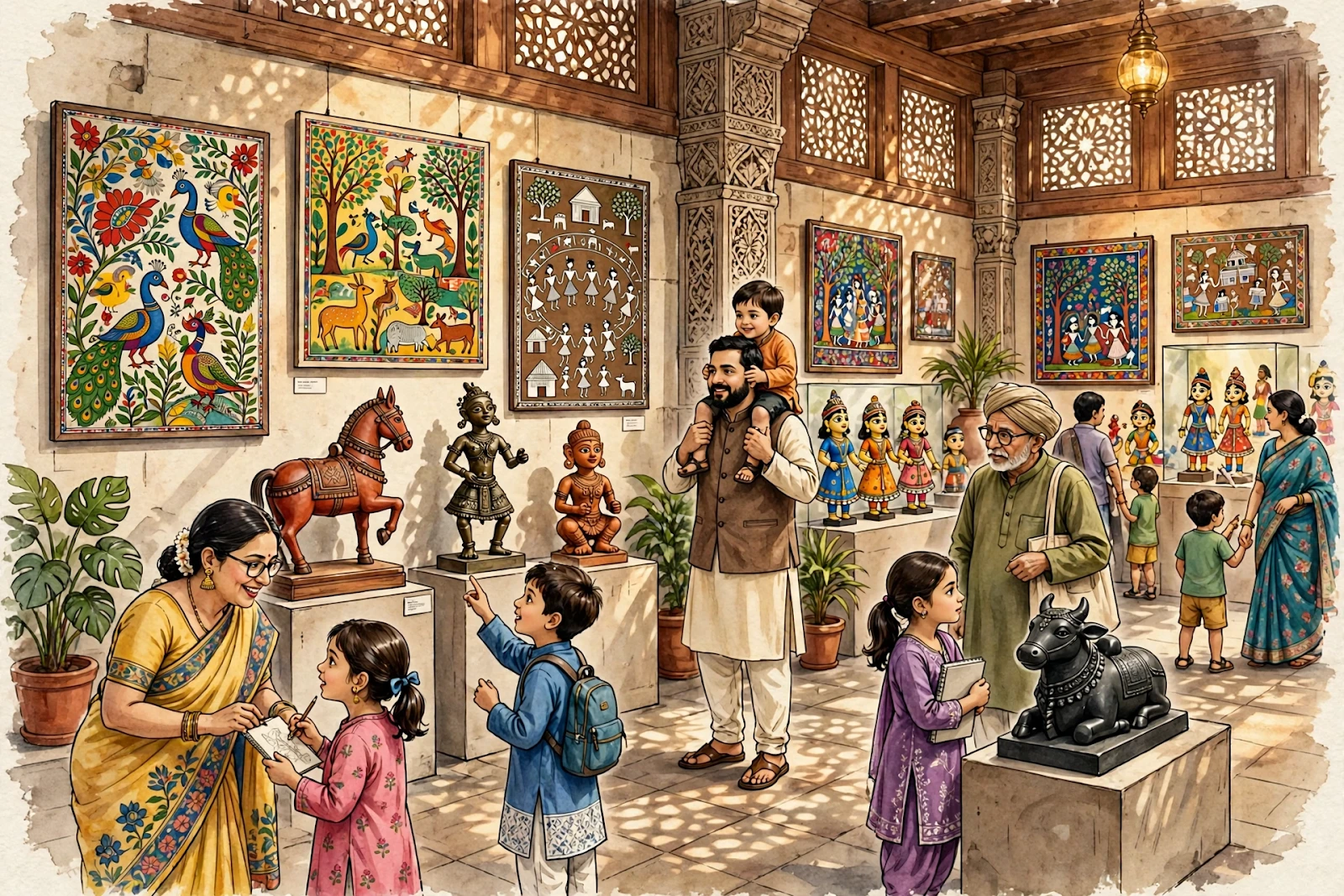
Illustration: Visitors explore the folk art and regional galleries at the Bihar Museum, which traces Bihar's history from the Stone Age to 1764.
It matters third because the ranking rewards a particular idea of what a museum should be. The publisher's profile of the Bihar Museum praises not only the breadth of its collections but the way they are presented: chronological displays, ancient sculpture collections, a regional folk art gallery, a Children's Gallery, a short historical film, spacious architecture and open courtyards and lawns. The museum was conceived as an experience rather than simply a repository — a place where folk art sits alongside archaeological collections, presenting regional traditions as part of a continuing cultural history rather than as remnants of a distant past.
And it matters because rankings, for all their limits, shape reputations. A list is not an eternal truth: it reflects a particular methodology, a particular moment and the views of the visitors whose reviews feed it. But a ninth-place finish on a list of the world's 100 best museums puts the Bihar Museum in conversations it was not part of a decade ago — and gives its curators, and the state behind them, a reason to keep investing in conservation, research, education and the visitor experience that will decide whether the attention lasts.
What Happens Next
Visitors to Patna can see the museum's current special exhibition, Cosmic Garden, featuring works by Madhvi and Manu Parekh, which runs from 22 October to 15 November 2026. The museum is open from 10 a.m. to 5 p.m., with tickets starting at INR 100.
The test for the Bihar Museum now is to turn a ranking into lasting growth. Its officials have said the priority is sustaining the quality of the visit — conservation of the collections, clearer interpretation, trained staff and assistance for visitors from different linguistic backgrounds — while connecting the museum more closely with Bihar's wider historical landscape. If the visibility brings school groups, domestic tourists and international visitors in greater numbers, the museum will need the research, education and visitor facilities to match.
For Worth a Journey, the 2026 list will itself be judged on how it ages: whether the Bihar Museum's ninth place looks like a one-year surprise or the start of a steadier presence among the world's best. For now, though, a museum that opened its first galleries just over a decade ago stands ninth in the world — ahead of the Met, ahead of the Louvre, and first in Asia.
Sponsored: explore today's featured sponsored offers
FAQ
What ranking did the Bihar Museum receive?
The Bihar Museum in Patna ranked ninth in the world and first in Asia in the World's 100 Best Museums 2026 list, published by the Munich-based travel publisher Worth a Journey on 29 October 2026. It is the only Indian institution in the global top ten.
Which museums finished ahead of the Bihar Museum?
The top ten is: 1. Museo Nacional de Antropología, Mexico City; 2. Museo del Prado, Madrid; 3. Louisiana Museum of Modern Art, Denmark; 4. State Hermitage Museum, Saint Petersburg; 5. Kunsthistorisches Museum, Vienna; 6. Şanlıurfa Archaeology Museum, Türkiye; 7. Museum of the Second World War, Gdańsk; 8. National WWII Museum, New Orleans; 9. Bihar Museum, Patna; 10. Metropolitan Museum of Art, New York. The Louvre in Paris ranked 31st.
How does Worth a Journey compile its museum ranking?
According to the publisher, the rankings draw on visitor reviews analysed using language models, with scores assessed through confidence intervals and supplemented by in-person visits. The publisher says it does not accept nominations, applications or payments for inclusion. The list is a travel-publishing assessment based on visitor feedback, not an official government award or formal accreditation by an international museum body.
What can visitors see at the Bihar Museum?
The museum holds more than 20,000 artefacts across ten galleries, tracing Bihar's history from the Stone Age to 1764. Highlights include the 2,300-year-old Didarganj Yakshi, a Mauryan-era sandstone sculpture, along with ancient sculptures, coins, manuscripts, folk art, a Children's Gallery and a Diaspora Gallery. The current special exhibition, Cosmic Garden by Madhvi and Manu Parekh, runs until 15 November 2026.
When did the Bihar Museum open and who designed it?
The museum opened in stages: its first section, including the children's museum and orientation theatre, opened in August 2015, and the remaining galleries opened in October 2017. It was designed by Pritzker Prize-winning Japanese architect Fumihiko Maki of Maki and Associates, working with Mumbai-based Studio Opolis, on a 13.9-acre site on Bailey Road in Patna. Construction began in October 2013 at an estimated cost of ₹498 crore (about US$52 million).
Sources
- Global Bihari — "Bihar Museum: Ancient Roots, Global Reach", 2 November 2026.
- Worth a Journey — World's 100 Best Museums 2026 list, released 29 October 2026, as reported by Indian national media, 28–30 October 2026.
- Herzindagi — "Bihar Museum Beats The Met And Louvre: Inside Its Architecture, Heritage And What It Says About Indian Art", 1 November 2026.
- Travel + Leisure Asia — "Bihar Museum In Patna: Permanent Exhibits, Galleries, And What's New", October 2026.
- Wikipedia — "Bihar Museum" (museum history, architecture and galleries).
- The Brighter World — "Bihar Museum Ranks 9th Among World's Best Museums, Takes Top Spot in Asia", updated 5 November 2026.
Comments
Post a Comment