
NEWPORT BEACH, California — Researchers in California have identified a molecular signal in blood that can reveal ovarian cancer at its earliest precancerous stage, long before a tumour forms or symptoms appear. The signal, an RNA molecule called Tu-Stroma, detected the precancerous condition known as serous tubal intraepithelial carcinoma (STIC) in 92.3 percent of women who had it in a validation group, while correctly identifying 98.2 percent of healthy women, according to a study published on 10 November 2026 in Nature Medicine.
The work, led by researchers at the Hoag Family Cancer Institute, offers the first realistic prospect of a blood-based early warning system for high-grade serous ovarian cancer, the most common and most lethal form of the disease. The cancer often begins not in the ovary but in the fallopian tube, as microscopic abnormal cells invisible to imaging and conventional blood tests. By the time most cases are found, the disease has already spread. A test that could catch it at the precancerous stage could change that picture entirely.
Tu-Stroma is a research discovery, not a clinical test. No patient can ask a doctor for it today, and further studies following women over time are needed before anyone knows whether it works well enough for routine care. But as a first step toward a screening test for a cancer that currently has none, the findings have drawn wide attention.

Illustration: A blood sample in a research laboratory — the Tu-Stroma signal is detected in blood, not in a tumour scan.
What Happened
The study, published on 10 November 2026 in Nature Medicine (DOI: 10.1038/s41591-026-04732-9), was led by Dr. Rajan Gogna, Director of Translational Research at Hoag, and Dr. Esha Madan, Principal Investigator of the Cell Competition in Tumor Microenvironment Laboratory at Hoag. It was an eight-year, international, multi-institutional effort using blood samples collected previously from women whose diagnoses had already been confirmed.
At the heart of the discovery is a biological process called cell competition. In healthy tissue, cells compete for space and resources, and weaker cells are pushed out. Cancer cells exploit this process, weakening the healthy cells around them to clear room to grow. Tu-Stroma is an RNA molecule linked to that competition — a molecular trace of the contest already under way in the fallopian tube, detectable in a blood sample.
The team tested whether that trace could serve as a warning signal for STIC, the precancerous stage of high-grade serous ovarian cancer (HGSOC). STIC consists of abnormal cells confined to the lining of the fallopian tube. The cells are not invasive, form no lump, and produce no symptoms, and they are usually discovered only by chance, when surgery to remove the fallopian tubes or ovaries leads a pathologist to examine the tissue under a microscope.
In a separate validation group, the signal was tested on blood samples from women known to have STIC and from healthy women. The test detected STIC in 92.3 percent of the women who had it and correctly identified 98.2 percent of the healthy women. The team also modelled a high-risk population: about 72 percent of positive results would be accurate — roughly three in ten false alarms needing follow-up — while a negative result would be correct nearly 100 percent of the time. That combination matters for a screening test: it needs to miss very few real cases, even at the cost of some false positives.
Dr. Gogna said: "Ovarian cancer does not begin the day we discover a tumor. It often begins much earlier, with microscopic changes in the fallopian tubes that we can't see during routine screenings."
Dr. Madan added: "For women at high risk, this could transform how we approach prevention."
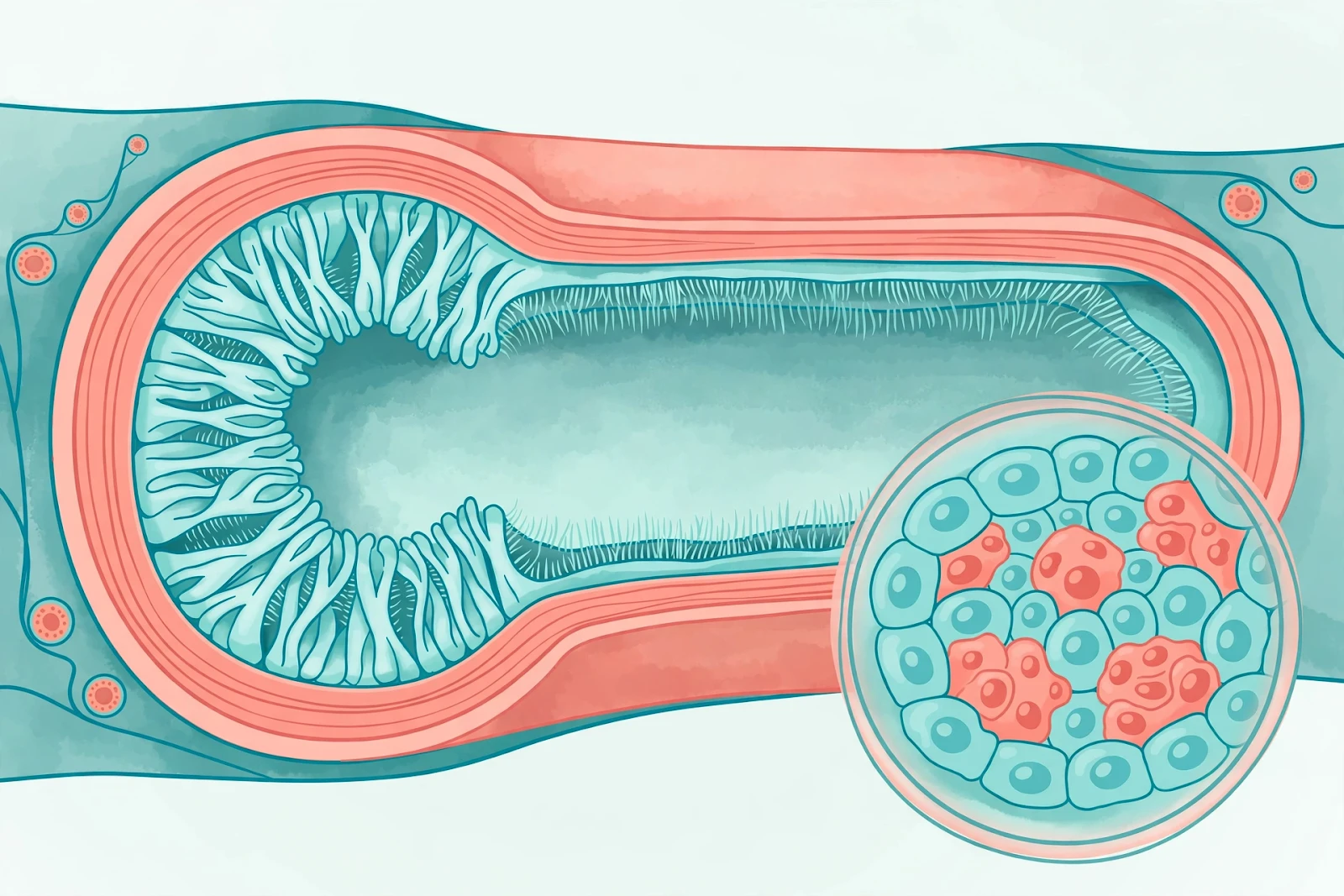
Illustration: Precancerous STIC cells in the fallopian tube — microscopic changes that imaging cannot see.
Background
Ovarian cancer is defined, above all, by late discovery. The American Cancer Society estimates that in 2026, about 21,010 women in the United States will receive a new diagnosis and about 12,450 will die from the disease. A woman's lifetime risk is about 1 in 91. It is the deadliest gynaecologic cancer and the fifth-leading cause of cancer death among US women, the society says.
The survival figures show why timing matters. SEER data put five-year relative survival at about 93 percent when ovarian cancer is found while still localised, about 74 to 75 percent regionally, and about 31 percent once it has spread to distant parts of the body — about 50 percent overall. Yet only about 20 percent of cases are found at the localised stage, when treatment is most effective.
There is currently no reliable screening test for ovarian cancer: ultrasound and the blood tests used in current practice cannot reliably detect the disease early, and no major health authority recommends routine screening for women at average risk. That gap is what makes a blood-based signal attractive: a simple blood draw, if validated, would be far easier to offer widely.
The biology explains the difficulty. High-grade serous ovarian cancer, the most common subtype, often begins in the fallopian tube rather than the ovary. The first step is STIC — a patch of abnormal cells in the lining of the tube, microscopic and non-invasive, shedding no signal existing tests can pick up. From there they can spread to the ovary and through the abdomen, often without symptoms until the disease is advanced.
Because STIC is rare and usually found only incidentally, assembling enough confirmed cases required collaboration across institutions and countries, using previously collected blood samples from women whose diagnoses were already established. The validation group was a separate set of samples, so the test was judged on samples it had not been built on.

Illustration: A doctor discussing test results with a patient — a validated blood test could one day inform decisions about preventive surgery.
Why It Matters
The findings matter most immediately for women at high genetic risk, particularly those who carry mutations in the BRCA1 or BRCA2 genes. For these women the lifetime risk of ovarian cancer is far higher than average, and the standard preventive option is stark: surgery to remove the fallopian tubes and ovaries, known as risk-reducing salpingo-oophorectomy.
That surgery is effective at preventing cancer, but it carries heavy costs. For women who have it before completing their families, it ends the possibility of a natural pregnancy. For younger women, it brings on early menopause, with the hormonal changes and bone-health concerns that accompany it. Many women face the decision in their thirties or forties, weighing a real risk against a surgery that changes their bodies and lives permanently.
A validated blood test could one day inform those decisions. If a woman at high risk could be monitored with a test that reliably showed whether precancerous changes were present, the timing of preventive surgery might be guided by evidence about her own body, not risk estimates alone. Some women might safely delay surgery; others might be prompted to act sooner. That is a direction of travel, not a promise for today.
The team also aims to find ways to stop STIC lesions from progressing into invasive cancer. If the precancerous changes could be halted or reversed, the need for preventive surgery might one day be reduced or even removed for some women. That goal remains distant.
For women at average risk, the implications are more remote. Ovarian cancer's toll — about 12,450 deaths a year in the United States alone, according to 2026 estimates — is driven largely by late detection. A blood test offered as part of routine care would address the central problem: curable when found early, so often found late. The gap between 93 percent survival for localised disease and 31 percent for distant disease is, in large part, a gap in detection.
What Happens Next
Tu-Stroma is not yet a clinical test, and no timeline for one has been announced. The next step is prospective clinical studies: research that enrols women — both those with elevated genetic risk and those without — and follows them over time, watching to see who develops STIC or ovarian cancer. Only studies of that kind can show whether the signal works when it is used to look forward, rather than tested on samples from women whose diagnoses are already known.
A test that performs well on previously collected samples from confirmed cases can behave differently in a real population, where the condition is rarer. The 92.3 percent and 98.2 percent figures were measured in a validation group; prospective studies will test whether they hold up when the test is applied to women before anyone knows the outcome.
The long-term goal is a clinically validated blood test — one regulators have assessed and doctors can order. Reaching it will require larger studies, standardised laboratory methods, and evidence that using the test improves outcomes, not just that it detects a signal. The team has not put a date on that goal.
In the meantime, the advice for women concerned about ovarian cancer risk is unchanged. Women with a family history of ovarian or breast cancer, or a BRCA1 or BRCA2 mutation, should discuss their risk and options with a clinician or genetic counsellor. Preventive surgery remains the established option for women at high genetic risk. What the finding changes is the horizon: for the first time, there is a blood-based signal that can see the disease at its precancerous stage, and a research path that could turn that signal into a test.
The study's publication in Nature Medicine on 10 November 2026 puts the finding into the scientific record, where other research groups can examine, reproduce, and build on it. That scrutiny is how early findings become reliable medicine — or are set aside. For now, Tu-Stroma stands as a promising early step: a molecular whisper from the fallopian tube, heard in a blood sample.
Sponsored: explore today's featured sponsored offers
Frequently Asked Questions
What is STIC, and why does it matter?
STIC stands for serous tubal intraepithelial carcinoma, the precancerous stage of high-grade serous ovarian cancer — a patch of abnormal cells in the lining of the fallopian tube that has not yet become invasive cancer. High-grade serous ovarian cancer often begins as STIC, which is microscopic, produces no symptoms, and cannot be seen on imaging scans or detected by conventional blood tests. Finding STIC would mean finding the disease before it becomes cancer.
What is Tu-Stroma?
Tu-Stroma is an RNA molecule identified by researchers at the Hoag Family Cancer Institute. It is linked to cell competition, the process by which cancer cells weaken neighbouring healthy cells to make room to grow. Because that competition is already under way when precancerous changes are present, Tu-Stroma can be detected in a blood sample as a warning signal of STIC.
How accurate was the test in the study?
In a separate validation group, it detected STIC in 92.3 percent of the women who had it and correctly identified 98.2 percent of healthy women. In modelling of a high-risk population, about 72 percent of positive results would be accurate, while a negative result would be correct nearly 100 percent of the time. These figures come from previously collected blood samples and still need confirmation in prospective studies.
Can I ask my doctor for this blood test now?
No. Tu-Stroma is a research discovery, not a clinical test, and it is not available to patients. Prospective clinical studies are planned, with the long-term goal of a clinically validated blood test. Until such a test is validated and approved, there is no reliable screening test for ovarian cancer — women concerned about their risk should speak with a clinician or genetic counsellor about established options.
What does this mean for women with BRCA1 or BRCA2 mutations?
Women with BRCA1 or BRCA2 mutations face a higher risk of ovarian cancer, and many currently choose preventive surgery to remove their fallopian tubes and ovaries, sometimes before completing their families and at the cost of early menopause. A validated blood test could one day help inform the timing of those decisions, and researchers also aim to stop STIC lesions from progressing, potentially reducing the need for preventive surgery. For now, preventive surgery remains the established option.
Disclaimer: This article is for general information only and is not medical advice. It describes a research finding, not an available test or treatment. If you are concerned about your risk of ovarian cancer, or you have a family history of ovarian or breast cancer, please speak with a qualified clinician or genetic counsellor.
Sources
- Hoag Family Cancer Institute, via GlobeNewswire, "Researchers Discover Blood-Based Warning Signal for Ovarian Cancer at Its Earliest Precancerous Stage," 10 November 2026. globenewswire.com
- MedicalXpress, "Blood RNA may reveal ovarian cancer at its earliest precancerous stage," 10 November 2026. medicalxpress.com
- Rajan Gogna, Esha Madan, et al., Nature Medicine, 10 November 2026. DOI: 10.1038/s41591-026-04732-9
- American Cancer Society, "Key Statistics for Ovarian Cancer." cancer.org
Comments
Post a Comment