
LONDON — A British healthcare worker infected with Ebola is being medically evacuated from the Democratic Republic of Congo to Britain for specialist treatment, according to an official document seen by Reuters on November 4, 2026. The patient is reported to be in a stable condition and was expected to arrive in Britain on Wednesday or Thursday, before being transferred by specialist ambulance to a high-consequence infectious disease unit.
British authorities quoted in the document said they did not expect the case to have a serious public health impact in Britain, and anticipated no disruption to international travel or trade. "A British citizen currently in the DRC has tested positive for Ebola," a spokesperson for Britain's government told Reuters in an emailed statement. "The risk to the UK public from Ebola remains low."
The patient, whose identity was not disclosed, had been sent to Congo by a humanitarian organisation to help support the response to the outbreak. It is the first case involving a British national linked to the current outbreak, although several other people from elsewhere in Europe have been infected, Reuters reported. This article is general news reporting, not medical advice.
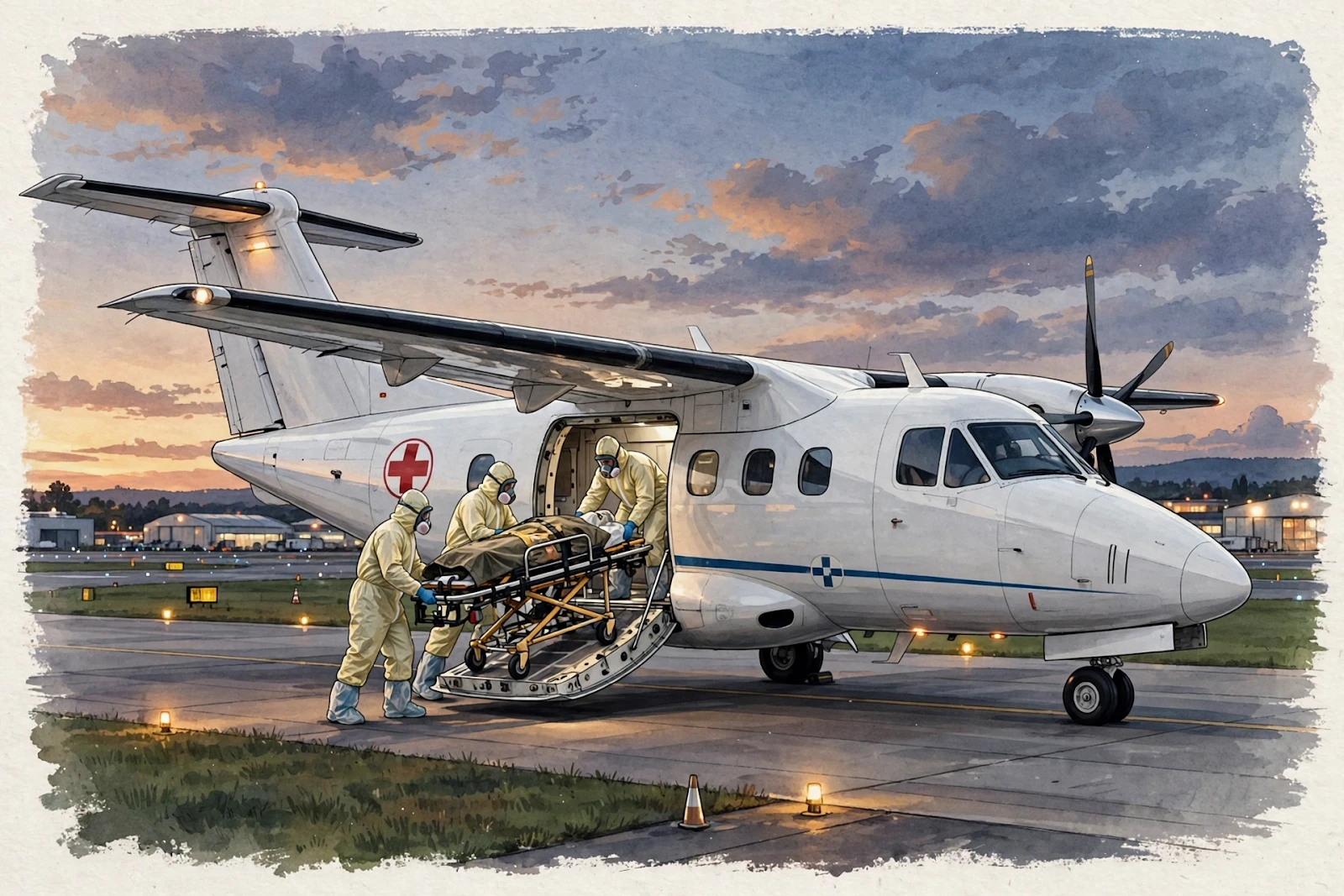
Illustration: A medical evacuation aircraft prepares to carry an Ebola patient to specialist treatment in Britain.
What Happened
Reuters reported on November 4, 2026, that an official document showed a British healthcare worker infected with Ebola was being medically evacuated from the Democratic Republic of Congo to Britain. The patient is in a stable condition, the document showed, and was expected to arrive in Britain on Wednesday or Thursday — November 4 or 5 — before being transferred by specialist ambulance to a high-consequence infectious disease unit.
High-consequence infectious disease units are specialist hospital facilities equipped to treat patients with rare, severe infections while preventing onward transmission. British health authorities said the National Health Service has procedures in place to manage suspected and confirmed infections, and that the risk to the wider public from imported Ebola cases remains low.
The British government confirmed the case in an emailed statement to Reuters but did not disclose the patient's identity, the humanitarian organisation that sent them to Congo, or the hospital unit that will receive them. Those details have not been made public, and this article does not speculate about them.
British authorities quoted in the document said they did not expect the case to have a serious public health impact in Britain, and anticipated no disruption to international travel or trade. That assessment rests on how Ebola spreads: the virus is transmitted through direct contact with the bodily fluids of a person who is showing symptoms, not through the air in the way that respiratory viruses spread.
Background
The outbreak in the Democratic Republic of Congo is the second-largest on record, with more than 10,000 confirmed cases and nearly 5,000 deaths reported by late October, Reuters reported. The scale of the outbreak has drawn humanitarian and medical teams from around the world, including the organisation that sent the British worker to Congo.
Ebola is a severe viral disease spread through direct contact with an infected person's bodily fluids. The World Health Organization says the disease is fatal in about half of cases on average, though mortality rates vary between outbreaks. Early supportive care, including rehydration and treatment of symptoms, improves survival chances, and the outbreak response in Congo has included vaccination and treatment efforts alongside isolation and contact tracing.

Illustration: Healthcare workers in protective equipment care for patients in an Ebola treatment ward in Congo.
This is not the first time a European patient has been evacuated from the region during the current outbreak. Switzerland last month evacuated an Ebola patient from Nigeria for treatment, Reuters reported, while France in June reported its first confirmed case tied to the outbreak in a doctor returning from a humanitarian mission in Congo. Several other people from elsewhere in Europe have also been infected, according to the Reuters report.
Imported cases in Britain itself are rare. Only four confirmed cases have been recorded in Britain since 1976, according to the UK Health Security Agency, as reported by Reuters. Each previous case was managed in specialist isolation facilities, and none led to sustained transmission within the UK.
The current evacuation follows a pattern established in earlier outbreaks, when aid workers infected in West and Central Africa were flown home for treatment in high-level isolation units. Those evacuations are complex operations: the patient travels in a sealed isolation pod, the air crew follows strict infection-control procedures, and the receiving hospital prepares a dedicated team and ward in advance.
Why It Matters
For the patient, the evacuation offers access to intensive specialist care in a dedicated unit. For the wider public, the case is a reminder of both the risks aid workers accept in outbreak zones and the systems that exist to bring them home safely without putting others at risk.
The British authorities' assessment — that the risk to the UK public remains low and that no disruption to travel or trade is anticipated — matters because Ebola evacuations can otherwise prompt alarm disproportionate to the actual risk. Because Ebola spreads only through direct contact with the bodily fluids of a symptomatic person, casual contact, shared air, or passing proximity do not transmit the virus. Public health agencies monitor close contacts of confirmed cases as a precaution, but the general population is not considered at risk from an imported case managed in isolation.
The case also underlines the human cost of the Congo outbreak. Behind the figures — more than 10,000 confirmed cases and nearly 5,000 deaths by late October — are health workers, many of them Congolese, who staff treatment centres at considerable personal risk, alongside international colleagues sent by humanitarian organisations. Each infection among responders strains a response that depends on experienced staff.
At the same time, the evacuation of European patients has at times raised questions about equity in outbreak response: international staff can usually be flown to advanced facilities abroad, while most Congolese patients rely on treatment centres inside the country. Strengthening those local facilities — with reliable supplies, trained staff and community trust — remains central to controlling the outbreak at its source.

Illustration: A specialist ambulance arrives at a UK high-consequence infectious disease unit prepared to receive the patient.
What Happens Next
The patient was expected to arrive in Britain on Wednesday or Thursday, November 4 or 5, and to be transferred by specialist ambulance to a high-consequence infectious disease unit. Further official updates may confirm the arrival and the patient's condition, though patient confidentiality means detailed clinical information is unlikely to be released.
British health authorities will monitor the situation under their established procedures for imported high-consequence infections, which include tracing and monitoring close contacts where appropriate. Officials have said they do not expect a serious public health impact in Britain, and no travel or trade disruption is anticipated.
In Congo, the outbreak response continues. The key measures of progress in the coming weeks will be whether new cases decline, whether transmission chains in affected communities are broken, and whether treatment centres remain staffed and supplied despite infections among health workers. International support, including the humanitarian organisations whose staff are on the ground, remains essential to that effort.
For readers, the essential facts remain those confirmed by Reuters and the British government: one British healthcare worker, infected while supporting the Ebola response in Congo, is being evacuated in stable condition for specialist treatment in the UK, and the risk to the UK public is assessed as low. Any further details should be treated as unconfirmed until they are reported by Reuters, the UK Health Security Agency, or the British government.
Sponsored: explore today's featured sponsored offers
FAQ
Who is the patient being evacuated from Congo?
A British healthcare worker who was sent to Congo by a humanitarian organisation to help support the Ebola outbreak response. The patient's identity has not been disclosed.
What condition is the patient in?
According to the official document seen by Reuters, the patient is in a stable condition and was expected to arrive in Britain on Wednesday or Thursday, November 4 or 5, 2026.
Where will the patient be treated in Britain?
The patient will be transferred by specialist ambulance to a high-consequence infectious disease unit. The specific hospital has not been publicly named.
Is there a risk to the UK public?
British authorities say the risk to the UK public remains low, and they do not expect a serious public health impact or disruption to travel or trade. Ebola spreads through direct contact with the bodily fluids of a symptomatic person, not through casual contact or shared air.
How large is the Ebola outbreak in Congo?
It is the second-largest on record, with more than 10,000 confirmed cases and nearly 5,000 deaths reported by late October 2026, according to Reuters.
Sources
- Reuters, "British healthcare worker with Ebola to be evacuated from Congo to UK, document shows," November 4, 2026.
- UK Health Security Agency, via Reuters, on confirmed Ebola cases recorded in Britain since 1976, November 4, 2026.
- World Health Organization, via Reuters, on Ebola fatality rates, November 4, 2026.
Comments
Post a Comment