
The Star That Keeps Faking Its Own Death: Chandra Cracks the Mystery of Supernova Impostor AT 2016blu
CHARLOTTESVILLE, Virginia — For fifteen years, a giant star in a distant spiral galaxy has been putting on a show that fooled even seasoned astronomers. Every few months it flares so violently that it looks like a supernova, the cataclysmic death of a massive star — and then, impossibly, it survives, dims, and does it all over again. Now, NASA's Chandra X-ray Observatory has caught the culprit in the act. A new study published on Monday, 9 November 2026, in The Astrophysical Journal reveals that the star, known as AT 2016blu, is being repeatedly disturbed by a previously hidden companion — either a stellar-mass black hole or a neutron star — that pulls material from the giant every 113 days as the two orbit each other.
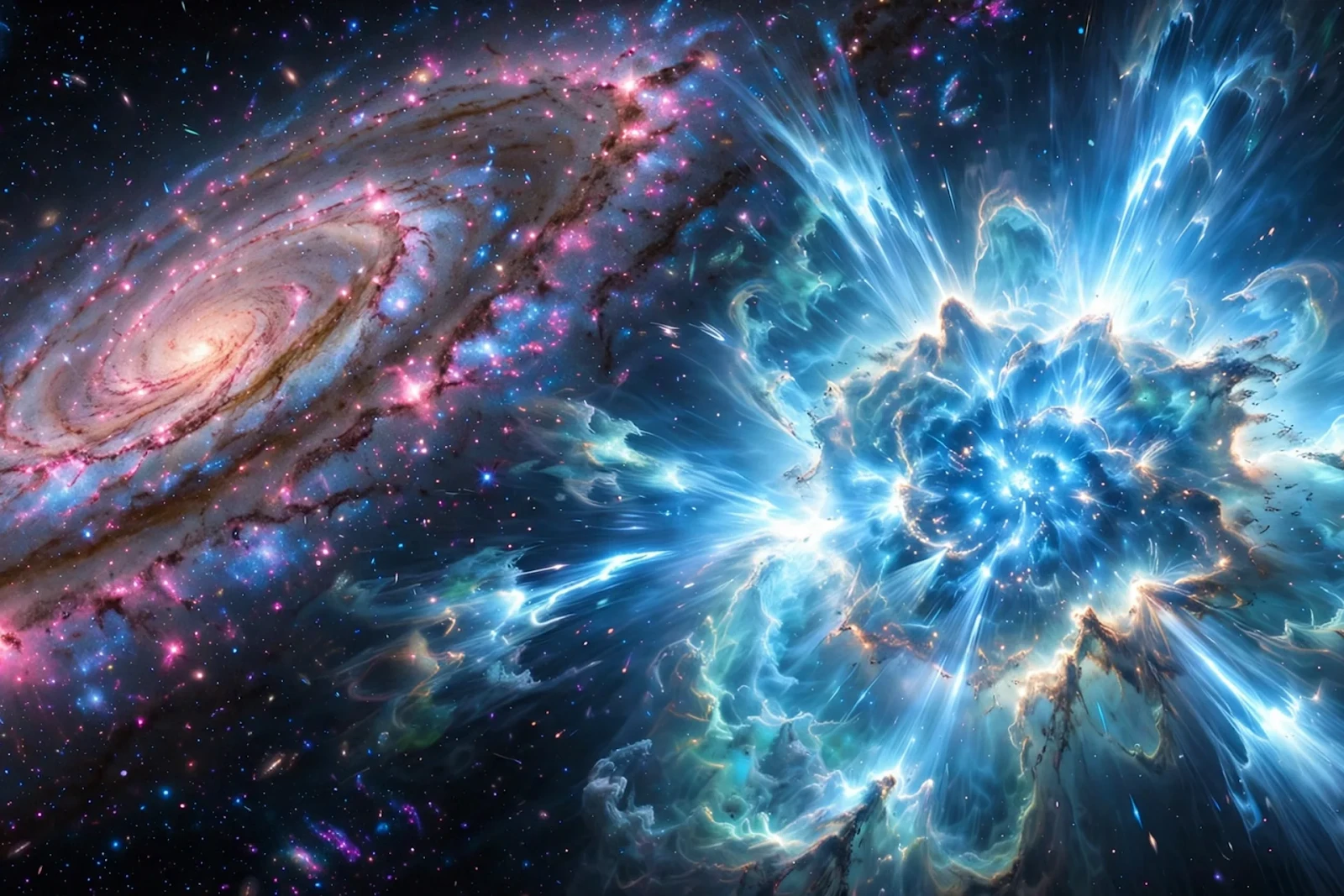
Illustration: A massive luminous blue variable star erupting with brilliant flares in the spiral galaxy NGC 4559, about 30 million light-years from Earth.
What Happened
Astronomers using NASA's Chandra X-ray Observatory have discovered what is triggering the repeated outbursts of AT 2016blu, a volatile star in the spiral galaxy NGC 4559, located about 30 million light-years from Earth. The star is estimated to have a mass of at least 33 times that of the Sun. The new research, led by Mojgan Aghakhanloo of the University of Virginia in Charlottesville, identifies a previously undetected companion object as the driving force behind the eruptions.
Between 2012 and 2026, astronomers detected at least 27 bursts of optical light from AT 2016blu, roughly every 113 days — about three times a year. Each outburst made the star flare dramatically brighter, rivalling a genuine supernova. Yet after every flare the star remained intact, dimmed back down, and prepared for the next eruption. That repeating pattern was the central mystery: real supernovae happen only once, because the star is destroyed.
The breakthrough came when the team timed Chandra to look at the star at exactly the right moment. Optical monitoring showed that AT 2016blu was entering an outburst in early 2026, and Chandra observations were triggered and obtained in March 2026 as part of the observatory's "Target of Opportunity" programme, which responds quickly to special events in the sky. The result was striking: Chandra data from March 2026 revealed that AT 2016blu was at least 100 times brighter in X-rays than in Chandra data from 2001 to 2002, before the outbursts began.
That surge of X-ray light is the fingerprint of the hidden companion. According to the researchers, the best explanation is that material from the giant star falls onto a neutron star or a black hole during the closest approach in the pair's oval-shaped orbit. When the two come close together, material ejected by the star gets captured by the compact object. The captured material orbits at very high speeds, close to the speed of light, and gets so hot that it shines brightly in X-rays. The dense gas surrounding the system is then heated by those X-rays and glows in visible, optical light — producing the dramatic brightening telescopes on Earth have recorded for more than a decade.
"For 15 years, astronomers have been watching this star get really bright and then dim again on a regular basis," said Aghakhanloo, who led the study. "Until we were able to get Chandra data at the right time, we couldn't figure out what was making this happen."
The discovery is a double first: the first X-ray detection of this class of erupting stars, and the first of these objects found with a black hole or neutron star companion. The team used Chandra because it is the only X-ray telescope with sharp enough vision to distinguish AT 2016blu from another nearby bright X-ray source.
Background
AT 2016blu belongs to a rare class of stars known as luminous blue variables, or LBVs: hot, massive stars characterised by large changes in brightness, among the most luminous stars in the universe. The most famous example is Eta Carinae, a notoriously unstable star in our own Milky Way that underwent a giant eruption in the 1840s, briefly becoming one of the brightest stars in the southern sky.
What makes AT 2016blu special even among luminous blue variables is the speed and regularity of its eruptions. Most LBVs brighten and fade over years or decades, often unpredictably. AT 2016blu, by contrast, erupts on a strict schedule, roughly every 113 days, and its spikes in brightness are so extreme that they resemble supernova explosions, in which a massive star collapses onto itself and material then hurtles outward into space. Because the star survives each event, astronomers call it a "supernova impostor" — a star that imitates the death of a massive star without actually dying.
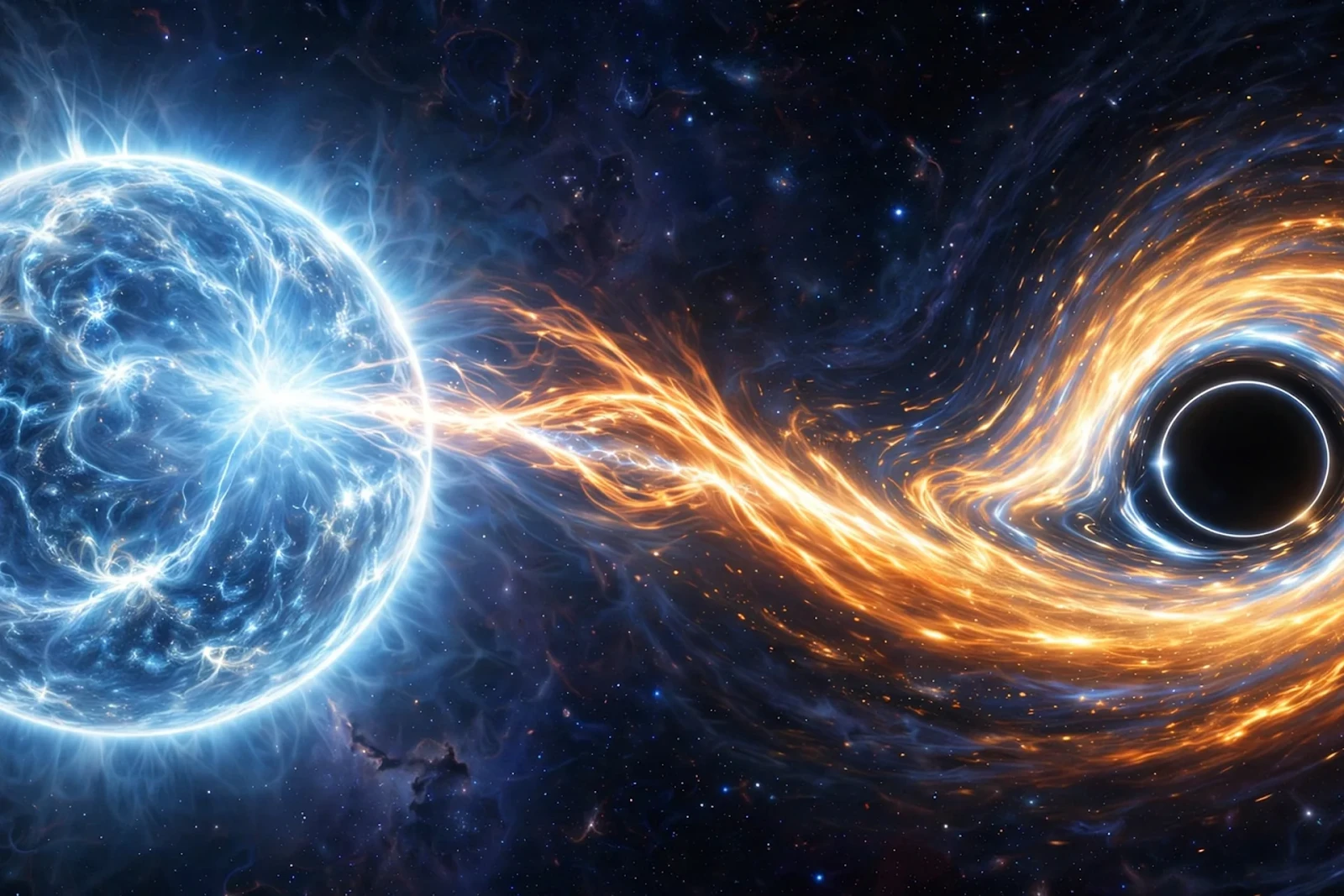
Illustration: A black hole companion pulling a stream of glowing material from the giant star AT 2016blu as the two orbit each other every 113 days.
The idea that a companion might be involved was not new, but proving it required evidence that only X-rays could provide. Visible light alone could show the star brightening, but it could not reveal what was heating the gas around it. "This star's behavior was confusing at first because it kept acting like a supernova, but clearly it's not because it keeps surviving these outbursts about three times a year," said co-author Núria Torres-Albà, also of the University of Virginia. "To understand the cause of these eruptions, we realized we needed X-ray data, timed so that we'd observe the star when it was in an outburst."
That timing depended on years of patient optical monitoring. The team used the Katzman Automatic Imaging Telescope, the Las Cumbres Observatory Global Supernova Project, and observations from the American Association of Variable Star Observers, including contributions from more than 30 amateur astronomers. It was this long-running watch that let the researchers predict when the next outburst was due and aim Chandra at precisely the right moment.
"We suspected that the bright repeating flashes at optical wavelengths might actually be powered by periodic blasts of high-energy X-rays," said co-author Nathan Smith of the University of Arizona in Tucson. "The dense gas surrounding the system is heated by the X-rays and then glows in the optical."
The new paper, "AT 2016blu: Accretion-powered Outbursts in a Luminous Blue Variable and Compact Object Binary," was published in The Astrophysical Journal. It was led by Aghakhanloo, with Torres-Albà and Smith among the co-authors. Its central conclusion is that the outbursts are accretion-powered: energy released as material falls onto the compact companion, rather than energy from the giant star itself, drives the repeated flares.
The companion itself has not been directly seen, and the observations cannot yet tell whether it is a black hole or a neutron star. Both are collapsed remnants left behind when a massive star dies: a neutron star packs more mass than the Sun into a sphere only about 20 kilometres across, while a stellar-mass black hole is a region where gravity is so strong that not even light can escape. Either one would be massive and dense enough to rip material from its giant neighbour at close approach and heat it to X-ray-emitting temperatures.
Why It Matters
The discovery matters well beyond a single strange star in a distant galaxy. First, it solves a fifteen-year mystery with a mechanism that astronomers can now test elsewhere. AT 2016blu is not the only supernova impostor known, and the finding suggests that other stars with repeating eruptions may also hide compact companions. If so, a whole class of puzzling stellar behaviour may turn out to be the signature of binary systems in which a giant star and a dead star orbit each other closely.
Second, AT 2016blu is bright enough in X-rays to be classified as a candidate ultra-luminous X-ray source, or ULX. These are rare, bright X-ray sources found with telescopes like Chandra that astronomers have yet to fully understand. Current thinking is that some ULXs contain neutron stars and others contain black holes. The new observations suggest a link between ultra-luminous X-ray sources and the kind of violent stellar eruptions seen in AT 2016blu, especially because many ULXs undergo large changes in X-ray brightness. Studying this system may therefore help astronomers understand what powers some of the brightest X-ray sources in the nearby universe.
Third, the discovery may help studies of stars that change in brightness before they undergo supernova explosions. Astronomers suspect that much of this pre-supernova behaviour may be caused by systems containing a massive star orbiting a compact object or another massive star. AT 2016blu offers a live, repeating example of exactly that kind of interaction — a natural laboratory in which the same process plays out every 113 days. The result also showcases the value of long-term monitoring and teamwork between professional observatories and amateur astronomers: without fourteen years of optical observations, the team could not have predicted the outbursts accurately enough to schedule Chandra, and without Chandra's sharp X-ray vision, the outburst's high-energy heart would have stayed hidden behind the glare of a neighbouring source.

Illustration: NASA's Chandra X-ray Observatory in space observing the distant spiral galaxy NGC 4559.
What Happens Next
The next outburst of AT 2016blu is expected to follow the same roughly 113-day rhythm, and astronomers will be watching. Each new eruption is another opportunity to catch the system in the act, and further observations — in X-rays and at other wavelengths — may narrow down the companion's identity. Distinguishing a black hole from a neutron star would sharpen the picture, because the two kinds of compact object accrete material differently and leave different fingerprints in the X-ray light they emit.
Researchers will also watch whether the pattern holds steady over time. The outbursts have recurred reliably since 2012, but binary systems evolve: as the giant star loses mass to its companion, the orbit and the timing of the eruptions may slowly change. Long-term monitoring will reveal whether the 113-day clock stays precise, drifts, or eventually breaks down — and each outcome would teach astronomers something different about how massive binary stars age.
Chandra itself remains central to this work. NASA's Marshall Space Flight Center in Huntsville, Alabama, manages the Chandra programme, while the Smithsonian Astrophysical Observatory's Chandra X-ray Center controls science operations from Cambridge, Massachusetts. More than a quarter of a century after its launch, the observatory's sharp X-ray vision continues to open windows that no other telescope can — in this case, resolving a mystery that began with a star pretending to die, and ending, for now, with the discovery of an invisible partner that keeps bringing it back to life.
Sponsored: explore today's featured sponsored offers
Frequently Asked Questions
What is AT 2016blu?
AT 2016blu is a giant, unstable star in the spiral galaxy NGC 4559, about 30 million light-years from Earth. It is a luminous blue variable — a hot, massive star, estimated at at least 33 times the mass of the Sun — that undergoes repeated, dramatic outbursts. Because its flares resemble supernova explosions but the star survives them, astronomers call it a "supernova impostor."
What causes the star's repeated outbursts?
According to a new study in The Astrophysical Journal, the outbursts are caused by a previously hidden companion — either a stellar-mass black hole or a neutron star — in an oval-shaped orbit around the giant star. Every 113 days, at their closest approach, the companion pulls material from the star. That material orbits at near light speed, heats up, and shines brightly in X-rays, heating the dense gas around the system so it glows in visible light.
How did NASA's Chandra telescope solve the mystery?
Chandra observed AT 2016blu in March 2026, timed to an outburst predicted from years of optical monitoring. It found the star at least 100 times brighter in X-rays than in observations from 2001–2002, before the outbursts began. Chandra is the only X-ray telescope sharp enough to separate AT 2016blu from a nearby bright X-ray source, making this the first X-ray detection of this class of erupting stars.
How often does AT 2016blu erupt?
Astronomers have detected at least 27 optical outbursts between 2012 and 2026, roughly every 113 days — about three times a year. The eruptions have followed this rhythm for more than a decade, and the next outburst is expected on roughly the same schedule.
Why are astronomers interested in this discovery?
The finding may explain other supernova impostors, link ultra-luminous X-ray sources to violent stellar eruptions, and help studies of stars that brighten before going supernova. AT 2016blu is bright enough in X-rays to be a candidate ultra-luminous X-ray source, a rare class of objects astronomers have yet to fully understand.
Sources
- NASA Science — "NASA's Chandra Finds Source of Star's Mysterious Outbursts" — 9 November 2026 — https://science.nasa.gov/missions/chandra/nasas-chandra-finds-source-of-stars-mysterious-outbursts/
- phys.org — "The supernova impostor: Chandra finds likely source of giant star's repeated outbursts" — 9 November 2026 — https://phys.org/news/2026-11-supernova-impostor-chandra-source-giant.html
- Mojgan Aghakhanloo et al., "AT 2016blu: Accretion-powered Outbursts in a Luminous Blue Variable and Compact Object Binary," The Astrophysical Journal (2026) — https://doi.org/10.3847/1538-4357/ae9a86
- Chandra X-ray Center — "NASA's Chandra Finds Source of Star's Mysterious Outbursts" (photo album) — 9 November 2026 — https://chandra.si.edu/photo/2026/at2016blu/more.html
- NASA — Chandra X-ray Observatory mission page — https://nasa.gov/chandra
Comments
Post a Comment