
Earth has a second moon right now — a tiny asteroid only about a metre across that slipped into our planet's gravitational grip in April 2026 and will stay with us through December, before heading back out into the solar system on its own.
The visitor is a small asteroid called 2026 QQ8. It is far too small and faint to notice with the naked eye, and it poses no danger to anyone on Earth. But its brief stay as a "mini-moon" is a reminder of just how busy the space around our planet really is — and how often Earth quietly picks up, and then lets go of, tiny travelling companions.

Illustration: A tiny asteroid like 2026 QQ8 drifting near Earth, with our planet glowing in the background.
What Happened
According to EarthSky, reporting on November 4, 2026, Earth's gravity temporarily captured the small space rock 2026 QQ8, making it a mini-moon. The object entered orbit around our planet back in April 2026, and it should stick with us through December. Then, in 2027, it will continue on its own journey around the Sun.
The rock was originally discovered near Earth on August 20, 2026, by astronomer Krisztián Sárneczky. On October 29, 2026, the Minor Planet Center — the international body that tracks small bodies in the solar system — reported the discovery, confirming the object's status as a temporarily captured companion of Earth.
There is no need to worry about a collision. The closest that 2026 QQ8 will get to Earth is 0.0038 astronomical units (AU), which EarthSky notes is about one and a half times farther away than our actual Moon. And at only about 3 feet (1 metre) across, the rock would do little more than put on a fiery show if it ever did enter Earth's atmosphere.
Background
At first, astronomers were not sure what they were looking at. When a small object shows up moving near Earth, there is always a question to settle first: is it a natural rock, or is it a piece of human-made junk — a spent rocket stage or an old satellite drifting through space?
To answer that question, astronomers took follow-up observations with the University of Hawaii 2.2-meter telescope and the Lowell Discovery Telescope. With those additional observations, the Minor Planet Center was able to confirm that 2026 QQ8 is not space junk. It is of natural origin — most likely a small asteroid that wandered a little too close to Earth and got caught.
That capture happened because of a boundary astronomers call the Hill sphere, or Hill radius. Outside the Hill sphere, the Sun dominates the motions of objects. But in April 2026, 2026 QQ8 passed inside Earth's Hill sphere, and Earth's gravity took over — at least temporarily. The result is a strange, looping path around our planet rather than a nice, neat circle like the Moon's orbit.
Looking at the orbital data, astronomers have been able to trace the little rock's path better, and they found a curious pattern: 2026 QQ8 comes close to Earth approximately every 10 years. Back in 1965, it came fairly close, but not quite close enough for a temporary capture. And in 2058 it will come close again — but, according to the same orbital tracing, also not quite close enough to regain its mini-moon status. This visit, it seems, is a rare alignment of timing and trajectory.
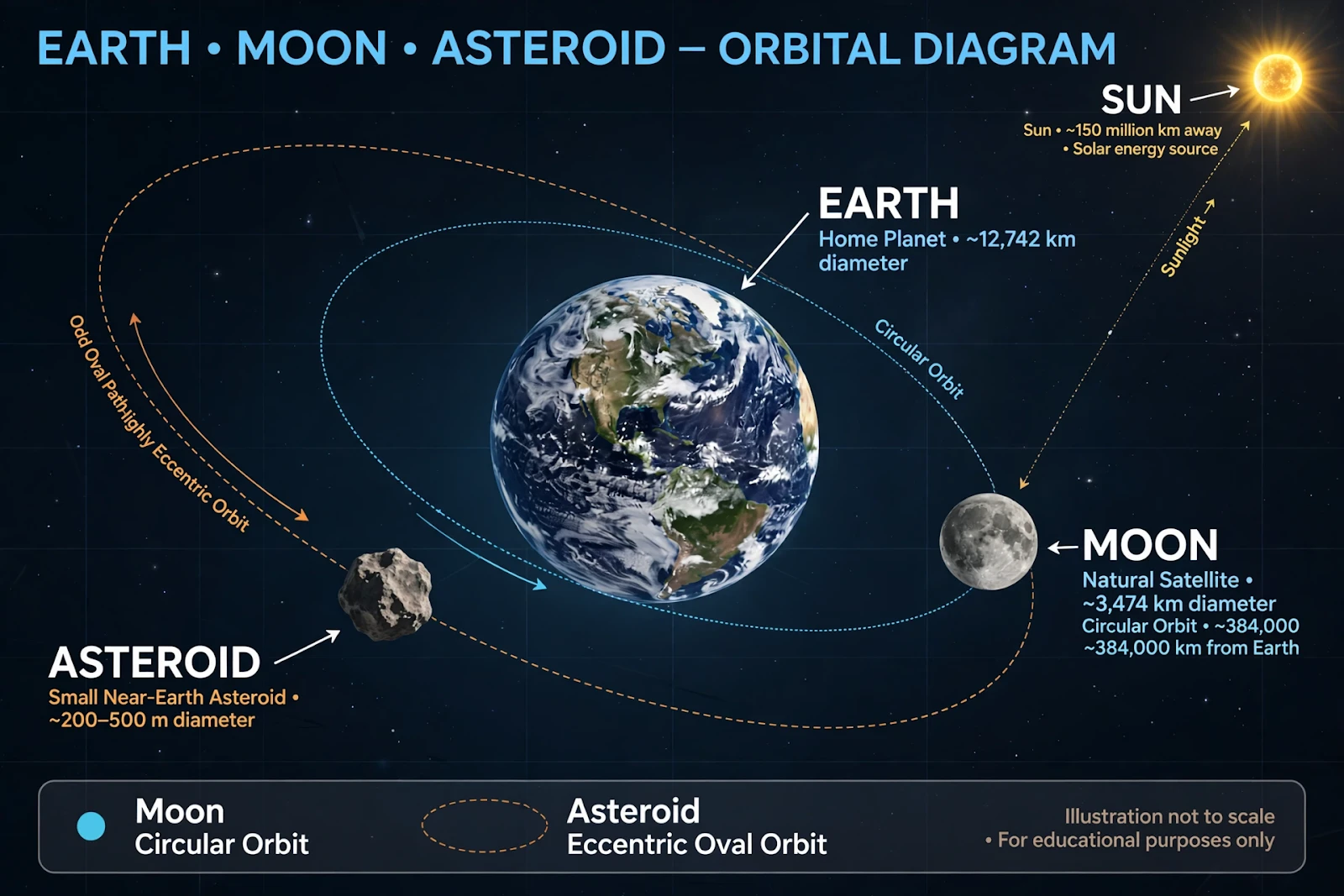
Illustration: The looping, uneven path of mini-moon 2026 QQ8 around Earth, compared with the Moon's steadier orbit.
Why It Matters
Mini-moons matter to astronomers for several reasons. First, they are a natural laboratory for understanding the population of small near-Earth objects. Every temporarily captured rock is a sample of the material drifting through the inner solar system — material that, on other occasions, arrives as a meteorite or burns up as a shooting star. Studying one while it is still in space, rather than after it has fallen to Earth, gives scientists a cleaner look at what these objects are made of and how they move.
Second, mini-moons are a useful rehearsal for planetary defence. The same telescopes, tracking networks and orbit calculations used to confirm that 2026 QQ8 is harmless are the ones that would be needed if a larger object ever headed our way. A tiny, harmless visitor is the ideal test case: it exercises the whole system — discovery, follow-up, confirmation by the Minor Planet Center — without any of the stakes.
Third, 2026 QQ8 is a reminder that Earth's neighbourhood is not static. Our planet does not simply sit in space with one permanent Moon; it constantly interacts with passing rocks, sometimes borrowing one for a few months. The fact that this particular rock returns roughly every decade, yet is only captured on this visit, shows how finely balanced those gravitational encounters can be.
It is also worth putting mini-moons in context. It is not unusual for Earth to temporarily capture a little space rock. Some of the previous mini-moons include 2020 SO, 2020 CD3 and 2024 PT5. There is also a related but different phenomenon: quasi-moons, such as 2025 PN7. A quasi-moon is not truly orbiting Earth — it just looks like it from our perspective. More accurately, a quasi-moon shares an orbit with us, but that orbit is not exactly the same as ours, so sometimes we see it ahead of us and sometimes behind us. 2026 QQ8, by contrast, is genuinely — if temporarily — bound to Earth.
What Happens Next
For now, 2026 QQ8 will keep looping around Earth through December 2026. Astronomers will continue tracking it while it remains nearby, refining its orbit and learning what they can from a visitor that will not stay long.
Then, in 2027, Earth's grip will loosen and the little asteroid will slip back into its own orbit around the Sun, resuming the roughly 10-year rhythm of close approaches that brought it here. Its next close pass, in 2058, is expected to fall just short of another capture — so this mini-moon visit may be a once-in-a-lifetime event for the rock itself, even if mini-moons as a class keep turning up every few years.
For skywatchers, the honest message is that this is a story to appreciate rather than to observe: at about a metre across and hundreds of thousands of kilometres away, 2026 QQ8 is a professional-telescope object, not a backyard one. Its value lies in what it teaches us about the crowded, dynamic space just beyond our atmosphere — and in the quiet wonder that, for a few months in 2026, Earth had two moons.

Illustration: An astronomer tracks the night sky with a large telescope, as follow-up observations confirmed 2026 QQ8 is a natural asteroid.
Sponsored: explore today's featured sponsored offers
FAQ
What is 2026 QQ8?
2026 QQ8 is a small natural asteroid, about 1 metre (3 feet) across, that Earth's gravity temporarily captured in April 2026, making it a mini-moon until the end of the year.
When was the mini-moon discovered?
It was originally discovered near Earth on August 20, 2026, by Krisztián Sárneczky, and reported by the Minor Planet Center on October 29, 2026.
Is 2026 QQ8 dangerous?
No. Its closest approach to Earth is about 0.0038 astronomical units — roughly one and a half times the distance of the Moon — and at about a metre across it would mostly burn up as a fiery streak if it ever entered the atmosphere.
How long will Earth keep its mini-moon?
2026 QQ8 became temporarily bound to Earth in late April 2026 and should stay through December 2026, before leaving in 2027 to continue its own journey around the Sun.
Has Earth had mini-moons before?
Yes. Previous mini-moons include 2020 SO, 2020 CD3 and 2024 PT5. Quasi-moons such as 2025 PN7 are different: they share Earth's orbit but are not truly orbiting Earth.
Sources
- EarthSky, Kelly Kizer Whitt, "A new mini-moon for Earth! Meet 2026 QQ8," November 4, 2026.
- Minor Planet Center, discovery report on 2026 QQ8, October 29, 2026, as reported by EarthSky.
Comments
Post a Comment