
Europe's Climate Extremes Cost at Least 1% of EU GDP in 2026, EEA Warns, as Heat, Drought and Storms Strain Critical Infrastructure
COPENHAGEN — Extreme heat amplified by climate change cost the European Union at least 1% of its gross domestic product in 2026, according to a new briefing from the European Environment Agency (EEA), which warns that the pace of adaptation must increase if Europe's critical infrastructure is to cope with a changing climate.
The briefing, titled "Europe's critical infrastructure under climate stress — lessons from 2026" and published on November 3, 2026, draws on a year in which heat, drought, wildfires and storms disrupted transport, energy and water supply across the continent. It arrives alongside a new European Commission Framework for Climate Resilience, which sets out a more systematic and anticipatory approach to managing climate risks across the EU.

Illustration: A European city under intense summer heat, with power lines straining under peak electricity demand.
What Happened
The EEA briefing examines how the climate extremes of 2026 tested the systems Europeans rely on every day. Low water levels on the Rhine disrupted freight transport and supply chains. Storms damaged road, rail and electricity networks in Portugal. Drought and heat put power generation under pressure in Central and Eastern Europe. In many cases, the briefing notes, the impacts spread from one sector to another, producing cascading disruption rather than isolated damage.
The headline economic figure is stark: extreme heat amplified by climate change cost the EU at least 1% of GDP in 2026. The briefing also estimates that the energy sector accounts for about 23% of drought-related economic losses in Europe, around 2 billion euros per year — a reminder that water scarcity is not only an agricultural problem but an energy problem too, since power plants need water for cooling and rivers carry fuel and freight.
Europe's experience in 2026, the EEA says, confirms risks identified two years earlier in the European Climate Risk Assessment (EUCRA), published in 2024. That assessment found that Europe's transport, energy, communication and water infrastructure is increasingly exposed to extreme weather, and that hazards can trigger cascading impacts across interconnected systems. Water links many of those systems: as EUCRA notes, prolonged drought can degrade the water resources on which people, agriculture, industry, power plants, river transport and ecosystems depend.
Background
The briefing does not arrive in a vacuum. In late October 2026, the European Commission presented its Framework for Climate Resilience, describing the summer of 2026 as a "summer of truth" in which almost no part of the continent was spared damaging climate extremes. According to that Commission communication, wildfires ravaged about 700,000 hectares of land in 2026 and destroyed 12 million tonnes of crops, while major rivers — the Danube, the Rhine and the Garonne — fell to critically low levels, with impacts on mobility and energy security.
The longer trend is equally sobering. Earlier EEA-linked reporting has put direct economic losses from extreme weather in Europe at an estimated 40 to 50 billion euros per year between 2021 and 2024, and around 822 billion euros over the period from 1980 to 2024, with recent years accounting for the highest annual losses. Those figures capture only direct losses such as destroyed infrastructure, damaged crops and disrupted transport — not the wider knock-on costs to health, productivity and public budgets.
The EEA briefing's six lessons are deliberately practical. They reflect a shift in the climate conversation: from asking whether extremes will worsen to asking whether the bridges, grids, railways and water systems already in place can survive the extremes that are already here.

Illustration: A European river at very low water level, where a cargo barge struggles to navigate the exposed riverbed.
Why It Matters
Infrastructure is where climate change stops being abstract and starts delaying trains, raising food prices and cutting power. A low river does not just strand a barge; it raises the cost of moving grain, coal and chemicals, and it can force power stations to reduce output when cooling water runs short. A storm that knocks out a rail line and a power line at once does not just inconvenience commuters; it can cut off the very route repair crews need to reach the damage.
That interconnectedness is the briefing's central warning. Assessing risks asset by asset — one bridge, one substation, one stretch of track — misses the dependencies that turn a local failure into a regional one. The EEA argues that assessments should consider networks, supply chains and cross-border impacts, and that stress-testing should become routine, so vulnerabilities are found in exercises rather than in emergencies.
The economic stakes reinforce the point. If heat alone can cost at least 1% of EU GDP in a single year, then adaptation is not a side project for environment ministries; it is a competitiveness issue. The Commission's resilience framework makes the same argument, framing climate resilience as a strategic investment in Europe's prosperity, economic and military security, and the safety, health and well-being of its people.
There is also a timing question. Infrastructure built today will still be standing in the 2050s and beyond, under a climate that will differ from today's. Designing for past weather, the EEA warns, is designing for a world that no longer exists. Planning for future climate conditions — in design, appraisal and maintenance — is therefore the briefing's first lesson, not an afterthought.
What Happens Next
The EEA sets out six lessons for making infrastructure resilient, and they read as a practical checklist for governments, regulators and infrastructure owners:
First, plan for future climate conditions, so that design, appraisal and maintenance anticipate a changing climate rather than assuming historical weather patterns will hold. Second, assess risks across systems, looking at networks, dependencies, supply chains and cross-border impacts, not only individual assets. Third, stress-test infrastructure regularly, to expose vulnerabilities and help prioritise investment before failures occur.
Fourth, prepare alternatives and contingency measures, including backup systems, alternative routes and early warning, so that disruption can be limited when an extreme event hits. Fifth, strengthen coordination, giving infrastructure owners, regulators, public authorities and emergency services clearer responsibilities and better information about dependencies between systems. Sixth, combine near-term and longer-term adaptation, using maintenance and targeted retrofits to address immediate vulnerabilities alongside more far-reaching adaptation where needed.
How quickly those lessons translate into spending and standards will be the test of the Commission's new resilience framework. The framework promises a more systematic approach, but its impact will depend on member states, regulators and infrastructure owners acting on the same risk picture — and on funding keeping pace with the scale of the task. With the COP31 climate summit opening in Antalya, Türkiye, on November 9, 2026, the EEA's message also lands in a global context: adaptation finance and implementation, not just new pledges, are expected to dominate the talks.
For now, the briefing's message is blunt. Europe's infrastructure survived 2026's extremes, but at a cost measured in billions of euros and disrupted lives. Without faster adaptation, the agency warns, the next hot, dry or stormy year could cost more.
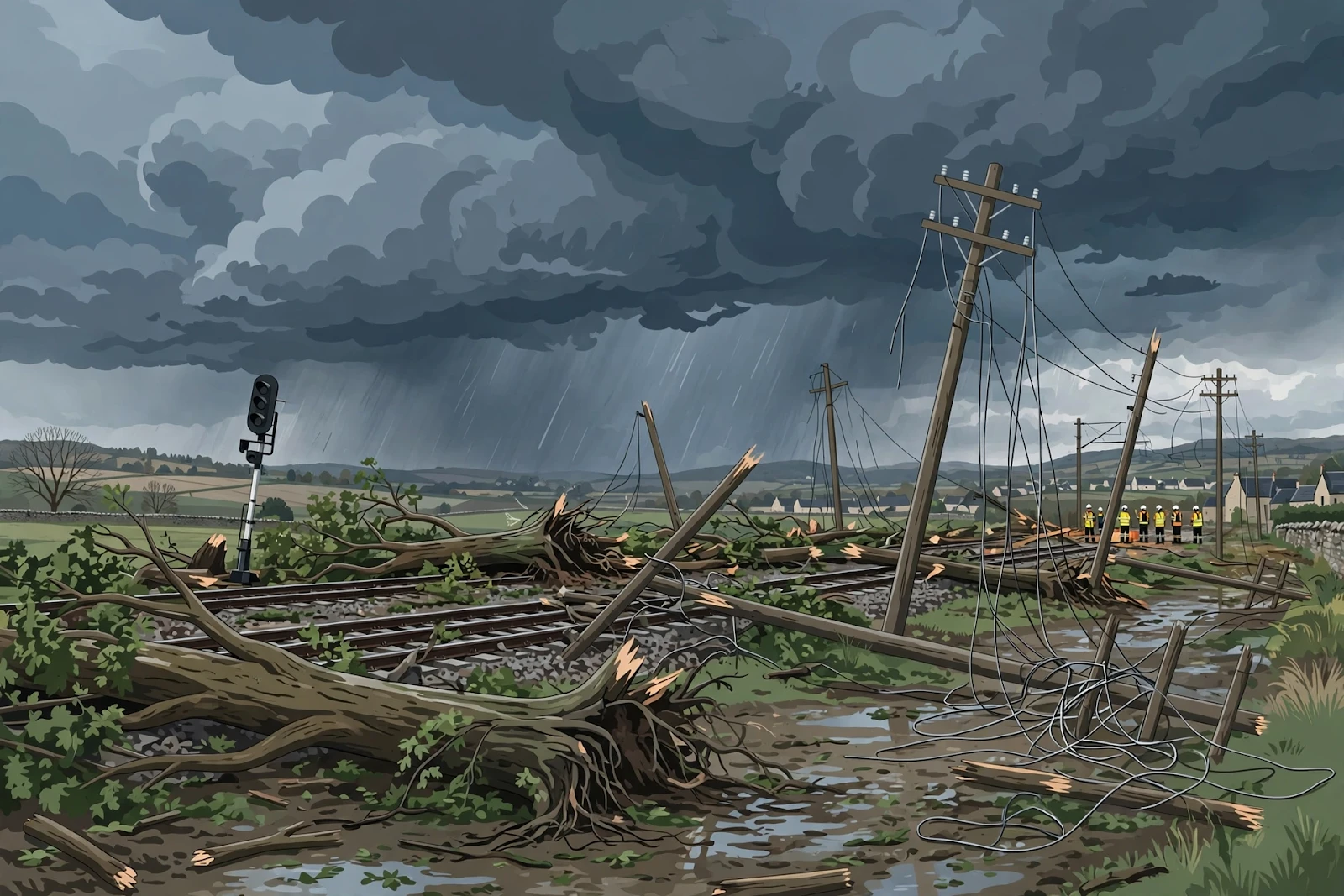
Illustration: Storm damage to a European railway line and electricity network, with repair crews assessing fallen poles.
Sponsored: explore today's featured sponsored offers
FAQ
What did the EEA briefing find about 2026?
It found that extreme heat amplified by climate change cost the EU at least 1% of GDP in 2026, and that heat, drought, wildfires and storms disrupted transport, energy and water supply across Europe, confirming risks identified in the 2024 European Climate Risk Assessment.
Which infrastructure was hit hardest?
The briefing highlights low Rhine water levels disrupting freight and supply chains, storms damaging road, rail and electricity networks in Portugal, and drought and heat pressuring power generation in Central and Eastern Europe — with impacts often cascading across sectors.
What are the EEA's six lessons?
Plan for future climate conditions; assess risks across systems; stress-test infrastructure regularly; prepare alternatives and contingency measures; strengthen coordination between owners, regulators and authorities; and combine near-term fixes with longer-term adaptation.
What is the EU Framework for Climate Resilience?
It is a European Commission framework presented in late October 2026 that sets out a more systematic and anticipatory approach to managing climate risks across the EU, following a summer the Commission called a "summer of truth."
Why does this matter ahead of COP31?
COP31 opens in Antalya, Türkiye, on November 9, 2026, with implementation and adaptation finance high on the agenda. The EEA briefing underscores that turning climate commitments into resilient infrastructure and funded adaptation is now the central challenge.
Sources
European Environment Agency, "What climate extremes of 2026 teach Europe about resilient infrastructure," November 3, 2026. European Commission, "A Resilient Europe for a Changing Climate — Communication on the EU Framework for Climate Resilience," COM(2026) 720 final, October 27, 2026. European Environment Agency, European Climate Risk Assessment (EUCRA), 2024, as cited in the EEA briefing.
Comments
Post a Comment