
Fossil Fuel Emissions Dip in 2026, Global Carbon Budget Finds — but Total CO2 Still Hits a Record High
ANTALYA, Türkiye — Carbon dioxide emissions from burning fossil fuels are projected to fall slightly in 2026 for the first time since the Covid-19 pandemic, according to the Global Carbon Budget 2026, released on Tuesday, 10 November 2026, during the COP31 climate summit in Antalya. But once emissions from deforestation and other land-use changes are added in, total global CO2 emissions are still projected to reach a record high of 43.3 billion tonnes this year — and the budget for holding warming to 1.5°C is now down to less than four years of current emissions.
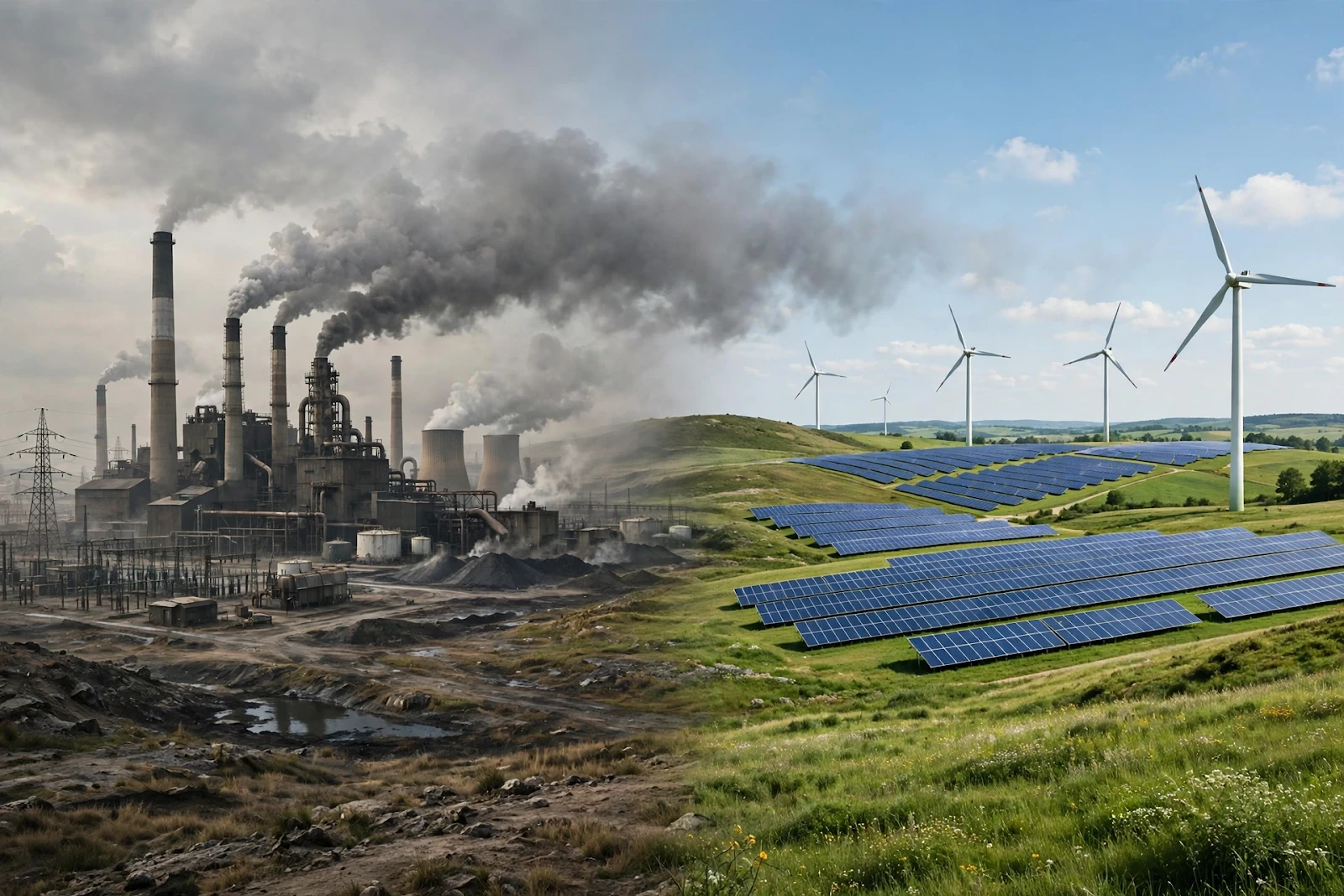
Illustration: A fossil fuel power plant shares the landscape with solar panels and wind turbines — clean energy now offsets about two-thirds of the emissions from rising energy demand.
What Happened
The Global Carbon Project projects that CO2 emissions from fossil fuels and cement will fall by around 0.4% in 2026 to 38.2 billion tonnes (gigatonnes, or GtCO2), down from 38.4 billion tonnes in 2025. That 2025 figure was itself a record high, after a 1.2% rise on 2024.
It is the first decline since 2020, when the pandemic brought economies to a standstill. But the projection is preliminary, with a range spanning a fall of 1.5% to a rise of 0.6%, so a small increase cannot be ruled out. Bill Hare, chief executive of Climate Analytics, called the picture "a flatline, not a decline — a projected fall of just 0.4% in 2026, a figure that is unfortunately statistically indistinguishable from zero".
The main driver is oil. Oil emissions are projected to drop by 1.9% in 2026 — 243 million tonnes of CO2 — one of the largest annual declines on record outside 2020. The report links most of that drop to higher prices and reduced output after the Iran conflict closed the Strait of Hormuz. Israeli and American strikes on Iran in February 2026 disrupted oil supplies and sent prices soaring; petrol and diesel prices in the United States, China and the European Union ran 10% to 50% higher than in 2025. Oil emissions are projected to fall in every major region, with the largest drop in China, down 4.6%.
Emissions from natural gas are projected to fall slightly, by 0.3%, making them effectively flat. Coal is the exception: coal emissions are projected to rise by 0.6%, with a strong increase in India partly offset by sharp falls in the EU and the United States.
The picture changes when land is included. Emissions from land-use change — deforestation, forest degradation, wood harvest, peatland drainage and fires — are projected to rise to 5.1 GtCO2 in 2026, up from 4.4 GtCO2 in 2025. The increase is attributed mainly to peat fires and forest degradation in South-East Asia, linked to drier conditions as a strong El Niño develops. Total CO2 emissions from fossil fuels and land use are therefore projected to reach a record 43.3 GtCO2 in 2026, up from 42.8 GtCO2 in 2025.
By country, fossil emissions are projected to fall in China (-0.9%), the United States (-1.3%) and the European Union (-1.5%), and in Japan (-1.0%), while rising in India (+4.4%).
Meanwhile the air itself keeps filling with carbon dioxide. Atmospheric CO2 is projected to rise by 2.2 parts per million in 2026, reaching an average of 427.7 ppm, roughly 54% above pre-industrial levels of around 278 ppm in 1750.
Background

Illustration: Delegates gather at the COP31 climate summit in Antalya, Türkiye, where the Global Carbon Budget 2026 was launched on 10 November 2026.
The Global Carbon Budget is now in its 21st edition. Published as a preprint in Earth System Science Data on 10 November 2026, it was produced by more than 140 scientists from over 90 institutions. Its lead author is Professor Pierre Friedlingstein of the University of Exeter, who also directs the Global Carbon Budget Office.
The report arrives on the opening day of COP31, the 31st United Nations climate conference, which opened on Monday, 9 November 2026, in Antalya, Türkiye. Leaders have gathered there to accelerate action against climate disruption, driven primarily by greenhouse gas emissions from burning coal, oil and gas.
The longer view is one of a dramatic slowdown, but not yet a turnaround. Total CO2 emissions grew by an average of 0.3% per year over 2016–2025, compared with 1.7% per year over the decade before. Fossil emissions grew by about 0.9% per year, compared with 1.9% the decade before. Land-use emissions averaged 4.9 GtCO2 per year over 2016–2025, around 21% lower than the decade before.
China's trajectory shapes the global total more than any other country's. The report projects China's fossil emissions will fall by 0.9% in 2026, after two years of low growth, with oil emissions falling sharply by 4.6%, gas by 0.9% and coal rising only slightly, by 0.3%. "Emissions started to fall already two years before the current fossil fuel crisis, and the oil shock has simply accelerated the key trends that led to the plateauing of emissions," said Lauri Myllyvirta of the Centre for Research on Energy and Clean Air.
In the United States, emissions are projected to fall by 1.3%, mainly because of a 6.7% fall in coal emissions after an unusual rise in 2025 driven by high gas prices and cold weather. In the European Union, the projected 1.5% decline — with coal down 2.9% and oil down 1.8% — is smaller than the average over the past decade.
India stands out in the opposite direction: its emissions are projected to rise by 4.4% in 2026, driven by coal, up 5.9%, while oil falls slightly, by 0.9%. "Economic growth tied to infrastructure development remains significant in the country," Professor Friedlingstein told Le Monde.
There is also a quieter success story in the data. The report finds that 40 countries, accounting for 26% of global fossil emissions, reduced their emissions while their economies grew over 2016–2025. Per-person fossil emissions have also eased, to around 4.6 tonnes per person in 2026, about 4% below their early-2010s peak.
The natural world is still absorbing about half of humanity's emissions: over 2016–2025, the ocean took up around 27% and the land around 22%. The land sink in 2025 was the highest on record, at around 13.3 GtCO2 — 50% larger than in 2024 — after the 2023–24 El Niño suppressed it.
Why It Matters
The most consequential number in the 2026 budget is not the 0.4% dip but the 150 billion tonnes. With human-caused warming reaching 1.37°C above pre-industrial levels in 2025, the report estimates that the remaining carbon budget to limit warming to 1.5°C, with a 50% chance, is 150 GtCO2 from the start of 2027 — less than four years of emissions at the current rate.
That is why the experts behind the report refuse to celebrate. "A decline in fossil CO2 emissions is encouraging, but a reduction driven partly by geopolitical shocks is not a sustainable climate solution," said Professor Friedlingstein. "The long-term answer remains the rapid deployment of clean energy technologies. While renewables and electric vehicles are increasingly offsetting growth in energy demand, further acceleration is needed if global emissions are to peak and enter a sustained decline."
Glen Peters, a research professor at the CICERO Center for International Climate Research, made the same point in the report's release: "A drop in emissions in one year is not a peak unless it is driven by structural change. Accelerated deployment of solar, wind, batteries, and electric vehicles are pushing emissions down in dozens of countries, and slowing emissions growth in many more, but the changes are not sufficient to lock in a peak in global emissions."
The clean-energy story is genuinely strong — and genuinely not yet strong enough. Research published alongside the report in Nature Climate Change finds clean energy now offsets around two-thirds of the emissions that would otherwise come from rising energy demand. In 2026, growth in solar, wind and EVs offset 0.54 GtCO2 of the 0.78 GtCO2 that rising demand would have added — about 69%. Electric vehicles accounted for around a fifth of the overall drop in oil emissions in 2026.

Illustration: Earth wrapped in a carbon budget gauge — only 150 billion tonnes of CO2 remain before warming reaches 1.5°C.
But the same research concludes that the 2026 decline is "not a sign that emissions have peaked from the transition to cleaner energy", but more likely a short-term response to higher oil prices. Clean energy alone was not enough to cut emissions in 2026: the researchers' central estimate suggests emissions would have continued to rise without the energy shock from the Iran war.
The scale of what remains is stark. According to the United Nations, holding warming to around 1.8°C by 2050, then returning to 1.5°C, now requires cutting emissions by 6% per year through 2035, and removing the equivalent of eight years' worth of emissions from the atmosphere over the coming decades. In 2026, according to the Global Carbon Project, carbon removal technologies extracted the equivalent of just 30 minutes of emissions from the atmosphere.
What Happens Next
The most immediate risk is a rebound: if hydrocarbon supplies recover and prices fall, consumption is likely to rise again, and the IEA expects oil use to rebound in 2027, though below 2025 levels. The IEA's Renewables 2026 report, released on 6 November, forecasts global renewable capacity rising by almost 4,800 gigawatts in 2026–2031.
The companion Nature Climate Change study looks ahead to 2028 under two scenarios. Clean technologies would offset 63% of the emissions from rising energy demand between 2025 and 2028 at current deployment rates, and 79% if deployment keeps accelerating. In both cases, overall emissions would still be higher in 2028 than in 2025.
The 2026 El Niño adds another near-term pressure. Its effects lag several months behind changes in the climate, so the researchers expect the current event — which began in June 2026 — to weaken the land sink predominantly in 2027. Land-use emissions are also the hardest part of the budget to estimate.
At COP31, negotiators face an unambiguous message: a 0.4% dip driven by war and high oil prices is not a peak, and the remaining budget for 1.5°C leaves no room for a rebound. The test of this summit is whether solar, wind, batteries and electric vehicles can be accelerated fast enough to turn a war-driven flatline into a genuine, lasting decline. The data suggest it could be a few years away. The budget suggests those few years are all that remain.
Sponsored: explore today's featured sponsored offers
FAQ
What is the Global Carbon Budget 2026?
It is the 21st annual assessment of the world's CO2 emissions and sinks, by the Global Carbon Project's team of more than 140 scientists, published as a preprint in Earth System Science Data on 10 November 2026.
Are global CO2 emissions falling in 2026?
Fossil-fuel and cement CO2 emissions are projected to fall by around 0.4% in 2026, to 38.2 billion tonnes — the first decline since 2020. But total CO2 emissions, including land-use change, are projected to reach a record 43.3 billion tonnes, as land-use emissions rise to 5.1 billion tonnes. The projection is preliminary, with a range of -1.5% to +0.6%.
Why did fossil fuel emissions dip in 2026?
The Iran conflict and the closure of the Strait of Hormuz created an energy shock that pushed oil prices sharply higher and cut oil use — oil emissions are projected to fall 1.9%, the main driver of the overall dip. Solar, wind and electric vehicles also offset about two-thirds of the emissions that would otherwise have come from rising energy demand. The authors stress the decline is largely a short-term response to higher oil prices, not yet proof of a peak.
How much carbon budget is left for 1.5°C?
The remaining carbon budget to limit warming to 1.5°C, with a 50% chance, is 150 billion tonnes of CO2 from the start of 2027 — less than four years of emissions at the current rate. The budgets for 1.7°C and 2°C are 510 and 1,035 billion tonnes. Human-caused warming had already reached 1.37°C in 2025.
Is this the same story as the COP31 opening covered earlier on this blog?
No. This blog previously covered the COP31 opening in Antalya on 9 November 2026 — the summit, its agenda and the leaders attending. This article covers a separate event: the launch of the Global Carbon Budget 2026 on 10 November 2026, with its own new figures.
Sources
- Carbon Brief — "Analysis: Fossil-fuel CO2 emissions set to dip in 2026 as Iran conflict hits oil use", by Zeke Hausfather and Pierre Friedlingstein, 10 November 2026 — https://www.carbonbrief.org/analysis-fossil-fuel-co2-emissions-set-to-dip-in-2026-as-iran-conflict-hits-oil-use
- Le Monde — "Fossil fuel-related CO2 emissions show slight global drop, an encouraging but insufficient sign", 10 November 2026 — https://www.lemonde.fr/en/environment/article/2026/11/10/fossil-fuel-related-co-emissions-show-slight-global-drop-an-encouraging-but-insufficient-sign_6776431_114.html
- Science Media Centre (SciMex) — "EXPERT REACTION: Fossil CO2 emissions decrease in 2026", Global Carbon Project news release, 10 November 2026 — https://www.scimex.org/newsfeed/fossil-co2-emissions-decrease-in-2026
- Friedlingstein, P. et al. (2026) — "Global Carbon Budget 2026", Earth System Science Data preprint, essd-2026-895, 10 November 2026 — https://essd.copernicus.org/preprints/essd-2026-895/
- International Energy Agency — "Renewables 2026: Executive Summary", 6 November 2026 — https://www.iea.org/reports/renewables-2026/executive-summary
- Le Quéré, C. et al. (2026) — "A further acceleration of clean energy is needed for global CO2 emissions to peak and decline", Nature Climate Change — https://doi.org/10.1038/s41558-026-02821-8
Comments
Post a Comment